Bangladesh Digital Lending Market Size & Growth Rate (2026-2032)
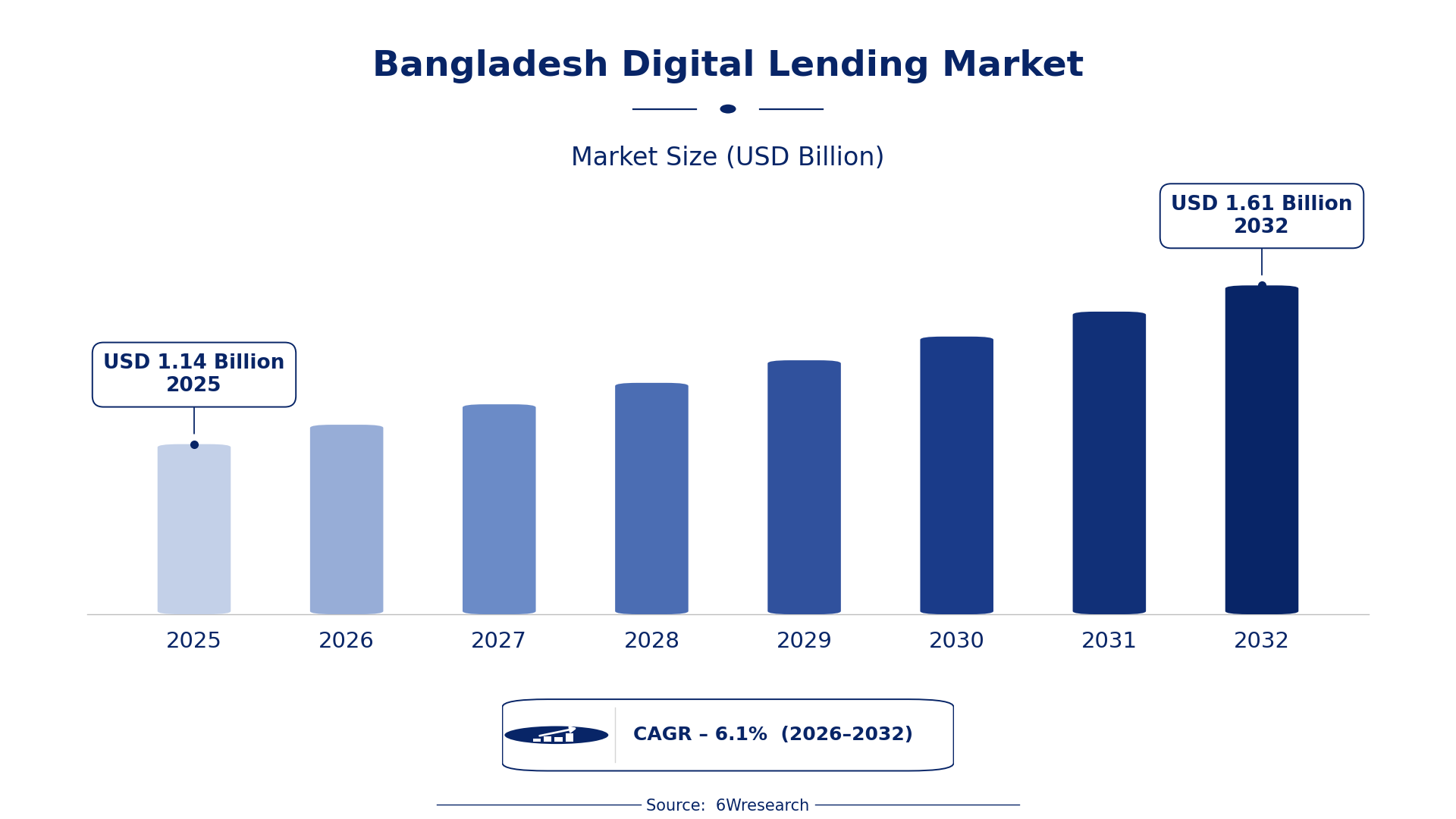
The Bangladesh Digital Lending Market was estimated at USD 1136 Million in 2025 and is projected to reach USD 1613 Million by 2032, growing at a CAGR of 6.1% from 2026 to 2032.
Bangladesh Digital Lending Market Synopsis
The rapid rise of internet connectivity and smartphone adoption is the most powerful force driving the Bangladesh Digital Lending Market. With more people gaining access to digital financial services, the demand for quick and accessible lending solutions is surging, particularly among underserved populations.
Digital lending platforms are filling a critical gap left by traditional banks, offering innovative solutions tailored to the needs of individuals and small businesses. This shift is not merely a trend; it signifies a fundamental change in how financial services are delivered in Bangladesh, promising to reshape the market for years to come.
Bangladesh Digital Lending Market Year-wise Growth Rate and Key Drivers
This graph illustrates the annual growth rates of the Bangladesh Digital Lending Market from 2021 to 2032, highlighting a steady upward trajectory and projected expansion over the forecast period.
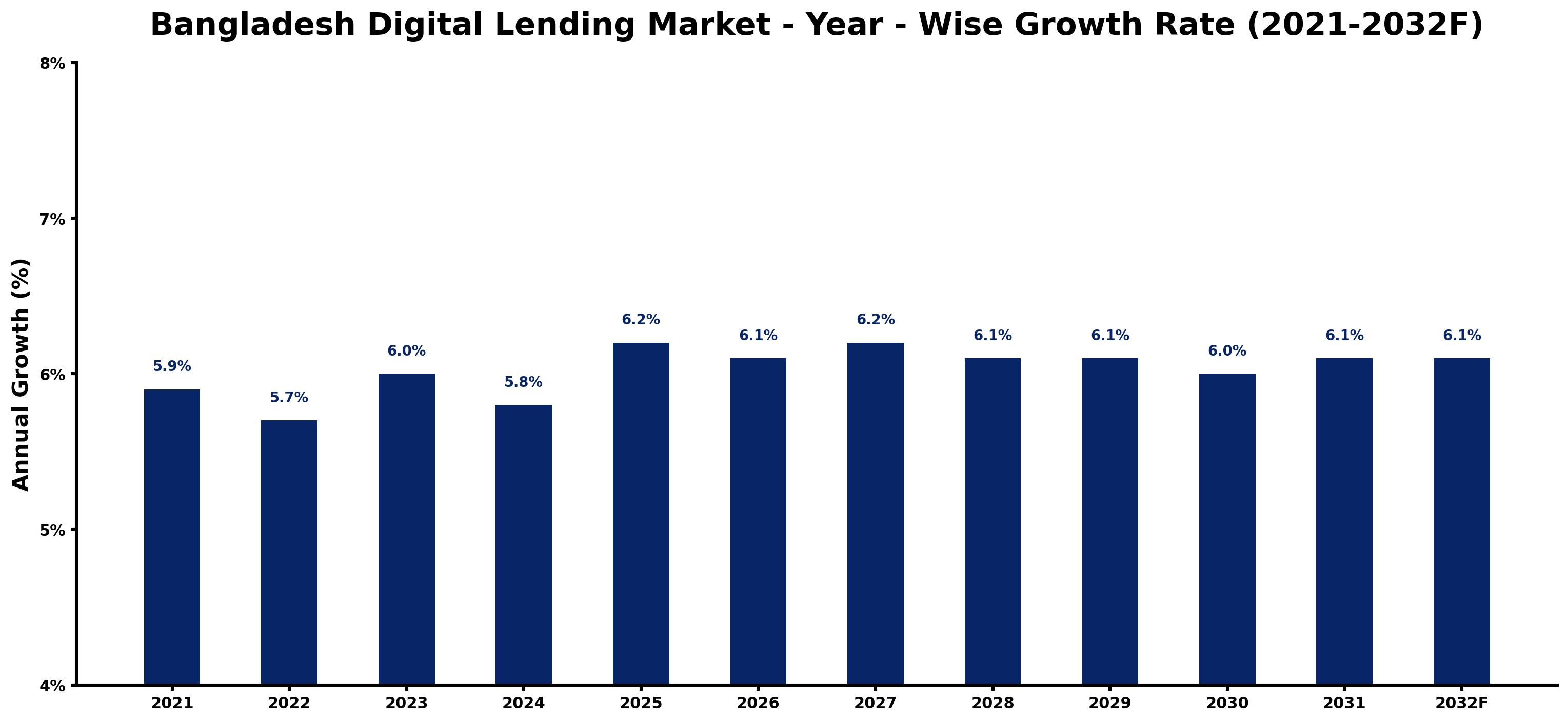
The table below presents the year‑wise growth rates along with the key drivers influencing the market
| Year | Growth Rate | Major Drivers |
| 2021 | 5.9% | Bangladesh Bank's fintech regulatory sandbox support. |
| 2022 | 5.7% | Increased smartphone penetration driving digital loan applications. |
| 2023 | 6.0% | Youth demographics seeking accessible credit solutions online. |
| 2024 | 5.8% | Government digital payment initiatives boosting fintech adoption. |
| 2025 | 6.2% | COVID-19 accelerated shift to online lending preferences. |
| 2026 | 6.1% | Local microfinance institutions digitizing services for efficiency. |
| 2027 | 6.2% | Rising middle-class demand for quick personal loans. |
| 2028 | 6.1% | Investments in mobile wallets facilitating easier borrowing. |
| 2029 | 6.1% | Supportive regulations enhancing borrower protection measures. |
| 2030 | 6.0% | Growing awareness of credit scores encouraging borrowing. |
| 2031 | 6.1% | Increased internet accessibility expanding user base for loans. |
| 2032 | 6.1% | Emerging fintech startups introducing innovative lending solutions. |
Note: Market size estimations and growth projections presented in this report are based on 6Wresearch's proprietary forecasting methodology, utilizing the latest available industry data, government publications, and primary research inputs.
Bangladesh Digital Lending Market Key Takeaways
Below are some of the specific key takeaways from the market, including:
- The growing demand for digital lending is supported by high smartphone penetration and improved internet access.
- Fintech partnerships with traditional banks are becoming increasingly common, enhancing service offerings.
- Alternative data is gaining traction for credit scoring, improving access to loans for those without traditional credit histories.
- Government initiatives are fostering a supportive regulatory environment for digital lending growth.
- There are substantial opportunities to serve the unbanked and underbanked populations, particularly in rural areas.
Evaluation of Restraints in Bangladesh Digital Lending Market
Despite its growth, the Bangladesh Digital Lending Market faces notable constraints. A significant challenge is the lack of a comprehensive regulatory framework, which has led to predatory lending practices and insufficient consumer protections. Additionally, many potential borrowers struggle with limited financial literacy, hampering their understanding of digital lending products. The absence of a robust credit information infrastructure further complicates lenders' ability to accurately assess creditworthiness, creating a barrier for both lenders and consumers.
Bangladesh Digital Lending Market Trends
Several trends are shaping the Bangladesh Digital Lending Market. The proliferation of mobile-based lending platforms is one of the most significant, as these services cater to the growing demand for accessible credit. Partnerships between fintech firms and traditional banks are also on the rise, driving innovation in product offerings and service delivery. on top of that, the use of alternative data for credit assessments is transforming how lenders evaluate potential borrowers, making credit more accessible to previously underserved segments.
Bangladesh Digital Lending Market Opportunities
The market presents numerous growth opportunities, particularly for fintech companies willing to innovate. There is a pressing need for tailored financial products aimed at small business owners and individuals lacking access to traditional banking services. Additionally, advancements in technology, such as AI and machine learning, can enhance credit assessments and speed up loan disbursal processes, giving digital lenders a competitive edge in the market.
Government Initiatives in the Bangladesh Digital Lending Market
The Bangladeshi government is actively shaping the Digital Lending Market through various initiatives aimed at fostering financial inclusion and stability. Regulatory bodies like the Microcredit Regulatory Authority (MRA) and Bangladesh Bank are working to create a conducive environment for digital lending operations, ensuring transparency and consumer protection. These efforts are crucial in establishing a reliable and trustworthy digital lending ecosystem.
- A regulatory framework was introduced in 2025 mandating improved transparency in digital lending practices.
- Currently, the MRA is conducting workshops to enhance awareness around digital financial services among the population.
- A planned public-private initiative expected to launch in 2026 aims to expand digital infrastructure in rural areas.
- The government is improving credit information systems to facilitate better credit assessments by lenders.
- Cybersecurity measures are being enhanced to protect consumers engaging with digital lending platforms.
Future Insights of the Bangladesh Digital Lending Market
Looking ahead to 2026-2032, the Bangladesh Digital Lending Market is set for substantial growth. As smartphone penetration continues to rise and the middle class expands, the appetite for fast and accessible credit solutions will only increase. With a favorable regulatory environment and continuous technological advancements, we anticipate a wave of innovation in lending products tailored to the specific needs of Bangladeshi consumers. The momentum built in recent years is expected to accelerate, paving the way for a more inclusive financial future.
Bangladesh Digital Lending Market Latest Developments
In the past year, the Bangladesh Digital Lending Market has witnessed dynamic changes, reflecting the growing interest in digital financial solutions. As fintech companies continue to evolve, their focus on consumer needs is driving innovation in service delivery and product offerings.
- A major technology vendor launched a new credit scoring system in early 2025, aimed at improving the assessment of borrowers with limited credit histories.
- In mid-2025, a collaboration between several fintech firms and traditional banks began to streamline loan application processes, enhancing customer experience.
- A regulatory review by Bangladesh Bank is currently ongoing to refine the legal framework for digital lending practices.
- Upcoming in late 2026, a national awareness campaign is set to educate the public about digital lending options and associated risks.
- A new digital lending platform is expected to launch in Q3 2025, focusing on small business loans with flexible repayment options.
Bangladesh Digital Lending Market - Key Attractiveness of the Report
- 10 Years of Market Numbers
- Historical Data Starting from 2022 to 2025
- Base Year: 2025
- Forecast Data until 2032
- Key Performance Indicators Impacting the Market
- Major Upcoming Developments and Projects
Key Highlights of the Report:
- Bangladesh Digital Lending Market Outlook
- Market Size of Bangladesh Digital Lending Market, 2025
- Forecast of Bangladesh Digital Lending Market, 2032
- Historical Data and Forecast of Bangladesh Digital Lending Revenues & Volume for the Period 2022-2032F
- Bangladesh Digital Lending Market Trend Evolution
- Bangladesh Digital Lending Market Drivers and Challenges
- Bangladesh Digital Lending Price Trends
- Bangladesh Digital Lending Porter's Five Forces
- Bangladesh Digital Lending Industry Life Cycle
- Historical Data and Forecast of Bangladesh Digital Lending Market Revenues & Volume By Offering for the Period 2022-2032F
- Historical Data and Forecast of Bangladesh Digital Lending Market Revenues & Volume By Solutions for the Period 2022-2032F
- Historical Data and Forecast of Bangladesh Digital Lending Market Revenues & Volume By Services for the Period 2022-2032F
- Historical Data and Forecast of Bangladesh Digital Lending Market Revenues & Volume By Deployment Mode for the Period 2022-2032F
- Historical Data and Forecast of Bangladesh Digital Lending Market Revenues & Volume By Cloud for the Period 2022-2032F
- Historical Data and Forecast of Bangladesh Digital Lending Market Revenues & Volume By On-premises for the Period 2022-2032F
- Historical Data and Forecast of Bangladesh Digital Lending Market Revenues & Volume By End User for the Period 2022-2032F
- Historical Data and Forecast of Bangladesh Digital Lending Market Revenues & Volume By Banks for the Period 2022-2032F
- Historical Data and Forecast of Bangladesh Digital Lending Market Revenues & Volume By Credit Unions for the Period 2022-2032F
- Historical Data and Forecast of Bangladesh Digital Lending Market Revenues & Volume By NBFCs for the Period 2022-2032F
- Bangladesh Digital Lending Import Export Trade Statistics
- Market Opportunity Assessment By Offering
- Market Opportunity Assessment By Deployment Mode
- Market Opportunity Assessment By End User
- Bangladesh Digital Lending Top Companies Market Share
- Bangladesh Digital Lending Competitive Benchmarking By Technical and Operational Parameters
- Bangladesh Digital Lending Company Profiles
- Bangladesh Digital Lending Key Strategic Recommendations






































