Bangladesh Educational Toys Market Size, Share & Growth Rate
The Bangladesh Educational Toys Market was estimated at USD 385 Million in 2025 and is projected to reach USD 516 Million by 2032, growing at a CAGR of 4.3% from 2026 to 2032. This growth trajectory is driven by an increasing middle-class population that prioritizes education and development for their children. Furthermore, a shift in parental attitudes towards the significance of educational toys is influencing purchasing decisions, thereby enhancing the market's expansion.
Bangladesh Educational Toys Market Year-wise Growth Rate and Key Drivers
This graph highlights how the Bangladesh Educational Toys Market has steadily grown over the years, supported by major growth factors.
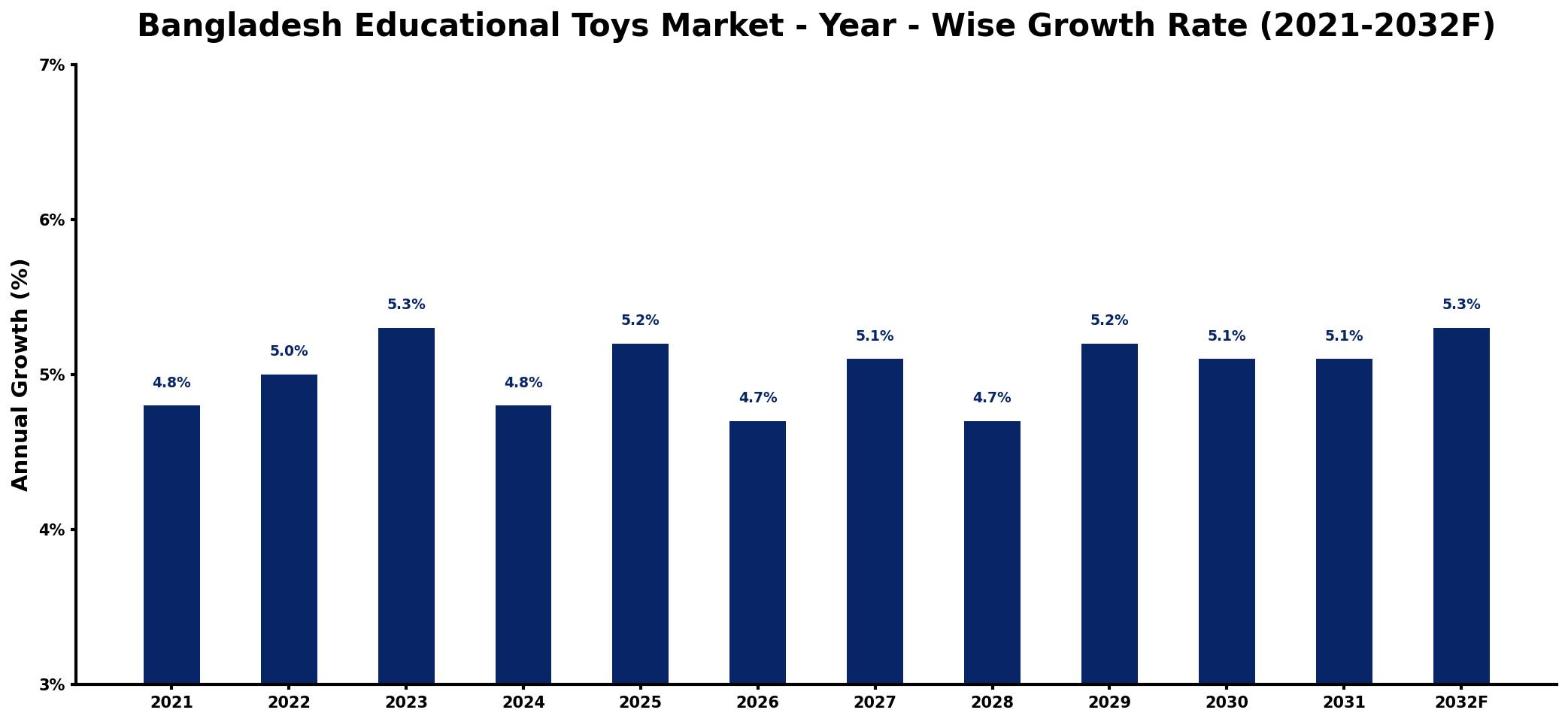
The table below presents the year‑wise growth rates along with the key drivers influencing the market
| Year | Growth Rate | Major Drivers |
| 2021 | 4.8% | Increased consumer spending on leisure |
| 2022 | 5.0% | Growing awareness of developmental benefits |
| 2023 | 5.3% | Surge in online retail platforms |
| 2024 | 4.8% | Expansion of local manufacturing capabilities |
| 2025 | 5.2% | Rise in disposable income levels |
| 2026 | 4.7% | Increased parental focus on skills |
| 2027 | 5.1% | strengthening international trade flows |
| 2028 | 4.7% | Development of innovative product designs |
| 2029 | 5.2% | Increase in international brand presence |
| 2030 | 5.1% | Enhanced marketing strategies and campaigns |
| 2031 | 5.1% | Boost in collaboration with schools |
| 2032 | 5.3% | Rising trend of sustainable products |
Note: Market size estimations and growth projections presented in this report are based on 6Wresearch's proprietary forecasting methodology, utilizing the latest available industry data, government publications, and primary research inputs.
Bangladesh Educational Toys Market Synopsis
The demand for STEM-focused educational toys is significantly rising in Bangladesh as parents increasingly recognize the need for their children to engage in creative and cognitive activities. This demand aligns with a broader global trend toward experiential learning, positioning educational toys as essential tools for nurturing young minds.
In terms of supply, the market is evolving to offer a broader variety of products, including eco-friendly options that resonate with environmentally conscious consumers. The surge in online shopping platforms further enhances accessibility, making it easier for families to find high-quality educational toys that meet diverse learning needs.
Bangladesh Educational Toys Market Key Takeaways
- The market is evolving rapidly, driven by increased awareness of the importance of educational toys.
- Interactive and technology-driven toys are becoming highly sought after by consumers.
- Affordability remains a key barrier to broader market penetration, requiring innovative pricing strategies.
- Government initiatives aim to enhance the safety and quality standards of educational toys.
- Investment opportunities abound, particularly in innovative product development and educational partnerships.
Evaluation of Restraints in Bangladesh Educational Toys Market
Despite its growth, the Bangladesh Educational Toys Market faces several restraints that could hamper its potential. Limited awareness among parents about the educational benefits of such toys continues to persist, which may contribute to a reliance on traditional options. Additionally, the higher price points of quality educational toys deter many families from making purchases. There is also an urgent need for improved regulatory measures to ensure product safety and quality, which could further build consumer trust and market growth.
Bangladesh Educational Toys Market Trends
The current trend in the Bangladesh Educational Toys Market points toward increased demand for interactive and STEM-based toys. Parents and educators are prioritizing products that promote skill development and cognitive engagement. Additionally, sustainability has become a significant factor, with eco-friendly toys gaining popularity among consumers who are increasingly aware of environmental impacts.
Bangladesh Educational Toys Market Opportunities
Opportunities for growth in the Bangladesh Educational Toys Market are promising. As disposable incomes rise, parents are more willing to invest in educational toys that enhance learning. There is also potential for partnerships with schools and educational institutions to integrate these toys into curriculums, which can amplify demand. Furthermore, by focusing on innovative and customized offerings tailored to the specific cultural context of Bangladesh, manufacturers can effectively capture market share.
Government Initiatives in the Bangladesh Educational Toys Market
The government of Bangladesh is actively promoting initiatives to enhance the educational landscape for children, particularly through the introduction of quality educational toys. Policies encourage the production of toys that are safe, non-toxic, and beneficial for cognitive development. There are also efforts to integrate educational toys into early childhood education frameworks, fostering a more comprehensive learning environment for young children.
Future Insights of the Bangladesh Educational Toys Market
Looking forward to 2026-2032, the Bangladesh Educational Toys Market is poised for continued growth driven by shifting consumer preferences and technological advancements. Increased disposable income and a heightened focus on early childhood education will further augment the demand for educational toys. Manufacturers who can innovate and adapt to these market changes will be well-positioned for success in this evolving landscape.
Bangladesh Educational Toys Market Latest Developments (2025 - 2026)
In recent months, the Bangladesh Educational Toys Market has seen a notable uptick in the introduction of interactive and tech-based educational products. There has been a marked increase in online retail sales, facilitating easier access to a diverse range of educational toys. Additionally, manufacturers are responding to the demand for eco-friendly toys, contributing to sustainability efforts within the industry.
Bangladesh Educational Toys Market - Key Attractiveness of the Report
- 10 Years of Market Numbers
- Historical Data Starting from 2022 to 2025
- Base Year: 2025
- Forecast Data until 2032
- Key Performance Indicators Impacting the Market
- Major Upcoming Developments and Projects
Key Highlights of the Report:
- Bangladesh Educational Toys Market Outlook
- Market Size of Bangladesh Educational Toys Market, 2025
- Forecast of Bangladesh Educational Toys Market, 2032
- Historical Data and Forecast of Bangladesh Educational Toys Revenues & Volume for the Period 2022-2032F
- Bangladesh Educational Toys Market Trend Evolution
- Bangladesh Educational Toys Market Drivers and Challenges
- Bangladesh Educational Toys Price Trends
- Bangladesh Educational Toys Porter's Five Forces
- Bangladesh Educational Toys Industry Life Cycle
- Historical Data and Forecast of Bangladesh Educational Toys Market Revenues & Volume By Product Type for the Period 2022-2032F
- Historical Data and Forecast of Bangladesh Educational Toys Market Revenues & Volume By Academic toys for the Period 2022-2032F
- Historical Data and Forecast of Bangladesh Educational Toys Market Revenues & Volume By Cognitive toys for the Period 2022-2032F
- Historical Data and Forecast of Bangladesh Educational Toys Market Revenues & Volume By Motor skills toys for the Period 2022-2032F
- Historical Data and Forecast of Bangladesh Educational Toys Market Revenues & Volume By Others for the Period 2022-2032F
- Historical Data and Forecast of Bangladesh Educational Toys Market Revenues & Volume By Age Group for the Period 2022-2032F
- Historical Data and Forecast of Bangladesh Educational Toys Market Revenues & Volume By 1 ?? 4 years for the Period 2022-2032F
- Historical Data and Forecast of Bangladesh Educational Toys Market Revenues & Volume By 4 ?? 8 years for the Period 2022-2032F
- Historical Data and Forecast of Bangladesh Educational Toys Market Revenues & Volume By Above 8 years for the Period 2022-2032F
- Historical Data and Forecast of Bangladesh Educational Toys Market Revenues & Volume By Others for the Period 2022-2032F
- Historical Data and Forecast of Bangladesh Educational Toys Market Revenues & Volume By End-Users for the Period 2022-2032F
- Historical Data and Forecast of Bangladesh Educational Toys Market Revenues & Volume By Residential for the Period 2022-2032F
- Historical Data and Forecast of Bangladesh Educational Toys Market Revenues & Volume By Commercial for the Period 2022-2032F
- Bangladesh Educational Toys Import Export Trade Statistics
- Market Opportunity Assessment By Product Type
- Market Opportunity Assessment By Age Group
- Market Opportunity Assessment By End-Users
- Bangladesh Educational Toys Top Companies Market Share
- Bangladesh Educational Toys Competitive Benchmarking By Technical and Operational Parameters
- Bangladesh Educational Toys Company Profiles
- Bangladesh Educational Toys Key Strategic Recommendations






































