Bangladesh Energy Saving & Fluorescent Market Summary
The bangladesh energy saving & fluorescent market was estimated at USD 992 Million in 2025 and is projected to reach USD 1454 Million by 2032, growing at a CAGR of 6.7% from 2026 to 2032.
Bangladesh Energy Saving & Fluorescent Market Year-wise Growth Rate and Key Drivers
This graph highlights how the Bangladesh Energy Saving & Fluorescent Market has steadily grown over the past five years, supported by major growth factors.
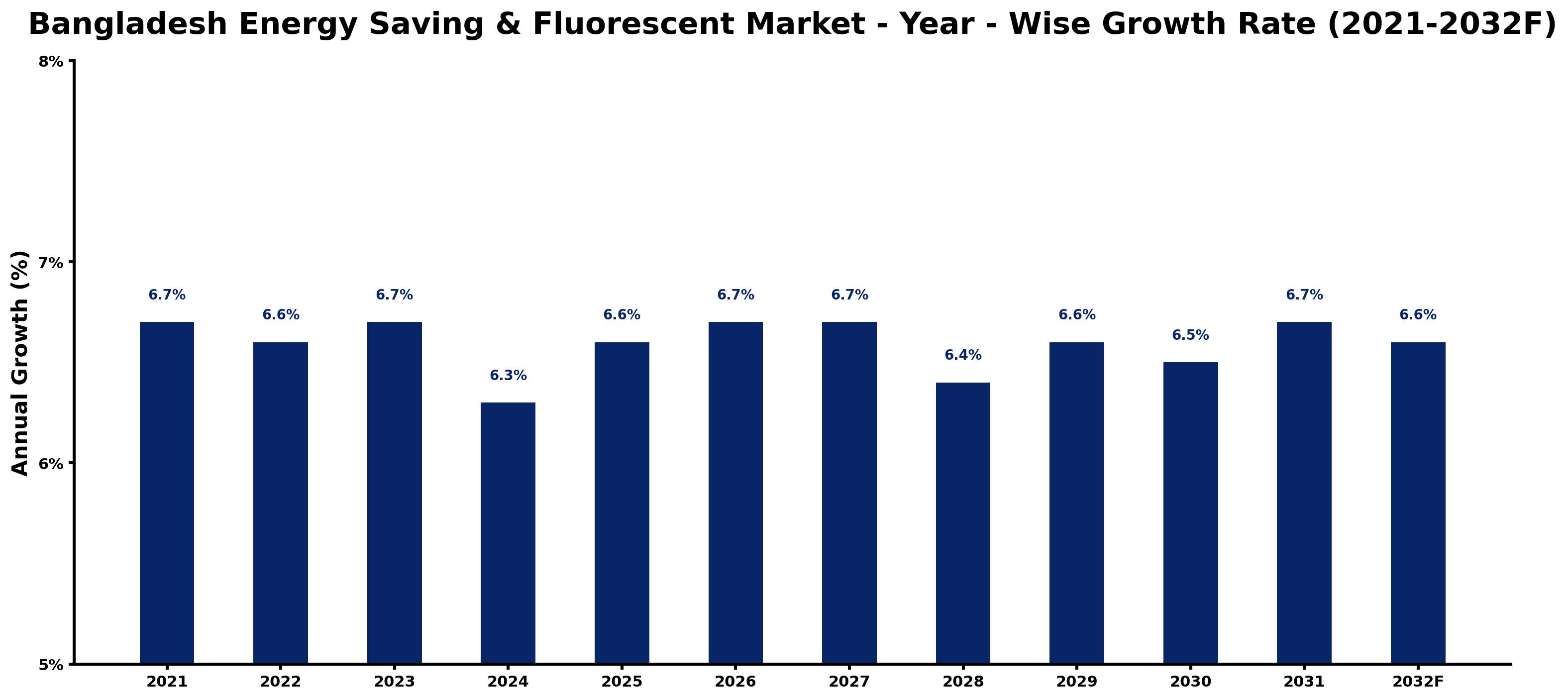
The table below presents the year wise growth rates along with the key drivers influencing the market
| Year | Growth Rate | Major Drivers |
| 2021 | 6.7% | Post-pandemic recovery plans prioritize energy efficiency, with investments from various sectors. |
| 2022 | 6.6% | Technological innovations enhance energy-efficient lighting, appealing to urban consumers' preferences. |
| 2023 | 6.7% | Rising electricity costs prompt households to seek affordable energy-saving solutions. |
| 2024 | 6.3% | Local manufacturers expand production capability, reducing reliance on imported lighting products. |
| 2025 | 6.6% | Awareness campaigns educate consumers on the long-term benefits of energy-efficient lighting. |
| 2026 | 6.7% | Urban migration increases demand for sustainable housing solutions and energy-saving products. |
| 2027 | 6.7% | Corporate social responsibility initiatives encourage businesses to adopt energy-efficient practices. |
| 2028 | 6.4% | Investment in smart grid technology improves efficiency, enhancing the appeal of fluorescent options. |
| 2029 | 6.6% | Collaborations between NGOs and government agencies promote energy-saving initiatives in rural areas. |
| 2030 | 6.5% | Ecosystem partners support the transition to energy-efficient lighting through joint marketing efforts. |
| 2031 | 6.7% | Consumer preferences shift toward sustainable brands, influence market dynamics significantly. |
| 2032 | 6.6% | Innovative financing models make energy-efficient lighting more accessible for low-income households. |
Note - Market size estimations and growth projections presented in this report are based on 6Wresearch's advanced forecasting approach, validated with industry datasets as of June 2026.
Bangladesh Energy Saving & Fluorescent Market Synopsis
The Bangladesh Energy Saving Fluorescent Market is projected to reach 6.7% and witness significant growth during the forecast period (2026-2032). This growth is primarily driven by the increasing demand for energy-efficient lighting solutions and supportive government initiatives aimed at reducing energy consumption. Additionally, rising awareness regarding environmental issues and the need for sustainable development are expected to further fuel this market. The availability of tax exemptions on compact fluorescent lamps (CFLs) serves as an incentive for broader adoption, positioning these lighting solutions as a cost-effective alternative to traditional incandescent bulbs.
Bangladesh Energy Saving & Fluorescent Market Growth Drivers
Significant growth in the Bangladesh Energy Saving & Fluorescent Market is influenced by several critical factors:
- The escalating demand for energy-efficient lighting solutions is driven by both commercial and residential sectors, which are keen on reducing energy bills and minimizing their carbon footprints.
- Government initiatives supporting the use of energy-efficient technologies have created an environment that encourages the adoption of fluorescent lighting systems, thereby enhancing market growth.
- Growing environmental concerns, particularly regarding climate change and energy conservation, have heightened consumer interest in eco-friendly lighting options, including energy-saving fluorescent lights.
- The influx of development projects and infrastructural enhancements within the country is augmenting the demand for durable and cost-effective lighting solutions, further boosting market potential.
- Customization options offered by manufacturers increasingly cater to specific consumer preferences, thereby enhancing the attractiveness of energy-saving fluorescent lights over conventional lighting solutions.
Bangladesh Energy Saving & Fluorescent Market Challenges and Restraints
While the Bangladesh Energy Saving & Fluorescent Market is poised for growth, there are challenges that could temper this trajectory:
- The rapid adoption of LED technology presents a formidable challenge, as LEDs offer higher efficiency, longer life spans, and reduced power consumption compared to fluorescent lamps.
- Price fluctuations in raw materials essential for manufacturing fluorescent lights could impact production costs, potentially leading to increased prices for consumers.
- Consumer preferences are increasingly shifting towards LED solutions, which may limit the market share for energy-saving fluorescent lights.
- Misinformation regarding the environmental impact of fluorescent lighting compared to other technologies can dissuade potential customers from making purchases.
- Regulatory challenges and varying standards in quality control may hinder new manufacturers from entering the market.
Bangladesh Energy Saving & Fluorescent Market Government Investment and Initiatives
The government of Bangladesh has actively promoted energy efficiency through various initiatives aimed at enhancing the market for energy-saving fluorescent lights. These initiatives include:
- Public spending on energy-efficient infrastructure projects, which often incorporates energy-saving fluorescent solutions, exemplifies the government's commitment to reducing energy consumption nationwide.
- Incentives such as tax exemptions for CFLs aim to encourage consumers to switch from conventional incandescent bulbs to more efficient lighting solutions.
- Education and awareness campaigns conducted by government bodies have raised public consciousness about the benefits of energy-saving technologies, further stimulating market demand.
- Collaborations between government agencies and private sectors foster innovation in energy-saving products and technologies.
- Regulatory frameworks emphasizing energy efficiency standards ensure that new products entering the market adhere to defined quality and safety parameters.
Bangladesh Energy Saving & Fluorescent Market Latest Developments (May 2025 - June 2026)
Recent developments in the Bangladesh Energy Saving & Fluorescent Market reflect ongoing shifts within the industry. In this period, enhancements in technology have gained momentum, leading to better efficiency and performance of fluorescent lamps. There has been an observable uptick in consumer demand, attributed to both infrastructural expansion and increased environmental awareness. Manufacturers are innovating with design and functionality to meet the diverse needs of consumers, providing tailored solutions across various applications. Furthermore, partnerships between stakeholders in the energy efficiency sector are becoming more prevalent, indicating a collaborative approach to addressing market challenges. Overall, these dynamics are signaling a progressive shift within the market as it navigates toward greater energy efficiency.
Bangladesh Energy Saving & Fluorescent Market - Key Attractiveness of the Report
- 10 Years of Market Numbers
- Historical Data Starting from 2022 to 2025
- Base Year: 2025
- Forecast Data until 2032
- Key Performance Indicators Impacting the Market
- Major Upcoming Developments and Projects
Key Highlights of the Report:
- Bangladesh Energy Saving & Fluorescent Market Outlook
- Market Size of Bangladesh Energy Saving & Fluorescent Market, 2025
- Forecast of Bangladesh Energy Saving & Fluorescent Market, 2032F
- Historical Data and Forecast of Bangladesh Energy Saving & Fluorescent Revenues & Volume for the Period 2022-2032F
- Bangladesh Energy Saving & Fluorescent Market Trend Evolution
- Bangladesh Energy Saving & Fluorescent Market Drivers and Challenges
- Bangladesh Energy Saving & Fluorescent Price Trends
- Bangladesh Energy Saving & Fluorescent Porter's Five Forces
- Bangladesh Energy Saving & Fluorescent Industry Life Cycle
- Historical Data and Forecast of Bangladesh Energy Saving & Fluorescent Market Revenues & Volume By Sources for the Period 2022-2032F
- Historical Data and Forecast of Bangladesh Energy Saving & Fluorescent Market Revenues & Volume By High-Intensity Discharge Lamps (HID) for the Period 2022-2032F
- Historical Data and Forecast of Bangladesh Energy Saving & Fluorescent Market Revenues & Volume By Linear Fluorescent Lamps (LFL) for the Period 2022-2032F
- Historical Data and Forecast of Bangladesh Energy Saving & Fluorescent Market Revenues & Volume By Light Emitting Diodes (LED) for the Period 2022-2032F
- Historical Data and Forecast of Bangladesh Energy Saving & Fluorescent Market Revenues & Volume By Applications for the Period 2022-2032F
- Historical Data and Forecast of Bangladesh Energy Saving & Fluorescent Market Revenues & Volume By Commercial for the Period 2022-2032F
- Historical Data and Forecast of Bangladesh Energy Saving & Fluorescent Market Revenues & Volume By Residential for the Period 2022-2032F
- Historical Data and Forecast of Bangladesh Energy Saving & Fluorescent Market Revenues & Volume By Government for the Period 2022-2032F
- Bangladesh Energy Saving & Fluorescent Import Export Trade Statistics
- Market Opportunity Assessment By Sources
- Market Opportunity Assessment By Applications
- Bangladesh Energy Saving & Fluorescent Top Companies Market Share
- Bangladesh Energy Saving & Fluorescent Competitive Benchmarking By Technical and Operational Parameters
- Bangladesh Energy Saving & Fluorescent Company Profiles
- Bangladesh Energy Saving & Fluorescent Key Strategic Recommendations






































