Bangladesh Enterprise Application Integration Market Size & Growth Rate (2026-2032)
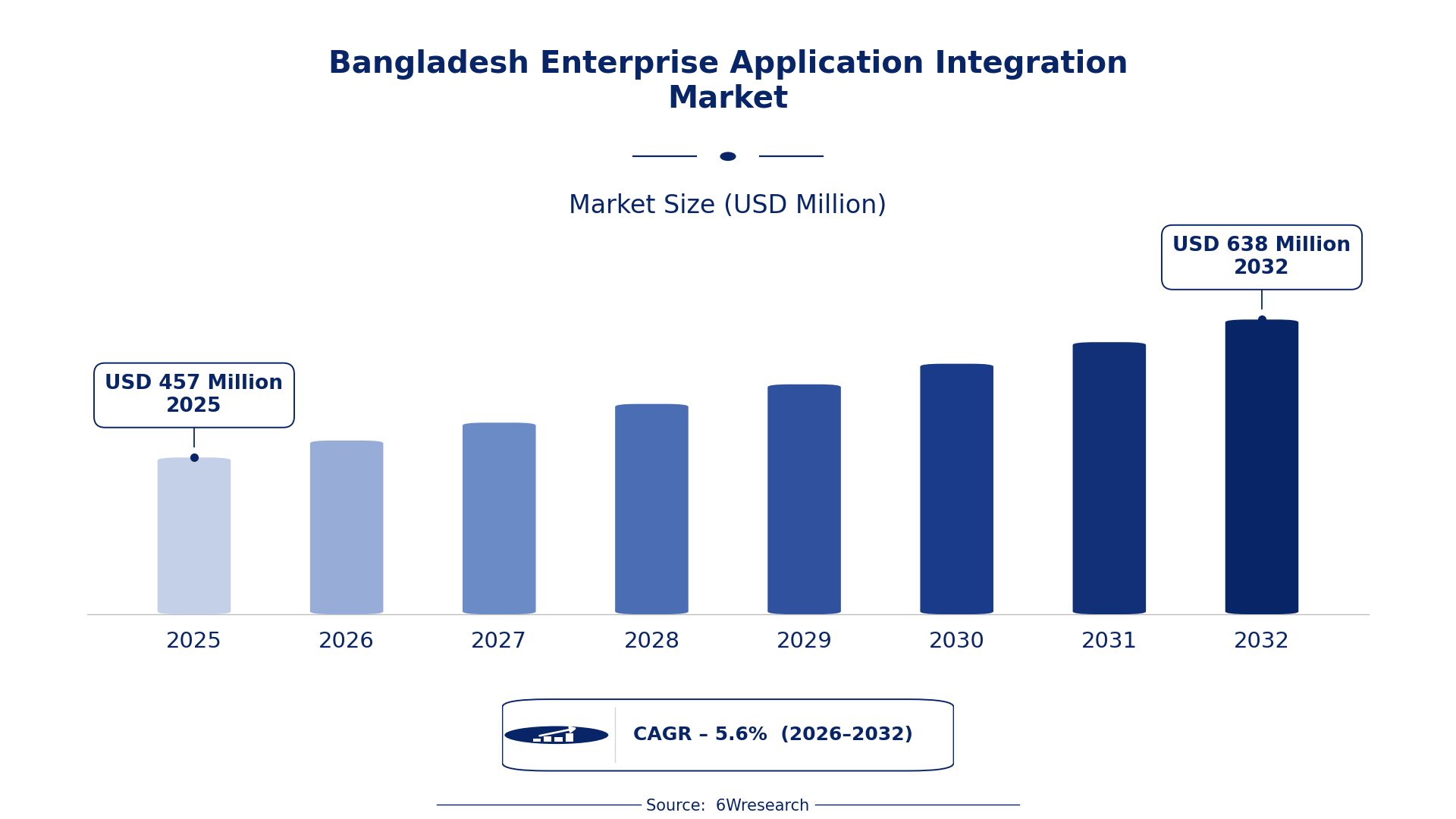
The Bangladesh Enterprise Application Integration Market was estimated at USD 457 Million in 2025 and is projected to reach USD 638 Million by 2032, growing at a CAGR of 5.6% from 2026 to 2032.
Bangladesh Enterprise Application Integration Market Synopsis
The Bangladesh Enterprise Application Integration market is currently enjoying steady growth, fueled by businesses eager to adopt digital technologies. As organizations recognize the importance of streamlined operations and real-time data integration, the demand for integration solutions is steadily rising.
Looking ahead, the trajectory of this market appears optimistic. As more businesses prioritize digital transformation and operational efficiency, the adoption of integration solutions is expected to surge. Key trends, including the rise of cloud-based services and IoT integration, will shape the future of enterprise application integration in Bangladesh.
Bangladesh Enterprise Application Integration Market Year-wise Growth Rate and Key Drivers
This graph illustrates the annual growth rates of the Bangladesh Enterprise Application Integration Market from 2021 to 2032, highlighting a steady upward trajectory and projected expansion over the forecast period.
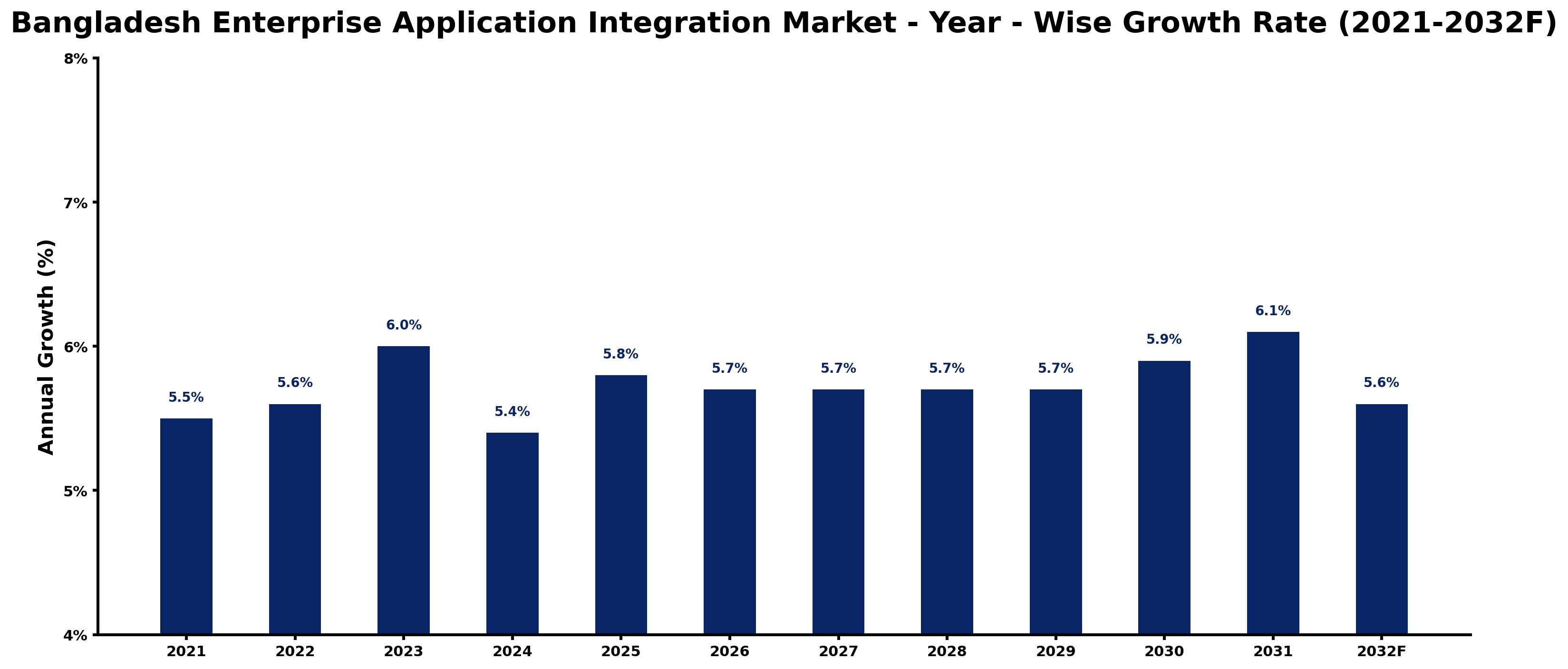
The table below presents the year‑wise growth rates along with the key drivers influencing the market
| Year | Growth Rate | Major Drivers |
| 2021 | 5.5% | Growing digitization in Bangladesh's banking sector demands integrations. |
| 2022 | 5.6% | Government's Digital Bangladesh Vision enhances enterprise software adoption. |
| 2023 | 6.0% | Rise of e-commerce platforms requiring advanced application integration. |
| 2024 | 5.4% | Increased cloud service adoption fuels integration requirements. |
| 2025 | 5.8% | Regulatory push for data interoperability in financial services. |
| 2026 | 5.7% | Emergence of local tech hubs innovating integration technologies. |
| 2027 | 5.7% | Bangladesh's IT sector growth driving enterprise solution demand. |
| 2028 | 5.7% | Surge in mobile application usage spurring integration needs. |
| 2029 | 5.7% | Increased foreign investment enhances enterprise software landscapes. |
| 2030 | 5.9% | Higher consumer demand for streamlined digital services integration. |
| 2031 | 6.1% | Focus on digital transformation in government agencies boosts integration. |
| 2032 | 5.6% | Sustainability initiatives promoting efficient business process integrations. |
Note: Market size estimations and growth projections presented in this report are based on 6Wresearch's proprietary forecasting methodology, utilizing the latest available industry data, government publications, and primary research inputs.
Bangladesh Enterprise Application Integration Market Key Takeaways
Below are some of the specific key takeaways from the market, including:
- The market is projected to reach USD 638 Million by 2032, indicating robust growth potential.
- Cloud-based solutions are driving the majority of investment in integration technologies.
- Real-time data integration is becoming a crucial requirement for many organizations.
- Government initiatives are supporting digital transformation across various sectors.
- There’s a growing focus on enhancing customer experiences through better data connectivity.
Evaluation of Restraints in Bangladesh Enterprise Application Integration Market
A few significant restraints are impacting the Bangladesh Enterprise Application Integration market. One of the most pressing challenges is the integration of legacy systems, which often hampers the seamless exchange of data across newer platforms. Additionally, the shortage of skilled professionals in the field complicates the implementation and maintenance of integration solutions, resulting in slower adoption rates. High costs associated with these technologies can also deter smaller businesses from investing, limiting overall market expansion.
Bangladesh Enterprise Application Integration Market Trends
Several trends are influencing the Bangladesh Enterprise Application Integration market. The shift towards cloud-based solutions is at the forefront, as organizations seek scalable and efficient integration methods. Concurrently, the integration of emerging technologies such as IoT and artificial intelligence is gaining traction, enabling smarter and more responsive business processes. Enhanced customer experience initiatives are prompting companies to invest in real-time data integration capabilities to provide better service and satisfaction.
Bangladesh Enterprise Application Integration Market Opportunities
Opportunities in this market are abundant. The growing demand for real-time data integration solutions presents a lucrative area for investment. on top of that, as businesses continue to embrace digital transformation, there is a strong need for integration solutions that can adapt to varying business models. Vendors that focus on providing customizable and scalable solutions will likely capture a significant share of the market. Additionally, as e-commerce and mobile applications proliferate, the need for efficient integration systems will only increase.
Government Initiatives in the Bangladesh Enterprise Application Integration Market
Government policies play a crucial role in shaping the Bangladesh Enterprise Application Integration market. The authorities are focused on promoting digital technologies and supporting the IT sector's growth. Initiatives like the Digital Bangladesh vision aim to create a knowledge-based society through technology, while various policies encourage businesses to adopt integration solutions.
- A recently completed national digital infrastructure upgrade program aims to enhance connectivity across urban and rural areas.
- Currently ongoing initiatives focus on providing tax incentives for companies investing in digital transformation, including EAI solutions.
- A planned public-private partnership program is expected to promote skill development in the IT sector by 2027.
- The ICT Policy of Bangladesh is actively working on creating a favorable environment for IT companies to innovate.
Future Insights of the Bangladesh Enterprise Application Integration Market
The Bangladesh Enterprise Application Integration market is set for a promising future. As digital transformation initiatives continue to gain momentum, the demand for integration solutions will likely accelerate. The expansion of IT infrastructure and increasing awareness of the benefits associated with seamless data connectivity are expected to drive growth. on top of that, the incorporation of AI and IoT technologies will create new avenues for innovation, making this a dynamic sector ripe for investment.
Bangladesh Enterprise Application Integration Market Latest Developments
In the last 12-14 months, the Bangladesh Enterprise Application Integration market has seen a variety of notable activities. With businesses increasingly recognizing the value of integration solutions, several initiatives have emerged to enhance operational efficiency and customer experiences.
- A major technology vendor launched a comprehensive cloud integration platform in early 2025, enhancing capabilities for local businesses.
- An ongoing initiative began in late 2024 to develop training programs for professionals in EAI, aimed at addressing the skills gap.
- A collaborative effort between private companies and government agencies is underway to create a framework for standardizing EAI practices, expected to roll out by mid-2026.
- Recently, a regional operator completed a service upgrade that significantly improved data processing speeds for integration services.
Bangladesh Enterprise Application Integration Market - Key Attractiveness of the Report
- 10 Years of Market Numbers
- Historical Data Starting from 2022 to 2025
- Base Year: 2025
- Forecast Data until 2032
- Key Performance Indicators Impacting the Market
- Major Upcoming Developments and Projects
Key Highlights of the Report:
- Bangladesh Enterprise Application Integration Market Outlook
- Market Size of Bangladesh Enterprise Application Integration Market, 2025
- Forecast of Bangladesh Enterprise Application Integration Market, 2032
- Historical Data and Forecast of Bangladesh Enterprise Application Integration Revenues & Volume for the Period 2022-2032F
- Bangladesh Enterprise Application Integration Market Trend Evolution
- Bangladesh Enterprise Application Integration Market Drivers and Challenges
- Bangladesh Enterprise Application Integration Price Trends
- Bangladesh Enterprise Application Integration Porter's Five Forces
- Bangladesh Enterprise Application Integration Industry Life Cycle
- Historical Data and Forecast of Bangladesh Enterprise Application Integration Market Revenues & Volume By Deployment type for the Period 2022-2032F
- Historical Data and Forecast of Bangladesh Enterprise Application Integration Market Revenues & Volume By Hosted for the Period 2022-2032F
- Historical Data and Forecast of Bangladesh Enterprise Application Integration Market Revenues & Volume By On-Premise for the Period 2022-2032F
- Historical Data and Forecast of Bangladesh Enterprise Application Integration Market Revenues & Volume By Hybrid for the Period 2022-2032F
- Historical Data and Forecast of Bangladesh Enterprise Application Integration Market Revenues & Volume By Organization size for the Period 2022-2032F
- Historical Data and Forecast of Bangladesh Enterprise Application Integration Market Revenues & Volume By Small for the Period 2022-2032F
- Historical Data and Forecast of Bangladesh Enterprise Application Integration Market Revenues & Volume By Medium for the Period 2022-2032F
- Historical Data and Forecast of Bangladesh Enterprise Application Integration Market Revenues & Volume By Enterprises for the Period 2022-2032F
- Historical Data and Forecast of Bangladesh Enterprise Application Integration Market Revenues & Volume By Large Enterprises for the Period 2022-2032F
- Historical Data and Forecast of Bangladesh Enterprise Application Integration Market Revenues & Volume By Industry Vertical for the Period 2022-2032F
- Historical Data and Forecast of Bangladesh Enterprise Application Integration Market Revenues & Volume By Banking, financial services and insurance(BFSI) for the Period 2022-2032F
- Historical Data and Forecast of Bangladesh Enterprise Application Integration Market Revenues & Volume By Business services for the Period 2022-2032F
- Historical Data and Forecast of Bangladesh Enterprise Application Integration Market Revenues & Volume By IT and telecom for the Period 2022-2032F
- Historical Data and Forecast of Bangladesh Enterprise Application Integration Market Revenues & Volume By Manufacturing for the Period 2022-2032F
- Historical Data and Forecast of Bangladesh Enterprise Application Integration Market Revenues & Volume By Retail and wholesale for the Period 2022-2032F
- Historical Data and Forecast of Bangladesh Enterprise Application Integration Market Revenues & Volume By Healthcare for the Period 2022-2032F
- Historical Data and Forecast of Bangladesh Enterprise Application Integration Market Revenues & Volume By Government for the Period 2022-2032F
- Historical Data and Forecast of Bangladesh Enterprise Application Integration Market Revenues & Volume By Other verticals( education, entertainment and media, power and utilities) for the Period 2022-2032F
- Bangladesh Enterprise Application Integration Import Export Trade Statistics
- Market Opportunity Assessment By Deployment type
- Market Opportunity Assessment By Organization size
- Market Opportunity Assessment By Industry Vertical
- Bangladesh Enterprise Application Integration Top Companies Market Share
- Bangladesh Enterprise Application Integration Competitive Benchmarking By Technical and Operational Parameters
- Bangladesh Enterprise Application Integration Company Profiles
- Bangladesh Enterprise Application Integration Key Strategic Recommendations






































