Bangladesh Fire Resistant Glass Market Size, Share & Growth Rate
The Bangladesh Fire Resistant Glass Market was estimated at USD 183 Million in 2025 and is projected to reach USD 243 Million by 2032, growing at a CAGR of 4.1% from 2026 to 2032. This growth is significantly driven by increasing awareness of fire safety measures across diverse sectors, notably in construction and automotive industries. As urbanization accelerates and infrastructure projects proliferate, the demand for high-quality, aesthetically pleasing fire-resistant glass solutions continues to climb, fueled by stringent regulatory frameworks aimed at enhancing building safety.
Bangladesh Fire Resistant Glass Market Year-wise Growth Rate and Key Drivers
This graph highlights how the Bangladesh Fire Resistant Glass Market has steadily grown over the years, supported by major growth factors.
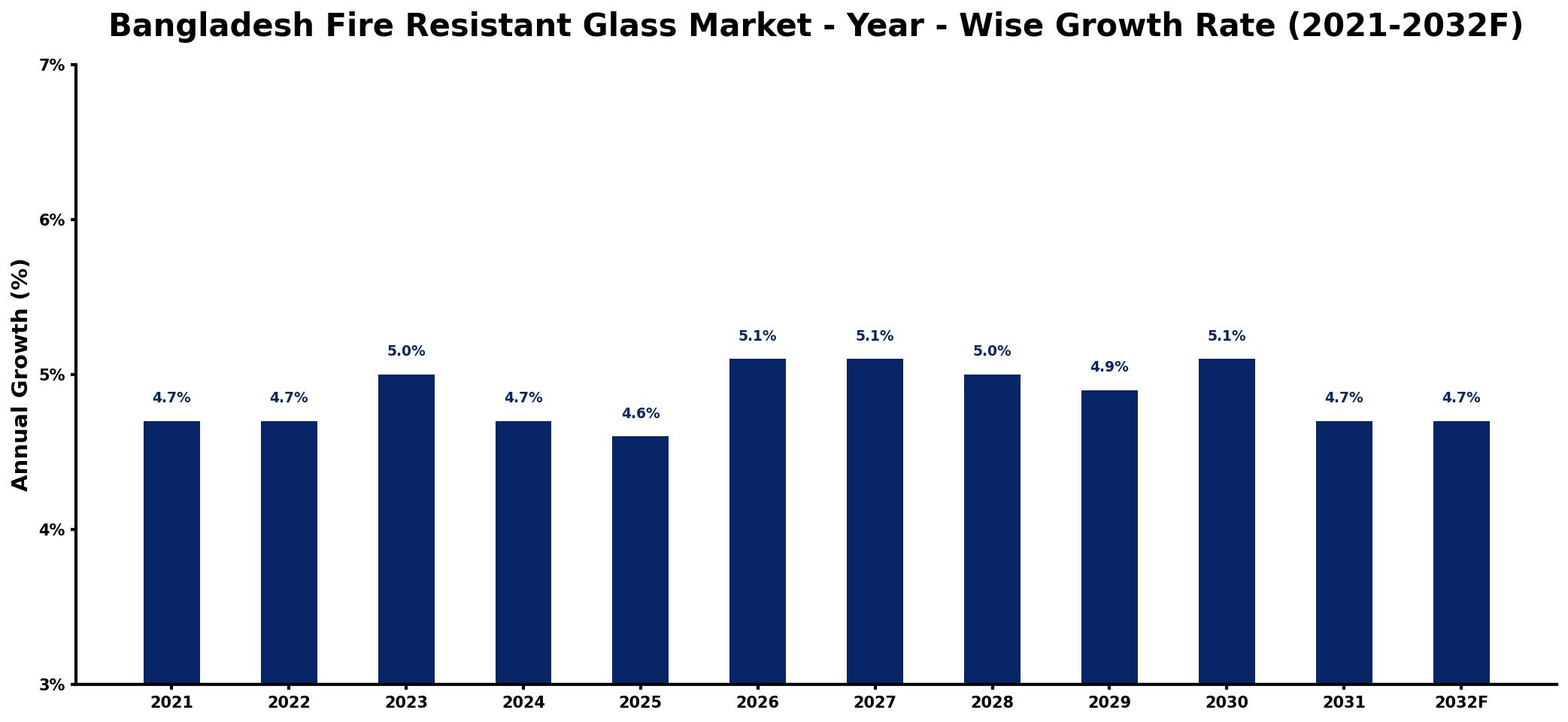
The table below presents the year‑wise growth rates along with the key drivers influencing the market
| Year | Growth Rate | Major Drivers |
| 2021 | 4.7% | Rising construction sector investments |
| 2022 | 4.7% | Increased safety regulations adoption |
| 2023 | 5.0% | Growing demand for innovative materials |
| 2024 | 4.7% | Expansion of commercial infrastructure projects |
| 2025 | 4.6% | Surge in residential building activities |
| 2026 | 5.1% | Increased focus on energy efficiency |
| 2027 | 5.1% | Emerging trends in architectural design |
| 2028 | 5.0% | Government incentives for sustainable materials |
| 2029 | 4.9% | Heightened awareness of safety standards |
| 2030 | 5.1% | Technological advancements in manufacturing |
| 2031 | 4.7% | Growing export opportunities in region |
| 2032 | 4.7% | Rise in urban development initiatives |
Note: Market size estimations and growth projections presented in this report are based on 6Wresearch's proprietary forecasting methodology, utilizing the latest available industry data, government publications, and primary research inputs.
Bangladesh Fire Resistant Glass Market Synopsis
In Bangladesh, the fire-resistant glass market is gaining momentum, reflecting a heightened focus on fire safety in both residential and commercial buildings. The rapid pace of urban development, combined with rising safety standards, is establishing a robust foundation for market expansion.
Moreover, a cultural shift towards proactive safety measures in construction is bolstering demand for innovative fire-resistant glass products that combine functionality with design. As a result, manufacturers are prioritizing technological advancements to meet the evolving needs of builders, architects, and consumers.
Bangladesh Fire Resistant Glass Market Key Takeaways
- Significant growth driven by increasing urbanization and infrastructure projects.
- Rising awareness of fire safety measures across various industries is boosting market demand.
- Strict building codes and regulations are accelerating the adoption of fire-resistant glass solutions.
- Technological innovation is leading to enhanced product offerings with improved safety features.
- Investment opportunities abound for suppliers and manufacturers focusing on this niche market.
Evaluation of Restraints in Bangladesh Fire Resistant Glass Market
Despite the promising prospects, the Bangladesh Fire Resistant Glass Market faces notable challenges. A lack of widespread awareness regarding the critical importance of fire safety measures among property developers and building owners remains a significant barrier to growth. Additionally, consumers are often price-sensitive, which can deter investments in higher-quality fire-resistant products. Furthermore, the availability of premium glass solutions is limited, and compliance with safety regulations requires skilled labor for proper installation and maintenance, underscoring the need for industry-wide education and capacity-building initiatives.
Bangladesh Fire Resistant Glass Market Trends
Current trends in the Bangladesh Fire Resistant Glass Market illustrate a shift towards advanced technology and product innovation. Manufacturers are increasingly focusing on enhancing the thermal insulation and durability of fire-resistant glass while ensuring compliance with local safety standards. The market is also observing a growing trend of integrating fire-resistant glass into modern architectural designs, especially in high-rise buildings and critical facilities such as hospitals and educational institutions.
Bangladesh Fire Resistant Glass Market Opportunities
The market presents a variety of lucrative investment opportunities. With the ongoing infrastructure development and an emphasis on safety, stakeholders can explore avenues such as supplying high-quality fire-resistant glass products, establishing manufacturing plants, or developing distribution networks. Collaborations with architects, construction firms, and government agencies can further enhance visibility and market penetration, making it an appealing segment for both existing and new investors.
Government Initiatives in the Bangladesh Fire Resistant Glass Market
The government of Bangladesh has been proactive in promoting fire safety through various policies. The Bangladesh National Building Code (BNBC) outlines critical guidelines for the application of fire-resistant materials in construction, including glass. Additionally, the Department of Inspection for Factories and Establishments (DIFE) emphasizes the importance of utilizing fire-resistant materials to ensure workplace safety. By offering incentives and subsidies for the adoption of advanced safety measures, the government is effectively fostering a safer building environment across the country.
Future Insights of the Bangladesh Fire Resistant Glass Market
Looking ahead to the period from 2026 to 2032, the Bangladesh Fire Resistant Glass Market is expected to maintain a trajectory of steady growth. As fire safety regulations become stricter and urban infrastructure continues to expand, the demand for fire-resistant glass is anticipated to surge. Advances in product technology and design will likely yield innovative solutions that not only meet safety standards but also appeal to a design-conscious consumer base, positioning the market for sustainable growth.
Bangladesh Fire Resistant Glass Market Latest Developments (2025 - 2026)
Recent developments in the Bangladesh Fire Resistant Glass Market indicate a growing emphasis on product innovation and sustainability. Manufacturers are increasingly investing in research and development to produce advanced fire-resistant glass options that align with emerging safety standards and consumer expectations. Additionally, there is a noticeable trend toward partnerships between industry players and regulatory bodies aimed at enhancing compliance with safety codes and promoting awareness of fire safety measures throughout the construction sector.
Bangladesh Fire Resistant Glass Market - Key Attractiveness of the Report
- 10 Years of Market Numbers
- Historical Data Starting from 2022 to 2025
- Base Year: 2025
- Forecast Data until 2032
- Key Performance Indicators Impacting the Market
- Major Upcoming Developments and Projects
Key Highlights of the Report:
- Bangladesh Fire Resistant Glass Market Outlook
- Market Size of Bangladesh Fire Resistant Glass Market, 2025
- Forecast of Bangladesh Fire Resistant Glass Market, 2032
- Historical Data and Forecast of Bangladesh Fire Resistant Glass Revenues & Volume for the Period 2022-2032F
- Bangladesh Fire Resistant Glass Market Trend Evolution
- Bangladesh Fire Resistant Glass Market Drivers and Challenges
- Bangladesh Fire Resistant Glass Price Trends
- Bangladesh Fire Resistant Glass Porter's Five Forces
- Bangladesh Fire Resistant Glass Industry Life Cycle
- Historical Data and Forecast of Bangladesh Fire Resistant Glass Market Revenues & Volume By Type for the Period 2022-2032F
- Historical Data and Forecast of Bangladesh Fire Resistant Glass Market Revenues & Volume By Integrity (E) for the Period 2022-2032F
- Historical Data and Forecast of Bangladesh Fire Resistant Glass Market Revenues & Volume By Integrity & Radiation Limitation (EW) for the Period 2022-2032F
- Historical Data and Forecast of Bangladesh Fire Resistant Glass Market Revenues & Volume By Integrity & Insulation (EI) for the Period 2022-2032F
- Historical Data and Forecast of Bangladesh Fire Resistant Glass Market Revenues & Volume By Application for the Period 2022-2032F
- Historical Data and Forecast of Bangladesh Fire Resistant Glass Market Revenues & Volume By Building and Construction for the Period 2022-2032F
- Historical Data and Forecast of Bangladesh Fire Resistant Glass Market Revenues & Volume By Other Applications for the Period 2022-2032F
- Bangladesh Fire Resistant Glass Import Export Trade Statistics
- Market Opportunity Assessment By Type
- Market Opportunity Assessment By Application
- Bangladesh Fire Resistant Glass Top Companies Market Share
- Bangladesh Fire Resistant Glass Competitive Benchmarking By Technical and Operational Parameters
- Bangladesh Fire Resistant Glass Company Profiles
- Bangladesh Fire Resistant Glass Key Strategic Recommendations






































