Bangladesh Food Packaging Market Summary
The bangladesh food packaging market was estimated at USD 433 Million in 2025 and is projected to reach USD 567 Million by 2032, growing at a CAGR of 4.9% from 2026 to 2032.
Bangladesh Food Packaging Market Year-wise Growth Rate and Key Drivers
This graph highlights how the Bangladesh Food Packaging Market has steadily grown over the past five years, supported by major growth factors.
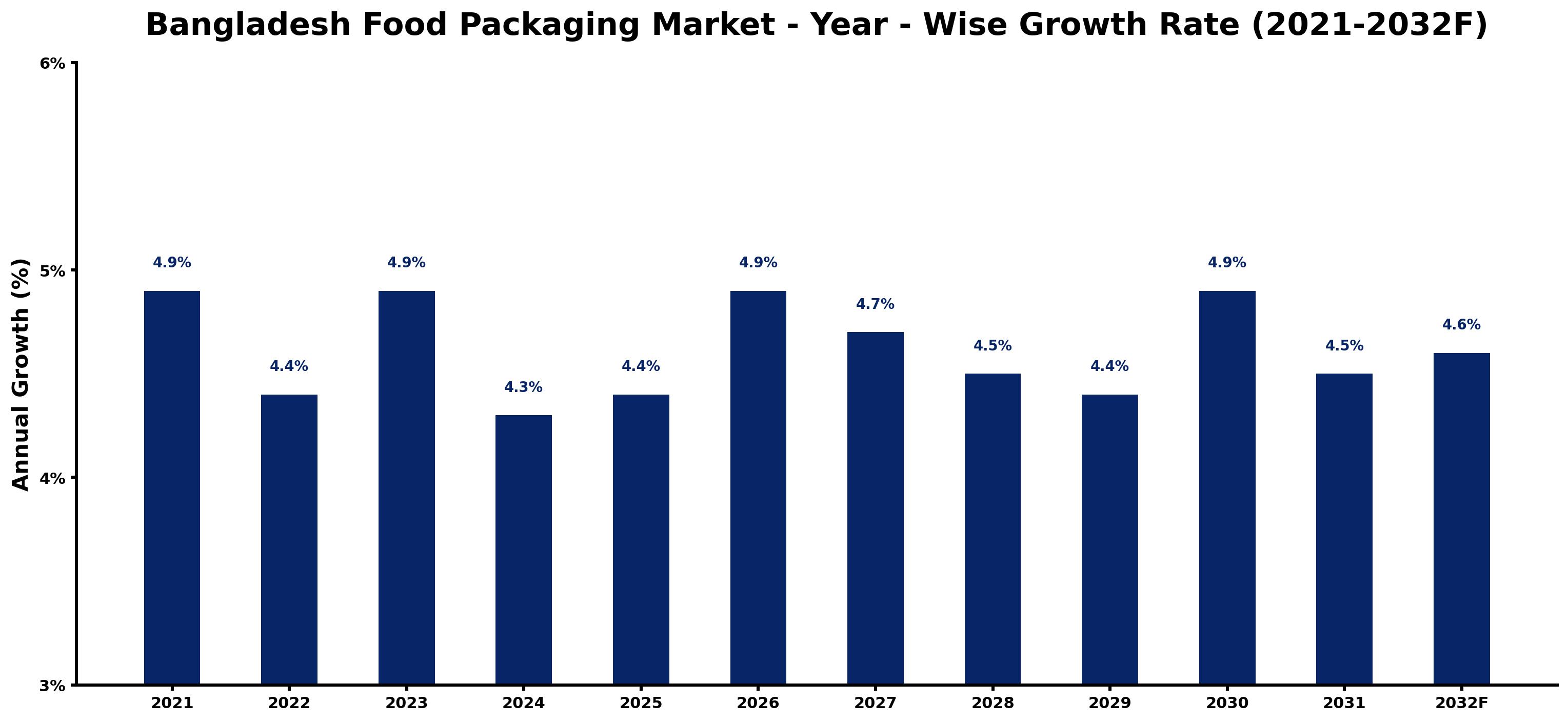
The table below presents the year wise growth rates along with the key drivers influencing the market
| Year | Growth Rate | Major Drivers |
| 2021 | 4.9% | Post-pandemic consumer behavior reflects a shift towards packaged food convenience. |
| 2022 | 4.4% | Increased urbanization intensifies the need for efficient food storage solutions. |
| 2023 | 4.9% | Local producers focus on sustainable materials to attract eco-conscious customers. |
| 2024 | 4.3% | E-commerce platforms expand, necessitating robust packaging innovations for safe transport. |
| 2025 | 4.4% | Rural distribution networks evolve, enhancing access to packaged goods in remote areas. |
| 2026 | 4.9% | Rising health consciousness prompts demand for packaging that preserves nutritional values. |
| 2027 | 4.7% | Emerging startups disrupt traditional packaging methods with innovative, biodegradable solutions. |
| 2028 | 4.5% | Collaboration between manufacturers and retailers enhances custom packaging offerings for brands. |
| 2029 | 4.4% | Export potential grows, requiring compliance with international packaging standards. |
| 2030 | 4.9% | Technological advancements improve packaging machinery efficiency, reducing production costs significantly. |
| 2031 | 4.5% | Consumer preference shifts towards minimalistic designs, influencing packaging aesthetics and materials. |
| 2032 | 4.6% | Investment in recycling infrastructure expands, promoting circular economy principles in packaging. |
Note - Market size estimations and growth projections presented in this report are based on 6Wresearch's advanced forecasting approach, validated with industry datasets as of June 2026.
Bangladesh Food Packaging Market Synopsis
The Bangladesh Food Packaging Market is projected to reach 4.9% and witness significant growth during the forecast period (2026-2032). This market is influenced by a myriad of factors, including urbanization, shifting consumer lifestyles, and escalating demand for convenience foods. As the country experiences rapid urban growth, the food packaging sector is expected to adapt to the changing needs of consumers who seek convenience and hygiene in their food products.
Bangladesh Food Packaging Market Growth Drivers
The growth of the Bangladesh Food Packaging Market is primarily driven by the following factors:
- The rapid urbanization observed in Bangladesh is leading to a surge in population density in cities, which is increasing the demand for packaged food products that are easy to store and consume.
- Changing lifestyles, particularly among the younger demographic, are pushing consumers towards convenient food options, thereby augmenting the demand for various packaging solutions.
- There is a marked increase in the consumption of ready-to-eat meals and convenience foods, propelling manufacturers to innovate packaging that enhances product appeal and shelf life.
- With rising environmental awareness among consumers, there is a shift towards sustainable packaging solutions, resulting in an increased focus on biodegradable and recyclable materials.
- The government's initiatives to enhance food safety standards are encouraging investment in advanced packaging technologies that extend shelf life and ensure the safety of food products.
Bangladesh Food Packaging Market Trends and Opportunities
Currently, the Bangladesh Food Packaging Market is witnessing several notable trends:
- There is a significant movement towards the use of eco-friendly packaging materials to address growing environmental concerns, which aligns with global trends and consumer preferences.
- Increasing consumer demand for convenience has led to a rise in innovative packaging formats such as resealable pouches and microwave-safe containers, enhancing the user experience.
- The market is embracing advanced technologies, including active and modified atmosphere packaging, which help prolong the freshness and enhance the safety of food products.
- As consumer awareness of food safety rises, manufacturers are focusing on packaging that provides clear information about ingredients and expiry dates, further promoting transparency.
- Investment in smart packaging technologies is emerging as a competitive advantage, allowing brands to interact with consumers and provide information regarding food quality and authenticity.
Bangladesh Food Packaging Market Challenges and Restraints
Despite the positive outlook, the Bangladesh Food Packaging Market faces several challenges:
- The presence of unorganized small-scale manufacturers results in quality control issues, making it difficult to uniformly regulate packaging standards across the industry.
- Inconsistent regulatory frameworks and enforcement pose significant hurdles, complicating compliance for packaging manufacturers and impacting product safety.
- Limited access to advanced packaging technologies can hinder the overall innovation capabilities within the market, affecting competitiveness.
- The growing demand for cost-effective solutions places pressure on manufacturers to balance quality with affordability, potentially compromising safety or sustainability.
- Environmental sustainability concerns related to traditional packaging materials create challenges for compliance, pushing companies to pivot towards greener alternatives.
Bangladesh Food Packaging Market Investment Opportunities
The Bangladesh Food Packaging Market offers numerous investment opportunities, primarily driven by the following factors:
- The expansion of the food industry suggests a growing demand for innovative and hygienic packaging solutions, attracting investments in the development of new packaging materials.
- Investors can explore opportunities in producing biodegradable and eco-friendly packaging, catering to an increasingly environmentally conscious consumer base.
- There is scope for investment in advanced packaging equipment that enhances production efficiency while addressing the diverse requirements of food manufacturers.
- Collaborating with local food enterprises to deliver tailored packaging solutions can lead to mutually beneficial partnerships and improved market positioning.
- Utilizing e-commerce platforms for distribution of packaging materials can open new revenue streams for investors, aligning with the shift towards online food delivery services.
Bangladesh Food Packaging Market Government Investment and Initiatives
Government policies significantly influence the Bangladesh Food Packaging Market, with several initiatives aimed at enhancing food safety and sustainability. The Bangladesh Food Safety Authority (BFSA) plays a crucial role in regulating food packaging materials, enforcing standards designed to protect public health.
Various regulations are in place to restrict harmful chemicals in packaging and ensure materials meet safety requirements. Additionally, the government promotes sustainable packaging practices through incentives and awareness programs, encouraging the adoption of eco-friendly alternatives. Such initiatives not only aim to improve food safety but also contribute to reducing the environmental impact of packaging waste.
Bangladesh Food Packaging Market Latest Developments (May 2025 - June 2026)
In the recent period from May 2025 to June 2026, the Bangladesh Food Packaging Market has experienced significant developments. One prominent trend is the accelerated adoption of sustainable packaging solutions across various food sectors, responding to increased consumer demand for environmentally friendly products. Manufacturers are increasingly investing in research and development to innovate in areas like biodegradable materials and smart packaging technologies.
Additionally, regulatory bodies have strengthened their focus on enforcing safety standards for food packaging materials. This has prompted companies to enhance quality control measures and adopt more stringent testing protocols. The market has also seen collaborations between government entities and industry stakeholders aimed at standardizing packaging practices and promoting sustainable solutions.
Bangladesh Food Packaging Market - Key Attractiveness of the Report
- 10 Years of Market Numbers
- Historical Data Starting from 2022 to 2025
- Base Year: 2025
- Forecast Data until 2032
- Key Performance Indicators Impacting the Market
- Major Upcoming Developments and Projects
Key Highlights of the Report:
- Bangladesh Food Packaging Market Outlook
- Market Size of Bangladesh Food Packaging Market, 2025
- Forecast of Bangladesh Food Packaging Market, 2032F
- Historical Data and Forecast of Bangladesh Food Packaging Revenues & Volume for the Period 2022-2032F
- Bangladesh Food Packaging Market Trend Evolution
- Bangladesh Food Packaging Market Drivers and Challenges
- Bangladesh Food Packaging Price Trends
- Bangladesh Food Packaging Porter's Five Forces
- Bangladesh Food Packaging Industry Life Cycle
- Historical Data and Forecast of Bangladesh Food Packaging Market Revenues & Volume By Material Types for the Period 2022-2032F
- Historical Data and Forecast of Bangladesh Food Packaging Market Revenues & Volume By Paper & board for the Period 2022-2032F
- Historical Data and Forecast of Bangladesh Food Packaging Market Revenues & Volume By Plastic for the Period 2022-2032F
- Historical Data and Forecast of Bangladesh Food Packaging Market Revenues & Volume By Metal for the Period 2022-2032F
- Historical Data and Forecast of Bangladesh Food Packaging Market Revenues & Volume By Glass for the Period 2022-2032F
- Historical Data and Forecast of Bangladesh Food Packaging Market Revenues & Volume By Others for the Period 2022-2032F
- Historical Data and Forecast of Bangladesh Food Packaging Market Revenues & Volume By Product Types for the Period 2022-2032F
- Historical Data and Forecast of Bangladesh Food Packaging Market Revenues & Volume By Rigid for the Period 2022-2032F
- Historical Data and Forecast of Bangladesh Food Packaging Market Revenues & Volume By Semi-Rigid for the Period 2022-2032F
- Historical Data and Forecast of Bangladesh Food Packaging Market Revenues & Volume By Flexible for the Period 2022-2032F
- Historical Data and Forecast of Bangladesh Food Packaging Market Revenues & Volume By Applications for the Period 2022-2032F
- Historical Data and Forecast of Bangladesh Food Packaging Market Revenues & Volume By Bakery & Confectionary for the Period 2022-2032F
- Historical Data and Forecast of Bangladesh Food Packaging Market Revenues & Volume By Dairy Products for the Period 2022-2032F
- Historical Data and Forecast of Bangladesh Food Packaging Market Revenues & Volume By Fruits & Vegetables for the Period 2022-2032F
- Historical Data and Forecast of Bangladesh Food Packaging Market Revenues & Volume By Meat, Poultry, & Seafood for the Period 2022-2032F
- Historical Data and Forecast of Bangladesh Food Packaging Market Revenues & Volume By Sauces & Dressings for the Period 2022-2032F
- Historical Data and Forecast of Bangladesh Food Packaging Market Revenues & Volume By Others for the Period 2022-2032F
- Bangladesh Food Packaging Import Export Trade Statistics
- Market Opportunity Assessment By Material Types
- Market Opportunity Assessment By Product Types
- Market Opportunity Assessment By Applications
- Bangladesh Food Packaging Top Companies Market Share
- Bangladesh Food Packaging Competitive Benchmarking By Technical and Operational Parameters
- Bangladesh Food Packaging Company Profiles
- Bangladesh Food Packaging Key Strategic Recommendations






































