Bangladesh Food Retail Market Summary
The bangladesh food retail market was estimated at USD 1464 Million in 2025 and is projected to reach USD 2428 Million by 2032, growing at a CAGR of 8.6% from 2026 to 2032.
Bangladesh Food Retail Market Year-wise Growth Rate and Key Drivers
This graph highlights how the Bangladesh Food Retail Market has steadily grown over the past five years, supported by major growth factors.
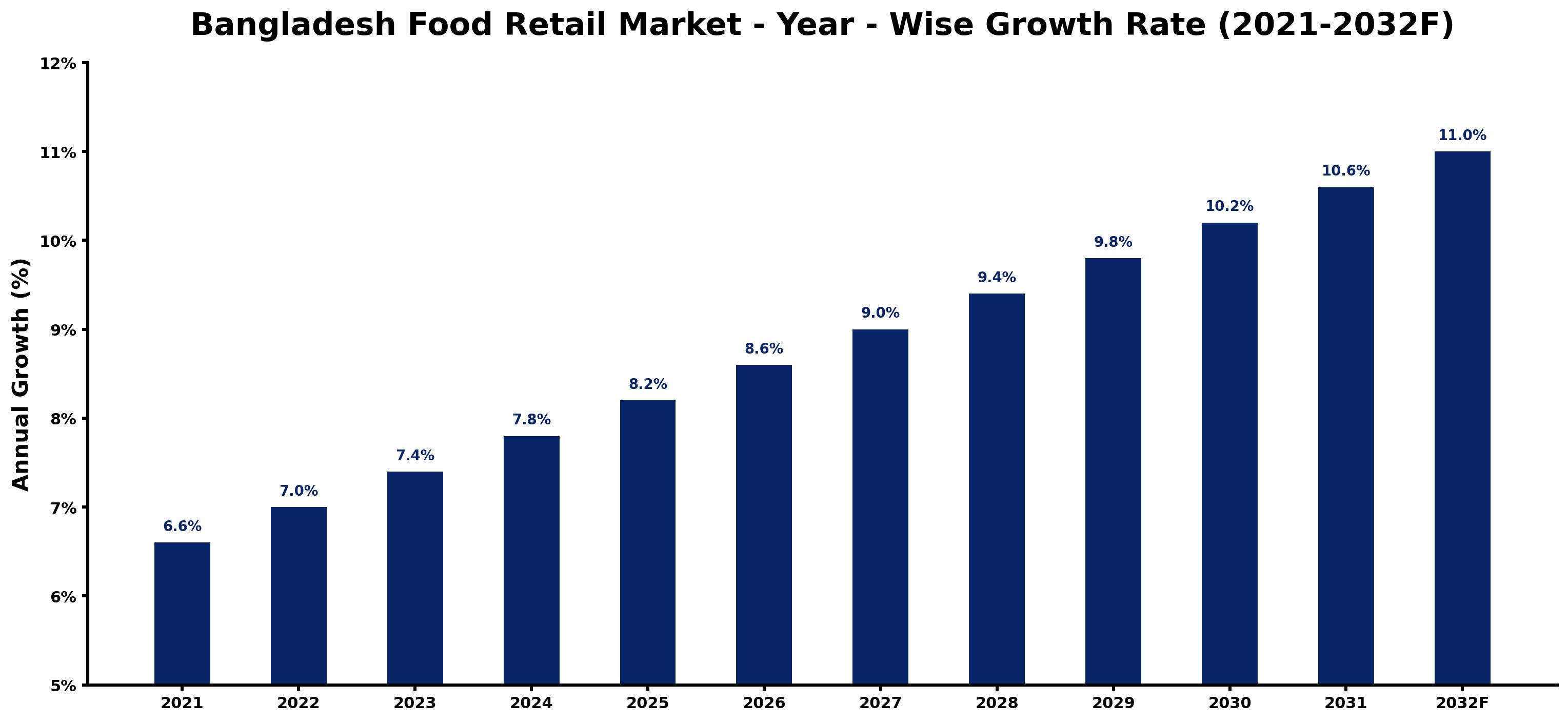
The table below presents the year wise growth rates along with the key drivers influencing the market
| Year | Growth Rate | Major Drivers |
| 2021 | 6.6% | Consumer preference shifted significantly towards online grocery shopping and delivery services. |
| 2022 | 7.0% | Local food production gained emphasis to enhance supply chain resilience and sustainability. |
| 2023 | 7.4% | Urbanization trends led to increased demand for modern retail formats and convenience stores. |
| 2024 | 7.8% | Food safety standards improved, pushing retailers to adopt stricter quality control measures. |
| 2025 | 8.2% | Innovative marketing strategies targeted younger demographics, reshaping traditional buying behaviors. |
| 2026 | 8.6% | Investment in cold chain logistics expanded, improving perishable goods distribution efficiency. |
| 2027 | 9.0% | The introduction of payment technologies fueled a rise in cashless transactions among consumers. |
| 2028 | 9.4% | Health-consciousness influenced product offerings, with organic and nutritious options becoming mainstream. |
| 2029 | 9.8% | Emerging local brands gained popularity, reflecting cultural preferences and regional flavors. |
| 2030 | 10.2% | Sustainability practices became essential, prompting retailers to minimize waste and encourage recycling. |
| 2031 | 10.6% | E-commerce partnerships with local farms enhanced direct-to-consumer sales channels significantly. |
| 2032 | 11.0% | Collaborative platforms among retailers and suppliers streamlined inventory and logistics management. |
Note - Market size estimations and growth projections presented in this report are based on 6Wresearch's advanced forecasting approach, validated with industry datasets as of June 2026.
Bangladesh Food Retail Market Synopsis
The Bangladesh Food Retail Market is projected to reach 8.6% and witness significant growth during the forecast period (2026-2032). This expansion is driven by various factors including a rising demand for convenience foods, a shift towards ready-to-eat meal options, and enhanced disposable incomes among consumers. Additionally, changing lifestyles coupled with rapid urbanization are reshaping consumer preferences, thereby propelling the market forward. The increase in organized retailing, particularly through hypermarkets and supermarkets, is also fostering a competitive landscape that influences purchasing decisions.
Bangladesh Food Retail Market Growth Drivers
Several key drivers are fueling growth in the Bangladesh food retail market. The increasing demand for convenience foods reflects busy lifestyles that prioritize time-saving options. Urban consumers are leaning towards ready-to-eat meals, which are not only convenient but also cater to their evolving culinary preferences. As disposable incomes rise, consumers are more willing to invest in quality food products, further stimulating market growth. Moreover, the proliferation of organized retail spaces like hypermarkets and supermarkets provides consumers access to a broader spectrum of products, enhancing their shopping experience.
- The shift in consumer lifestyles, particularly in urban areas, is leading to a greater preference for modern retail formats.
- Enhanced marketing strategies by retailers are appealing directly to consumers, increasing brand loyalty and influencing purchase behaviors.
- The rise of e-commerce platforms is making food retail more accessible, allowing consumers to shop conveniently from their homes.
- Technological advancements in supply chain management are optimizing inventory, ensuring product availability, and reducing costs.
- Growing urbanization continues to shift demographic profiles, necessitating more sophisticated retail solutions to meet diverse consumer needs.
Bangladesh Food Retail Market Challenges and Restraints
Despite the robust growth prospects of the Bangladesh food retail market, several challenges must be navigated. One significant restraint is the lack of infrastructure, particularly in rural areas, which can hinder efficient distribution and product availability. Additionally, regulatory bottlenecks often impede the swift establishment of new retail outlets. The competitive landscape is also intensifying, which may result in price wars and reduced profit margins for retailers. Furthermore, fluctuating agricultural productivity can impact the availability and pricing of food products, thereby affecting consumer confidence. Lastly, changing consumer preferences necessitate frequent adaptation by retailers to stay relevant in the market.
- Inadequate logistics and distribution networks in rural regions limit market reach.
- Stringent regulations and compliance issues can create challenges for new entrants into the market.
- Increased competition may lead to price sensitivity among consumers, affecting profit margins.
- Fluctuations in agricultural output can directly influence food prices, creating volatility in the market.
- The evolving landscape of consumer preferences requires companies to continuously innovate and adapt.
Bangladesh Food Retail Market Government Investment and Initiatives
The government of Bangladesh has implemented several initiatives aimed at strengthening the food retail market. Investments into infrastructure development, including roads and transportation, are crucial for improving logistics and supply chain operations. Furthermore, the government is promoting digital payment systems, such as Bkash and mobile banking, which enhance the shopping experience for consumers, leading to higher sales volumes. Policies aimed at fostering a business-friendly environment encourage private sector investment in modern retail formats. Additionally, the government is focusing on agricultural policies that ensure food security and stabilize prices for consumers, indirectly supporting the food retail market.
Bangladesh Food Retail Market Latest Developments (May 2025 - June 2026)
Recent developments in the Bangladesh food retail market indicate a significant shift towards digital transformation, with many retailers enhancing their online platforms to capture the growing e-commerce trend. Consumers are increasingly utilizing mobile applications for grocery shopping, leading to a surge in online sales. The introduction of various promotional campaigns has also garnered consumer interest, stimulating sales in both brick-and-mortar and online formats. Retailers are focusing on sustainability initiatives, such as eco-friendly packaging and sourcing local products, which appeal to environmentally conscious consumers. Furthermore, strategic partnerships among retail chains and tech firms are being forged to optimize supply chain efficiencies and improve customer engagement.
Bangladesh Food Retail Market - Key Attractiveness of the Report
- 10 Years of Market Numbers
- Historical Data Starting from 2022 to 2025
- Base Year: 2025
- Forecast Data until 2032
- Key Performance Indicators Impacting the Market
- Major Upcoming Developments and Projects
Key Highlights of the Report:
- Bangladesh Food Retail Market Outlook
- Market Size of Bangladesh Food Retail Market, 2025
- Forecast of Bangladesh Food Retail Market, 2032F
- Historical Data and Forecast of Bangladesh Food Retail Revenues & Volume for the Period 2022-2032F
- Bangladesh Food Retail Market Trend Evolution
- Bangladesh Food Retail Market Drivers and Challenges
- Bangladesh Food Retail Price Trends
- Bangladesh Food Retail Porter's Five Forces
- Bangladesh Food Retail Industry Life Cycle
- Historical Data and Forecast of Bangladesh Food Retail Market Revenues & Volume By Product Types for the Period 2022-2032F
- Historical Data and Forecast of Bangladesh Food Retail Market Revenues & Volume By Unpackaged Food for the Period 2022-2032F
- Historical Data and Forecast of Bangladesh Food Retail Market Revenues & Volume By Packaged Food for the Period 2022-2032F
- Historical Data and Forecast of Bangladesh Food Retail Market Revenues & Volume By Drinks for the Period 2022-2032F
- Historical Data and Forecast of Bangladesh Food Retail Market Revenues & Volume By Household Products for the Period 2022-2032F
- Historical Data and Forecast of Bangladesh Food Retail Market Revenues & Volume By Packaging Types for the Period 2022-2032F
- Historical Data and Forecast of Bangladesh Food Retail Market Revenues & Volume By Boxes for the Period 2022-2032F
- Historical Data and Forecast of Bangladesh Food Retail Market Revenues & Volume By Cans for the Period 2022-2032F
- Historical Data and Forecast of Bangladesh Food Retail Market Revenues & Volume By Cellophane Wrapping for the Period 2022-2032F
- Historical Data and Forecast of Bangladesh Food Retail Market Revenues & Volume By Cylindrical Cardboard for the Period 2022-2032F
- Bangladesh Food Retail Import Export Trade Statistics
- Market Opportunity Assessment By Product Types
- Market Opportunity Assessment By Packaging Types
- Bangladesh Food Retail Top Companies Market Share
- Bangladesh Food Retail Competitive Benchmarking By Technical and Operational Parameters
- Bangladesh Food Retail Company Profiles
- Bangladesh Food Retail Key Strategic Recommendations






































