Bangladesh Formwork Market Summary
The bangladesh formwork market was estimated at USD 1128 Million in 2025 and is projected to reach USD 1626 Million by 2032, growing at a CAGR of 6.0% from 2026 to 2032.
Bangladesh Formwork Market Year-wise Growth Rate and Key Drivers
This graph highlights how the Bangladesh Formwork Market has steadily grown over the past five years, supported by major growth factors.
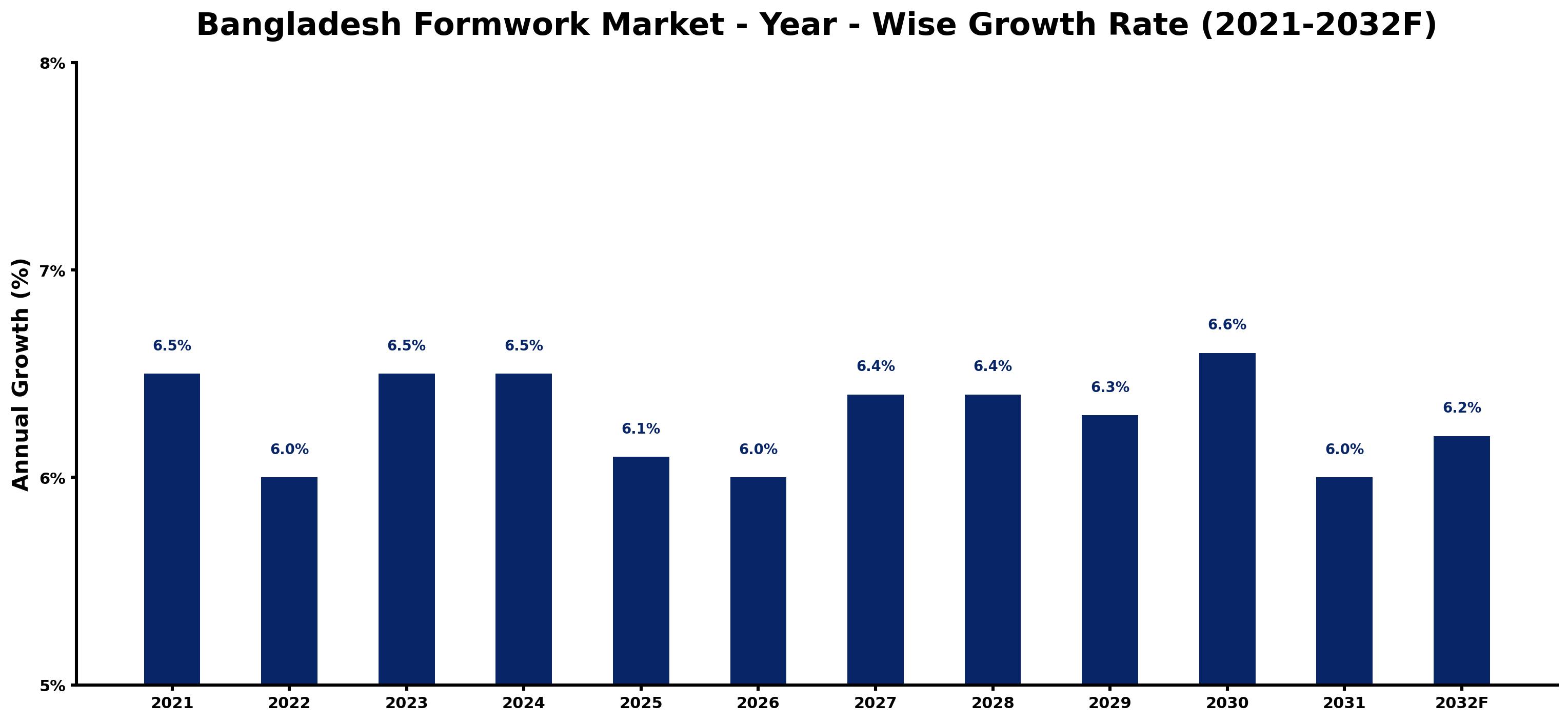
The table below presents the year wise growth rates along with the key drivers influencing the market
| Year | Growth Rate | Major Drivers |
| 2021 | 6.5% | Construction activity rebounded, spurred by infrastructure projects in urban centers. |
| 2022 | 6.0% | Investment in local manufacturing enhanced product availability and reduced import dependency. |
| 2023 | 6.5% | Rising urbanization led to a surge in multi-storey building projects nationwide. |
| 2024 | 6.5% | Technological innovations in design improved efficiency and lowered construction costs significantly. |
| 2025 | 6.1% | Increased focus on sustainable construction practices created opportunities for eco-friendly formwork materials. |
| 2026 | 6.0% | Partnerships between local firms and international companies optimized supply chain management and logistics. |
| 2027 | 6.4% | Growing demand for commercial spaces resulted in expanded formwork applications across sectors. |
| 2028 | 6.4% | Investment in skilled labor development improved workforce capabilities for advanced construction techniques. |
| 2029 | 6.3% | The hospitality sector's expansion fueled demand for innovative and customizable formwork solutions. |
| 2030 | 6.6% | Legacy construction methods faced challenges, prompting the shift to modern formwork systems. |
| 2031 | 6.0% | Post-pandemic recovery led to increased funding for new urban infrastructure projects. |
| 2032 | 6.2% | Emergence of smart cities necessitated advanced formwork solutions for high-tech construction needs. |
Note - Market size estimations and growth projections presented in this report are based on 6Wresearch's advanced forecasting approach, validated with industry datasets as of June 2026.
Bangladesh Formwork Market Synopsis
The Bangladesh Formwork Market is projected to reach 6.0% and witness significant growth during the forecast period (2026-2032). This growth is being propelled by an expanding construction industry, which is essential for various infrastructure projects such as buildings, bridges, and roads. The rising demand for formwork solutions is largely attributable to the increasing number of infrastructure development initiatives undertaken by the government and private sector. As urbanization accelerates, the need for efficient, durable, and adaptable formwork systems has become critical in supporting the country's construction capabilities.
Bangladesh Formwork Market Growth Drivers
A combination of factors is driving the growth of the Bangladesh Formwork Market, including:
- Robust Economic Development: Bangladesh's steady economic growth has led to an upsurge in construction activities, creating a sustained demand for formwork solutions.
- Urbanization Trends: Rapid urban growth necessitates the construction of residential and commercial buildings, boosting the requirement for efficient formwork systems.
- Infrastructure Development Projects: Government-funded initiatives aimed at improving the country's infrastructure directly influence the demand for advanced formwork solutions.
- Sustainability Focus: The rising emphasis on sustainable construction practices is leading to increased adoption of eco-friendly formwork materials.
- Technological Advancements: Innovations in formwork design and delivery systems are enhancing the efficiency and safety of construction projects, encouraging market growth.
Bangladesh Formwork Market Trends and Opportunities
The Bangladesh Formwork Market is evolving with several notable trends, including:
- Shift Toward Modular Solutions: Modular and customizable formwork systems are in demand as they significantly reduce construction timelines and improve efficiency.
- Increasing Adoption of Eco-Friendly Materials: There is a growing market for sustainable formwork solutions that minimize environmental footprints, aligning with global green building trends.
- Digital Integration: The use of digital platforms for designing and planning formwork systems is becoming prevalent, streamlining operations and enhancing project management.
- Formwork Rental Services Expansion: Construction companies are increasingly opting for rental services to reduce capital expenditure and adapt to fluctuating project needs.
- Enhanced Safety Standards: As safety regulations tighten, there is a heightened focus on high-quality formwork systems that meet stringent safety criteria.
Bangladesh Formwork Market Challenges and Restraints
Despite its promising growth, the Bangladesh Formwork Market faces several challenges:
- High Initial Investment: The upfront costs of acquiring formwork materials can be prohibitive, hindering project feasibility for some operators.
- Skilled Labor Shortages: The industry grapples with a lack of skilled labor for formwork installation and dismantling, affecting overall project timelines.
- Inconsistent Quality Standards: The absence of standardized regulations leads to variations in product quality, impacting safety and performance.
- Logistical Hurdles: Transportation and storage issues related to formwork materials can disrupt project schedules and increase costs.
- Competitive Pricing Pressure: The presence of numerous market players creates intense competition, leading to pricing pressures on manufacturers and suppliers.
Bangladesh Formwork Market Investment Opportunities
Investors are presented with numerous opportunities in the Bangladesh Formwork Market, driven by the expanding construction sector:
- Advanced Formwork Technologies: There is significant demand for innovative formwork technologies, such as lightweight aluminum systems, that offer efficiency and cost-effectiveness.
- Formwork Rental Markets: The rise in short-term construction projects creates potential for formwork rental services, appealing to contractors seeking flexibility.
- Public-Private Partnerships: Collaborating with government projects opens avenues for investment in high-scale infrastructure initiatives.
- Training and Development: Investments in skill development programs for labor can mitigate the human resource challenges faced by the industry.
- Research and Development: Focusing on R&D for new formwork materials can lead to pioneering solutions that enhance sustainability and performance.
Bangladesh Formwork Market Government Investment and Initiatives
The Bangladesh government has laid down several initiatives aimed at regulating and enhancing the formwork market:
- Standards and Regulations: Government policies enforce standards for formwork materials and construction techniques to ensure quality and safety across projects.
- Support for Sustainable Practices: The government promotes eco-friendly formwork solutions to align with broader environmental objectives, encouraging manufacturers to innovate.
- Infrastructure Development Plans: Public investment in infrastructure, including roads, bridges, and urban housing, provides a stable demand for formwork solutions.
- Industry Collaboration: The government engages with industry stakeholders to foster growth, offering incentives for technological advancements and best practices.
- Funding and Grants: Dedicated funds and grants are available for projects that utilize modern and sustainable construction methodologies, further stimulating market growth.
Bangladesh Formwork Market Latest Developments (May 2025 - June 2026)
Recent developments in the Bangladesh Formwork Market indicate a significant shift towards advanced technologies and sustainable practices. Over this period, industry stakeholders have focused on improving productivity through the adoption of modular and customizable formwork solutions. Additionally, there has been an uptick in collaborations between local firms and international manufacturers, fostering the exchange of innovative techniques and materials. The government has also reiterated its commitment to sustainable construction, promoting policies that support eco-friendly formwork technologies. Furthermore, with the increasing emphasis on digital tools for construction planning, various stakeholders are investing in software solutions to streamline design and project management processes. Overall, the market is showing resilience and adaptability in response to evolving construction needs.
Bangladesh Formwork Market - Key Attractiveness of the Report
- 10 Years of Market Numbers
- Historical Data Starting from 2022 to 2025
- Base Year: 2025
- Forecast Data until 2032
- Key Performance Indicators Impacting the Market
- Major Upcoming Developments and Projects
Key Highlights of the Report:
- Bangladesh Formwork Market Outlook
- Market Size of Bangladesh Formwork Market, 2025
- Forecast of Bangladesh Formwork Market, 2032F
- Historical Data and Forecast of Bangladesh Formwork Revenues & Volume for the Period 2022-2032F
- Bangladesh Formwork Market Trend Evolution
- Bangladesh Formwork Market Drivers and Challenges
- Bangladesh Formwork Price Trends
- Bangladesh Formwork Porter's Five Forces
- Bangladesh Formwork Industry Life Cycle
- Historical Data and Forecast of Bangladesh Formwork Market Revenues & Volume By Product Type for the Period 2022-2032F
- Historical Data and Forecast of Bangladesh Formwork Market Revenues & Volume By Traditional timber formwork for the Period 2022-2032F
- Historical Data and Forecast of Bangladesh Formwork Market Revenues & Volume By Engineered Formwork System for the Period 2022-2032F
- Historical Data and Forecast of Bangladesh Formwork Market Revenues & Volume By Re-usable plastic formwork for the Period 2022-2032F
- Historical Data and Forecast of Bangladesh Formwork Market Revenues & Volume By Others for the Period 2022-2032F
- Historical Data and Forecast of Bangladesh Formwork Market Revenues & Volume By Applications for the Period 2022-2032F
- Historical Data and Forecast of Bangladesh Formwork Market Revenues & Volume By Buildings for the Period 2022-2032F
- Historical Data and Forecast of Bangladesh Formwork Market Revenues & Volume By Transportation for the Period 2022-2032F
- Historical Data and Forecast of Bangladesh Formwork Market Revenues & Volume By Industrial Facilities for the Period 2022-2032F
- Bangladesh Formwork Import Export Trade Statistics
- Market Opportunity Assessment By Product Type
- Market Opportunity Assessment By Applications
- Bangladesh Formwork Top Companies Market Share
- Bangladesh Formwork Competitive Benchmarking By Technical and Operational Parameters
- Bangladesh Formwork Company Profiles
- Bangladesh Formwork Key Strategic Recommendations






































