Bangladesh Fruit Powder Market Size, Share & Growth Rate
The Bangladesh Fruit Powder Market was estimated at USD 381 Million in 2025 and is projected to reach USD 519 Million by 2032, growing at a CAGR of 4.5% from 2026 to 2032. This growth trajectory is primarily driven by an increasing consumer preference for convenient, shelf-stable food options that do not compromise on nutritional value. As health awareness continues to rise, fruit powders are emerging as popular substitutes for artificial flavorings, thereby fostering a robust market expansion.
Bangladesh Fruit Powder Market Year-wise Growth Rate and Key Drivers
This graph highlights how the Bangladesh Fruit Powder Market has steadily grown over the years, supported by major growth factors.
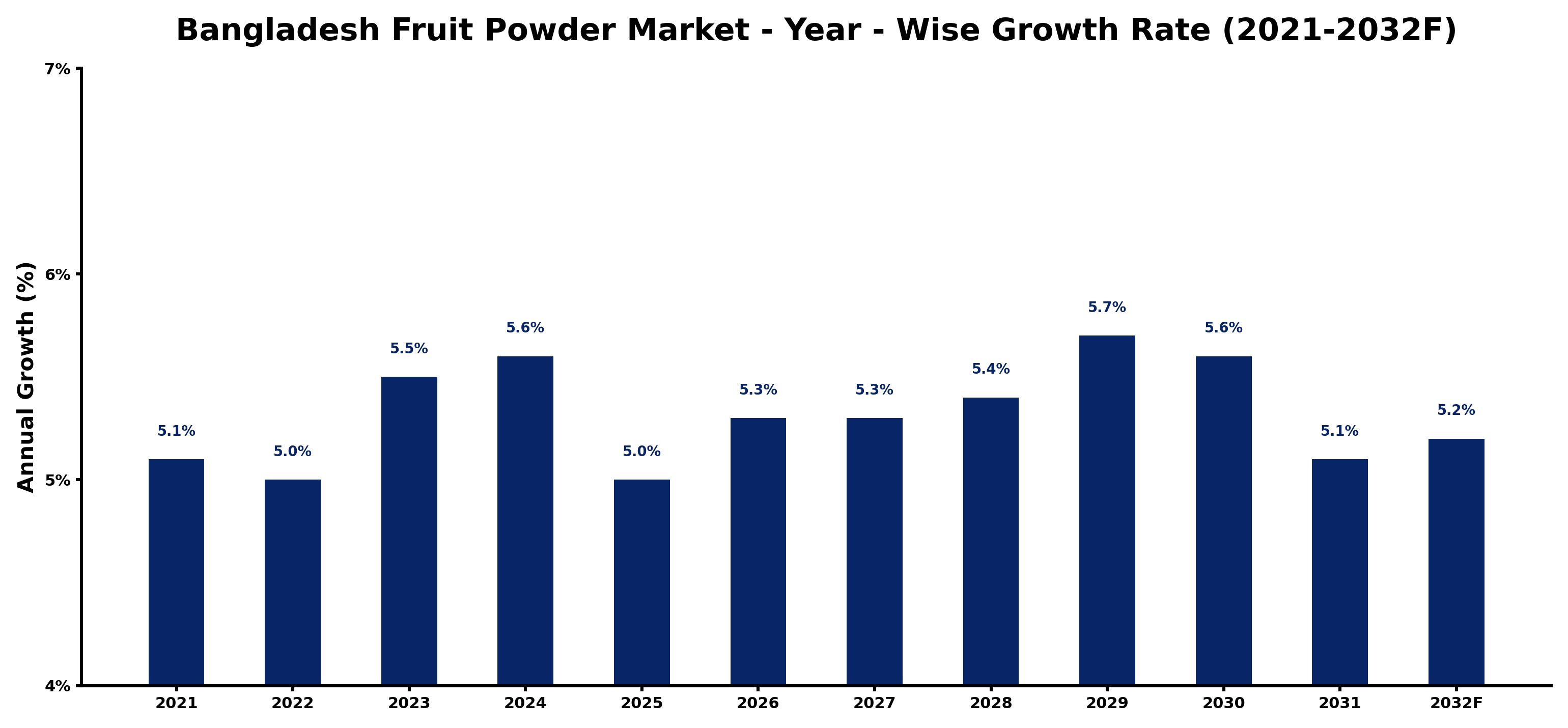
The table below presents the year‑wise growth rates along with the key drivers influencing the market
| Year | Growth Rate | Major Drivers |
| 2021 | 5.1% | Cold chain logistics development boosted fruit powder export capabilities |
| 2022 | 5.0% | Fruit powder processing facilities adopt advanced drying technology systems |
| 2023 | 5.5% | Upgraded drying technology boosted fruit powder processing efficiency |
| 2024 | 5.6% | Fruit powder manufacturers boost capacity to meet export demand |
| 2025 | 5.0% | Fruit processing capacity upgrades boost export opportunities for manufacturers |
| 2026 | 5.3% | Fruit powder processing plants attract foreign manufacturing investments in Bangladesh |
| 2027 | 5.3% | Domestic fruit processing facilities adopt advanced dehydration technology integration |
| 2028 | 5.4% | Local fruit powder manufacturers expand capacity for export markets |
| 2029 | 5.7% | New fruit drying facilities boost powder production capabilities significantly |
| 2030 | 5.6% | Modernized processing facilities boost efficiency in fruit powder production |
| 2031 | 5.1% | Optimized drying techniques boosted fruit powder production efficiency |
| 2032 | 5.2% | Improved fruit processing facilities enhanced powder production capabilities |
Note - Market size estimations and growth projections presented in this report are based on 6Wresearch’s advanced forecasting approach, validated with industry datasets as of June 2026.
Bangladesh Fruit Powder Market Synopsis
Demand for fruit powders in Bangladesh is surging, particularly for flavors such as mango and banana, which resonate with local tastes. This trend aligns with the booming food processing industry, which is actively incorporating fruit powders into beverages, snacks, and desserts to enhance flavor and nutritional content.
Supply chain dynamics in the fruit powder market are evolving, with increased emphasis on sourcing high-quality raw materials. As manufacturers seek to establish stronger ties with local farmers, the quality and consistency of fruit powders are expected to improve, addressing some existing market challenges.
Bangladesh Fruit Powder Market Key Takeaways
- The market is witnessing a shift towards natural and healthy food alternatives, with fruit powders gaining popularity.
- Product innovations and diversified packaging are crucial strategies being employed to attract health-conscious consumers.
- Expansion of the food processing sector is creating increased demand for fruit powders across various applications.
- Investment in local sourcing and processing technologies is essential for maintaining quality and competitiveness.
- Government support for agricultural initiatives can significantly enhance the market's growth potential.
Evaluation of Restraints in Bangladesh Fruit Powder Market
Despite its potential, the Bangladesh Fruit Powder Market faces significant restraints. Inconsistent quality across products, stemming from variations in raw material sourcing and processing practices, has raised concerns about consumer trust. Furthermore, limited consumer education on the benefits and uses of fruit powders has impeded wider market acceptance. The presence of counterfeit products also threatens established brands, causing potential damage to overall market reputation. Addressing these challenges is crucial for fostering a sustainable growth environment.
Bangladesh Fruit Powder Market Trends
A notable trend in the Bangladesh Fruit Powder Market is the rising preference for clean-label products. Consumers are increasingly inclined towards items made from natural and ethically sourced ingredients, which has prompted manufacturers to reformulate and innovate their product offerings. Additionally, the popularity of fruit powders as versatile ingredients in smoothies, baked goods, and ready-to-drink beverages is expanding, catering to both health-conscious and convenience-driven segments.
Bangladesh Fruit Powder Market Opportunities
The Bangladesh Fruit Powder Market presents substantial investment opportunities as consumer demand grows for nutritious and easy-to-use food products. Investors can capitalize on the trend by establishing fruit powder manufacturing facilities or developing unique product formulations that align with local culinary preferences. Collaborations with local fruit growers can also ensure a steady supply chain, further enhancing product quality and market appeal.
Government Initiatives in the Bangladesh Fruit Powder Market
The Bangladeshi government has taken proactive measures to bolster the fruit powder market by implementing policies that promote agricultural growth and export potential. Support mechanisms such as financial assistance for technology upgrades and infrastructure development are crucial for manufacturers. Furthermore, initiatives aimed at enforcing food safety standards enhance product quality, ensuring competitiveness in both domestic and international arenas.
Future Insights of the Bangladesh Fruit Powder Market
Looking ahead to 2026-2032, the Bangladesh Fruit Powder Market is anticipated to undergo substantial evolution. Increased health consciousness among consumers, coupled with ongoing growth in the food processing sector, is expected to drive demand for fruit powders. As younger demographics continue to seek quick, healthy options, the market will likely see innovations that leverage new flavors and improved nutritional profiles, further enhancing its growth trajectory.
Bangladesh Fruit Powder Market Latest Developments (May 2025 - June 2026)
Recent developments in the Bangladesh Fruit Powder Market indicate a shift towards improved quality control and greater consumer education initiatives. Manufacturers are increasingly investing in advanced processing technologies to ensure the consistency and safety of their products. Moreover, marketing campaigns aimed at raising awareness about the benefits of fruit powders are becoming more prevalent, contributing to overall market growth.
Bangladesh Fruit Powder Market - Key Attractiveness of the Report
- 10 Years of Market Numbers
- Historical Data Starting from 2022 to 2025
- Base Year: 2025
- Forecast Data until 2032
- Key Performance Indicators Impacting the Market
- Major Upcoming Developments and Projects
Key Highlights of the Report:
- Bangladesh Fruit Powder Market Outlook
- Market Size of Bangladesh Fruit Powder Market, 2025
- Forecast of Bangladesh Fruit Powder Market, 2032
- Historical Data and Forecast of Bangladesh Fruit Powder Revenues & Volume for the Period 2022-2032F
- Bangladesh Fruit Powder Market Trend Evolution
- Bangladesh Fruit Powder Market Drivers and Challenges
- Bangladesh Fruit Powder Price Trends
- Bangladesh Fruit Powder Porter's Five Forces
- Bangladesh Fruit Powder Industry Life Cycle
- Historical Data and Forecast of Bangladesh Fruit Powder Market Revenues & Volume By Type for the Period 2022-2032F
- Historical Data and Forecast of Bangladesh Fruit Powder Market Revenues & Volume By Banana for the Period 2022-2032F
- Historical Data and Forecast of Bangladesh Fruit Powder Market Revenues & Volume By Grapes for the Period 2022-2032F
- Historical Data and Forecast of Bangladesh Fruit Powder Market Revenues & Volume By Blueberry for the Period 2022-2032F
- Historical Data and Forecast of Bangladesh Fruit Powder Market Revenues & Volume By Mango for the Period 2022-2032F
- Historical Data and Forecast of Bangladesh Fruit Powder Market Revenues & Volume By others for the Period 2022-2032F
- Historical Data and Forecast of Bangladesh Fruit Powder Market Revenues & Volume By Application for the Period 2022-2032F
- Historical Data and Forecast of Bangladesh Fruit Powder Market Revenues & Volume By Bakery & Confectionery for the Period 2022-2032F
- Historical Data and Forecast of Bangladesh Fruit Powder Market Revenues & Volume By Dairy & Frozen Desserts for the Period 2022-2032F
- Historical Data and Forecast of Bangladesh Fruit Powder Market Revenues & Volume By Beverages for the Period 2022-2032F
- Historical Data and Forecast of Bangladesh Fruit Powder Market Revenues & Volume By Food Supplements for the Period 2022-2032F
- Historical Data and Forecast of Bangladesh Fruit Powder Market Revenues & Volume By others for the Period 2022-2032F
- Bangladesh Fruit Powder Import Export Trade Statistics
- Market Opportunity Assessment By Type
- Market Opportunity Assessment By Application
- Bangladesh Fruit Powder Top Companies Market Share
- Bangladesh Fruit Powder Competitive Benchmarking By Technical and Operational Parameters
- Bangladesh Fruit Powder Company Profiles
- Bangladesh Fruit Powder Key Strategic Recommendations






































