Bangladesh Fruit Pulp Market Size, Share & Growth Rate
The Bangladesh Fruit Pulp Market was estimated at USD 435 Million in 2025 and is projected to reach USD 600 Million by 2032, growing at a CAGR of 4.7% from 2026 to 2032. This growth trajectory is largely fueled by the increasing consumer shift towards healthy and natural food options, which has significantly bolstered the demand for fruit pulp. Additionally, the expanding food processing industry in Bangladesh is encouraging manufacturers to incorporate fruit pulp into a variety of products, enhancing market dynamics.
Bangladesh Fruit Pulp Market Year-wise Growth Rate and Key Drivers
This graph highlights how the Bangladesh Fruit Pulp Market has steadily grown over the years, supported by major growth factors.
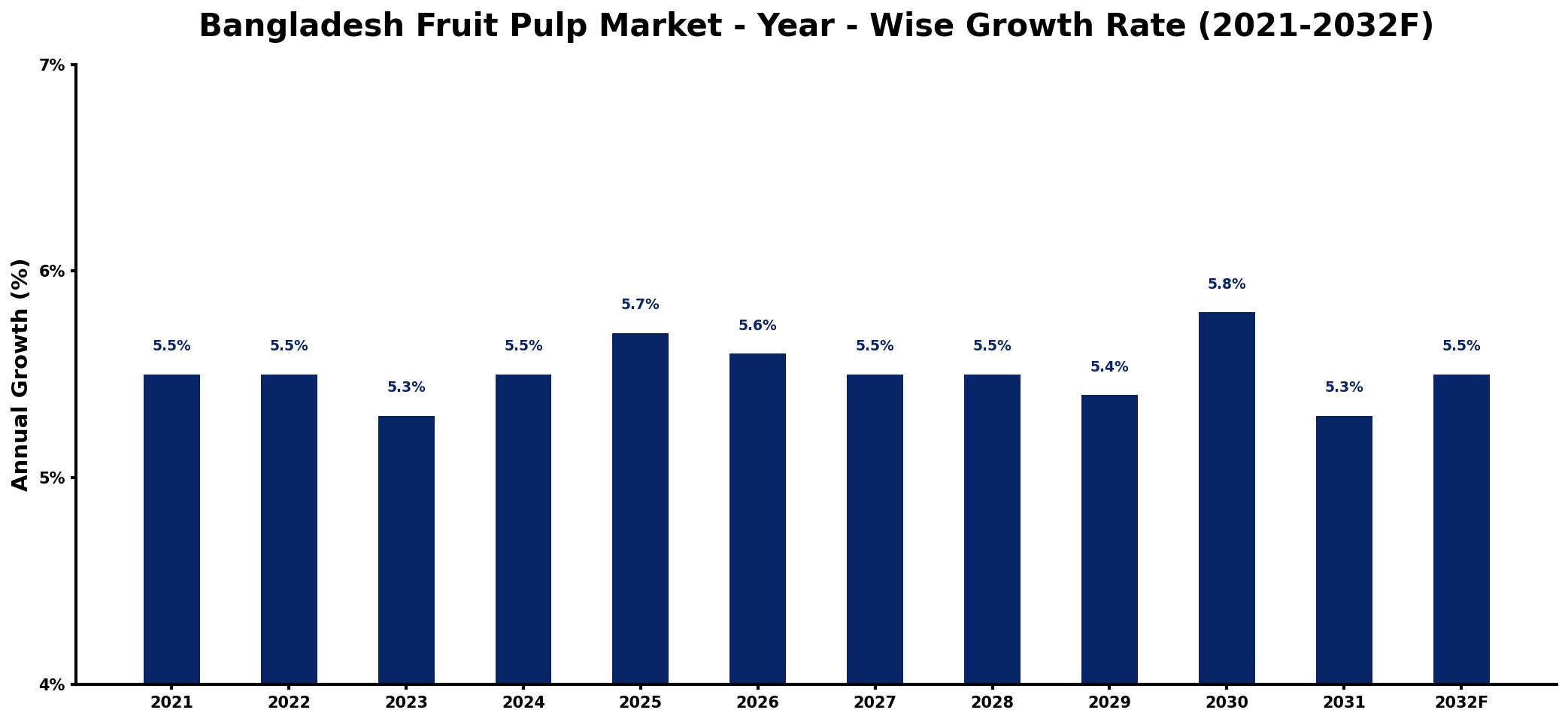
The table below presents the year‑wise growth rates along with the key drivers influencing the market
| Year | Growth Rate | Major Drivers |
| 2021 | 5.5% | Rising health consciousness among consumers |
| 2022 | 5.5% | Increased demand for natural ingredients |
| 2023 | 5.3% | Growing popularity of smoothies |
| 2024 | 5.5% | Expansion of retail distribution channels |
| 2025 | 5.7% | Increase in food processing investments |
| 2026 | 5.6% | Surge in online grocery shopping |
| 2027 | 5.5% | Growth in beverage innovation trends |
| 2028 | 5.5% | Rising consumer preference for convenience |
| 2029 | 5.4% | Enhanced marketing strategies effectiveness |
| 2030 | 5.8% | Growing demand for organic products |
| 2031 | 5.3% | Innovation in packaging solutions |
| 2032 | 5.5% | Increasing focus on sustainability practices |
Note: Market size estimations and growth projections presented in this report are based on 6Wresearch's proprietary forecasting methodology, utilizing the latest available industry data, government publications, and primary research inputs.
Bangladesh Fruit Pulp Market Synopsis
In Bangladesh, the availability of diverse fruit pulp varieties—most notably mango, guava, and pineapple—caters to a wide spectrum of culinary applications. Food processors are increasingly favoring fruit pulp for its flavor and nutritional benefits, further driving demand.
Despite challenges related to supply chain logistics and seasonal fruit availability, producers are adapting by implementing better quality control measures. This responsiveness to market demand underscores the potential for continued growth in this sector.
Bangladesh Fruit Pulp Market Key Takeaways
- The market is seeing robust growth driven by health-conscious consumer preferences.
- Diverse fruit pulp products are catering to the needs of food manufacturers and end consumers alike.
- Improving supply chain logistics and quality management is crucial for market sustainability.
- Government initiatives are poised to enhance investment in fruit processing infrastructure.
- Ongoing research and development efforts are expected to elevate product quality and shelf life.
Evaluation of Restraints in Bangladesh Fruit Pulp Market
Despite its growth potential, the Bangladesh Fruit Pulp Market faces significant restraints. Supply chain logistics remain a pressing concern, often hindering the timely delivery of high-quality raw materials. Additionally, maintaining the freshness and flavor of fruit pulp during processing poses a challenge that requires advanced technology and stringent quality control measures. Moreover, market players must navigate the complexities of seasonal fruit availability and the corresponding price volatility, which can significantly impact production and pricing strategies.
Bangladesh Fruit Pulp Market Trends
Current trends indicate a rising preference for organic and sustainably sourced fruit pulps as consumers become more environmentally conscious. This is further accentuated by innovations in processing technologies that enhance the nutritional value and flavor profiles of fruit pulp products. Additionally, the integration of fruit pulp into non-traditional applications, such as health supplements and snacks, is gaining traction, opening up new avenues for growth.
Bangladesh Fruit Pulp Market Opportunities
Significant growth opportunities exist for investment in advanced processing technologies that enhance the shelf life and quality of fruit pulps. Furthermore, expanding distribution channels, particularly in urban areas and through e-commerce platforms, can increase market accessibility. The burgeoning health food sector also presents lucrative avenues for innovation, as manufacturers explore new formulations that incorporate fruit pulp in functional foods.
Government Initiatives in the Bangladesh Fruit Pulp Market
The government of Bangladesh is actively promoting the fruit pulp market through various initiatives aimed at boosting investment in fruit processing infrastructure. Policies designed to enhance supply chain efficiency are being implemented, alongside incentives such as tax breaks and low-interest loans for processing facilities. Additionally, governmental support for research and development initiatives focuses on improving fruit pulp processing technologies, thereby enhancing product quality and market competitiveness.
Future Insights of the Bangladesh Fruit Pulp Market
Looking ahead to the period between 2026 and 2032, the Bangladesh Fruit Pulp Market is expected to continue its upward trajectory. The increasing emphasis on health and nutrition among consumers is likely to sustain demand for fruit pulp, particularly as more food manufacturers seek to include natural ingredients in their products. Furthermore, innovations in processing and preservation techniques are anticipated to enhance product offerings, ultimately leading to a more competitive and diverse market landscape.
Bangladesh Fruit Pulp Market Latest Developments (2025 - 2026)
Recently, the market has seen a surge in new product launches focusing on organic fruit pulps, aligning with the growing consumer trend toward healthy eating. Additionally, advancements in cold chain logistics have begun to address some of the supply chain challenges that producers face, enabling more consistent quality and availability of fruit pulps. Moreover, collaborative initiatives between government and private sectors are fostering innovation and enhancing the processing capabilities of local producers.
Bangladesh Fruit Pulp Market - Key Attractiveness of the Report
- 10 Years of Market Numbers
- Historical Data Starting from 2022 to 2025
- Base Year: 2025
- Forecast Data until 2032
- Key Performance Indicators Impacting the Market
- Major Upcoming Developments and Projects
Key Highlights of the Report:
- Bangladesh Fruit Pulp Market Outlook
- Market Size of Bangladesh Fruit Pulp Market, 2025
- Forecast of Bangladesh Fruit Pulp Market, 2032
- Historical Data and Forecast of Bangladesh Fruit Pulp Revenues & Volume for the Period 2022-2032F
- Bangladesh Fruit Pulp Market Trend Evolution
- Bangladesh Fruit Pulp Market Drivers and Challenges
- Bangladesh Fruit Pulp Price Trends
- Bangladesh Fruit Pulp Porter's Five Forces
- Bangladesh Fruit Pulp Industry Life Cycle
- Historical Data and Forecast of Bangladesh Fruit Pulp Market Revenues & Volume By Fruit Type for the Period 2022-2032F
- Historical Data and Forecast of Bangladesh Fruit Pulp Market Revenues & Volume By Mango for the Period 2022-2032F
- Historical Data and Forecast of Bangladesh Fruit Pulp Market Revenues & Volume By Strawberry for the Period 2022-2032F
- Historical Data and Forecast of Bangladesh Fruit Pulp Market Revenues & Volume By Apple for the Period 2022-2032F
- Historical Data and Forecast of Bangladesh Fruit Pulp Market Revenues & Volume By Guava for the Period 2022-2032F
- Historical Data and Forecast of Bangladesh Fruit Pulp Market Revenues & Volume By Berries for the Period 2022-2032F
- Historical Data and Forecast of Bangladesh Fruit Pulp Market Revenues & Volume By Citrus Fruits for the Period 2022-2032F
- Historical Data and Forecast of Bangladesh Fruit Pulp Market Revenues & Volume By Others for the Period 2022-2032F
- Historical Data and Forecast of Bangladesh Fruit Pulp Market Revenues & Volume By Form for the Period 2022-2032F
- Historical Data and Forecast of Bangladesh Fruit Pulp Market Revenues & Volume By Liquid for the Period 2022-2032F
- Historical Data and Forecast of Bangladesh Fruit Pulp Market Revenues & Volume By Powder for the Period 2022-2032F
- Historical Data and Forecast of Bangladesh Fruit Pulp Market Revenues & Volume By Application for the Period 2022-2032F
- Historical Data and Forecast of Bangladesh Fruit Pulp Market Revenues & Volume By Food and Beverages for the Period 2022-2032F
- Historical Data and Forecast of Bangladesh Fruit Pulp Market Revenues & Volume By Distribution for the Period 2022-2032F
- Historical Data and Forecast of Bangladesh Fruit Pulp Market Revenues & Volume By E-Commerce for the Period 2022-2032F
- Historical Data and Forecast of Bangladesh Fruit Pulp Market Revenues & Volume By Convenience Stores for the Period 2022-2032F
- Historical Data and Forecast of Bangladesh Fruit Pulp Market Revenues & Volume By Supermarkets/Hypermarkets for the Period 2022-2032F
- Historical Data and Forecast of Bangladesh Fruit Pulp Market Revenues & Volume By Specialty Stores for the Period 2022-2032F
- Historical Data and Forecast of Bangladesh Fruit Pulp Market Revenues & Volume By Others for the Period 2022-2032F
- Bangladesh Fruit Pulp Import Export Trade Statistics
- Market Opportunity Assessment By Fruit Type
- Market Opportunity Assessment By Form
- Market Opportunity Assessment By Application
- Market Opportunity Assessment By Distribution
- Bangladesh Fruit Pulp Top Companies Market Share
- Bangladesh Fruit Pulp Competitive Benchmarking By Technical and Operational Parameters
- Bangladesh Fruit Pulp Company Profiles
- Bangladesh Fruit Pulp Key Strategic Recommendations






































