Bangladesh Gas Sensors Market Size, Share & Growth Rate
The Bangladesh Gas Sensors Market was estimated at USD 159 Million in 2025 and is projected to reach USD 212 Million by 2032, growing at a CAGR of 4.2% from 2026 to 2032. This upward trajectory is primarily driven by heightened awareness regarding air quality monitoring, coupled with strict industrial safety regulations across various sectors. The escalating need for detecting harmful gases in environments like manufacturing plants and residential areas is catalyzing the demand for advanced gas sensor technologies.
Bangladesh Gas Sensors Market Year-wise Growth Rate and Key Drivers
This graph highlights how the Bangladesh Gas Sensors Market has steadily grown over the years, supported by major growth factors.
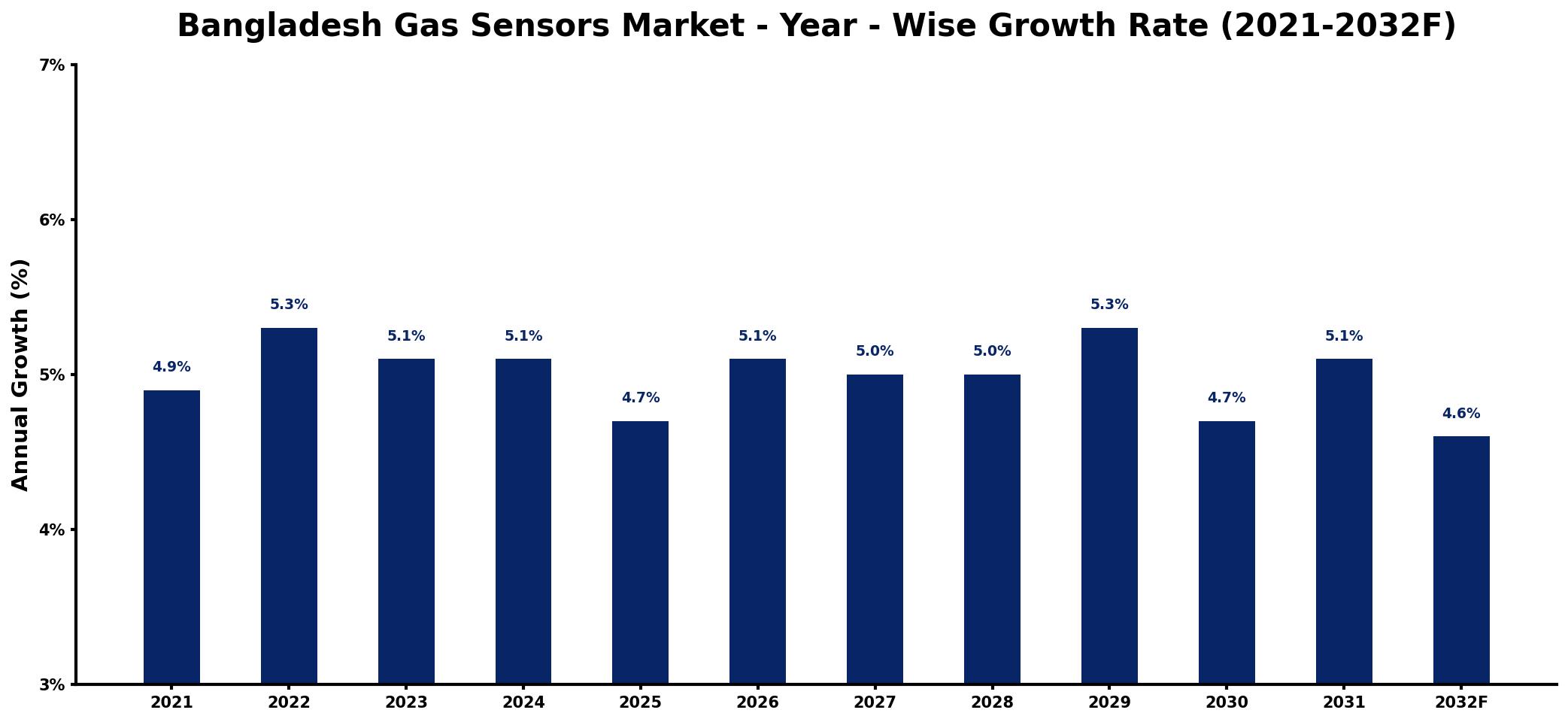
The table below presents the year‑wise growth rates along with the key drivers influencing the market
| Year | Growth Rate | Major Drivers |
| 2021 | 4.9% | Rising demand for safety solutions |
| 2022 | 5.3% | Increased industrial automation adoption |
| 2023 | 5.1% | Growing awareness of environmental protection |
| 2024 | 5.1% | Expansion of smart city initiatives |
| 2025 | 4.7% | Investment in infrastructure development projects |
| 2026 | 5.1% | Surge in energy sector growth |
| 2027 | 5.0% | Enhanced regulatory compliance requirements |
| 2028 | 5.0% | Greater focus on health monitoring |
| 2029 | 5.3% | Emergence of new technology applications |
| 2030 | 4.7% | Advancements in data analytics capabilities |
| 2031 | 5.1% | Increased funding for research initiatives |
| 2032 | 4.6% | Strengthening of public safety regulations |
Note: Market size estimations and growth projections presented in this report are based on 6Wresearch's proprietary forecasting methodology, utilizing the latest available industry data, government publications, and primary research inputs.
Bangladesh Gas Sensors Market Synopsis
A pivotal force currently shaping the Bangladesh Gas Sensors Market is the growing emphasis on environmental monitoring. As public awareness of pollution impacts on health increases, industries are prioritizing investments in gas sensors for better air quality control.
Furthermore, the expansion of industries such as automotive, healthcare, and oil & gas adds complexity to the market landscape. This diversification not only boosts demand but also encourages the adoption of innovative technologies like IoT, which enhances real-time monitoring capabilities.
Bangladesh Gas Sensors Market Key Takeaways
- The market is influenced by government initiatives promoting safety standards and environmental sustainability.
- Technological advancements are leading to miniaturized and more sensitive gas sensors.
- Adoption of IoT and smart technologies is becoming essential for real-time data monitoring.
- There are growing investment opportunities in industries like automotive and healthcare.
- Education on the importance of gas sensors is critical for market expansion, especially in residential sectors.
Evaluation of Restraints in Bangladesh Gas Sensors Market
Despite a promising outlook, the Bangladesh Gas Sensors Market faces notable restraints. A significant barrier is the limited awareness among potential end-users, particularly in residential and small-scale industrial sectors, regarding the importance and benefits of gas sensors. The presence of counterfeit or low-quality products further jeopardizes the market, undermining consumer trust in legitimate manufacturers. Additionally, the high initial cost of quality gas sensors may deter budget-conscious buyers, while restricted research and development efforts in the country hinder the progress of innovative gas sensor technologies. Together, these factors could impede more rapid market growth.
Bangladesh Gas Sensors Market Trends
Current trends within the Bangladesh Gas Sensors Market indicate a pronounced shift towards greater environmental accountability. Industries are increasingly adopting air quality monitoring systems, reflecting a commitment to both worker safety and community health. The integration of IoT technology into gas sensors represents a significant trend, allowing for seamless data collection and analysis. Moreover, miniaturization and enhanced sensitivity of sensors are becoming hallmarks of innovative designs, improving efficiency and performance in detecting harmful gases.
Bangladesh Gas Sensors Market Opportunities
The potential for investment in the Bangladesh Gas Sensors Market is substantial. With the increasing focus on regulatory compliance for workplace safety and environmental monitoring, businesses can benefit from providing advanced gas sensor solutions. The rise of smart cities and urban planning initiatives presents further opportunities for integrating gas sensors into public infrastructure. Collaborations with local manufacturers and government agencies can also pave the way for tailored solutions that meet specific industry needs, facilitating further growth.
Government Initiatives in the Bangladesh Gas Sensors Market
The Bangladeshi government is actively supporting the gas sensors market through policies that promote quality standards and environmental protection. Incentives and subsidies are being offered to encourage industries such as oil & gas, manufacturing, and healthcare to adopt gas sensor technologies. Additionally, government-backed research and development programs aim to foster innovation and competitiveness within the sector, creating a conducive environment for growth.
Future Insights of the Bangladesh Gas Sensors Market
Looking forward to the period between 2026 and 2032, the Bangladesh Gas Sensors Market is positioned for sustained growth. A rising focus on air quality and stricter workplace safety regulations will drive demand across multiple sectors, including healthcare and environmental monitoring. Technological advancements will likely yield cost-effective and high-performance gas sensors, contributing to market expansion. Nevertheless, addressing the challenges of initial costs and a skilled workforce will be essential for realizing the full potential of this burgeoning market.
Bangladesh Gas Sensors Market Latest Developments (2025 - 2026)
Recent developments in the Bangladesh Gas Sensors Market have been characterized by an uptick in partnerships between technology firms and local manufacturers aimed at enhancing sensor capabilities. Innovations surrounding IoT integration have gained momentum, positioning these sensors as vital components of smart city initiatives. Additionally, there is a noticeable increase in public sector investments dedicated to air quality monitoring initiatives across urban centers, reflecting an overarching commitment to environmental health.
Bangladesh Gas Sensors Market - Key Attractiveness of the Report
- 10 Years of Market Numbers
- Historical Data Starting from 2022 to 2025
- Base Year: 2025
- Forecast Data until 2032
- Key Performance Indicators Impacting the Market
- Major Upcoming Developments and Projects
Key Highlights of the Report:
- Bangladesh Gas Sensors Market Outlook
- Market Size of Bangladesh Gas Sensors Market, 2025
- Forecast of Bangladesh Gas Sensors Market, 2032
- Historical Data and Forecast of Bangladesh Gas Sensors Revenues & Volume for the Period 2022-2032F
- Bangladesh Gas Sensors Market Trend Evolution
- Bangladesh Gas Sensors Market Drivers and Challenges
- Bangladesh Gas Sensors Price Trends
- Bangladesh Gas Sensors Porter's Five Forces
- Bangladesh Gas Sensors Industry Life Cycle
- Historical Data and Forecast of Bangladesh Gas Sensors Market Revenues & Volume By Product for the Period 2022-2032F
- Historical Data and Forecast of Bangladesh Gas Sensors Market Revenues & Volume By Hydrogen for the Period 2022-2032F
- Historical Data and Forecast of Bangladesh Gas Sensors Market Revenues & Volume By Ammonia for the Period 2022-2032F
- Historical Data and Forecast of Bangladesh Gas Sensors Market Revenues & Volume By Hydrogen Sulfide for the Period 2022-2032F
- Historical Data and Forecast of Bangladesh Gas Sensors Market Revenues & Volume By Methyl Mercaptan Sensor for the Period 2022-2032F
- Historical Data and Forecast of Bangladesh Gas Sensors Market Revenues & Volume By NOx Sensor for the Period 2022-2032F
- Historical Data and Forecast of Bangladesh Gas Sensors Market Revenues & Volume By Carbon Monoxide Sensor for the Period 2022-2032F
- Historical Data and Forecast of Bangladesh Gas Sensors Market Revenues & Volume By Carbon Dioxide Sensor for the Period 2022-2032F
- Historical Data and Forecast of Bangladesh Hydrogen Gas Sensors Market Revenues & Volume By Oxygen/Lambda Sensor for the Period 2022-2032F
- Historical Data and Forecast of Bangladesh Gas Sensors Market Revenues & Volume By Technology for the Period 2022-2032F
- Historical Data and Forecast of Bangladesh Gas Sensors Market Revenues & Volume By Infrared for the Period 2022-2032F
- Historical Data and Forecast of Bangladesh Gas Sensors Market Revenues & Volume By Catalytic for the Period 2022-2032F
- Historical Data and Forecast of Bangladesh Gas Sensors Market Revenues & Volume By Photo-Ionization Detector for the Period 2022-2032F
- Historical Data and Forecast of Bangladesh Gas Sensors Market Revenues & Volume By Solid State/MOS for the Period 2022-2032F
- Historical Data and Forecast of Bangladesh Gas Sensors Market Revenues & Volume By Semiconductor for the Period 2022-2032F
- Historical Data and Forecast of Bangladesh Gas Sensors Market Revenues & Volume By Electrochemical for the Period 2022-2032F
- Bangladesh Gas Sensors Import Export Trade Statistics
- Market Opportunity Assessment By Product
- Market Opportunity Assessment By Technology
- Bangladesh Gas Sensors Top Companies Market Share
- Bangladesh Gas Sensors Competitive Benchmarking By Technical and Operational Parameters
- Bangladesh Gas Sensors Company Profiles
- Bangladesh Gas Sensors Key Strategic Recommendations






































