Bangladesh Glass Tiles Market Size, Share & Growth Rate
The Bangladesh Glass Tiles Market was estimated at USD 1106 Million in 2025 and is projected to reach USD 1613 Million by 2032, growing at a CAGR of 5.5% from 2026 to 2032. This positive trajectory is primarily driven by an increasing demand for aesthetically pleasing and durable materials in the booming construction and renovation sectors. As urbanization accelerates in Bangladesh, both residential and commercial projects are leaning heavily towards glass tiles, appreciated for their design versatility and low maintenance requirements.
Bangladesh Glass Tiles Market Year-wise Growth Rate and Key Drivers
This graph highlights how the Bangladesh Glass Tiles Market has steadily grown over the years, supported by major growth factors.
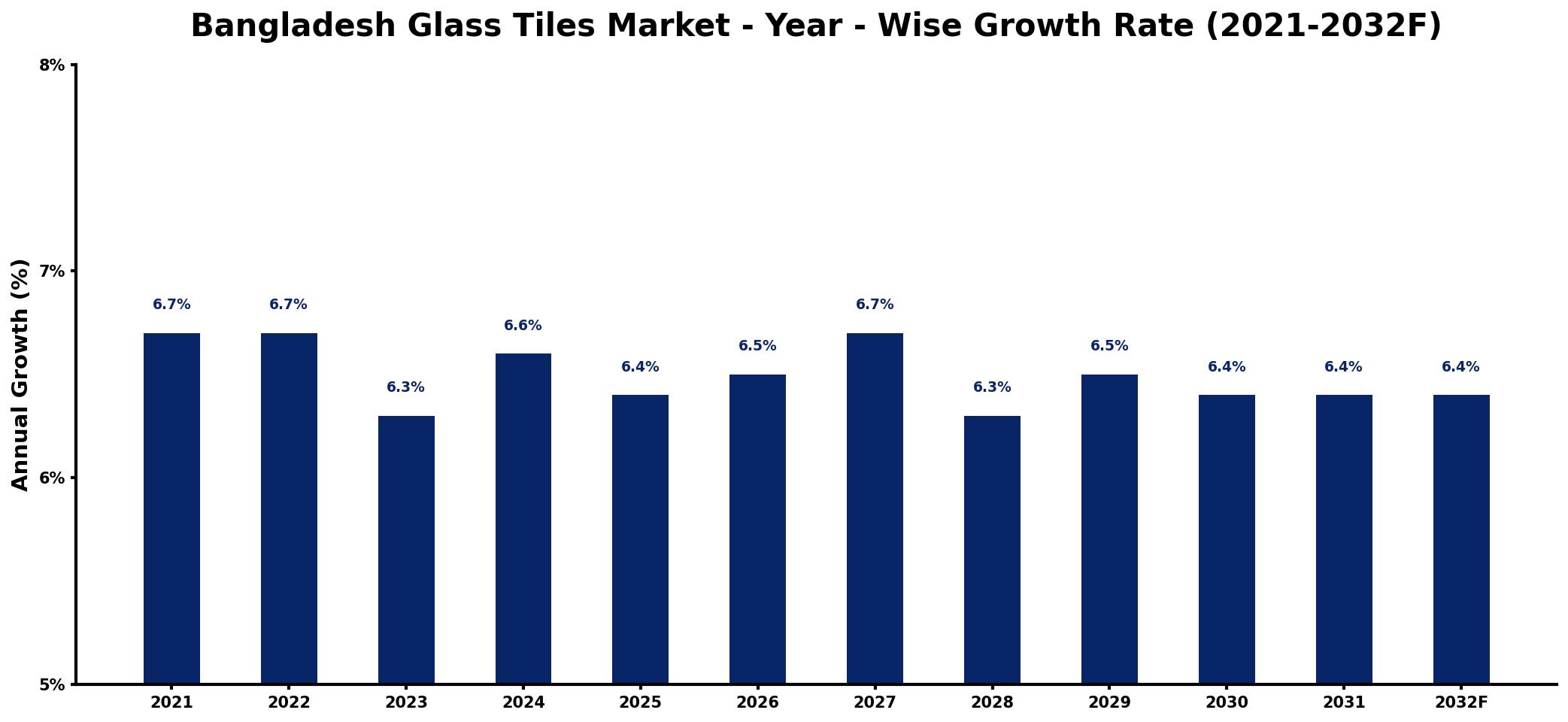
The table below presents the year‑wise growth rates along with the key drivers influencing the market
| Year | Growth Rate | Major Drivers |
| 2021 | 6.7% | Rising construction activity nationwide |
| 2022 | 6.7% | Increased demand for sustainable materials |
| 2023 | 6.3% | Growing interest in interior design |
| 2024 | 6.6% | Expansion of residential projects |
| 2025 | 6.4% | Surge in commercial developments |
| 2026 | 6.5% | Higher investments in infrastructure |
| 2027 | 6.7% | Boost in tourism sector projects |
| 2028 | 6.3% | Emergence of eco-friendly trends |
| 2029 | 6.5% | Increased urbanization and migration |
| 2030 | 6.4% | Growing focus on renovation projects |
| 2031 | 6.4% | Rise in luxury housing demand |
| 2032 | 6.4% | increased pharmaceutical industry usage |
Note: Market size estimations and growth projections presented in this report are based on 6Wresearch's proprietary forecasting methodology, utilizing the latest available industry data, government publications, and primary research inputs.
Bangladesh Glass Tiles Market Synopsis
The strongest force currently shaping the Bangladesh Glass Tiles Market is the heightened consumer preference for innovative design solutions. Architects and homeowners alike are increasingly drawn to the myriad of colors, patterns, and finishes offered by glass tiles, which seamlessly blend functionality with artistic expression in both modern and traditional settings.
Another significant factor is the rising awareness of sustainability. As environmental concerns take center stage, consumers are more inclined to choose materials that not only enhance the aesthetic appeal of their spaces but also contribute to energy efficiency and reduced waste, further propelling the demand for glass tiles in construction.
Bangladesh Glass Tiles Market Key Takeaways
- Rapid urbanization is significantly influencing the demand for glass tiles in residential and commercial projects.
- Innovative design trends are pushing manufacturers to expand their product offerings to meet diverse consumer preferences.
- Sustainability is becoming a major purchasing factor, with eco-friendly glass tiles gaining traction among environmentally conscious buyers.
- Government regulations aim to ensure product safety and quality, shaping a competitive market landscape.
- Advanced manufacturing technologies are essential for meeting the quality standards and design versatility demanded by consumers.
Evaluation of Restraints in Bangladesh Glass Tiles Market
Despite the growth potential, the Bangladesh Glass Tiles Market faces several limitations. A key restraint is the challenge of achieving material consistency and uniformity in color and surface finish. This often requires sophisticated manufacturing processes that can strain the resources of smaller producers. Furthermore, competition within the market is fierce, with various alternative materials available that challenge the supremacy of glass tiles. Installation difficulties also pose a barrier, as not all contractors are adept at working with glass tiles, which can deter potential buyers.
Bangladesh Glass Tiles Market Trends
In recent years, the trend towards personalization in interior design has surged, with consumers seeking custom-designed glass tiles that reflect their individual style. This is complemented by the growing popularity of larger format tiles that offer a more seamless appearance. Additionally, the integration of smart technology into home design is beginning to influence tile choices, with consumers looking for solutions that combine beauty with functionality. Decorative uses, such as in feature walls and backsplashes, are particularly gaining traction.
Bangladesh Glass Tiles Market Opportunities
Significant growth opportunities lie within the commercial sector, particularly in hospitality and retail, where unique aesthetic choices can create memorable experiences. Furthermore, expansion into rural and semi-urban areas presents a chance for manufacturers to tap into new customer bases eager to enhance their properties. Collaborations with interior designers and architects can also yield lucrative partnerships, driving both product adoption and innovation in design.
Government Initiatives in the Bangladesh Glass Tiles Market
The Bangladeshi government has been proactive in regulating the glass tiles market, focusing on ensuring product safety and quality control measures. Public policies are increasingly directed at promoting sustainable construction practices. Initiatives that encourage the adoption of environmentally friendly materials are expected to gain momentum, creating a supportive framework for the growth of the glass tiles sector. Efforts to enhance consumer awareness of quality standards further bolster trust in the market.
Future Insights of the Bangladesh Glass Tiles Market
Looking ahead to 2026-2032, the Bangladesh Glass Tiles Market is poised for continued growth, driven by ongoing urbanization and an increasing focus on design innovation. As consumer demands evolve, manufacturers that can adapt quickly to new trends while maintaining quality will thrive. The anticipated expansion of green building initiatives will also open doors for eco-friendly glass tile options, further enriching the product landscape and appealing to a broader audience.
Bangladesh Glass Tiles Market Latest Developments (2025 - 2026)
Recent developments in the Bangladesh glass tiles industry highlight a surge in collaborative projects between manufacturers and designers aimed at integrating more sustainable practices into production. Innovations in manufacturing techniques are also emerging, with players focusing on enhancing the durability and aesthetic appeal of glass tiles to meet the growing market demand. Additionally, the introduction of customer-centric customization options is reshaping competitive dynamics in the market.
Bangladesh Glass Tiles Market - Key Attractiveness of the Report
- 10 Years of Market Numbers
- Historical Data Starting from 2022 to 2025
- Base Year: 2025
- Forecast Data until 2032
- Key Performance Indicators Impacting the Market
- Major Upcoming Developments and Projects
Key Highlights of the Report:
- Bangladesh Glass Tiles Market Outlook
- Market Size of Bangladesh Glass Tiles Market, 2025
- Forecast of Bangladesh Glass Tiles Market, 2032
- Historical Data and Forecast of Bangladesh Glass Tiles Revenues & Volume for the Period 2022-2032F
- Bangladesh Glass Tiles Market Trend Evolution
- Bangladesh Glass Tiles Market Drivers and Challenges
- Bangladesh Glass Tiles Price Trends
- Bangladesh Glass Tiles Porter's Five Forces
- Bangladesh Glass Tiles Industry Life Cycle
- Historical Data and Forecast of Bangladesh Glass Tiles Market Revenues & Volume By Manufacturing Process for the Period 2022-2032F
- Historical Data and Forecast of Bangladesh Glass Tiles Market Revenues & Volume By Smalti Tiles for the Period 2022-2032F
- Historical Data and Forecast of Bangladesh Glass Tiles Market Revenues & Volume By Fused Tiles for the Period 2022-2032F
- Historical Data and Forecast of Bangladesh Glass Tiles Market Revenues & Volume By Sintered Tiles for the Period 2022-2032F
- Historical Data and Forecast of Bangladesh Glass Tiles Market Revenues & Volume By Cast Tiles for the Period 2022-2032F
- Historical Data and Forecast of Bangladesh Glass Tiles Market Revenues & Volume By Other for the Period 2022-2032F
- Historical Data and Forecast of Bangladesh Glass Tiles Market Revenues & Volume By Product Type for the Period 2022-2032F
- Historical Data and Forecast of Bangladesh Glass Tiles Market Revenues & Volume By Matte-finished Glass Tile for the Period 2022-2032F
- Historical Data and Forecast of Bangladesh Glass Tiles Market Revenues & Volume By Smooth Glass Tile for the Period 2022-2032F
- Historical Data and Forecast of Bangladesh Glass Tiles Market Revenues & Volume By End-User Industry for the Period 2022-2032F
- Historical Data and Forecast of Bangladesh Glass Tiles Market Revenues & Volume By Residential for the Period 2022-2032F
- Historical Data and Forecast of Bangladesh Glass Tiles Market Revenues & Volume By Commercial for the Period 2022-2032F
- Historical Data and Forecast of Bangladesh Glass Tiles Market Revenues & Volume By Infrastructure for the Period 2022-2032F
- Bangladesh Glass Tiles Import Export Trade Statistics
- Market Opportunity Assessment By Manufacturing Process
- Market Opportunity Assessment By Product Type
- Market Opportunity Assessment By End-User Industry
- Bangladesh Glass Tiles Top Companies Market Share
- Bangladesh Glass Tiles Competitive Benchmarking By Technical and Operational Parameters
- Bangladesh Glass Tiles Company Profiles
- Bangladesh Glass Tiles Key Strategic Recommendations






































