Bangladesh Greenhouse Horticulture Market Size, Share & Growth Rate
The Bangladesh Greenhouse Horticulture Market was estimated at USD 229 Million in 2025 and is projected to reach USD 251 Million by 2032, growing at a CAGR of 1.3% from 2026 to 2032. This growth trajectory is bolstered by an increasing shift toward high-value crop production, driven by a rising middle class with greater demand for fresh, year-round produce. Additionally, government incentives and investments in modern greenhouse technologies are catalyzing more sustainable agricultural practices across the region.
Bangladesh Greenhouse Horticulture Market Year-wise Growth Rate and Key Drivers
This graph highlights how the Bangladesh Greenhouse Horticulture Market has steadily grown over the years, supported by major growth factors.
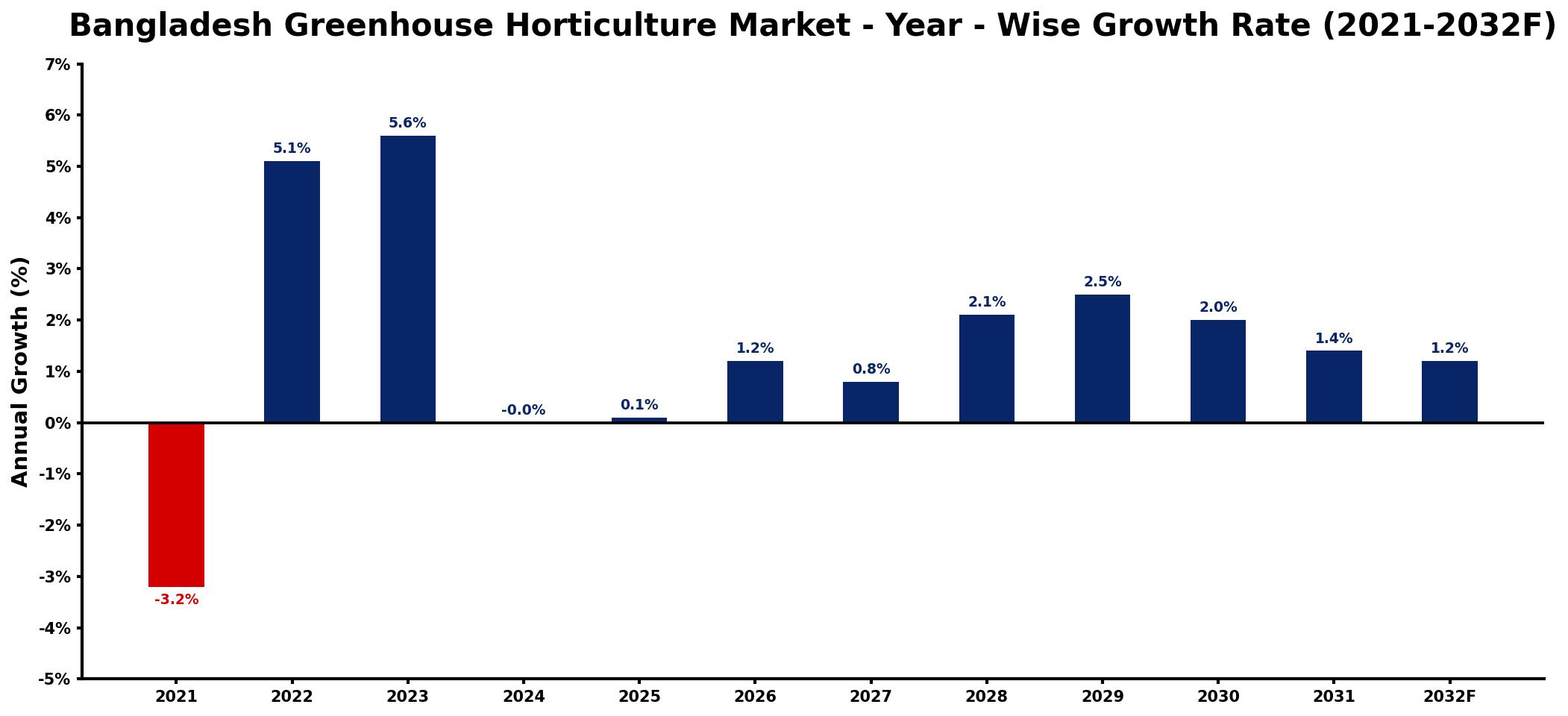
The table below presents the year‑wise growth rates along with the key drivers influencing the market
| Year | Growth Rate | Major Drivers |
| 2021 | -3.2% | decreased consumer interest in agriculture |
| 2022 | 5.1% | rising demand for fresh produce |
| 2023 | 5.6% | expansion of urban farming initiatives |
| 2024 | -0.0% | increased investment in technology |
| 2025 | 0.1% | growth in organic farming practices |
| 2026 | 1.2% | enhanced distribution network capabilities |
| 2027 | 0.8% | growing awareness of sustainability |
| 2028 | 2.1% | increased export opportunities emerging |
| 2029 | 2.5% | supportive government policy frameworks |
| 2030 | 2.0% | advancements in agricultural technology |
| 2031 | 1.4% | rising popularity of local sourcing |
| 2032 | 1.2% | strengthened consumer health consciousness |
Note: Market size estimations and growth projections presented in this report are based on 6Wresearch's proprietary forecasting methodology, utilizing the latest available industry data, government publications, and primary research inputs.
Bangladesh Greenhouse Horticulture Market Synopsis
The demand for greenhouse-grown fruits, vegetables, and flowers is on the rise as consumers become more health-conscious and environmentally aware. This change is reshaping traditional farming practices, pushing for more efficient methods that promise consistent quality and output.
Government support has been pivotal in encouraging farmers to adopt greenhouse techniques, leading to improved agricultural resilience against climate challenges. The integration of advanced climate control systems in greenhouse structures is further enhancing yield quality and productivity, making it a lucrative venture for many farmers in Bangladesh.
Bangladesh Greenhouse Horticulture Market Key Takeaways
- The market is projected to grow steadily, driven by consumer demand for high-quality produce.
- Government initiatives play a crucial role in promoting sustainable greenhouse practices.
- Adoption of advanced technology is enhancing productivity and operational efficiency.
- Investment opportunities are expanding in greenhouse construction and agricultural technology.
- Capacity-building efforts are essential for overcoming the technical expertise gap among farmers.
Evaluation of Restraints in Bangladesh Greenhouse Horticulture Market
Despite the promising growth landscape, the Bangladesh Greenhouse Horticulture Market faces several critical challenges. Limited access to modern agricultural technologies and a shortage of skilled labor hinder the efficiency of greenhouse operations. Additionally, the country's infrastructure often falls short in supporting advanced agricultural practices. Unpredictable weather patterns create additional uncertainty for producers, further complicating efforts to maintain crop quality and yield consistency. Addressing these challenges through targeted investments and training initiatives will be essential for unlocking the full potential of this market.
Bangladesh Greenhouse Horticulture Market Trends
The Bangladesh Greenhouse Horticulture Market is currently witnessing several transformative trends. A significant move towards organic farming practices is emerging, driven by consumer preferences for healthier, chemical-free options. Furthermore, the incorporation of hydroponics and vertical farming techniques is gaining traction, allowing for more efficient use of space and resources. The integration of digital technologies for monitoring greenhouse operations is also on the rise, facilitating better decision-making and operational management. These trends collectively indicate a strong move towards modernization and sustainability in the sector.
Bangladesh Greenhouse Horticulture Market Opportunities
The market is ripe with investment opportunities, particularly in areas such as greenhouse construction, provision of technological solutions, and consultancy services. As the demand for sustainable and fresh produce continues to surge, investors can play a vital role in developing innovative agricultural solutions. Collaborations between government bodies and private sector stakeholders are essential in fostering research and development initiatives aimed at improving yield and sustainability. This creates an appealing environment for both domestic and international investors looking to make a significant impact in the horticulture landscape of Bangladesh.
Government Initiatives in the Bangladesh Greenhouse Horticulture Market
The Bangladeshi government has established various initiatives to bolster the greenhouse horticulture sector. By offering financial incentives and technical support, the government aims to encourage farmers to transition to greenhouse farming, thereby enhancing food security and agricultural productivity. Training programs are also in place to equip farmers with the skills necessary to effectively manage greenhouse operations. These initiatives highlight the governments commitment to modernizing the agricultural landscape and promoting environmentally sustainable practices.
Future Insights of the Bangladesh Greenhouse Horticulture Market
The future outlook for the Bangladesh Greenhouse Horticulture Market is highly optimistic. As awareness of sustainable farming practices grows, the appetite for high-quality, locally-produced foods will continue to drive market demand. Technological advancements, including sophisticated climate control systems and innovative growing techniques, will likely enhance productivity and expand operational capabilities. Urbanization trends and increasing interest in organic produce are also expected to propel market growth. By 2032, the sector is positioned for substantial development, leading to greater innovation and overall efficiency.
Bangladesh Greenhouse Horticulture Market Latest Developments (2025 - 2026)
In recent months, the Bangladesh Greenhouse Horticulture Market has seen an uptick in investment towards modern greenhouse infrastructure. Initiatives aimed at improving resource management and integrating smart technologies have gained traction, positioning local farmers to better withstand climate fluctuations. Additionally, there has been a notable rise in training programs designed to equip farmers with essential skills for effective greenhouse management, fostering a more knowledgeable workforce in the sector.
Bangladesh Greenhouse Horticulture Market - Key Attractiveness of the Report
- 10 Years of Market Numbers
- Historical Data Starting from 2022 to 2025
- Base Year: 2025
- Forecast Data until 2032
- Key Performance Indicators Impacting the Market
- Major Upcoming Developments and Projects
Key Highlights of the Report:
- Bangladesh Greenhouse Horticulture Market Outlook
- Market Size of Bangladesh Greenhouse Horticulture Market, 2025
- Forecast of Bangladesh Greenhouse Horticulture Market, 2032
- Historical Data and Forecast of Bangladesh Greenhouse Horticulture Revenues & Volume for the Period 2022-2032F
- Bangladesh Greenhouse Horticulture Market Trend Evolution
- Bangladesh Greenhouse Horticulture Market Drivers and Challenges
- Bangladesh Greenhouse Horticulture Price Trends
- Bangladesh Greenhouse Horticulture Porter's Five Forces
- Bangladesh Greenhouse Horticulture Industry Life Cycle
- Historical Data and Forecast of Bangladesh Greenhouse Horticulture Market Revenues & Volume By Material Type for the Period 2022-2032F
- Historical Data and Forecast of Bangladesh Greenhouse Horticulture Market Revenues & Volume By Glass for the Period 2022-2032F
- Historical Data and Forecast of Bangladesh Greenhouse Horticulture Market Revenues & Volume By Plastic for the Period 2022-2032F
- Historical Data and Forecast of Bangladesh Greenhouse Horticulture Market Revenues & Volume By Crop Type for the Period 2022-2032F
- Historical Data and Forecast of Bangladesh Greenhouse Horticulture Market Revenues & Volume By Fruits and Vegetables for the Period 2022-2032F
- Historical Data and Forecast of Bangladesh Greenhouse Horticulture Market Revenues & Volume By Flowers and Ornamentals for the Period 2022-2032F
- Historical Data and Forecast of Bangladesh Greenhouse Horticulture Market Revenues & Volume By Nursery Crops for the Period 2022-2032F
- Historical Data and Forecast of Bangladesh Greenhouse Horticulture Market Revenues & Volume By Others for the Period 2022-2032F
- Historical Data and Forecast of Bangladesh Greenhouse Horticulture Market Revenues & Volume By Technology for the Period 2022-2032F
- Historical Data and Forecast of Bangladesh Greenhouse Horticulture Market Revenues & Volume By Heating System for the Period 2022-2032F
- Historical Data and Forecast of Bangladesh Greenhouse Horticulture Market Revenues & Volume By Cooling System for the Period 2022-2032F
- Bangladesh Greenhouse Horticulture Import Export Trade Statistics
- Market Opportunity Assessment By Material Type
- Market Opportunity Assessment By Crop Type
- Market Opportunity Assessment By Technology
- Bangladesh Greenhouse Horticulture Top Companies Market Share
- Bangladesh Greenhouse Horticulture Competitive Benchmarking By Technical and Operational Parameters
- Bangladesh Greenhouse Horticulture Company Profiles
- Bangladesh Greenhouse Horticulture Key Strategic Recommendations






































