Bangladesh Groceries Market Summary
The bangladesh groceries market was estimated at USD 401 Million in 2025 and is projected to reach USD 533 Million by 2032, growing at a CAGR of 4.8% from 2026 to 2032.
Bangladesh Groceries Market Year-wise Growth Rate and Key Drivers
This graph highlights how the Bangladesh Groceries Market has steadily grown over the past five years, supported by major growth factors.
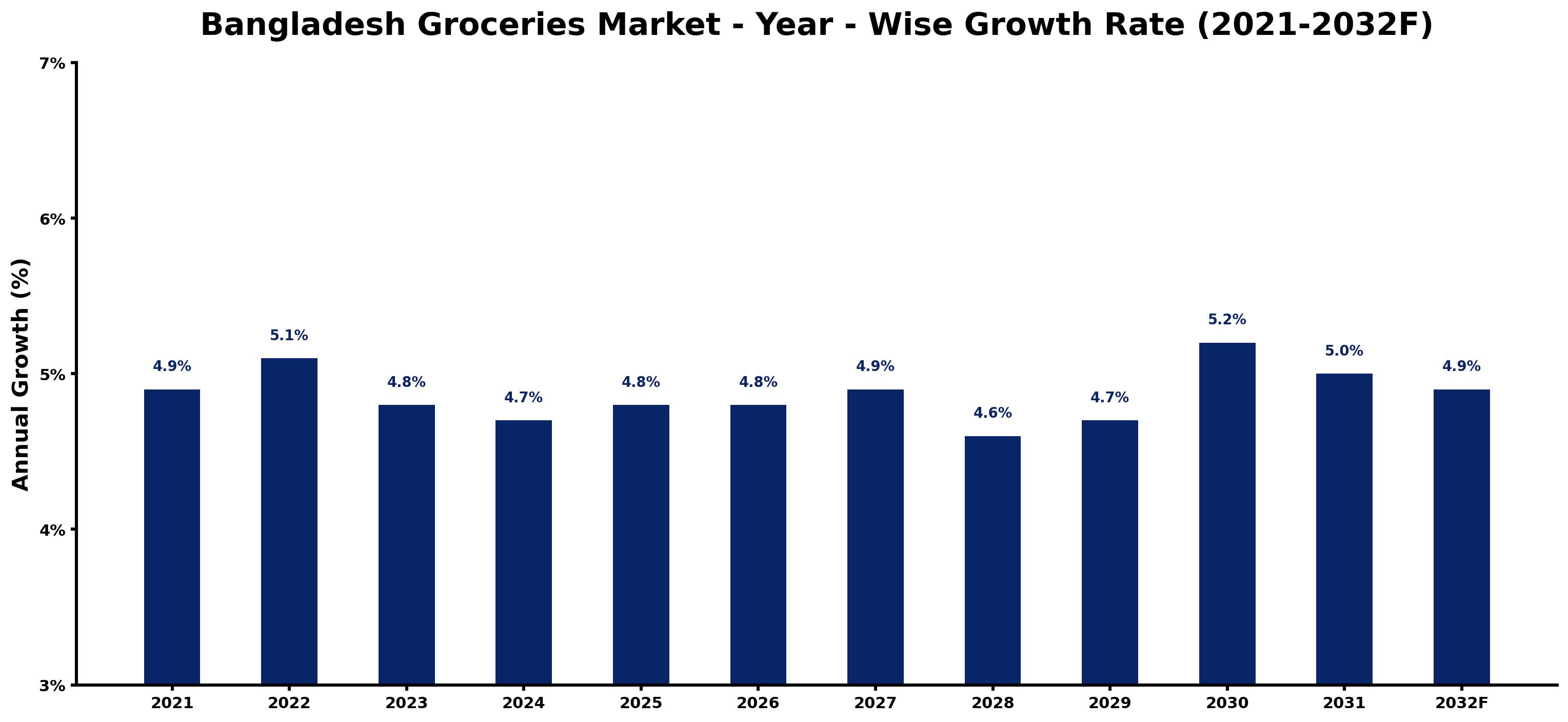
The table below presents the year wise growth rates along with the key drivers influencing the market
| Year | Growth Rate | Major Drivers |
| 2021 | 4.9% | Post-lockdown retail projects emphasize digital integrations within grocery operations. |
| 2022 | 5.1% | Urbanization trends shift consumer behavior towards convenience-oriented grocery shopping. |
| 2023 | 4.8% | Increased smartphone penetration fosters mobile shopping applications for groceries. |
| 2024 | 4.7% | Rural electrification initiatives expand supply chains to underserved regions effectively. |
| 2025 | 4.8% | Local sourcing practices gain popularity due to rising health consciousness among consumers. |
| 2026 | 4.8% | Collaborations between e-commerce platforms and local sellers enhance market accessibility. |
| 2027 | 4.9% | Investment in cold chain logistics supports fresh produce distribution across Bangladesh. |
| 2028 | 4.6% | Cultural festivals encourage seasonal product launches, boosting sales during peak times. |
| 2029 | 4.7% | Sustainable packaging trends reshape brand loyalty among environmentally conscious shoppers. |
| 2030 | 5.2% | Consumer interest in organic products drives premium pricing strategies for retailers. |
| 2031 | 5.0% | Digital payment solutions streamline purchases, enhancing customer experience in grocery shopping. |
| 2032 | 4.9% | Increased focus on health and wellness creates new product categories in grocery sectors. |
Note - Market size estimations and growth projections presented in this report are based on 6Wresearch's advanced forecasting approach, validated with industry datasets as of June 2026.
Bangladesh Groceries Market Synopsis
The Bangladesh Groceries Market is projected to reach 4.8% and witness significant growth during the forecast period (2026-2032). This sector encompasses a wide array of products, from staple foods and fresh produce to packaged goods and household items. Key growth drivers include a burgeoning population, increasing urbanization, and rising disposable incomes, which collectively fuel the demand for convenience-oriented grocery options.
Bangladesh Groceries Market Growth Drivers
The growth of the Bangladesh Groceries Market is underpinned by several fundamental drivers:
- Population Growth: With over 160 million residents, Bangladesh boasts a youthful demographic that continues to expand, leading to increased grocery consumption.
- Urban Migration: The trend of urbanization is prompting more individuals to relocate to cities, where access to modern grocery retail formats is improving, thereby altering shopping habits.
- Rising Income Levels: An increase in disposable income has empowered consumers to seek higher-quality and more convenient grocery products.
- E-commerce Growth: The proliferation of online grocery shopping platforms has transformed how consumers purchase essentials, driven by both convenience and safety concerns.
- Awareness of Health Trends: A growing focus on health and wellness among consumers fosters demand for organic, locally sourced, and specialty products, prompting retailers to adapt their offerings.
Bangladesh Groceries Market Trends and Opportunities
The Bangladesh Groceries Market is evolving, with several noteworthy trends emerging:
- Shift to Online Retail: The ongoing digital shift continues as more consumers embrace online grocery shopping, facilitated by mobile apps and user-friendly e-commerce websites.
- Demand for Specialty Products: Consumers are increasingly interested in unique food items, leading to opportunities for niche retailers specializing in gourmet or organic products.
- Convenience Foods: Ready-to-eat meals and easy-preparation foods are growing in popularity as busy lifestyles necessitate quick dining solutions.
- Consumer Education: As awareness around sustainability and health grows, retailers have opportunities to educate consumers about the benefits of organic and locally sourced goods.
- Technological Innovations: Investment in technology, such as supply chain analytics and inventory management systems, can streamline operations and enhance consumer experiences.
Bangladesh Groceries Market Challenges and Restraints
While the market is poised for growth, it also confronts several challenges:
- Supply Chain Issues: Inconsistent supply chains can lead to product shortages, impacting consumer satisfaction and retailer profitability.
- Dependence on Imports: High reliance on imported goods contributes to price volatility and affects local producers.
- Storage and Distribution Limitations: A lack of quality storage and distribution infrastructure can hinder the availability of fresh goods.
- Intense Competition: The presence of both traditional retailers and online platforms creates a highly competitive environment, posing challenges for smaller players.
- Evolving Consumer Preferences: Retailers must continuously adapt to changing tastes, particularly as consumers gravitate towards healthier and more sustainable options.
Bangladesh Groceries Market Government Investment and Initiatives
Government policies play a pivotal role in shaping the Bangladesh Groceries Market. Regulatory measures are in place to uphold food safety and quality, overseen by the Bangladesh Food Safety Authority (BFSA). Efforts to protect local producers are reflected in import tariffs on essential goods such as rice and sugar, aimed at fostering self-sufficiency in agriculture. Additionally, the government offers subsidies to support local farmers and agribusinesses, enhancing overall market stability. Initiatives to modernize supply chain infrastructure and promote e-commerce for grocery shopping further illustrate the government's commitment to improving market efficiency. Collectively, these policies aim to foster a balanced ecosystem that benefits consumers while supporting local industry.
Bangladesh Groceries Market Latest Developments (May 2025 - June 2026)
In the period from May 2025 to June 2026, the Bangladesh Groceries Market has experienced notable transformations. The surge in online grocery shopping continues to gather momentum, driven by heightened consumer preference for convenience and safety. Additionally, several key developments in infrastructure enhancements have been observed, aimed at streamlining supply chains and improving distribution channels. Retailers are increasingly expanding their product offerings to include a broader range of organic and specialty items, addressing the evolving tastes of consumers. Furthermore, strategic collaborations between retailers and technology providers have begun to emerge, fostering the integration of advanced analytics and inventory management tools for optimization and efficiency enhancements.
Bangladesh Groceries Market - Key Attractiveness of the Report
- 10 Years of Market Numbers
- Historical Data Starting from 2022 to 2025
- Base Year: 2025
- Forecast Data until 2032
- Key Performance Indicators Impacting the Market
- Major Upcoming Developments and Projects
Q: How are consumer preferences changing in the groceries sector?
Q: What challenges does the Bangladesh Groceries Market face?
Q: What role does the government play in the groceries market?
Key Highlights of the Report:
- Bangladesh Groceries Market Outlook
- Market Size of Bangladesh Groceries Market, 2025
- Forecast of Bangladesh Groceries Market, 2032F
- Historical Data and Forecast of Bangladesh Groceries Revenues & Volume for the Period 2022-2032F
- Bangladesh Groceries Market Trend Evolution
- Bangladesh Groceries Market Drivers and Challenges
- Bangladesh Groceries Price Trends
- Bangladesh Groceries Porter's Five Forces
- Bangladesh Groceries Industry Life Cycle
- Historical Data and Forecast of Bangladesh Groceries Market Revenues & Volume By Product Types for the Period 2022-2032F
- Historical Data and Forecast of Bangladesh Groceries Market Revenues & Volume By Packaged Food for the Period 2022-2032F
- Historical Data and Forecast of Bangladesh Groceries Market Revenues & Volume By Unpackaged Food for the Period 2022-2032F
- Historical Data and Forecast of Bangladesh Groceries Market Revenues & Volume By Drinks for the Period 2022-2032F
- Historical Data and Forecast of Bangladesh Groceries Market Revenues & Volume By Tobacco for the Period 2022-2032F
- Historical Data and Forecast of Bangladesh Groceries Market Revenues & Volume By Household Products for the Period 2022-2032F
- Historical Data and Forecast of Bangladesh Groceries Market Revenues & Volume By Others for the Period 2022-2032F
- Historical Data and Forecast of Bangladesh Groceries Market Revenues & Volume By Distribution Channel for the Period 2022-2032F
- Historical Data and Forecast of Bangladesh Groceries Market Revenues & Volume By Supermarkets & Hypermarkets for the Period 2022-2032F
- Historical Data and Forecast of Bangladesh Groceries Market Revenues & Volume By Convenience Store for the Period 2022-2032F
- Historical Data and Forecast of Bangladesh Groceries Market Revenues & Volume By Online for the Period 2022-2032F
- Bangladesh Groceries Import Export Trade Statistics
- Market Opportunity Assessment By Product Types
- Market Opportunity Assessment By Distribution Channel
- Bangladesh Groceries Top Companies Market Share
- Bangladesh Groceries Competitive Benchmarking By Technical and Operational Parameters
- Bangladesh Groceries Company Profiles
- Bangladesh Groceries Key Strategic Recommendations






































