Bangladesh Hand Dryers Market Summary
The bangladesh hand dryers market was estimated at USD 689 Million in 2025 and is projected to reach USD 991 Million by 2032, growing at a CAGR of 6.5% from 2026 to 2032.
Bangladesh Hand Dryers Market Year-wise Growth Rate and Key Drivers
This graph highlights how the Bangladesh Hand Dryers Market has steadily grown over the past five years, supported by major growth factors.
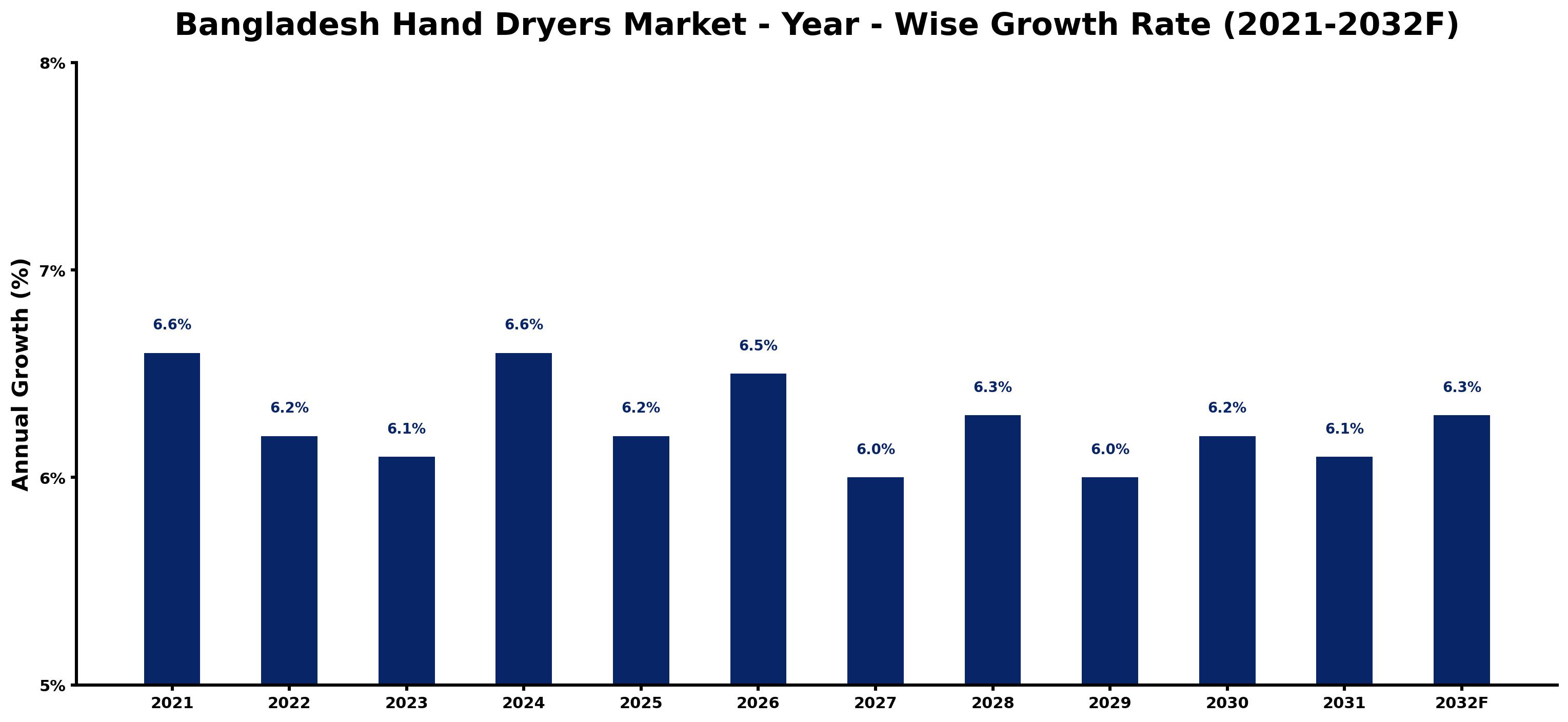
The table below presents the year wise growth rates along with the key drivers influencing the market
| Year | Growth Rate | Major Drivers |
| 2021 | 6.6% | Increased awareness of hygiene significantly impacts the adoption of hand dryers. |
| 2022 | 6.2% | Retail expansion in urban areas creates new opportunities for hand dryer installations. |
| 2023 | 6.1% | Environmental concerns push businesses to consider eco-friendly hand drying solutions. |
| 2024 | 6.6% | Construction of new facilities in sectors like healthcare drives hand dryer demand. |
| 2025 | 6.2% | Local manufacturers enhance product offerings, improving competitiveness against imports. |
| 2026 | 6.5% | Corporate responsibility initiatives prompt organizations to invest in sustainable technologies. |
| 2027 | 6.0% | Travel and hospitality sectors recover, boosting the need for efficient hand drying. |
| 2028 | 6.3% | Government contracts for public infrastructure include provisions for modern hand dryers. |
| 2029 | 6.0% | Technological innovations lead to more efficient and faster hand drying systems. |
| 2030 | 6.2% | Tourism growth encourages higher standards in public restroom facilities, including dryers. |
| 2031 | 6.1% | Rising disposable incomes enable consumers to prefer premium hand drying options. |
| 2032 | 6.3% | Increased urbanization correlates with higher demand for hygiene-focused products. |
Note - Market size estimations and growth projections presented in this report are based on 6Wresearch's advanced forecasting approach, validated with industry datasets as of June 2026.
Bangladesh Hand Dryers Market Synopsis
The Bangladesh Hand Dryers Market is projected to reach 6.5% and witness significant growth during the forecast period (2026-2032). This growth is attributed to an increasing emphasis on hygiene and sanitation across various public spaces. As the demand for efficient hand-drying solutions rises, factors such as government initiatives, infrastructure development, and consumer preference for eco-friendly products are driving the expansion of this market.
Bangladesh Hand Dryers Market Growth Drivers
A multitude of factors contribute to the growth of the Bangladesh Hand Dryers Market, each reinforcing the market's potential.
- The heightened awareness regarding hygiene in public facilities, spurred by recent health crises, has led consumers and businesses alike to seek out efficient solutions like hand dryers over traditional alternatives such as paper towels.
- Government initiatives aimed at promoting cleanliness and reducing waste further bolster market demand. These policies encourage the adoption of hand dryers as a sustainable option for facilities management.
- The increase in infrastructure projects across Bangladesh, including new commercial buildings, airports, and healthcare facilities, necessitates the installation of modern hand-drying solutions to meet the growing public demand.
- Consumer preferences are also shifting toward innovative features such as touchless operation and energy efficiency, which drive manufacturers to develop more advanced hand dryer technology.
- Additionally, the rise of the hospitality and healthcare sectors, which prioritize cleanliness, significantly impacts the demand for high-performance hand dryers that enhance user experience.
Bangladesh Hand Dryers Market Trends and Opportunities
Current trends in the Bangladesh Hand Dryers Market indicate a strong move towards energy-efficient and sustainable solutions, aligning with global shifts in consumer preferences.
- There is a notable increase in the adoption of high-speed hand dryers, which offer quick drying times while conserving energy, catering to the evolving needs of end-users.
- Manufacturers are increasingly incorporating touchless technologies in their designs, addressing hygiene concerns heightened by the COVID-19 pandemic and creating a safe user environment.
- Innovative designs focusing on aesthetics and functionality are becoming popular, as establishments seek to enhance the overall ambiance of their facilities.
- The trend towards eco-friendly products is leading to a growing investment in materials and technologies that reduce environmental impact, appealing to environmentally conscious consumers.
- Public awareness campaigns promoting the benefits of hand dryers over paper towels are paving the way for increased acceptance and usage, further supporting market growth.
Bangladesh Hand Dryers Market Challenges and Restraints
Despite its growth potential, the Bangladesh Hand Dryers Market faces several challenges that must be addressed to ensure sustained expansion.
- Low awareness and adoption rates among certain segments remain a hurdle, with many still favoring traditional hand-drying methods like paper towels due to perceived familiarity and convenience.
- Infrastructure limitations in public restrooms, including inconsistent electricity supply and inadequate space for installation, impede the widespread adoption of hand dryers.
- Initial investment costs for hand dryers may deter potential users who compare them to the lower ongoing expenditures associated with paper towels.
- Concerns surrounding hygiene effectiveness, especially in high-traffic areas, can lead to hesitation among business owners in choosing hand dryers over disposable options.
- Addressing these challenges will require strategic marketing efforts and educational initiatives to highlight the benefits and efficiency of hand dryers.
Bangladesh Hand Dryers Market Investment Opportunities
The Bangladesh Hand Dryers Market offers diverse investment opportunities particularly tied to the growing focus on hygiene and sustainability.
- Manufacturers and investors can consider developing high-quality, localized products that cater to the specific needs and preferences of Bangladeshi consumers.
- Partnerships with local businesses and facility management companies can enhance market penetration and foster mutually beneficial relationships that lead to increased sales.
- Government incentives for businesses that adopt energy-efficient solutions can significantly offset initial costs, making hand dryers more viable for establishments.
- Through consumer education regarding the benefits of hand dryers, businesses can boost acceptance and demand, thereby driving profitable growth.
- The upcoming influx of new commercial establishments presents a prime opportunity for market entry and expansion, especially in the hospitality and healthcare sectors.
Bangladesh Hand Dryers Market Government Investment and Initiatives
The Bangladesh government has rolled out targeted policies to encourage the installation of hand dryers as an eco-friendly alternative to paper towels. Among these initiatives is a framework aimed at promoting energy efficiency in public facilities. The government also sets quality standards for hand dryers, ensuring that products meet safety and performance criteria. Incentives and subsidies for businesses adopting energy-efficient solutions further support the market's expansion, aligning with global trends toward sustainability. These policies create a favorable environment for the growth of the Bangladesh Hand Dryers Market, highlighting the government's commitment to enhancing public hygiene practices.
Bangladesh Hand Dryers Market Latest Developments (May 2025 - June 2026)
Recent developments in the Bangladesh Hand Dryers Market between May 2025 and June 2026 demonstrate a significant focus on innovation and consumer education. Manufacturers are stepping up efforts to enhance product features, emphasizing speed and energy efficiency. Concurrently, public health campaigns aim to bolster recognition of the advantages of hand dryers over traditional options. In addition, some businesses are beginning to implement touchless hand dryer solutions as part of their hygiene protocols, reflecting a shift in market dynamics influenced by ongoing health concerns. These trends indicate a proactive response to consumer demand and a commitment to advancing hygienic standards in public spaces.
Bangladesh Hand Dryers Market - Key Attractiveness of the Report
- 10 Years of Market Numbers
- Historical Data Starting from 2022 to 2025
- Base Year: 2025
- Forecast Data until 2032
- Key Performance Indicators Impacting the Market
- Major Upcoming Developments and Projects
Key Highlights of the Report:
- Bangladesh Hand Dryers Market Outlook
- Market Size of Bangladesh Hand Dryers Market, 2025
- Forecast of Bangladesh Hand Dryers Market, 2032F
- Historical Data and Forecast of Bangladesh Hand Dryers Revenues & Volume for the Period 2022-2032F
- Bangladesh Hand Dryers Market Trend Evolution
- Bangladesh Hand Dryers Market Drivers and Challenges
- Bangladesh Hand Dryers Price Trends
- Bangladesh Hand Dryers Porter's Five Forces
- Bangladesh Hand Dryers Industry Life Cycle
- Historical Data and Forecast of Bangladesh Hand Dryers Market Revenues & Volume By Product Type for the Period 2022-2032F
- Historical Data and Forecast of Bangladesh Hand Dryers Market Revenues & Volume By Jet Air for the Period 2022-2032F
- Historical Data and Forecast of Bangladesh Hand Dryers Market Revenues & Volume By Hot Air for the Period 2022-2032F
- Historical Data and Forecast of Bangladesh Hand Dryers Market Revenues & Volume By Operation Mode for the Period 2022-2032F
- Historical Data and Forecast of Bangladesh Hand Dryers Market Revenues & Volume By Manual On-Automatic Off for the Period 2022-2032F
- Historical Data and Forecast of Bangladesh Hand Dryers Market Revenues & Volume By Fully Automatic for the Period 2022-2032F
- Historical Data and Forecast of Bangladesh Hand Dryers Market Revenues & Volume By Mounting Technique for the Period 2022-2032F
- Historical Data and Forecast of Bangladesh Hand Dryers Market Revenues & Volume By Surface Mounted for the Period 2022-2032F
- Historical Data and Forecast of Bangladesh Hand Dryers Market Revenues & Volume By Wall Mounted for the Period 2022-2032F
- Historical Data and Forecast of Bangladesh Hand Dryers Market Revenues & Volume By End-users for the Period 2022-2032F
- Historical Data and Forecast of Bangladesh Hand Dryers Market Revenues & Volume By Airports for the Period 2022-2032F
- Historical Data and Forecast of Bangladesh Hand Dryers Market Revenues & Volume By Hotel & Restaurants for the Period 2022-2032F
- Historical Data and Forecast of Bangladesh Hand Dryers Market Revenues & Volume By Hospitals for the Period 2022-2032F
- Historical Data and Forecast of Bangladesh Hand Dryers Market Revenues & Volume By Offices for the Period 2022-2032F
- Historical Data and Forecast of Bangladesh Hand Dryers Market Revenues & Volume By Shopping Malls for the Period 2022-2032F
- Historical Data and Forecast of Bangladesh Hand Dryers Market Revenues & Volume By Others for the Period 2022-2032F
- Bangladesh Hand Dryers Import Export Trade Statistics
- Market Opportunity Assessment By Product Type
- Market Opportunity Assessment By Operation Mode
- Market Opportunity Assessment By Mounting Technique
- Market Opportunity Assessment By End-users
- Bangladesh Hand Dryers Top Companies Market Share
- Bangladesh Hand Dryers Competitive Benchmarking By Technical and Operational Parameters
- Bangladesh Hand Dryers Company Profiles
- Bangladesh Hand Dryers Key Strategic Recommendations






































