Bangladesh Industrial Analytics Market Size & Growth Rate (2026-2032)
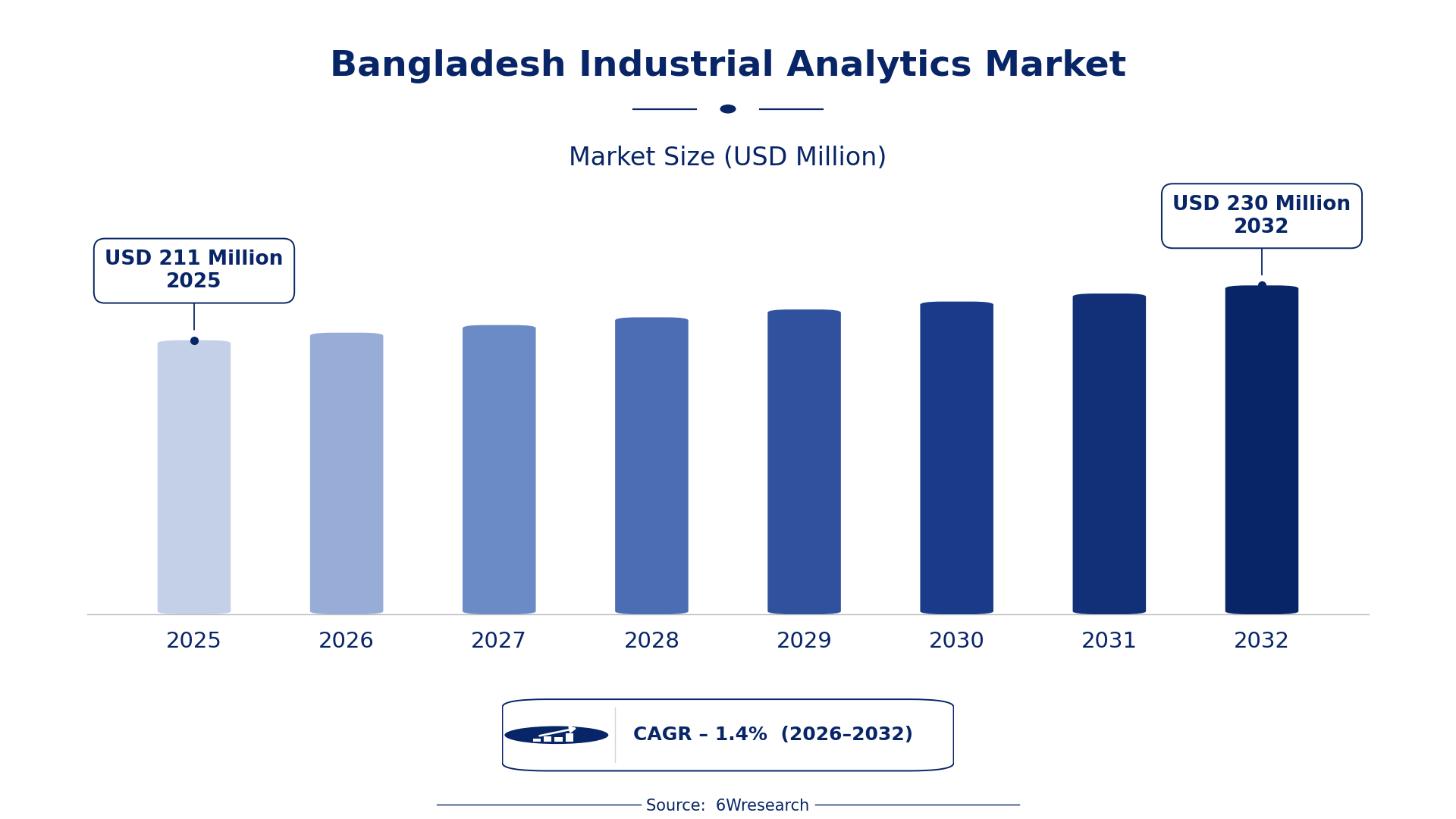
The Bangladesh Industrial Analytics Market was estimated at USD 211 Million in 2025 and is projected to reach USD 230 Million by 2032, growing at a CAGR of 1.4% from 2026 to 2032.
Bangladesh Industrial Analytics Market Synopsis
The demand for industrial analytics solutions is currently being driven by the need for operational efficiency across various sectors in Bangladesh. Key industries such as textiles, pharmaceuticals, and food processing are increasingly integrating analytics into their processes to optimize production and reduce costs.
As industries embrace digital transformation, the government’s push towards Industry 4.0 is significantly shaping this market. Companies are not only looking for predictive maintenance and asset performance management but also seeking real-time insights to drive innovation and competitiveness.
Bangladesh Industrial Analytics Market Year-wise Growth Rate and Key Drivers
This graph illustrates the annual growth rates of the Bangladesh Industrial Analytics Market from 2021 to 2032, highlighting a steady upward trajectory and projected expansion over the forecast period.
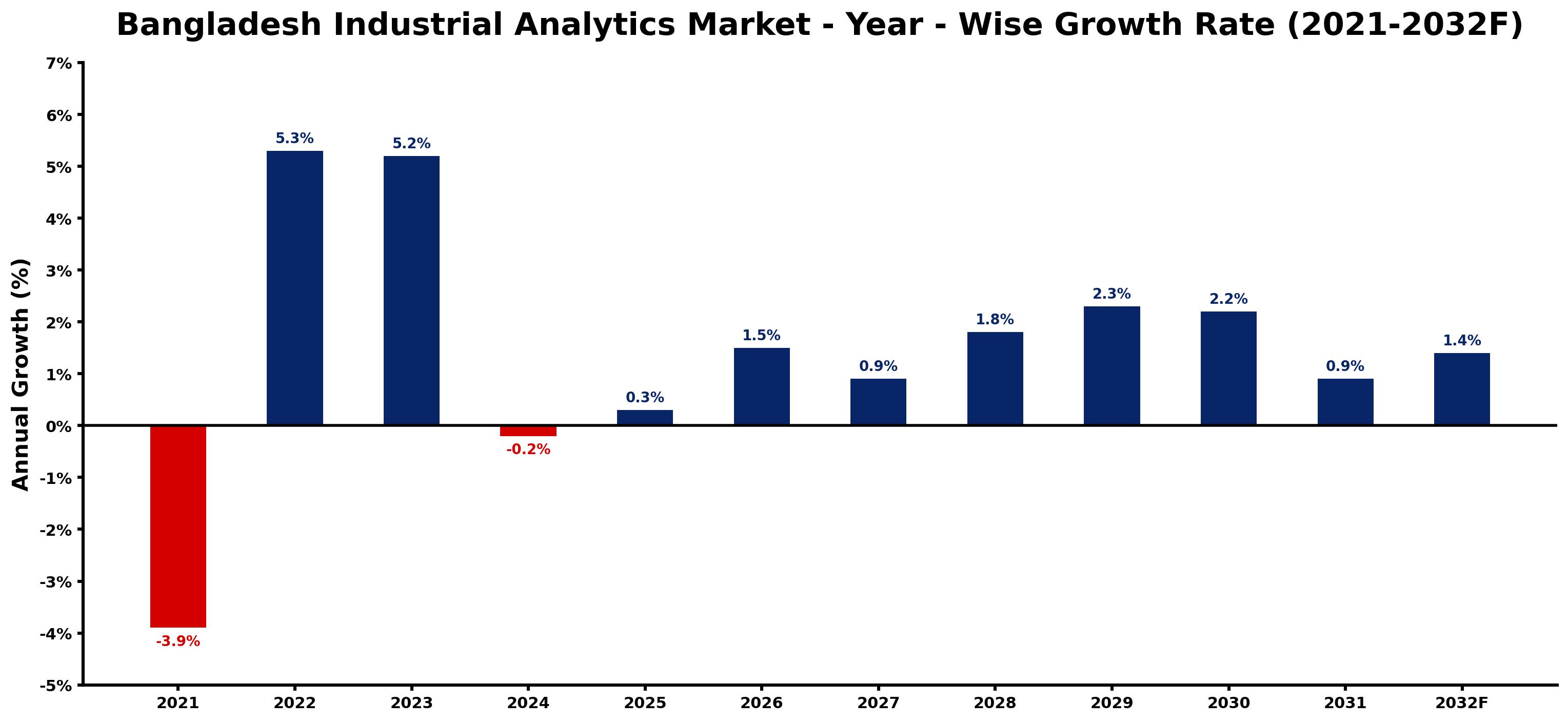
The table below presents the year‑wise growth rates along with the key drivers influencing the market
| Year | Growth Rate | Major Drivers |
| 2021 | -3.9% | Pandemic-related disruptions hindered industrial investment projects. |
| 2022 | 5.3% | Government's Digital Bangladesh initiative boosting analytics adoption |
| 2023 | 5.2% | Increased demand for data-driven decision-making in manufacturing |
| 2024 | -0.2% | Declining infrastructure investment limits data analysis capabilities. |
| 2025 | 0.3% | Rising foreign investments in Bangladeshi textile analytics |
| 2026 | 1.5% | Growing emphasis on supply chain optimization technologies |
| 2027 | 0.9% | Increased focus on operational efficiency in garment factories |
| 2028 | 1.8% | Emergence of local startups specializing in industrial data solutions |
| 2029 | 2.3% | Supportive policies for data analytics from Bangladesh Bank |
| 2030 | 2.2% | Government subsidies for technology adoption in heavy industries |
| 2031 | 0.9% | Rising workforce skilled in data science and analytics |
| 2032 | 1.4% | Strengthening partnerships between universities and industry on analytics |
Note: Market size estimations and growth projections presented in this report are based on 6Wresearch's proprietary forecasting methodology, utilizing the latest available industry data, government publications, and primary research inputs.
Bangladesh Industrial Analytics Market Key Takeaways
Below are some of the specific key takeaways from the market, including:
- The increasing adoption of advanced analytics is enhancing production efficiency in key sectors.
- Predictive maintenance solutions are gaining traction as companies prioritize operational reliability.
- The government's initiatives are creating a supportive environment for analytics adoption.
- Data security concerns remain a significant barrier to widespread analytics implementation.
- Tailored analytics solutions for specific industries present substantial market opportunities.
Evaluation of Restraints in Bangladesh Industrial Analytics Market
Despite its growth potential, the Bangladesh Industrial Analytics Market faces notable restraints. A significant portion of small and medium enterprises lacks the understanding of analytics benefits, which hampers adoption rates. on top of that, the shortage of skilled professionals in data analytics constrains the effective implementation of advanced solutions. Concerns over data security and the high initial investment costs also deter organizations from embracing these technologies, particularly in cost-sensitive sectors.
Bangladesh Industrial Analytics Market Trends
Several trends are emerging within the Bangladesh Industrial Analytics Market. The shift towards predictive maintenance is notable, as organizations seek to minimize downtime and extend asset life. Real-time monitoring capabilities are becoming essential, enabling industries to respond swiftly to operational challenges. Advanced analytics tools are being prioritized, with businesses looking to utilize AI and IoT technologies to enhance their decision-making processes.
Bangladesh Industrial Analytics Market Opportunities
There are significant growth opportunities within this market, particularly in sectors that are currently under-analysed. Custom analytics solutions tailored to specific industry needs can unlock new revenue streams. The ongoing expansion of IoT and AI technologies presents fertile ground for innovation, while partnerships with local firms can facilitate deeper market penetration and accelerate the adoption of analytics solutions across various industries.
Government Initiatives in the Bangladesh Industrial Analytics Market
The Bangladeshi government is actively fostering the growth of the industrial analytics market through several initiatives. Recently, programs offering tax incentives and subsidies have been launched to encourage investment in analytics technologies. Currently, the government is implementing training programs in collaboration with educational institutions to build a skilled workforce in data analytics. Looking ahead, there are plans for expanding digital infrastructure, aimed at enhancing data security regulations to instill greater confidence among businesses in using analytics tools.
Future Insights of the Bangladesh Industrial Analytics Market
The future of the Bangladesh Industrial Analytics Market is bright, with growth driven by ongoing digital transformation efforts. As industries recognize the necessity of data-driven decision-making, demand for analytics solutions is set to escalate. With government support for Industry 4.0 initiatives, coupled with an improving infrastructure and workforce capabilities, companies are likely to invest more heavily in customized analytics solutions to meet evolving industry demands.
Bangladesh Industrial Analytics Market Latest Developments
In the past year, several noteworthy developments have occurred in the Bangladesh Industrial Analytics Market. A leading regional operator recently launched a new suite of predictive maintenance tools designed for the manufacturing sector, completed by late 2025. Concurrently, a major technology vendor is currently rolling out advanced analytics capabilities aimed at food processing industries, enhancing operational efficiency. Additionally, a government-backed initiative is expected to begin in the second half of 2026, focusing on expanding IoT infrastructure to support data analytics applications across various sectors.
Bangladesh Industrial Analytics Market - Key Attractiveness of the Report
- 10 Years of Market Numbers
- Historical Data Starting from 2022 to 2025
- Base Year: 2025
- Forecast Data until 2032
- Key Performance Indicators Impacting the Market
- Major Upcoming Developments and Projects
Key Highlights of the Report:
- Bangladesh Industrial Analytics Market Outlook
- Market Size of Bangladesh Industrial Analytics Market, 2025
- Forecast of Bangladesh Industrial Analytics Market, 2032
- Historical Data and Forecast of Bangladesh Industrial Analytics Revenues & Volume for the Period 2022-2032F
- Bangladesh Industrial Analytics Market Trend Evolution
- Bangladesh Industrial Analytics Market Drivers and Challenges
- Bangladesh Industrial Analytics Price Trends
- Bangladesh Industrial Analytics Porter's Five Forces
- Bangladesh Industrial Analytics Industry Life Cycle
- Historical Data and Forecast of Bangladesh Industrial Analytics Market Revenues & Volume By Component for the Period 2022-2032F
- Historical Data and Forecast of Bangladesh Industrial Analytics Market Revenues & Volume By Software for the Period 2022-2032F
- Historical Data and Forecast of Bangladesh Industrial Analytics Market Revenues & Volume By Service for the Period 2022-2032F
- Historical Data and Forecast of Bangladesh Industrial Analytics Market Revenues & Volume By Software for the Period 2022-2032F
- Historical Data and Forecast of Bangladesh Industrial Analytics Market Revenues & Volume By Operational analytics for the Period 2022-2032F
- Historical Data and Forecast of Bangladesh Industrial Analytics Market Revenues & Volume By Risk analytics for the Period 2022-2032F
- Historical Data and Forecast of Bangladesh Industrial Analytics Market Revenues & Volume By Financial analytics for the Period 2022-2032F
- Historical Data and Forecast of Bangladesh Industrial Analytics Market Revenues & Volume By Marketing analytics for the Period 2022-2032F
- Historical Data and Forecast of Bangladesh Industrial Analytics Market Revenues & Volume By Customer analytics for the Period 2022-2032F
- Historical Data and Forecast of Bangladesh Industrial Analytics Market Revenues & Volume By Workforce analytics for the Period 2022-2032F
- Historical Data and Forecast of Bangladesh Industrial Analytics Market Revenues & Volume By Service for the Period 2022-2032F
- Historical Data and Forecast of Bangladesh Industrial Analytics Market Revenues & Volume By Managed services for the Period 2022-2032F
- Historical Data and Forecast of Bangladesh Industrial Analytics Market Revenues & Volume By Professional services for the Period 2022-2032F
- Historical Data and Forecast of Bangladesh Industrial Analytics Market Revenues & Volume By Analytics Type for the Period 2022-2032F
- Historical Data and Forecast of Bangladesh Industrial Analytics Market Revenues & Volume By Descriptive for the Period 2022-2032F
- Historical Data and Forecast of Bangladesh Industrial Analytics Market Revenues & Volume By Diagnostic for the Period 2022-2032F
- Historical Data and Forecast of Bangladesh Industrial Analytics Market Revenues & Volume By Predictive for the Period 2022-2032F
- Historical Data and Forecast of Bangladesh Industrial Analytics Market Revenues & Volume By Prescriptive for the Period 2022-2032F
- Historical Data and Forecast of Bangladesh Industrial Analytics Market Revenues & Volume By Organization size for the Period 2022-2032F
- Historical Data and Forecast of Bangladesh Industrial Analytics Market Revenues & Volume By Large enterprises for the Period 2022-2032F
- Historical Data and Forecast of Bangladesh Industrial Analytics Market Revenues & Volume By Small and medium-sized enterprises for the Period 2022-2032F
- Bangladesh Industrial Analytics Import Export Trade Statistics
- Market Opportunity Assessment By Component
- Market Opportunity Assessment By Software
- Market Opportunity Assessment By Service
- Market Opportunity Assessment By Analytics Type
- Market Opportunity Assessment By Organization size
- Bangladesh Industrial Analytics Top Companies Market Share
- Bangladesh Industrial Analytics Competitive Benchmarking By Technical and Operational Parameters
- Bangladesh Industrial Analytics Company Profiles
- Bangladesh Industrial Analytics Key Strategic Recommendations






































