Bangladesh Industrial Gases Market Summary
The bangladesh industrial gases market was estimated at USD 196 Million in 2025 and is projected to reach USD 214 Million by 2032, growing at a CAGR of 1.1% from 2026 to 2032.
Bangladesh Industrial Gases Market Year-wise Growth Rate and Key Drivers
This graph highlights how the Bangladesh Industrial Gases Market has steadily grown over the past five years, supported by major growth factors.
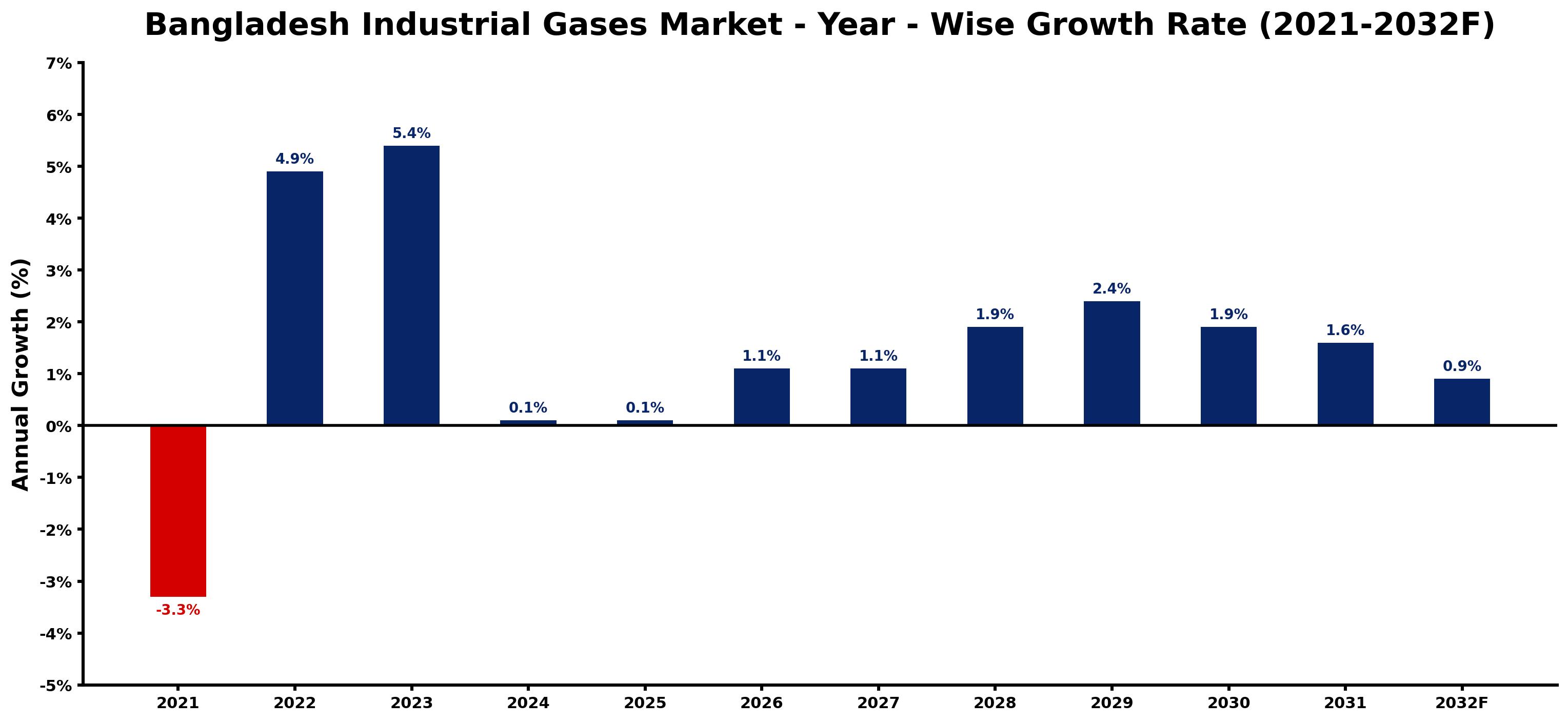
The table below presents the year wise growth rates along with the key drivers influencing the market
| Year | Growth Rate | Major Drivers |
| 2021 | -3.3% | Significant power shortages hindered production capabilities, leading to decreased supply and market contraction. |
| 2022 | 4.9% | Investment in infrastructure attracts foreign players, stimulating competitive market dynamics in Bangladesh. |
| 2023 | 5.4% | Manufacturing recovery post-COVID creates robust demand for welding and cutting gases. |
| 2024 | 0.1% | Local production capabilities emerge, reducing dependency on imported industrial gases significantly. |
| 2025 | 0.1% | Technological innovations in gas production drive efficiency, benefitting major industrial players. |
| 2026 | 1.1% | Construction sector expansion necessitates a reliable supply of specialty gases for various applications. |
| 2027 | 1.1% | Competitive pricing strategies adopted by local suppliers boost market accessibility for SMEs. |
| 2028 | 1.9% | Increased awareness of environmental considerations influences preference towards greener gas alternatives. |
| 2029 | 2.4% | Healthcare sector growth demands more medical gases, further expanding the industrial gas market. |
| 2030 | 1.9% | Digitalization efforts in the logistics sector enhance supply chain efficiency for gas distribution. |
| 2031 | 1.6% | Enhanced training programs for gas handling improve safety standards across industries significantly. |
| 2032 | 0.9% | Sustainable practices adopted by industries shift focus towards eco-friendly gas solutions and technologies. |
Note - Market size estimations and growth projections presented in this report are based on 6Wresearch's advanced forecasting approach, validated with industry datasets as of June 2026.
Bangladesh Industrial Gases Market Synopsis
The Bangladesh Industrial Gases Market is projected to reach 1.1% and witness significant growth during the forecast period (2026-2032). This growth is primarily driven by the surging demand for industrial gases across various sectors, including manufacturing, healthcare, food and beverage, and metal fabrication. As industries increasingly rely on gases like oxygen, nitrogen, argon, and carbon dioxide for their operations, the market is evolving to meet these demands amid a backdrop of rising industrialization and government initiatives to attract foreign investments.
Bangladesh Industrial Gases Market Growth Drivers
Several key factors are contributing to the expansion of the Bangladesh Industrial Gases Market. The first significant driver is the increased production capacity within local industries, which is leading to a higher consumption of industrial gases. Additionally, the healthcare sector is expanding rapidly, resulting in greater utilization of medical gases. The food and beverage industry's growth, particularly in preserving and packaging food products, is also creating more opportunities for gas applications. Furthermore, advancements in gas production technology are enhancing efficiency, making it easier and more cost-effective for industries to incorporate these gases into their processes. Lastly, government support for industrialization is creating a favorable environment for market growth.
Bangladesh Industrial Gases Market Trends and Opportunities
The Bangladesh Industrial Gases Market is witnessing several trends that present notable opportunities for growth. A prominent trend is the growing shift towards sustainable and eco-friendly industrial gas solutions. This shift is driven by increasing environmental regulations and a corporate focus on reducing carbon footprints. The rise in demand for specialty gases tailored to specific industrial applications, such as welding, cutting, and cryogenics, further expands market prospects. Moreover, advances in technology are leading to innovations in gas production, distribution methods, and safety standards. Companies are also forming strategic partnerships and investing in research and development to align with evolving consumer preferences.
Bangladesh Industrial Gases Market Challenges and Restraints
Despite the positive outlook, the Bangladesh Industrial Gases Market faces several challenges that could hinder growth. One significant challenge is the intense competition among suppliers, which has led to price wars and lowered profit margins. Additionally, limited infrastructure and logistical concerns in remote areas can hinder the efficient distribution of industrial gases. Quality control remains a pressing issue, as many suppliers struggle to meet international safety standards, risking both compliance issues and consumer safety. Fluctuations in raw material prices further complicate the landscape, alongside regulatory uncertainties that can impact market stability. The presence of unorganized players exacerbates market fragmentation, making it difficult for established companies to maintain a competitive edge.
Bangladesh Industrial Gases Market Investment Opportunities
The growing industrial sector in Bangladesh presents multiple investment opportunities within the industrial gases market. The demand for traditional gases such as oxygen, nitrogen, and argon is on the rise owing to expansion in sectors like manufacturing and healthcare. Furthermore, as industries seek greater self-reliance, there is an increasing need for specialized gases, particularly in applications such as food preservation and welding. Investors could also capitalize on opportunities by focusing on research and development of innovative gas solutions tailored to local market needs. Overall, the Bangladesh Industrial Gases Market signifies potential for substantial growth and diversification, appealing to investors looking for fruitful ventures in an emerging economy.
Bangladesh Industrial Gases Market Government Investment and Initiatives
The government of Bangladesh has established various policies to regulate and promote the industrial gases market effectively. The Department of Environment (DoE) oversees licensing and compliance, ensuring that production, import, and storage of industrial gases adhere to environmental and safety standards. Furthermore, the government actively enforces regulations on pricing and quality control of industrial gases, which aim to protect consumer interests and promote equitable competition. The Bangladesh Standards and Testing Institution (BSTI) plays a critical role in setting and maintaining standards for gas production, enhancing product quality and safety. These policies collectively support sustainable development, environmental protection, and public health in the growing industrial gases sector.
Bangladesh Industrial Gases Market Latest Developments (May 2025 - June 2026)
Recent developments in the Bangladesh Industrial Gases Market from May 2025 to June 2026 reflect a direction towards increased efficiency and sustainability. The shift towards eco-friendly gas solutions is gaining momentum, with companies exploring alternatives to traditional gas production. Innovations in gas distribution networks are improving logistical capabilities, especially in less accessible areas. Additionally, there is a reported rise in collaborative efforts among local businesses to enhance technology adoption, leading to improved safety and quality standards. As the market evolves, industry stakeholders are focusing on addressing regulatory compliance to ensure long-term sustainability and competitiveness.
Bangladesh Industrial Gases Market - Key Attractiveness of the Report
- 10 Years of Market Numbers
- Historical Data Starting from 2022 to 2025
- Base Year: 2025
- Forecast Data until 2032
- Key Performance Indicators Impacting the Market
- Major Upcoming Developments and Projects
Key Highlights of the Report:
- Bangladesh Industrial Gases Market Outlook
- Market Size of Bangladesh Industrial Gases Market, 2025
- Forecast of Bangladesh Industrial Gases Market, 2032F
- Historical Data and Forecast of Bangladesh Industrial Gases Revenues & Volume for the Period 2022-2032F
- Bangladesh Industrial Gases Market Trend Evolution
- Bangladesh Industrial Gases Market Drivers and Challenges
- Bangladesh Industrial Gases Price Trends
- Bangladesh Industrial Gases Porter's Five Forces
- Bangladesh Industrial Gases Industry Life Cycle
- Historical Data and Forecast of Bangladesh Industrial Gases Market Revenues & Volume By Product Type for the Period 2022-2032F
- Historical Data and Forecast of Bangladesh Industrial Gases Market Revenues & Volume By Oxygen for the Period 2022-2032F
- Historical Data and Forecast of Bangladesh Industrial Gases Market Revenues & Volume By Nitrogen for the Period 2022-2032F
- Historical Data and Forecast of Bangladesh Industrial Gases Market Revenues & Volume By Hydrogen for the Period 2022-2032F
- Historical Data and Forecast of Bangladesh Industrial Gases Market Revenues & Volume By Carbon Dioxide for the Period 2022-2032F
- Historical Data and Forecast of Bangladesh Industrial Gases Market Revenues & Volume By Acetylene for the Period 2022-2032F
- Historical Data and Forecast of Bangladesh Industrial Gases Market Revenues & Volume By Argon for the Period 2022-2032F
- Historical Data and Forecast of Bangladesh Industrial Gases Market Revenues & Volume By Others for the Period 2022-2032F
- Historical Data and Forecast of Bangladesh Industrial Gases Market Revenues & Volume By Application for the Period 2022-2032F
- Historical Data and Forecast of Bangladesh Industrial Gases Market Revenues & Volume By Healthcare for the Period 2022-2032F
- Historical Data and Forecast of Bangladesh Industrial Gases Market Revenues & Volume By Manufacturing for the Period 2022-2032F
- Historical Data and Forecast of Bangladesh Industrial Gases Market Revenues & Volume By Metallurgy & Glasses for the Period 2022-2032F
- Historical Data and Forecast of Bangladesh Industrial Gases Market Revenues & Volume By Food & Beverage for the Period 2022-2032F
- Historical Data and Forecast of Bangladesh Industrial Gases Market Revenues & Volume By Retail for the Period 2022-2032F
- Historical Data and Forecast of Bangladesh Industrial Gases Market Revenues & Volume By Chemicals & Energy for the Period 2022-2032F
- Historical Data and Forecast of Bangladesh Industrial Gases Market Revenues & Volume By Others for the Period 2022-2032F
- Historical Data and Forecast of Bangladesh Industrial Gases Market Revenues & Volume By Distribution for the Period 2022-2032F
- Historical Data and Forecast of Bangladesh Industrial Gases Market Revenues & Volume By On-site for the Period 2022-2032F
- Historical Data and Forecast of Bangladesh Industrial Gases Market Revenues & Volume By Bulk (Liquid Gas Transport) for the Period 2022-2032F
- Historical Data and Forecast of Bangladesh Industrial Gases Market Revenues & Volume By Cylinder (Merchant) for the Period 2022-2032F
- Bangladesh Industrial Gases Import Export Trade Statistics
- Market Opportunity Assessment By Product Type
- Market Opportunity Assessment By Application
- Market Opportunity Assessment By Distribution
- Bangladesh Industrial Gases Top Companies Market Share
- Bangladesh Industrial Gases Competitive Benchmarking By Technical and Operational Parameters
- Bangladesh Industrial Gases Company Profiles
- Bangladesh Industrial Gases Key Strategic Recommendations






































