Bangladesh LED Traffic Signs and Signals Market Size, Share & Growth Rate
The Bangladesh LED Traffic Signs and Signals Market was estimated at USD 1337 Million in 2025 and is projected to reach USD 1935 Million by 2032, growing at a CAGR of 5.4% from 2026 to 2032. This growth trajectory is primarily fueled by the rapid urbanization and infrastructural improvements happening across major cities in Bangladesh, especially with rising vehicle ownership and the government's commitment to enhancing road safety. As urban centers become increasingly congested, the demand for smart traffic management solutions that incorporate advanced LED technologies is driving the evolution of the market.
Bangladesh LED Traffic Signs and Signals Market Year-wise Growth Rate and Key Drivers
This graph highlights how the Bangladesh LED Traffic Signs and Signals Market has steadily grown over the years, supported by major growth factors.
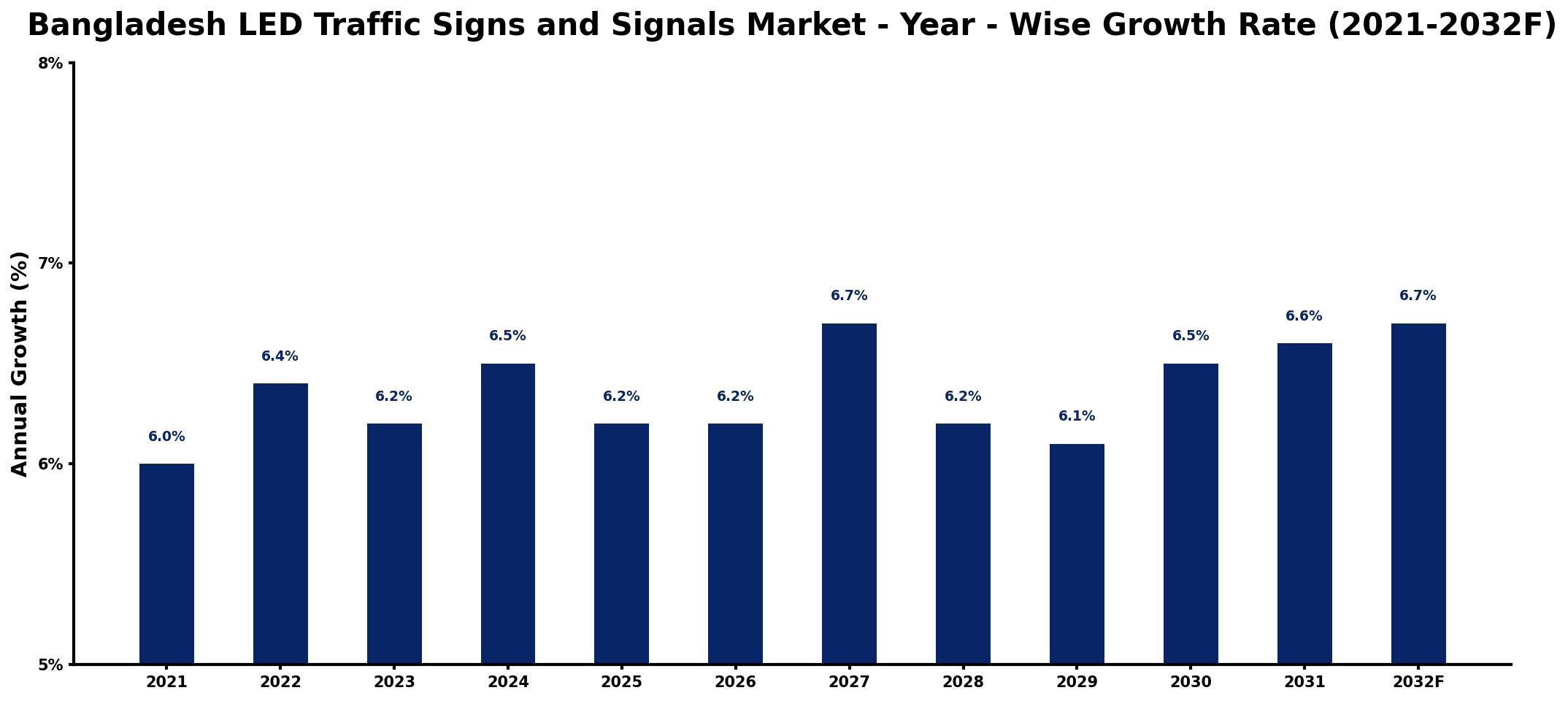
The table below presents the year‑wise growth rates along with the key drivers influencing the market
| Year | Growth Rate | Major Drivers |
| 2021 | 6.0% | Increased urban infrastructure investments |
| 2022 | 6.4% | Rising smart city initiatives |
| 2023 | 6.2% | Growing focus on road safety |
| 2024 | 6.5% | Expansion of public transportation networks |
| 2025 | 6.2% | Higher government funding allocations |
| 2026 | 6.2% | Advancements in digital technology |
| 2027 | 6.7% | Surge in renewable energy adoption |
| 2028 | 6.2% | Enhanced urban planning regulations |
| 2029 | 6.1% | Boost in environmental sustainability efforts |
| 2030 | 6.5% | increased production capacity utilization |
| 2031 | 6.6% | Growing demand for smart solutions |
| 2032 | 6.7% | Increased awareness of mobility solutions |
Note: Market size estimations and growth projections presented in this report are based on 6Wresearch's proprietary forecasting methodology, utilizing the latest available industry data, government publications, and primary research inputs.
Bangladesh LED Traffic Signs and Signals Market Synopsis
The most significant force shaping the Bangladesh LED Traffic Signs and Signals Market today is the government's proactive approach towards modernizing transportation infrastructure. This initiative is designed not only to enhance traffic flow but also to significantly improve safety for both drivers and pedestrians. With policies promoting energy-efficient technologies, the adoption of LED signs and signals is gaining momentum.
Additionally, the increasing urban population has led to heightened traffic congestion, necessitating the implementation of more effective traffic control systems. The integration of LED technology in traffic management is viewed as a sustainable and efficient solution that meets contemporary needs while addressing the challenges posed by urban growth.
Bangladesh LED Traffic Signs and Signals Market Key Takeaways
- Government initiatives are pivotal in driving the adoption of LED traffic solutions.
- Urbanization and rising vehicle ownership are key contributors to market expansion.
- Energy efficiency and durability of LED technology make it a preferred choice over traditional solutions.
- Investment in smart traffic management systems is on the rise, reflecting a trend towards digital integration.
- Awareness and education among decision-makers remain crucial for overcoming existing market barriers.
Evaluation of Restraints in Bangladesh LED Traffic Signs and Signals Market
Despite the promising growth prospects, the Bangladesh LED Traffic Signs and Signals Market faces several restraints. One of the key challenges is the limited awareness of the benefits of LED technology among municipal decision-makers. Budget constraints are also a significant hurdle, as many municipalities struggle to allocate funds for upgrading existing infrastructure to incorporate LED solutions. Compounding these issues is the presence of cheaper, conventional alternatives which can deter investment in higher-quality, more efficient LED systems. Furthermore, inconsistent regulations and standards hinder the uniform implementation of LED products across the country, impacting reliability and overall performance.
Bangladesh LED Traffic Signs and Signals Market Trends
Several trends are currently shaping the Bangladesh LED Traffic Signs and Signals Market. One notable trend is the move towards smart traffic management systems that integrate IoT and data analytics with LED traffic solutions, enhancing the efficiency of traffic control. Another emerging trend is the customization of products to cater to local needs and conditions, ensuring durability and effectiveness. The focus on sustainability is also growing, with an increasing preference for energy-efficient solutions that contribute to environmental conservation.
Bangladesh LED Traffic Signs and Signals Market Opportunities
There are considerable growth and investment opportunities within the Bangladesh LED Traffic Signs and Signals Market. As government initiatives toward modernizing transportation infrastructure gain momentum, investors can find lucrative prospects by developing advanced LED traffic management systems. The ongoing urbanization presents an additional opportunity; cities like Dhaka, grappling with traffic congestion, require efficient solutions, making this an ideal time for stakeholders to engage. Partnering with local authorities can further bolster market presence and ensure alignment with government goals for improved road safety.
Government Initiatives in the Bangladesh LED Traffic Signs and Signals Market
The Bangladeshi government has enacted several policies to foster the adoption of LED traffic signs and signals. These policies include setting quality standards for LED products and offering incentives for municipalities to install energy-efficient systems. Furthermore, public-private partnerships are encouraged to implement advanced traffic control technologies. By raising awareness among stakeholders about the benefits of LED solutions in enhancing road safety and reducing energy consumption, the government aims to streamline the modernization of traffic management infrastructure across the country.
Future Insights of the Bangladesh LED Traffic Signs and Signals Market
The future outlook for the Bangladesh LED Traffic Signs and Signals Market is robust, driven by sustained government investment in infrastructure and safety initiatives. As demand for energy-efficient and cost-effective solutions increases, the adoption of LED technology is expected to rise significantly. Urban growth, alongside the need to upgrade transportation systems, will continue to push market expansion. Overall, this market is poised for sustained growth as Bangladesh prioritizes safety and modernization in its traffic management strategies.
Bangladesh LED Traffic Signs and Signals Market Latest Developments (2025 - 2026)
Recently, the Bangladesh LED Traffic Signs and Signals Market has seen significant advancements, particularly in the adoption of smart traffic management technologies. Initiatives focusing on integrating LED systems with IoT capabilities have gained traction, allowing for enhanced data collection and analytics to improve traffic flow. Additionally, there has been a noticeable increase in collaborations between public and private sectors aimed at expanding the infrastructure necessary for implementing these advanced solutions.
Bangladesh LED Traffic Signs and Signals Market - Key Attractiveness of the Report
- 10 Years of Market Numbers
- Historical Data Starting from 2022 to 2025
- Base Year: 2025
- Forecast Data until 2032
- Key Performance Indicators Impacting the Market
- Major Upcoming Developments and Projects
Key Highlights of the Report:
- Bangladesh LED Traffic Signs and Signals Market Outlook
- Market Size of Bangladesh LED Traffic Signs and Signals Market, 2025
- Forecast of Bangladesh LED Traffic Signs and Signals Market, 2032
- Historical Data and Forecast of Bangladesh LED Traffic Signs and Signals Revenues & Volume for the Period 2022-2032F
- Bangladesh LED Traffic Signs and Signals Market Trend Evolution
- Bangladesh LED Traffic Signs and Signals Market Drivers and Challenges
- Bangladesh LED Traffic Signs and Signals Price Trends
- Bangladesh LED Traffic Signs and Signals Porter's Five Forces
- Bangladesh LED Traffic Signs and Signals Industry Life Cycle
- Historical Data and Forecast of Bangladesh LED Traffic Signs and Signals Market Revenues & Volume By Product for the Period 2022-2032F
- Historical Data and Forecast of Bangladesh LED Traffic Signs and Signals Market Revenues & Volume By LED Traffic Signals for the Period 2022-2032F
- Historical Data and Forecast of Bangladesh LED Traffic Signs and Signals Market Revenues & Volume By LED Traffic Signs for the Period 2022-2032F
- Bangladesh LED Traffic Signs and Signals Import Export Trade Statistics
- Market Opportunity Assessment By Product
- Bangladesh LED Traffic Signs and Signals Top Companies Market Share
- Bangladesh LED Traffic Signs and Signals Competitive Benchmarking By Technical and Operational Parameters
- Bangladesh LED Traffic Signs and Signals Company Profiles
- Bangladesh LED Traffic Signs and Signals Key Strategic Recommendations






































