Bangladesh Licensed Merchandise Market Size, Share & Growth Rate
The Bangladesh Licensed Merchandise Market was estimated at USD 281 Million in 2025 and is projected to reach USD 375 Million by 2032, growing at a CAGR of 4.2% from 2026 to 2032. This trajectory is bolstered by a burgeoning middle class with increasing disposable incomes and a strong inclination towards branded products. Moreover, the influence of social media and a tech-savvy youth demographic are enhancing the appeal of licensed merchandise, paving the way for sustained growth in various product categories.
Bangladesh Licensed Merchandise Market Year-wise Growth Rate and Key Drivers
This graph highlights how the Bangladesh Licensed Merchandise Market has steadily grown over the years, supported by major growth factors.
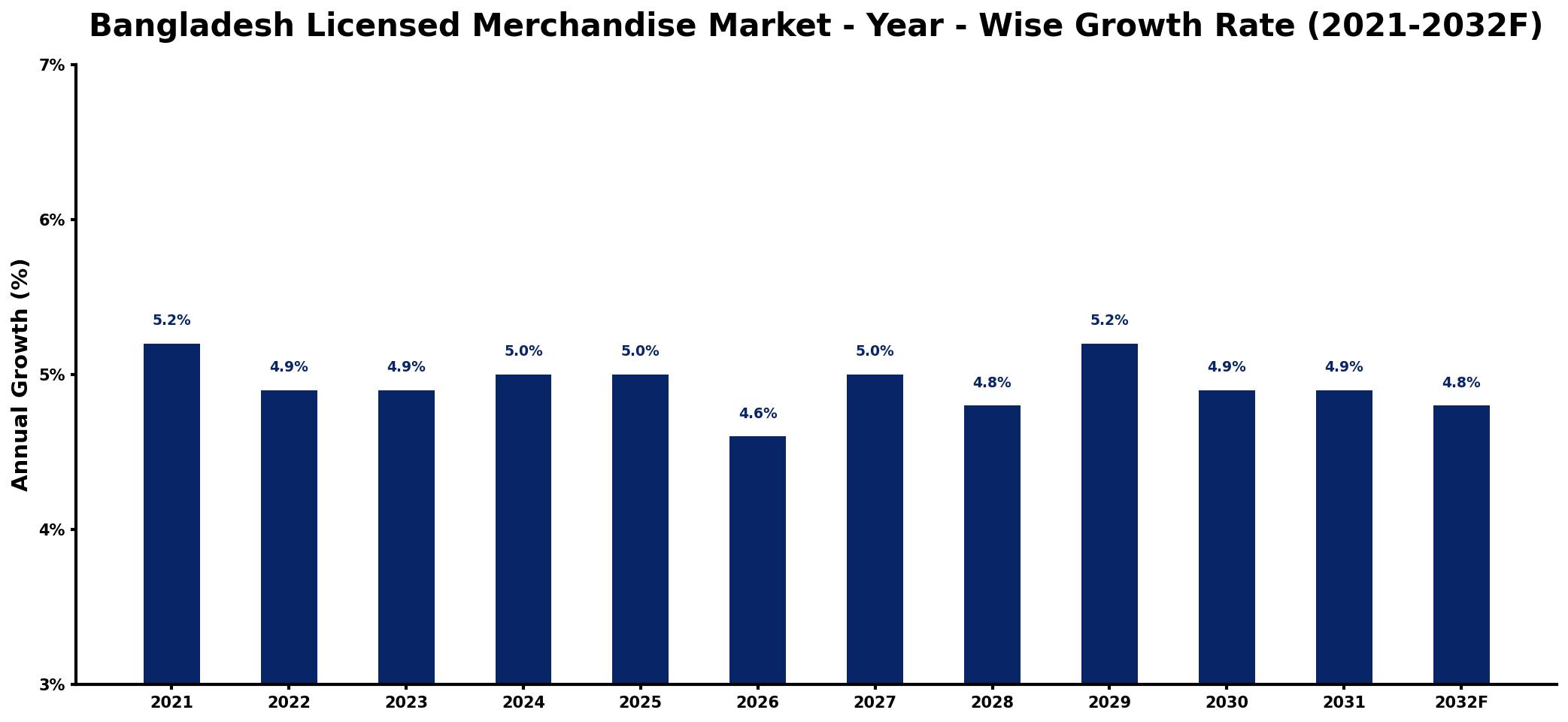
The table below presents the year‑wise growth rates along with the key drivers influencing the market
| Year | Growth Rate | Major Drivers |
| 2021 | 5.2% | increased consumer spending habits |
| 2022 | 4.9% | growing popularity of local brands |
| 2023 | 4.9% | expansion of online retail platforms |
| 2024 | 5.0% | rising demand for fashion collaborations |
| 2025 | 5.0% | enhanced marketing strategies adopted |
| 2026 | 4.6% | increased investment in e-commerce |
| 2027 | 5.0% | growing youth population engagement |
| 2028 | 4.8% | surge in brand partnerships globally |
| 2029 | 5.2% | development of sustainable production methods |
| 2030 | 4.9% | emphasis on cultural heritage promotion |
| 2031 | 4.9% | rise of influencer marketing channels |
| 2032 | 4.8% | growing interest in niche markets |
Note: Market size estimations and growth projections presented in this report are based on 6Wresearch's proprietary forecasting methodology, utilizing the latest available industry data, government publications, and primary research inputs.
Bangladesh Licensed Merchandise Market Synopsis
The most significant force currently shaping the Bangladesh Licensed Merchandise Market is the rising consumer demand for branded products. This trend is particularly pronounced among younger generations, who actively seek out items that reflect their interests in popular culture, including movies, television, and sports.
Additionally, collaborations between international brands and local manufacturers are driving innovation and quality within the market. As local producers adapt to global trends, the availability of diverse, appealing licensed merchandise is rapidly expanding, fostering a more competitive landscape.
Bangladesh Licensed Merchandise Market Key Takeaways
- The market is experiencing robust growth, driven by increased brand consciousness among consumers.
- Local manufacturers are forming strategic partnerships with global brands, enhancing product quality and diversity.
- E-commerce platforms are facilitating broader access to licensed merchandise, particularly among tech-savvy youth.
- The middle-class demographic is expanding, leading to higher disposable incomes and willingness to spend on branded products.
- Government initiatives are enhancing protections for intellectual property, promoting fair competition in the market.
Evaluation of Restraints in Bangladesh Licensed Merchandise Market
Despite its growth potential, the Bangladesh Licensed Merchandise Market grapples with significant challenges. A prevailing lack of consumer awareness regarding the value of licensed products often leads to a preference for cheaper, unlicensed alternatives. Additionally, the market is plagued by counterfeit goods, which not only dilute brand value but also hinder the revenue of legitimate licensors. Furthermore, inadequate enforcement of intellectual property rights continues to undermine confidence among stakeholders, making it crucial for the industry to address these vulnerabilities effectively.
Bangladesh Licensed Merchandise Market Trends
Several key trends are shaping the Bangladesh Licensed Merchandise Market today. The growth in online shopping, particularly through mobile commerce, is redefining how consumers access licensed products. As more brands enter the market, there is also a noticeable uptick in merchandise tied to popular media franchises, allowing consumers to connect with their favorite characters or sports teams. Moreover, sustainability is becoming a prominent factor in product development, with consumers increasingly favoring eco-friendly materials and ethical sourcing practices.
Bangladesh Licensed Merchandise Market Opportunities
The potential for investment in the Bangladesh Licensed Merchandise Market is vast, driven by increasing consumer demand for unique, branded products. Opportunities abound in forming licensing agreements with international brands to enhance product offerings. Retail establishments specializing in licensed merchandise can cater to a growing customer base eager for quality products. Furthermore, leveraging e-commerce platforms for distribution will open additional channels for growth, appealing particularly to younger, tech-oriented consumers.
Government Initiatives in the Bangladesh Licensed Merchandise Market
The government of Bangladesh is actively promoting the licensed merchandise market through legislation aimed at protecting intellectual property rights. Efforts include enforcing trademark rights and copyright protections to prevent unauthorized use of licensed products. Regulatory frameworks are being established to ensure fair competition, supporting both licensors and local businesses. By fostering trade agreements and partnerships with international stakeholders, the government is working to expand the market and create a more conducive environment for growth.
Future Insights of the Bangladesh Licensed Merchandise Market
Looking ahead to 2026-2032, the Bangladesh Licensed Merchandise Market is anticipated to flourish further, spurred by rising disposable incomes and a youthful, brand-conscious population. As international brands increasingly enter the market, the collaboration with local manufacturers is set to enhance product variety. The impact of social media will also continue to drive consumer interest and demand for licensed merchandise, making this market ripe for innovation and investment.
Bangladesh Licensed Merchandise Market Latest Developments (2025 - 2026)
In recent months, the Bangladesh Licensed Merchandise Market has witnessed a surge in partnerships between local manufacturers and international brands, aimed at enhancing product quality and variety. E-commerce platforms have significantly expanded their offerings of licensed products, catering to the increasing demand among consumers. Additionally, initiatives to strengthen intellectual property protection have begun to take shape, aiming to mitigate the challenges posed by counterfeit goods.
Bangladesh Licensed Merchandise Market - Key Attractiveness of the Report
- 10 Years of Market Numbers
- Historical Data Starting from 2022 to 2025
- Base Year: 2025
- Forecast Data until 2032
- Key Performance Indicators Impacting the Market
- Major Upcoming Developments and Projects
Key Highlights of the Report:
- Bangladesh Licensed Merchandise Market Outlook
- Market Size of Bangladesh Licensed Merchandise Market, 2025
- Forecast of Bangladesh Licensed Merchandise Market, 2032
- Historical Data and Forecast of Bangladesh Licensed Merchandise Revenues & Volume for the Period 2022-2032F
- Bangladesh Licensed Merchandise Market Trend Evolution
- Bangladesh Licensed Merchandise Market Drivers and Challenges
- Bangladesh Licensed Merchandise Price Trends
- Bangladesh Licensed Merchandise Porter's Five Forces
- Bangladesh Licensed Merchandise Industry Life Cycle
- Historical Data and Forecast of Bangladesh Licensed Merchandise Market Revenues & Volume By Product Type for the Period 2022-2032F
- Historical Data and Forecast of Bangladesh Licensed Merchandise Market Revenues & Volume By Apparel and Footwear for the Period 2022-2032F
- Historical Data and Forecast of Bangladesh Licensed Merchandise Market Revenues & Volume By Accessories and Gifts for the Period 2022-2032F
- Historical Data and Forecast of Bangladesh Licensed Merchandise Market Revenues & Volume By Toys and Games for the Period 2022-2032F
- Historical Data and Forecast of Bangladesh Licensed Merchandise Market Revenues & Volume By Others for the Period 2022-2032F
- Historical Data and Forecast of Bangladesh Licensed Merchandise Market Revenues & Volume By for the Period 2022-2032F
- Historical Data and Forecast of Bangladesh Licensed Merchandise Market Revenues & Volume By Distribution Channel for the Period 2022-2032F
- Historical Data and Forecast of Bangladesh Licensed Merchandise Market Revenues & Volume By Online Stores for the Period 2022-2032F
- Historical Data and Forecast of Bangladesh Licensed Merchandise Market Revenues & Volume By Supermarkets and Hypermarkets for the Period 2022-2032F
- Historical Data and Forecast of Bangladesh Licensed Merchandise Market Revenues & Volume By Departmental Stores for the Period 2022-2032F
- Historical Data and Forecast of Bangladesh Licensed Merchandise Market Revenues & Volume By Specialty Stores for the Period 2022-2032F
- Historical Data and Forecast of Bangladesh Licensed Merchandise Market Revenues & Volume By Others for the Period 2022-2032F
- Historical Data and Forecast of Bangladesh Licensed Merchandise Market Revenues & Volume By for the Period 2022-2032F
- Historical Data and Forecast of Bangladesh Licensed Merchandise Market Revenues & Volume By Price Range for the Period 2022-2032F
- Historical Data and Forecast of Bangladesh Licensed Merchandise Market Revenues & Volume By Premium for the Period 2022-2032F
- Historical Data and Forecast of Bangladesh Licensed Merchandise Market Revenues & Volume By Economic for the Period 2022-2032F
- Historical Data and Forecast of Bangladesh Licensed Merchandise Market Revenues & Volume By for the Period 2022-2032F
- Historical Data and Forecast of Bangladesh Licensed Merchandise Market Revenues & Volume By End-User for the Period 2022-2032F
- Historical Data and Forecast of Bangladesh Licensed Merchandise Market Revenues & Volume By Men for the Period 2022-2032F
- Historical Data and Forecast of Bangladesh Licensed Merchandise Market Revenues & Volume By Women for the Period 2022-2032F
- Historical Data and Forecast of Bangladesh Licensed Merchandise Market Revenues & Volume By Children for the Period 2022-2032F
- Bangladesh Licensed Merchandise Import Export Trade Statistics
- Market Opportunity Assessment By Product Type
- Market Opportunity Assessment By Distribution Channel
- Market Opportunity Assessment By Price Range
- Market Opportunity Assessment By End-User
- Bangladesh Licensed Merchandise Top Companies Market Share
- Bangladesh Licensed Merchandise Competitive Benchmarking By Technical and Operational Parameters
- Bangladesh Licensed Merchandise Company Profiles
- Bangladesh Licensed Merchandise Key Strategic Recommendations






































