Bangladesh Manufacturing Analytics Market Size & Growth Rate (2026-2032)
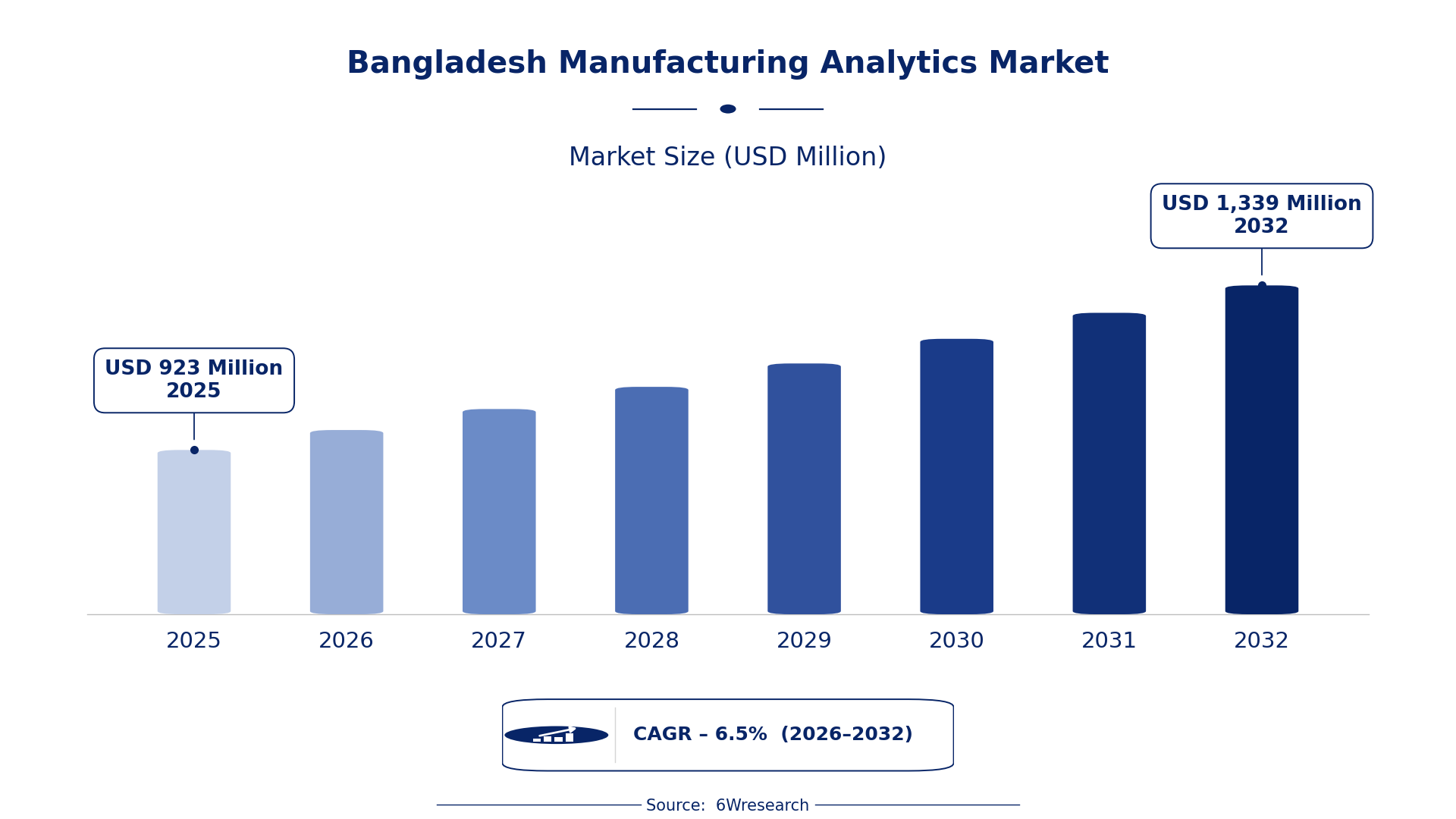
The Bangladesh Manufacturing Analytics Market was estimated at USD 923 Million in 2025 and is projected to reach USD 1339 Million by 2032, growing at a CAGR of 6.5% from 2026 to 2032.
Bangladesh Manufacturing Analytics Market Synopsis
The increasing adoption of big data analytics and artificial intelligence in manufacturing processes is the primary force driving the Bangladesh Manufacturing Analytics Market. Companies are actively seeking data-driven insights to enhance operational efficiency, reduce costs, and improve product quality.
As manufacturers prioritize predictive maintenance and real-time analytics, the demand for comprehensive manufacturing analytics solutions is set to rise. This trend is crucial for staying competitive in both domestic and global markets, particularly as industries strive for digital transformation.
Bangladesh Manufacturing Analytics Market Year-wise Growth Rate and Key Drivers
This graph illustrates the annual growth rates of the Bangladesh Manufacturing Analytics Market from 2021 to 2032, highlighting a steady upward trajectory and projected expansion over the forecast period.
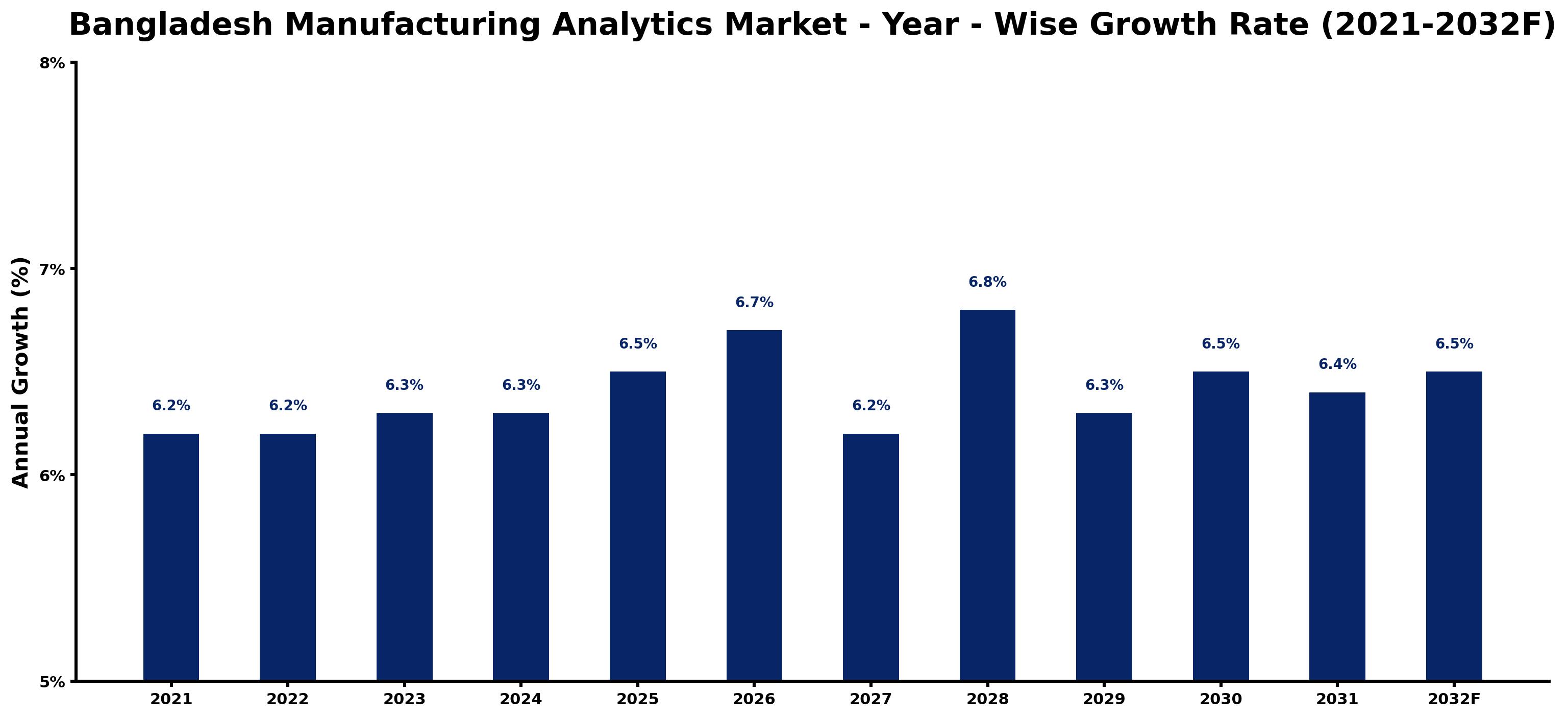
The table below presents the year‑wise growth rates along with the key drivers influencing the market
| Year | Growth Rate | Major Drivers |
| 2021 | 6.2% | Government's Digital Bangladesh initiative boosting analytics adoption. |
| 2022 | 6.2% | Rise in textile exports driving data analytics demand. |
| 2023 | 6.3% | Increased investment in garment sector technology upgrades. |
| 2024 | 6.3% | National Skill Development Policy enhancing workforce analytics training. |
| 2025 | 6.5% | E-commerce growth prompting advanced supply chain analytics. |
| 2026 | 6.7% | Rising local startups utilizing data for manufacturing efficiency. |
| 2027 | 6.2% | Regulatory focus on quality assurance driving analytics adoption. |
| 2028 | 6.8% | Emergence of Industry 4.0 initiatives promoting advanced data solutions. |
| 2029 | 6.3% | Increased emphasis on sustainability fostering data-driven insights. |
| 2030 | 6.5% | Government tax incentives for tech adoption in factories. |
| 2031 | 6.4% | Growing interest in operational efficiency through predictive analytics. |
| 2032 | 6.5% | Public-private partnerships enhancing technological capabilities in manufacturing. |
Note: Market size estimations and growth projections presented in this report are based on 6Wresearch's proprietary forecasting methodology, utilizing the latest available industry data, government publications, and primary research inputs.
Bangladesh Manufacturing Analytics Market Key Takeaways
Below are some of the specific key takeaways from the market, including:
- The market is fueled by a growing need for data-driven decision-making and operational optimization.
- Integration of IoT technologies is enhancing the scope of manufacturing analytics solutions.
- Challenges such as data integration and workforce shortages may hinder market growth.
- Government initiatives are increasingly focused on promoting digital transformation in manufacturing.
- Emerging trends in predictive analytics are reshaping quality control and supply chain management.
Evaluation of Restraints in Bangladesh Manufacturing Analytics Market
Despite the promising outlook, the Bangladesh Manufacturing Analytics Market faces several restraints. Data integration complexities are a major hurdle, as manufacturers often struggle to consolidate data from various sources effectively. Additionally, a shortage of skilled professionals in data analytics exacerbates the issue, limiting the sector's ability to fully utilize advanced analytics tools. Resistance to adopting data-driven practices can also stall progress, as many companies remain hesitant to shift from traditional methods to more modern, analytics-driven approaches.
Bangladesh Manufacturing Analytics Market Trends
Several trends are shaping the Bangladesh Manufacturing Analytics Market. The shift towards automation and smart manufacturing is gaining momentum, with companies increasingly investing in IoT and machine learning technologies. Predictive maintenance is also becoming more prevalent, as manufacturers seek to minimize downtime and optimize their operations. on top of that, the focus on sustainability is driving the demand for analytics solutions that help reduce waste and energy consumption, making analytics an integral part of environmentally-conscious manufacturing practices.
Bangladesh Manufacturing Analytics Market Opportunities
The potential for growth in the Bangladesh Manufacturing Analytics Market is substantial. Opportunities lie in the development of tailored analytics solutions for specific sectors, such as textiles and pharmaceuticals, which are crucial to the economy. Additionally, partnerships between technology providers and manufacturers can foster innovation and drive adoption. As the government continues to support digital initiatives, manufacturers should leverage these policies to modernize their operations and enhance productivity.
Government Initiatives in the Bangladesh Manufacturing Analytics Market
The government of Bangladesh is actively supporting the adoption of manufacturing analytics technologies through various initiatives. By implementing policies that encourage digitization, the government is laying the groundwork for a more data-driven industrial sector. Regulatory frameworks are also being developed to address data privacy and security, which are crucial for building trust in analytics solutions.
- A national digital infrastructure upgrade programme now in its rollout phase aims to enhance connectivity for manufacturers.
- Current initiatives focus on building data analytics talent through partnerships with educational institutions and industry stakeholders.
- A regulatory framework introduced in 2025 mandates data privacy standards for analytics software used in manufacturing.
- Plans for upcoming incentives to support small and medium enterprises in adopting analytics technologies are underway.
Future Insights of the Bangladesh Manufacturing Analytics Market
Looking ahead to 2026-2032, the Bangladesh Manufacturing Analytics Market is set for accelerated growth. As manufacturers increasingly recognize the value of data-driven insights, the demand for advanced analytics solutions will surge. The convergence of AI and IoT technologies will further enhance capabilities, allowing for smarter decision-making and improved efficiency. With continued government support and a growing focus on innovation, the market is likely to witness a transformative shift in how manufacturing processes are managed and optimized.
Bangladesh Manufacturing Analytics Market Latest Developments
Recent activity in the Bangladesh Manufacturing Analytics Market indicates a strong push towards modernization and digital transformation. Over the past year, manufacturers have begun to adopt more sophisticated analytics tools, driven by the necessity for improved operational efficiency and competitiveness.
- A leading technology vendor launched an advanced manufacturing analytics platform in early 2025, targeting the textile sector.
- Ongoing partnerships between local manufacturers and international analytics firms aim to enhance data integration capabilities.
- A major initiative that began in mid-2025 focuses on training programs to develop skills in data analytics within the manufacturing workforce.
- A rollout expected to begin in Q3 2026 will introduce a new regulatory framework for data sharing among manufacturers.
Bangladesh Manufacturing Analytics Market - Key Attractiveness of the Report
- 10 Years of Market Numbers
- Historical Data Starting from 2022 to 2025
- Base Year: 2025
- Forecast Data until 2032
- Key Performance Indicators Impacting the Market
- Major Upcoming Developments and Projects
Key Highlights of the Report:
- Bangladesh Manufacturing Analytics Market Outlook
- Market Size of Bangladesh Manufacturing Analytics Market, 2025
- Forecast of Bangladesh Manufacturing Analytics Market, 2032
- Historical Data and Forecast of Bangladesh Manufacturing Analytics Revenues & Volume for the Period 2022-2032F
- Bangladesh Manufacturing Analytics Market Trend Evolution
- Bangladesh Manufacturing Analytics Market Drivers and Challenges
- Bangladesh Manufacturing Analytics Price Trends
- Bangladesh Manufacturing Analytics Porter's Five Forces
- Bangladesh Manufacturing Analytics Industry Life Cycle
- Historical Data and Forecast of Bangladesh Manufacturing Analytics Market Revenues & Volume By Type for the Period 2022-2032F
- Historical Data and Forecast of Bangladesh Manufacturing Analytics Market Revenues & Volume By Software for the Period 2022-2032F
- Historical Data and Forecast of Bangladesh Manufacturing Analytics Market Revenues & Volume By Service for the Period 2022-2032F
- Historical Data and Forecast of Bangladesh Manufacturing Analytics Market Revenues & Volume By Deployment Models for the Period 2022-2032F
- Historical Data and Forecast of Bangladesh Manufacturing Analytics Market Revenues & Volume By On-premises for the Period 2022-2032F
- Historical Data and Forecast of Bangladesh Manufacturing Analytics Market Revenues & Volume By On-demand for the Period 2022-2032F
- Historical Data and Forecast of Bangladesh Manufacturing Analytics Market Revenues & Volume By Applications for the Period 2022-2032F
- Historical Data and Forecast of Bangladesh Manufacturing Analytics Market Revenues & Volume By Predictive maintenance & asset management for the Period 2022-2032F
- Historical Data and Forecast of Bangladesh Manufacturing Analytics Market Revenues & Volume By Inventory management for the Period 2022-2032F
- Historical Data and Forecast of Bangladesh Manufacturing Analytics Market Revenues & Volume By Supply chain planning & procurement for the Period 2022-2032F
- Historical Data and Forecast of Bangladesh Manufacturing Analytics Market Revenues & Volume By Energy management for the Period 2022-2032F
- Historical Data and Forecast of Bangladesh Manufacturing Analytics Market Revenues & Volume By Emergency management for the Period 2022-2032F
- Historical Data and Forecast of Bangladesh Manufacturing Analytics Market Revenues & Volume By Sales & customer management for the Period 2022-2032F
- Historical Data and Forecast of Bangladesh Manufacturing Analytics Market Revenues & Volume By Other applications for the Period 2022-2032F
- Historical Data and Forecast of Bangladesh Manufacturing Analytics Market Revenues & Volume By Industry Vertical for the Period 2022-2032F
- Historical Data and Forecast of Bangladesh Manufacturing Analytics Market Revenues & Volume By Automotive & aerospace manufacturing for the Period 2022-2032F
- Historical Data and Forecast of Bangladesh Manufacturing Analytics Market Revenues & Volume By Electronics equipment manufacturing for the Period 2022-2032F
- Historical Data and Forecast of Bangladesh Manufacturing Analytics Market Revenues & Volume By Food & beverages manufacturing for the Period 2022-2032F
- Historical Data and Forecast of Bangladesh Manufacturing Analytics Market Revenues & Volume By Chemicals & materials manufacturing for the Period 2022-2032F
- Historical Data and Forecast of Bangladesh Manufacturing Analytics Market Revenues & Volume By Machinery & industrial equipment manufacturing for the Period 2022-2032F
- Historical Data and Forecast of Bangladesh Manufacturing Analytics Market Revenues & Volume By Pharma and life sciences for the Period 2022-2032F
- Historical Data and Forecast of Bangladesh Manufacturing Analytics Market Revenues & Volume By Paper, pulp, plastic and rubber manufacturing for the Period 2022-2032F
- Historical Data and Forecast of Bangladesh Manufacturing Analytics Market Revenues & Volume By Others for the Period 2022-2032F
- Bangladesh Manufacturing Analytics Import Export Trade Statistics
- Market Opportunity Assessment By Type
- Market Opportunity Assessment By Deployment Models
- Market Opportunity Assessment By Applications
- Market Opportunity Assessment By Industry Vertical
- Bangladesh Manufacturing Analytics Top Companies Market Share
- Bangladesh Manufacturing Analytics Competitive Benchmarking By Technical and Operational Parameters
- Bangladesh Manufacturing Analytics Company Profiles
- Bangladesh Manufacturing Analytics Key Strategic Recommendations






































