Bangladesh Meat Packaging Market Summary
The bangladesh meat packaging market was estimated at USD 1291 Million in 2025 and is projected to reach USD 1878 Million by 2032, growing at a CAGR of 6.2% from 2026 to 2032.
Bangladesh Meat Packaging Market Year-wise Growth Rate and Key Drivers
This graph highlights how the Bangladesh Meat Packaging Market has steadily grown over the past five years, supported by major growth factors.
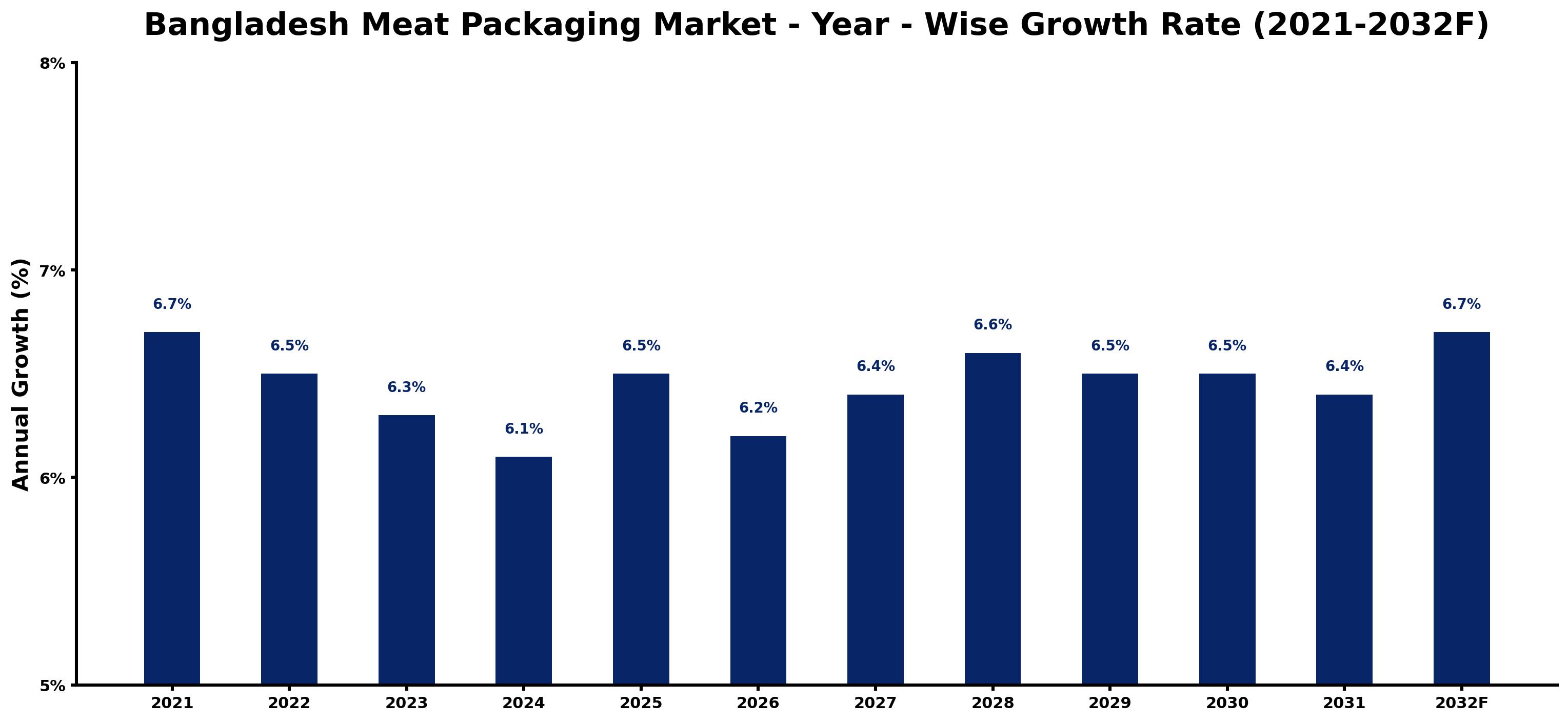
The table below presents the year wise growth rates along with the key drivers influencing the market
| Year | Growth Rate | Major Drivers |
| 2021 | 6.7% | Consumer awareness about hygiene and packaging convenience shapes initial market growth. |
| 2022 | 6.5% | Increased urbanization leads to higher demand for packaged meat products across cities. |
| 2023 | 6.3% | Supply chain improvements ensure fresher meat reaches consumers through effective distribution networks. |
| 2024 | 6.1% | Rising disposable incomes allow households to prioritize quality meat products over cheaper options. |
| 2025 | 6.5% | E-commerce platforms facilitate easier access to packaged meats for urban consumers. |
| 2026 | 6.2% | Local meat producers invest in modern packaging technologies, enhancing product shelf life. |
| 2027 | 6.4% | Health consciousness prompts consumers to choose safer, packaged meat alternatives over traditional options. |
| 2028 | 6.6% | Export opportunities grow as Bangladeshi meat packaging meets international quality standards. |
| 2029 | 6.5% | Collaboration between producers and retailers optimizes chilled supply chains to reduce spoilage. |
| 2030 | 6.5% | Emerging lifestyles influence preferences for ready-to-cook meat products, boosting packaging demand. |
| 2031 | 6.4% | Sustainability initiatives encourage eco-friendly packaging materials among local meat manufacturers. |
| 2032 | 6.7% | Increased retail competition intensifies innovation in meat packaging solutions to attract consumers. |
Note - Market size estimations and growth projections presented in this report are based on 6Wresearch's advanced forecasting approach, validated with industry datasets as of June 2026.
Bangladesh Meat Packaging Market Synopsis
The Bangladesh Meat Packaging Market is projected to reach 6.2% and witness significant growth during the forecast period (2026-2032). This growth is primarily fueled by escalating consumer demand for packaged meat products, an increase in disposable incomes, and evolving preferences towards convenience and hygiene in food options. As urbanization progresses, the market is experiencing a transformation characterized by the implementation of advanced packaging technologies aimed at extending shelf life, enhancing product freshness, and ensuring safety in food consumption.
Bangladesh Meat Packaging Market Growth Drivers
Several factors are driving robust growth in the Bangladesh Meat Packaging Market. The rise in disposable income, particularly among the burgeoning middle class, has led to a marked increase in the consumption of processed and packaged meat products. This demographic shift is accompanied by changing dietary preferences, with consumers gravitating towards ready-to-eat meals and hygienically packaged options. Additionally, the adoption of innovative packaging solutions such as vacuum and modified atmosphere packaging is becoming mainstream, significantly enhancing the appeal of meat products.
- The urban population is expanding rapidly, leading to increased demand for convenient food options that meet the busy lifestyles of city dwellers.
- Consumer awareness regarding food safety and quality is on the rise, further propelling demand for high-quality packaged meat solutions.
- Regulatory bodies are enforcing stringent food safety standards, which necessitate the adoption of safe and durable packaging materials.
- Environmental concerns are driving the demand for sustainable and eco-friendly packaging solutions, aligning with global trends towards environmental responsibility.
- Technological advancements in packaging, such as the development of intelligent packaging systems that offer freshness indicators, are gaining traction in the market.
Bangladesh Meat Packaging Market Trends and Opportunities
Key trends shaping the Bangladesh Meat Packaging Market include a rise in consumer preference for innovative packaging formats, particularly those that offer improved convenience and product safety. Vacuum-sealed packs and modified atmosphere packaging solutions are increasingly being adopted as essential requirements to maintain the freshness and quality of meat products. Additionally, there is a notable shift towards sustainable packaging, with consumers favoring products that utilize eco-friendly materials.
- The increasing prevalence of portion-controlled packaging formats caters to the health-conscious consumer, making it easier to manage food intake and portion sizes.
- The ready-to-eat meal trend is propelling the demand for innovative meat packaging solutions that provide convenience without compromising quality.
- Packaging technologies such as active packaging, which can enhance food safety by using substances that actively extend shelf life, are becoming more prominent.
- Consumer education regarding hygiene and quality standards is expected to amplify the demand for packaged meat, as people become more discerning about food choices.
- Collaboration between packaging firms and local suppliers is on the rise, fostering innovation and customer-centric packaging solutions tailored to local preferences.
Bangladesh Meat Packaging Market Challenges and Restraints
While the Bangladesh Meat Packaging Market exhibits promising growth potential, it faces several challenges that must be addressed. One of the primary impediments is the inadequate infrastructure for cold storage and transportation, which often results in the deterioration of meat quality during transit. Furthermore, the lack of standardized packaging practices and regulatory compliance can compromise food safety and consumer trust in packaged meat products.
- Limited access to modern packaging technologies restricts the market's ability to meet global standards and adapt to changing consumer demands.
- The presence of unorganized market players introduces volatility in pricing and quality, making it difficult for established companies to maintain competitive edges.
- There exists a consumer perception issue, where some may not fully trust the safety and quality of packaged meat compared to fresh alternatives.
- Economic fluctuations can impact disposable incomes, subsequently affecting the purchasing power of consumers in the meat sector.
- Addressing logistical challenges, especially in rural areas, is crucial to ensure product accessibility and safety across all market segments.
Bangladesh Meat Packaging Market Investment Opportunities
The landscape of the Bangladesh Meat Packaging Market is replete with investment opportunities, particularly in light of the growing consumer appetite for high-quality and convenient meat products. The shift towards urban lifestyles coupled with rising disposable incomes creates a fertile environment for investors looking to capitalize on the increasing demand for packaged meat solutions. Establishing modern packaging facilities equipped with advanced technologies can significantly enhance supply chain efficiency and product quality.
- Investors should focus on developing sustainable packaging solutions that address environmental concerns and align with consumer preferences for eco-friendly products.
- Engagement with local producers to provide customized packaging solutions can facilitate market penetration and foster long-term partnerships.
- Exploring value-added products, such as marinated or pre-seasoned meats, can attract diverse consumer segments seeking convenience.
- Leveraging technology to create smarter packaging that enhances food safety and quality can further differentiate offerings in a competitive market.
- There is significant potential for investment in cold chain logistics to improve the distribution of packaged meat products throughout the country.
Bangladesh Meat Packaging Market Government Investment and Initiatives
The government of Bangladesh has made significant strides in promoting the meat packaging market through various initiatives aimed at regulatory compliance and food safety. The Department of Livestock Services (DLS) plays a pivotal role in instituting regulations pertaining to meat packaging and labeling, which are essential for maintaining hygiene and preventing adulteration. These regulations not only enhance consumer trust but also protect public health by ensuring the proper handling and storage of meat products.
Additionally, government efforts include guidelines for monitoring the use of additives and preservatives in meat packaging, which are indicative of a commitment to safeguarding consumer health. By fostering transparency in the meat packaging industry, these policies contribute to reinforcing Bangladesh's reputation as a reliable source of high-quality meat products. Through ongoing investments in infrastructure and technology, the government aims to elevate the standards of meat packaging, thus enabling market participants to compete on a global stage.
Bangladesh Meat Packaging Market Latest Developments (May 2025 - June 2026)
The Bangladesh Meat Packaging Market has witnessed several key developments between May 2025 and June 2026, highlighting its dynamic nature and responsiveness to industry trends. During this period, there has been an uptick in the implementation of advanced packaging technologies tailored to enhance product shelf life and safety. As sustainability remains a priority, increased adoption of eco-friendly materials has been observed, aligning with consumer advocacy for environmental responsibility.
Moreover, the market has seen a shift towards portion-controlled packaging formats, catering to the health-conscious demographic. Alongside this, industry players have been focusing on collaboration with local farmers and suppliers to create customized, market-driven packaging solutions. These collaborative efforts have resulted in a more integrated supply chain, ensuring better quality control and product consistency. Overall, the developments within this timeframe reflect an industry that is evolving to meet both consumer preferences and stringent regulatory standards.
Bangladesh Meat Packaging Market - Key Attractiveness of the Report
- 10 Years of Market Numbers
- Historical Data Starting from 2022 to 2025
- Base Year: 2025
- Forecast Data until 2032
- Key Performance Indicators Impacting the Market
- Major Upcoming Developments and Projects
Key Highlights of the Report:
- Bangladesh Meat Packaging Market Outlook
- Market Size of Bangladesh Meat Packaging Market, 2025
- Forecast of Bangladesh Meat Packaging Market, 2032F
- Historical Data and Forecast of Bangladesh Meat Packaging Revenues & Volume for the Period 2022-2032F
- Bangladesh Meat Packaging Market Trend Evolution
- Bangladesh Meat Packaging Market Drivers and Challenges
- Bangladesh Meat Packaging Price Trends
- Bangladesh Meat Packaging Porter's Five Forces
- Bangladesh Meat Packaging Industry Life Cycle
- Historical Data and Forecast of Bangladesh Meat Packaging Market Revenues & Volume By Material Type for the Period 2022-2032F
- Historical Data and Forecast of Bangladesh Meat Packaging Market Revenues & Volume By Plastic for the Period 2022-2032F
- Historical Data and Forecast of Bangladesh Meat Packaging Market Revenues & Volume By Rigid? for the Period 2022-2032F
- Historical Data and Forecast of Bangladesh Meat Packaging Market Revenues & Volume By Metal for the Period 2022-2032F
- Historical Data and Forecast of Bangladesh Meat Packaging Market Revenues & Volume By Meat Type for the Period 2022-2032F
- Historical Data and Forecast of Bangladesh Meat Packaging Market Revenues & Volume By Fresh and Frozen for the Period 2022-2032F
- Historical Data and Forecast of Bangladesh Meat Packaging Market Revenues & Volume By Processed for the Period 2022-2032F
- Historical Data and Forecast of Bangladesh Meat Packaging Market Revenues & Volume By Ready to Eat for the Period 2022-2032F
- Bangladesh Meat Packaging Import Export Trade Statistics
- Market Opportunity Assessment By Material Type
- Market Opportunity Assessment By Meat Type
- Bangladesh Meat Packaging Top Companies Market Share
- Bangladesh Meat Packaging Competitive Benchmarking By Technical and Operational Parameters
- Bangladesh Meat Packaging Company Profiles
- Bangladesh Meat Packaging Key Strategic Recommendations






































