Bangladesh Non-ferrous Metal Market Summary
The bangladesh non-ferrous metal market was estimated at USD 155 Million in 2025 and is projected to reach USD 169 Million by 2032, growing at a CAGR of 1.0% from 2026 to 2032.
Bangladesh Non-ferrous Metal Market Year-wise Growth Rate and Key Drivers
This graph highlights how the Bangladesh Non-ferrous Metal Market has steadily grown over the past five years, supported by major growth factors.
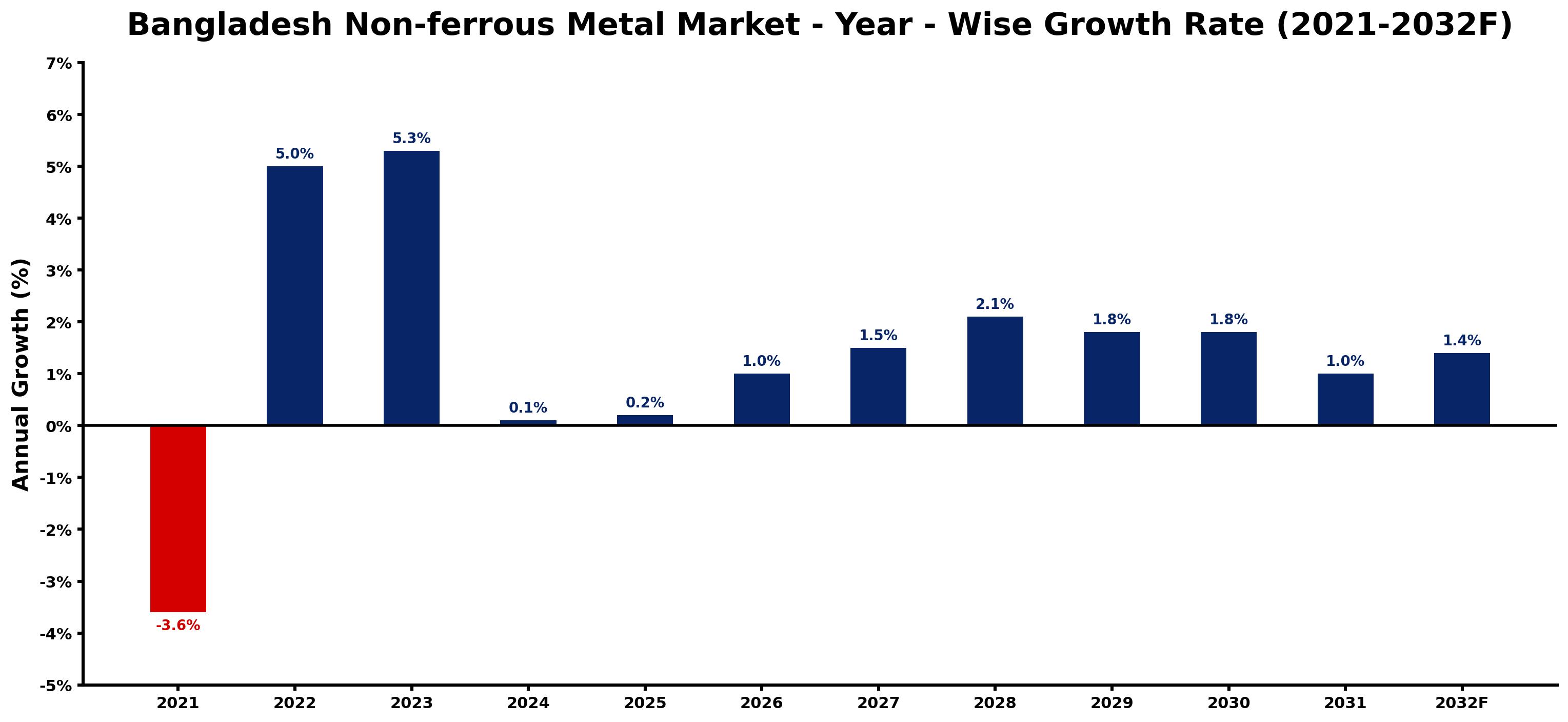
The table below presents the year wise growth rates along with the key drivers influencing the market
| Year | Growth Rate | Major Drivers |
| 2021 | -3.6% | Decreased global demand for nonferrous metals led to diminished exports, adversely impacting local production levels. |
| 2022 | 5.0% | Emerging electric vehicle industry increases copper requirements for manufacturing and infrastructure. |
| 2023 | 5.3% | Local industries transition to sustainable practices, boosting demand for recyclable metals. |
| 2024 | 0.1% | Infrastructure projects expand, driving increased consumption of aluminum and copper products. |
| 2025 | 0.2% | Urbanization trends lead to higher demand for non-ferrous metals in housing developments. |
| 2026 | 1.0% | Technological improvements in mining enhance extraction efficiency of essential non-ferrous minerals. |
| 2027 | 1.5% | Rising consumer electronics production fuels substantial demand for high-purity metals. |
| 2028 | 2.1% | Bangladesh's export potential in non-ferrous metals attracts foreign investment and partnerships. |
| 2029 | 1.8% | Increased focus on renewable energy systems requires more copper for installation. |
| 2030 | 1.8% | Local manufacturers prioritize domestic sourcing, stimulating growth in regional metal supply chains. |
| 2031 | 1.0% | Innovative recycling technologies emerge, transforming waste into valuable non-ferrous resources. |
| 2032 | 1.4% | Economic stability enhances infrastructure investment, securing long-term growth for metal markets. |
Note - Market size estimations and growth projections presented in this report are based on 6Wresearch's advanced forecasting approach, validated with industry datasets as of June 2026.
Bangladesh Non-ferrous Metal Market Synopsis
The Bangladesh Non-ferrous Metal Market is projected to reach 1.0% and witness significant growth during the forecast period (2026-2032). This growth is attributed to the increasing demand for lightweight metals utilized across various sectors, including automotive, construction, and electronics. Non-ferrous metals are favored in multiple end-user industries owing to their superior performance compared to ferrous metals, making them a key component in modern manufacturing processes.
Bangladesh Non-ferrous Metal Market Growth Drivers
The expansion of the Bangladesh non-ferrous metal market is propelled by several pivotal factors. Firstly, the booming automotive sector demands lightweight materials to enhance fuel efficiency and performance. Secondly, the surge in construction activities, fueled by urbanization, necessitates durable and corrosion-resistant materials typical of non-ferrous metals. Thirdly, increased governmental initiatives for infrastructure development lead to heightened demand for these metals. Fourthly, the rising focus on green technologies and energy efficiency drives investments in modern manufacturing practices. Lastly, enhanced awareness among industries regarding the recyclability and sustainability of non-ferrous metals fuels their adoption.
Bangladesh Non-ferrous Metal Market Trends and Opportunities
Emerging trends in the Bangladesh non-ferrous metal market indicate a shift towards innovation and technology-driven solutions. The ongoing urbanization trend presents significant opportunities for manufacturers to develop applications tailored for urban construction projects. Furthermore, advancements in metal recycling technologies create avenues for approaching a circular economy within the sector. Additionally, the growing emphasis on sustainable practices encourages industries to invest in eco-friendly non-ferrous metal production processes. The proliferation of technology-driven approaches in the automotive sector also opens new market opportunities for lightweight metal applications in electric vehicles, signalling an evolving landscape.
Bangladesh Non-ferrous Metal Market Government Investment and Initiatives
The role of government investment and initiatives is crucial for the development of the Bangladesh non-ferrous metal market. The government has been proactive in launching various infrastructure projects aimed at revitalizing the economy, which subsequently increases the demand for non-ferrous metals. Furthermore, policies promoting industrialization and foreign investment are designed to attract capital into the manufacturing sector. These initiatives often include tax incentives for companies investing in green technologies, thereby aligning with global sustainability goals. Moreover, infrastructure development plans position non-ferrous metals as essential materials in construction, thereby fostering a conducive environment for growth in this sector. Lastly, programs aimed at enhancing skill development in metallurgy and engineering continue to support the industry's expansion.
Bangladesh Non-ferrous Metal Market Latest Developments (May 2025 - June 2026)
Recent developments in the Bangladesh non-ferrous metal market from May 2025 to June 2026 reflect advancements in production techniques and increasing collaborations among stakeholders. Noteworthy is the momentum surrounding projects that aim to modernize existing infrastructure. The sector has also seen an uptick in the integration of eco-friendly practices, as industries shift towards greener production methods. The government's drive towards enhancing infrastructure has catalyzed investments in non-ferrous materials, aligning these developments with national growth objectives. Furthermore, the increased presence and acceptance of non-ferrous metals in emerging applications, such as in renewable energy systems, indicate a growing recognition of their versatility and importance. Overall, these developments signal a robust trajectory for the market in the near future.
Bangladesh Non-ferrous Metal Market - Key Attractiveness of the Report
- 10 Years of Market Numbers
- Historical Data Starting from 2022 to 2025
- Base Year: 2025
- Forecast Data until 2032
- Key Performance Indicators Impacting the Market
- Major Upcoming Developments and Projects
Key Highlights of the Report:
- Bangladesh Non-ferrous Metal Market Outlook
- Market Size of Bangladesh Non-ferrous Metal Market, 2025
- Forecast of Bangladesh Non-ferrous Metal Market, 2032F
- Historical Data and Forecast of Bangladesh Non-ferrous Metal Revenues & Volume for the Period 2022-2032F
- Bangladesh Non-ferrous Metal Market Trend Evolution
- Bangladesh Non-ferrous Metal Market Drivers and Challenges
- Bangladesh Non-ferrous Metal Price Trends
- Bangladesh Non-ferrous Metal Porter's Five Forces
- Bangladesh Non-ferrous Metal Industry Life Cycle
- Historical Data and Forecast of Bangladesh Non-ferrous Metal Market Revenues & Volume By Types for the Period 2022-2032F
- Historical Data and Forecast of Bangladesh Non-ferrous Metal Market Revenues & Volume By Aluminum for the Period 2022-2032F
- Historical Data and Forecast of Bangladesh Non-ferrous Metal Market Revenues & Volume By Copper for the Period 2022-2032F
- Historical Data and Forecast of Bangladesh Non-ferrous Metal Market Revenues & Volume By Lead for the Period 2022-2032F
- Historical Data and Forecast of Bangladesh Non-ferrous Metal Market Revenues & Volume By Tin for the Period 2022-2032F
- Historical Data and Forecast of Bangladesh Non-ferrous Metal Market Revenues & Volume By Nickel for the Period 2022-2032F
- Historical Data and Forecast of Bangladesh Non-ferrous Metal Market Revenues & Volume By Titanium for the Period 2022-2032F
- Historical Data and Forecast of Bangladesh Non-ferrous Metal Market Revenues & Volume By Zinc for the Period 2022-2032F
- Historical Data and Forecast of Bangladesh Non-ferrous Metal Market Revenues & Volume By Applications for the Period 2022-2032F
- Historical Data and Forecast of Bangladesh Non-ferrous Metal Market Revenues & Volume By Automobile Industry for the Period 2022-2032F
- Historical Data and Forecast of Bangladesh Non-ferrous Metal Market Revenues & Volume By Electronic Power Industry for the Period 2022-2032F
- Historical Data and Forecast of Bangladesh Non-ferrous Metal Market Revenues & Volume By Construction Industry for the Period 2022-2032F
- Historical Data and Forecast of Bangladesh Non-ferrous Metal Market Revenues & Volume By Other for the Period 2022-2032F
- Bangladesh Non-ferrous Metal Import Export Trade Statistics
- Market Opportunity Assessment By Types
- Market Opportunity Assessment By Applications
- Bangladesh Non-ferrous Metal Top Companies Market Share
- Bangladesh Non-ferrous Metal Competitive Benchmarking By Technical and Operational Parameters
- Bangladesh Non-ferrous Metal Company Profiles
- Bangladesh Non-ferrous Metal Key Strategic Recommendations






































