Bangladesh Orphan Drugs Market Size, Share & Growth Rate
The Bangladesh Orphan Drugs Market was estimated at USD 1472 Million in 2025 and is projected to reach USD 2102 Million by 2032, growing at a CAGR of 5.2% from 2026 to 2032. This growth trajectory is largely fueled by an increased recognition of rare diseases among healthcare providers and patients, alongside a government push to enhance healthcare infrastructure. Moreover, the rising demand for personalized medicine further underpins market expansion.
Bangladesh Orphan Drugs Market Year-wise Growth Rate and Key Drivers
This graph highlights how the Bangladesh Orphan Drugs Market has steadily grown over the years, supported by major growth factors.
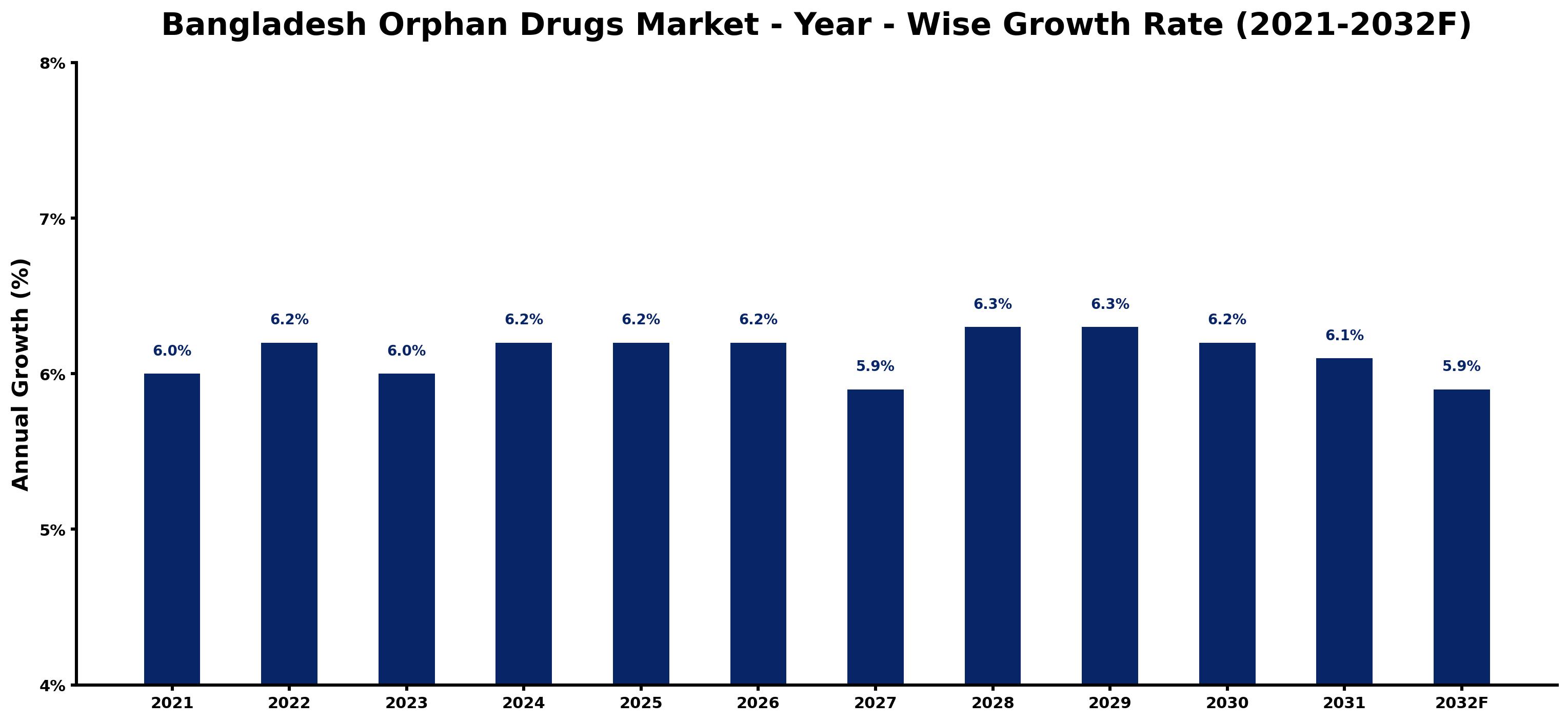
The table below presents the year‑wise growth rates along with the key drivers influencing the market
| Year | Growth Rate | Major Drivers |
| 2021 | 6.0% | Government infrastructure modernization initiatives |
| 2022 | 6.2% | Expansion of transportation and logistics networks |
| 2023 | 6.0% | Increasing industrial automation investments |
| 2024 | 6.2% | Government infrastructure modernization initiatives |
| 2025 | 6.2% | Growing renewable energy integration projects |
| 2026 | 6.2% | Government infrastructure modernization initiatives |
| 2027 | 5.9% | Rising electricity demand across industries |
| 2028 | 6.3% | Expansion of manufacturing activities |
| 2029 | 6.3% | Expansion of commercial construction activities |
| 2030 | 6.2% | Growing urbanization and commercial development |
| 2031 | 6.1% | Increasing adoption of advanced technologies |
| 2032 | 5.9% | Increasing adoption of advanced technologies |
Note - Market size estimations and growth projections presented in this report are based on 6Wresearch's advanced forecasting approach, validated with industry datasets as of June 2026.
Bangladesh Orphan Drugs Market Synopsis
Currently, increased awareness surrounding rare diseases is the primary force shaping the Bangladesh orphan drugs market. As more patients and healthcare professionals recognize the significance of specialized treatments, the demand for orphan drugs is steadily rising.
Additionally, the government's initiatives aimed at improving healthcare access and encouraging local production of essential medicines indirectly benefit this niche market. These efforts set the stage for future growth by fostering an environment conducive to investment in orphan drug development.
Bangladesh Orphan Drugs Market Key Takeaways
- The market is set for substantial growth with a projected value increase from USD 1472 Million in 2025 to USD 2102 Million by 2032.
- Rising prevalence of rare diseases and increased awareness are pivotal in driving market demand.
- Government initiatives play a crucial role in enhancing healthcare access for patients needing orphan drugs.
- Collaborations between pharmaceutical companies and research institutions are expected to accelerate drug discovery and development.
- Investment opportunities exist in tailored treatments to address specific rare diseases prevalent in the region.
Evaluation of Restraints in Bangladesh Orphan Drugs Market
The Bangladesh orphan drugs market faces real limitations primarily due to limited awareness among healthcare professionals and patients regarding orphan drugs, which often results in diminished demand. Regulatory hurdles and the high cost associated with research and development further complicate market dynamics. Additionally, the lack of comprehensive data on rare disease prevalence poses significant challenges, hampering targeted drug development and market expansion. To unlock the full potential of this market, addressing these constraints is essential.
Bangladesh Orphan Drugs Market Trends
Key trends shaping the Bangladesh orphan drugs market include a shift towards personalized medicine, with treatments increasingly tailored to individual genetic profiles. Advancements in biotechnology are leading to the emergence of more targeted therapies, generating a significant interest among investors and researchers alike. Furthermore, increasing collaborations between pharmaceutical firms and research institutions are expediting drug discovery processes, fostering innovation within this niche segment.
Bangladesh Orphan Drugs Market Opportunities
Investment opportunities within the Bangladesh orphan drugs market are significant. With around 7,000 rare diseases impacting nearly 8 million individuals, there exists a profound unmet medical need. This opens avenues for partnerships with local pharmaceutical companies to develop and commercialize orphan drugs specifically designed for the Bangladeshi population. The government's commitment to improving healthcare infrastructure further enhances the investment landscape, presenting favorable conditions for market entrants.
Government Initiatives in the Bangladesh Orphan Drugs Market
Although there are no specific policies exclusively targeting orphan drugs, the Bangladesh government is working to improve access to essential medicines, which indirectly benefits rare disease treatments. The National Drug Policy aims to ensure that pharmaceuticals are available, affordable, and of high quality, while the Drug Control Ordinance regulates drug registration and pricing. These initiatives create a supportive environment for the orphan drugs market, highlighting the government's dedication to enhancing public health.
Future Insights of the Bangladesh Orphan Drugs Market
Looking ahead to 2026-2032, the future of the Bangladesh orphan drugs market is optimistic. With growing awareness of rare diseases and a consistent focus on improving healthcare infrastructure, we expect substantial market advancements. The government's supportive initiatives will likely lead to streamlined regulatory processes, further encouraging the development and availability of orphan drugs. As the number of diagnoses rises, particularly in the context of personalized medicine, demand for these specialized treatments is anticipated to increase steadily.
Bangladesh Orphan Drugs Market Latest Developments (May 2025 - June 2026)
Recent developments in the Bangladesh orphan drugs market indicate a stronger collaboration between pharmaceutical companies and healthcare providers. There has been a notable push towards enhancing the research infrastructure to support the development of orphan drugs tailored to local patient needs. Additionally, stakeholders are engaging in dialogues about regulatory reforms aimed at expediting the approval process for orphan drugs, thereby facilitating faster market entry for innovative treatments.
Bangladesh Orphan Drugs Market - Key Attractiveness of the Report
- 10 Years of Market Numbers
- Historical Data Starting from 2022 to 2025
- Base Year: 2025
- Forecast Data until 2032
- Key Performance Indicators Impacting the Market
- Major Upcoming Developments and Projects
Key Highlights of the Report:
- Bangladesh Orphan Drugs Market Outlook
- Market Size of Bangladesh Orphan Drugs Market, 2025
- Forecast of Bangladesh Orphan Drugs Market, 2032
- Historical Data and Forecast of Bangladesh Orphan Drugs Revenues & Volume for the Period 2022-2032F
- Bangladesh Orphan Drugs Market Trend Evolution
- Bangladesh Orphan Drugs Market Drivers and Challenges
- Bangladesh Orphan Drugs Price Trends
- Bangladesh Orphan Drugs Porter's Five Forces
- Bangladesh Orphan Drugs Industry Life Cycle
- Historical Data and Forecast of Bangladesh Orphan Drugs Market Revenues & Volume By Drugs for the Period 2022-2032F
- Historical Data and Forecast of Bangladesh Orphan Drugs Market Revenues & Volume By Revlimid for the Period 2022-2032F
- Historical Data and Forecast of Bangladesh Orphan Drugs Market Revenues & Volume By Rituxan for the Period 2022-2032F
- Historical Data and Forecast of Bangladesh Orphan Drugs Market Revenues & Volume By Opdivo for the Period 2022-2032F
- Historical Data and Forecast of Bangladesh Orphan Drugs Market Revenues & Volume By Keytruda for the Period 2022-2032F
- Historical Data and Forecast of Bangladesh Orphan Drugs Market Revenues & Volume By Imbruvica for the Period 2022-2032F
- Historical Data and Forecast of Bangladesh Orphan Drugs Market Revenues & Volume By Soliris for the Period 2022-2032F
- Historical Data and Forecast of Bangladesh Orphan Drugs Market Revenues & Volume By Other Orphan Drugs for the Period 2022-2032F
- Historical Data and Forecast of Bangladesh Orphan Drugs Market Revenues & Volume By Drug Type for the Period 2022-2032F
- Historical Data and Forecast of Bangladesh Orphan Drugs Market Revenues & Volume By Biologics for the Period 2022-2032F
- Historical Data and Forecast of Bangladesh Orphan Drugs Market Revenues & Volume By Non-Biologics for the Period 2022-2032F
- Historical Data and Forecast of Bangladesh Orphan Drugs Market Revenues & Volume By Therapy Class for the Period 2022-2032F
- Historical Data and Forecast of Bangladesh Orphan Drugs Market Revenues & Volume By Oncology for the Period 2022-2032F
- Historical Data and Forecast of Bangladesh Orphan Drugs Market Revenues & Volume By Blood for the Period 2022-2032F
- Historical Data and Forecast of Bangladesh Orphan Drugs Market Revenues & Volume By Endocrine for the Period 2022-2032F
- Historical Data and Forecast of Bangladesh Orphan Drugs Market Revenues & Volume By Central Nervous Systems for the Period 2022-2032F
- Historical Data and Forecast of Bangladesh Orphan Drugs Market Revenues & Volume By Cardiovascular for the Period 2022-2032F
- Historical Data and Forecast of Bangladesh Orphan Drugs Market Revenues & Volume By Respiratory for the Period 2022-2032F
- Bangladesh Orphan Drugs Import Export Trade Statistics
- Market Opportunity Assessment By Drugs
- Market Opportunity Assessment By Drug Type
- Market Opportunity Assessment By Therapy Class
- Bangladesh Orphan Drugs Top Companies Market Share
- Bangladesh Orphan Drugs Competitive Benchmarking By Technical and Operational Parameters
- Bangladesh Orphan Drugs Company Profiles
- Bangladesh Orphan Drugs Key Strategic Recommendations






































