Bangladesh Perchloroethylene Market Size, Share & Growth Rate
The Bangladesh Perchloroethylene Market was estimated at USD 245 Million in 2025 and is projected to reach USD 334 Million by 2032, growing at a CAGR of 4.5% from 2026 to 2032. This growth is primarily fueled by the burgeoning textile and garment sector, where the demand for high-quality dry cleaning is on the rise. Additionally, the increasing urban population with higher disposable incomes contributes to a greater appetite for professional cleaning services, further propelling market dynamics.
Bangladesh Perchloroethylene Market Year-wise Growth Rate and Key Drivers
This graph highlights how the Bangladesh Perchloroethylene Market has steadily grown over the years, supported by major growth factors.
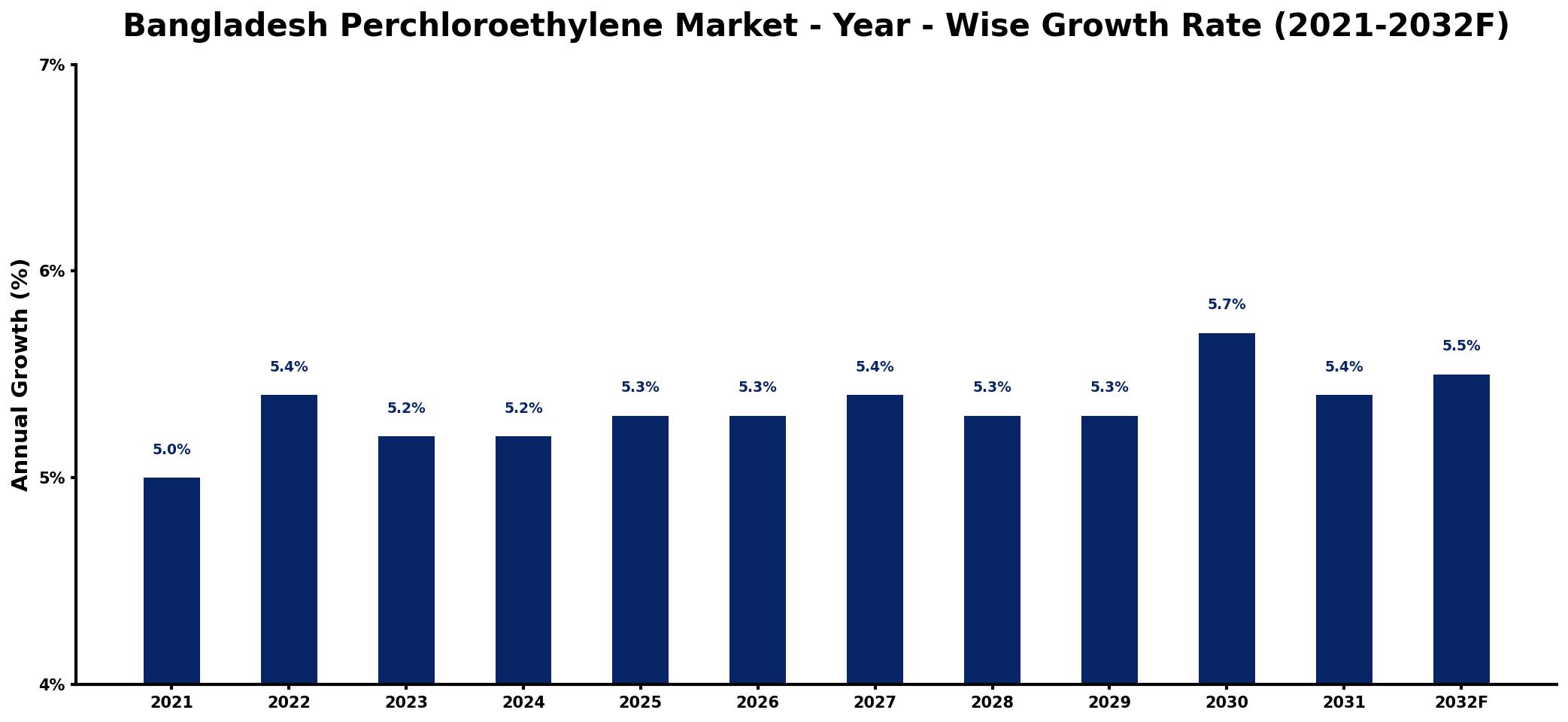
The table below presents the year‑wise growth rates along with the key drivers influencing the market
| Year | Growth Rate | Major Drivers |
| 2021 | 5.0% | Increased demand from textile industry |
| 2022 | 5.4% | Growth in industrial cleaning applications |
| 2023 | 5.2% | Expansion of automotive sector usage |
| 2024 | 5.2% | Rise in manufacturing investments |
| 2025 | 5.3% | Growing need for solvent alternatives |
| 2026 | 5.3% | Emergence of new chemical applications |
| 2027 | 5.4% | Strengthening regulations for environmental safety |
| 2028 | 5.3% | Enhancement of supply chain efficiencies |
| 2029 | 5.3% | Surge in electronics manufacturing demand |
| 2030 | 5.7% | improved processing technologies adoption |
| 2031 | 5.4% | Increased focus on sustainable practices |
| 2032 | 5.5% | Advancements in waste management technologies |
Note: Market size estimations and growth projections presented in this report are based on 6Wresearch's proprietary forecasting methodology, utilizing the latest available industry data, government publications, and primary research inputs.
Bangladesh Perchloroethylene Market Synopsis
The Bangladesh Perchloroethylene market is witnessing a robust uptick, largely driven by the country's thriving textile and garment industries. With the demand for dry cleaning services surging in urban locales, the application of Perchloroethylene in these processes has become indispensable for fabric care and quality enhancement.
As consumers become increasingly quality-conscious and affluent, the emphasis on professional fabric care rises. This trend not only positions Perchloroethylene as a critical solvent in dry cleaning but also highlights the industry's shift towards sustainability and environmental awareness.
Bangladesh Perchloroethylene Market Key Takeaways
- The market is experiencing growth fueled by the expanding textile and garment sector.
- Increasing disposable incomes among the middle class are driving demand for dry cleaning services.
- Environmental concerns are prompting a gradual shift towards eco-friendly alternatives.
- Government regulations are evolving to ensure safe handling and usage of Perchloroethylene.
- Investment opportunities are ripe in manufacturing, supply chains, and technological advancements.
Evaluation of Restraints in Bangladesh Perchloroethylene Market
The Bangladesh Perchloroethylene market faces significant constraints due to rising regulatory scrutiny and environmental concerns. With the introduction of stringent regulations governing hazardous materials, dry cleaning businesses are increasingly pressured to comply, resulting in higher operational costs. The public perception of Perchloroethylene as a potential health risk further complicates its use, compelling businesses to seek alternative solvents that are safer for both workers and the environment.
Bangladesh Perchloroethylene Market Trends
Current trends in the Bangladesh Perchloroethylene market highlight a dual focus on quality and sustainability. The surge in demand for professional dry cleaning services correlates with heightened awareness of fabric care, while the environmental movement drives interest in alternatives to traditional solvents. Businesses are also exploring innovative cleaning technologies that align with these sustainability goals, indicating a pivotal shift in operational practices.
Bangladesh Perchloroethylene Market Opportunities
The burgeoning demand for dry cleaning and textile processing services presents lucrative opportunities for investors in the Bangladesh Perchloroethylene market. Establishing manufacturing facilities to produce Perchloroethylene locally can help mitigate high import costs and foster supply chain efficiency. Moreover, investment in research and development of eco-friendly solvent alternatives and cleaning technologies can position companies favorably in an increasingly competitive landscape.
Government Initiatives in the Bangladesh Perchloroethylene Market
The Bangladeshi government is actively implementing policies aimed at promoting health and environmental safety concerning the use of Perchloroethylene. Through the Department of Environment (DoE), regulations have been established to oversee the handling and disposal of hazardous materials. These initiatives not only enhance compliance with international standards but also encourage sustainable practices within the industry, driving forward the overall market landscape.
Future Insights of the Bangladesh Perchloroethylene Market
Looking ahead to 2026-2032, the Bangladesh Perchloroethylene market is poised for steady growth, propelled by an expanding textile sector and increasing consumer preferences for premium cleaning services. While environmental considerations may challenge traditional practices, they also pave the way for innovation and adoption of greener alternatives. Thus, companies that adapt and evolve in line with market needs will likely thrive in this dynamic landscape.
Bangladesh Perchloroethylene Market Latest Developments (2025 - 2026)
Recent developments in the Bangladesh Perchloroethylene market reveal a shift towards enhancing operational standards in dry cleaning services. Industry players are increasingly investing in training programs aimed at safe handling and environmental management. Additionally, collaborations between the government and private sectors to promote eco-friendly practices are emerging, reflecting a collective commitment to sustainable growth in the industry.
Bangladesh Perchloroethylene Market - Key Attractiveness of the Report
- 10 Years of Market Numbers
- Historical Data Starting from 2022 to 2025
- Base Year: 2025
- Forecast Data until 2032
- Key Performance Indicators Impacting the Market
- Major Upcoming Developments and Projects
Key Highlights of the Report:
- Bangladesh Perchloroethylene Market Outlook
- Market Size of Bangladesh Perchloroethylene Market, 2025
- Forecast of Bangladesh Perchloroethylene Market, 2032
- Historical Data and Forecast of Bangladesh Perchloroethylene Revenues & Volume for the Period 2022-2032F
- Bangladesh Perchloroethylene Market Trend Evolution
- Bangladesh Perchloroethylene Market Drivers and Challenges
- Bangladesh Perchloroethylene Price Trends
- Bangladesh Perchloroethylene Porter's Five Forces
- Bangladesh Perchloroethylene Industry Life Cycle
- Historical Data and Forecast of Bangladesh Perchloroethylene Market Revenues & Volume By Type for the Period 2022-2032F
- Historical Data and Forecast of Bangladesh Perchloroethylene Market Revenues & Volume By Ethylene Oxychlorination for the Period 2022-2032F
- Historical Data and Forecast of Bangladesh Perchloroethylene Market Revenues & Volume By Acetylene Method for the Period 2022-2032F
- Historical Data and Forecast of Bangladesh Perchloroethylene Market Revenues & Volume By Ethylene Direct Chlorination for the Period 2022-2032F
- Historical Data and Forecast of Bangladesh Perchloroethylene Market Revenues & Volume By End-use for the Period 2022-2032F
- Historical Data and Forecast of Bangladesh Perchloroethylene Market Revenues & Volume By Dry Cleaning Agent for the Period 2022-2032F
- Historical Data and Forecast of Bangladesh Perchloroethylene Market Revenues & Volume By Solvent for the Period 2022-2032F
- Historical Data and Forecast of Bangladesh Perchloroethylene Market Revenues & Volume By Others for the Period 2022-2032F
- Bangladesh Perchloroethylene Import Export Trade Statistics
- Market Opportunity Assessment By Type
- Market Opportunity Assessment By End-use
- Bangladesh Perchloroethylene Top Companies Market Share
- Bangladesh Perchloroethylene Competitive Benchmarking By Technical and Operational Parameters
- Bangladesh Perchloroethylene Company Profiles
- Bangladesh Perchloroethylene Key Strategic Recommendations






































