Bangladesh Photography Equipment Market Summary
The bangladesh photography equipment market was estimated at USD 1481 Million in 2025 and is projected to reach USD 2115 Million by 2032, growing at a CAGR of 5.8% from 2026 to 2032.
Bangladesh Photography Equipment Market Year-wise Growth Rate and Key Drivers
This graph highlights how the Bangladesh Photography Equipment Market has steadily grown over the past five years, supported by major growth factors.
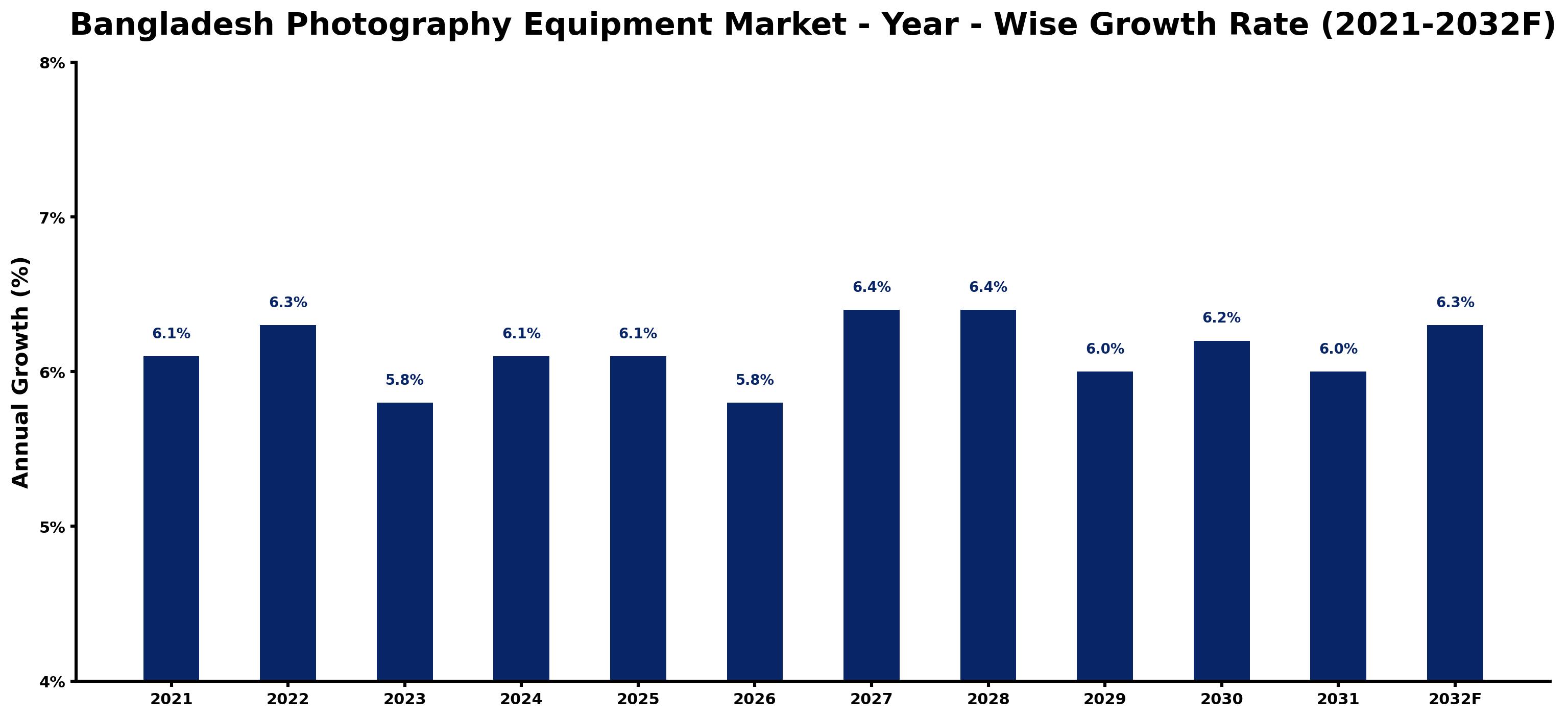
The table below presents the year wise growth rates along with the key drivers influencing the market
| Year | Growth Rate | Major Drivers |
| 2021 | 6.1% | The local photography community rapidly embraces digital platforms for sharing work. |
| 2022 | 6.3% | Increased tourism fueled a demand for high-quality photography services and equipment. |
| 2023 | 5.8% | Emerging influencers shaped aesthetic trends, prompting investments in advanced gear. |
| 2024 | 6.1% | Local brands innovate with affordable photography solutions tailored to regional preferences. |
| 2025 | 6.1% | Photography workshops gain popularity, encouraging enthusiasts to purchase better equipment. |
| 2026 | 5.8% | Social media campaigns spotlight Bangladeshi landscapes, boosting amateur photographer engagement. |
| 2027 | 6.4% | E-commerce platforms expand product offerings, enhancing accessibility for consumers nationwide. |
| 2028 | 6.4% | Photography schools establish partnerships with brands, driving demand for professional gear. |
| 2029 | 6.0% | Increased smartphone capabilities shift focus towards specialized photography accessories. |
| 2030 | 6.2% | International brands enter Bangladesh, fostering competition and variety in product offerings. |
| 2031 | 6.0% | Sustainable practices in manufacturing attract environmentally conscious consumers to new products. |
| 2032 | 6.3% | Cinematic projects increase, leading to a surge in demand for professional video equipment. |
Note - Market size estimations and growth projections presented in this report are based on 6Wresearch's advanced forecasting approach, validated with industry datasets as of June 2026.
Bangladesh Photography Equipment Market Synopsis
The Bangladesh Photography Equipment Market is projected to reach 5.8% and witness significant growth during the forecast period (2026-2032). This market is experiencing a robust expansion driven by an increasing interest in photography, both as a hobby and a professional pursuit. Factors propelling this growth encompass rising disposable incomes, enhanced accessibility to photography equipment, and the widespread influence of social media platforms which encourage the sharing of visual content.
Bangladesh Photography Equipment Market Growth Drivers
The growth trajectory of the Bangladesh photography equipment market is supported by several key drivers:
- The surge in disposable incomes among the Bangladeshi populace enables greater expenditure on quality photography gear, making it more accessible to a wider audience.
- As social media continues to ascend in popularity, there is a thriving demand for high-quality images, amplifying the need for superior photography equipment across various sectors including advertising and e-commerce.
- Technological advancements in photography equipment, particularly the rise of mirrorless cameras and smartphone accessories, capture the attention of both avid hobbyists and professional photographers.
- The burgeoning interest in drone photography is shaping new market segments, as aerial imaging becomes increasingly popular among content creators and enthusiasts.
- Growth in online retail channels facilitates access to a diverse range of products, enhancing consumer purchasing power and market competition.
Bangladesh Photography Equipment Market Trends and Opportunities
The Bangladesh photography equipment market is witnessing notable trends that present lucrative opportunities for stakeholders:
- An increasing focus on high-quality digital photography equipment indicates that consumers are willing to invest in advanced devices, encouraging manufacturers to innovate and diversify their offerings.
- The rise of visual content on social media platforms is prompting more individuals to pursue photography, leading to higher demand for training programs and workshops within the industry.
- There is a growing interest in value-added services such as photography editing and post-processing, expanding the scope for businesses to offer comprehensive photography solutions.
- The acceptance of online platforms for purchasing photography gear showcases the market's shift towards digital commerce, encouraging businesses to establish a strong online presence.
- Emerging startups in the photography sector are exploring niche markets such as specialized accessories and personalized photography goods, catering to specific consumer needs.
Bangladesh Photography Equipment Market Challenges and Restraints
Despite its growth potential, the Bangladesh photography equipment market faces several challenges:
- High import duties and taxes on photography equipment significantly inflate prices, creating affordability issues for both emerging and hobbyist photographers.
- The influx of low-quality, cheaper photography products from unregulated sources threatens the sales of established brands, leading to market dilution.
- Limited access to financing options for purchasing high-end equipment restricts market growth, particularly for new entrants in the photography field.
- The lack of specialized retail outlets and technical support for photographers in many regions complicates the purchasing process and after-sales service.
- Consumer education on the benefits of quality photography equipment remains limited, impacting overall market penetration and equipment sales.
Bangladesh Photography Equipment Market Investment Opportunities
The landscape of the Bangladesh photography equipment market presents myriad investment opportunities:
- Investors can delve into importing a diverse range of photography equipment, aligning with the rising demand from both amateurs and professionals.
- The burgeoning need for photography training and workshops creates a viable niche market for educational services, appealing to both aspiring and seasoned photographers.
- The rise of content creation has amplified the demand for high-quality equipment and services, encouraging investments in innovative photography solutions.
- Potential partnerships with established brands can bolster market presence and credibility, enhancing accessibility for consumers.
- Emerging trends in drone photography equipment open up avenues for capitalizing on new technologies that enhance consumer engagement.
Bangladesh Photography Equipment Market Government Investment and Initiatives
The Bangladesh government is actively fostering growth in the photography equipment market through various initiatives and policies:
- Reduction in import duties on photography equipment has been implemented to make products more accessible to local consumers, promoting market expansion.
- Regulatory measures have been established to uphold the quality and safety of photography products, protecting consumers from counterfeit goods.
- Initiatives to support local manufacturing and assembly of photography equipment have been initiated, providing incentives to domestic producers.
- Public spending on infrastructural improvements aims to enhance accessibility to photography services, benefiting both consumers and businesses.
- The government's engagement in consumer protection initiatives ensures a safer marketplace, thereby fostering consumer confidence in purchasing photography equipment.
Bangladesh Photography Equipment Market Latest Developments (May 2025 - June 2026)
Recent developments in the Bangladesh photography equipment market reflect a dynamic shift towards modernization and consumer engagement:
- New products featuring the latest technological advancements in imaging and accessories have entered the market, appealing to tech-savvy consumers.
- Industry players have reported a surge in online shopping activity, with more consumers opting for digital platforms to purchase photography equipment.
- Collaborations between training institutions and photography equipment retailers have emerged, promoting educational initiatives that cater to the growing number of photography enthusiasts.
- Drone photography has gained significant traction, leading to specialized events and exhibitions focused on aerial imaging technologies.
- An increase in social media marketing efforts by equipment distributors has effectively reached a younger demographic, stimulating demand for photographic products.
Bangladesh Photography Equipment Market - Key Attractiveness of the Report
- 10 Years of Market Numbers
- Historical Data Starting from 2022 to 2025
- Base Year: 2025
- Forecast Data until 2032
- Key Performance Indicators Impacting the Market
- Major Upcoming Developments and Projects
Key Highlights of the Report:
- Bangladesh Photography Equipment Market Outlook
- Market Size of Bangladesh Photography Equipment Market, 2025
- Forecast of Bangladesh Photography Equipment Market, 2032F
- Historical Data and Forecast of Bangladesh Photography Equipment Revenues & Volume for the Period 2022-2032F
- Bangladesh Photography Equipment Market Trend Evolution
- Bangladesh Photography Equipment Market Drivers and Challenges
- Bangladesh Photography Equipment Price Trends
- Bangladesh Photography Equipment Porter's Five Forces
- Bangladesh Photography Equipment Industry Life Cycle
- Historical Data and Forecast of Bangladesh Photography Equipment Market Revenues & Volume By Product Type for the Period 2022-2032F
- Historical Data and Forecast of Bangladesh Photography Equipment Market Revenues & Volume By Camera for the Period 2022-2032F
- Historical Data and Forecast of Bangladesh Photography Equipment Market Revenues & Volume By Lens for the Period 2022-2032F
- Historical Data and Forecast of Bangladesh Photography Equipment Market Revenues & Volume By Others for the Period 2022-2032F
- Historical Data and Forecast of Bangladesh Photography Equipment Market Revenues & Volume By Distribution Channel for the Period 2022-2032F
- Historical Data and Forecast of Bangladesh Photography Equipment Market Revenues & Volume By Online Retail for the Period 2022-2032F
- Historical Data and Forecast of Bangladesh Photography Equipment Market Revenues & Volume By Offline Retail for the Period 2022-2032F
- Bangladesh Photography Equipment Import Export Trade Statistics
- Market Opportunity Assessment By Product Type
- Market Opportunity Assessment By Distribution Channel
- Bangladesh Photography Equipment Top Companies Market Share
- Bangladesh Photography Equipment Competitive Benchmarking By Technical and Operational Parameters
- Bangladesh Photography Equipment Company Profiles
- Bangladesh Photography Equipment Key Strategic Recommendations






































