Bangladesh Physiotherapy Equipment Market Summary
The bangladesh physiotherapy equipment market was estimated at USD 1240 Million in 2025 and is projected to reach USD 1798 Million by 2032, growing at a CAGR of 6.2% from 2026 to 2032.
Bangladesh Physiotherapy Equipment Market Year-wise Growth Rate and Key Drivers
This graph highlights how the Bangladesh Physiotherapy Equipment Market has steadily grown over the past five years, supported by major growth factors.
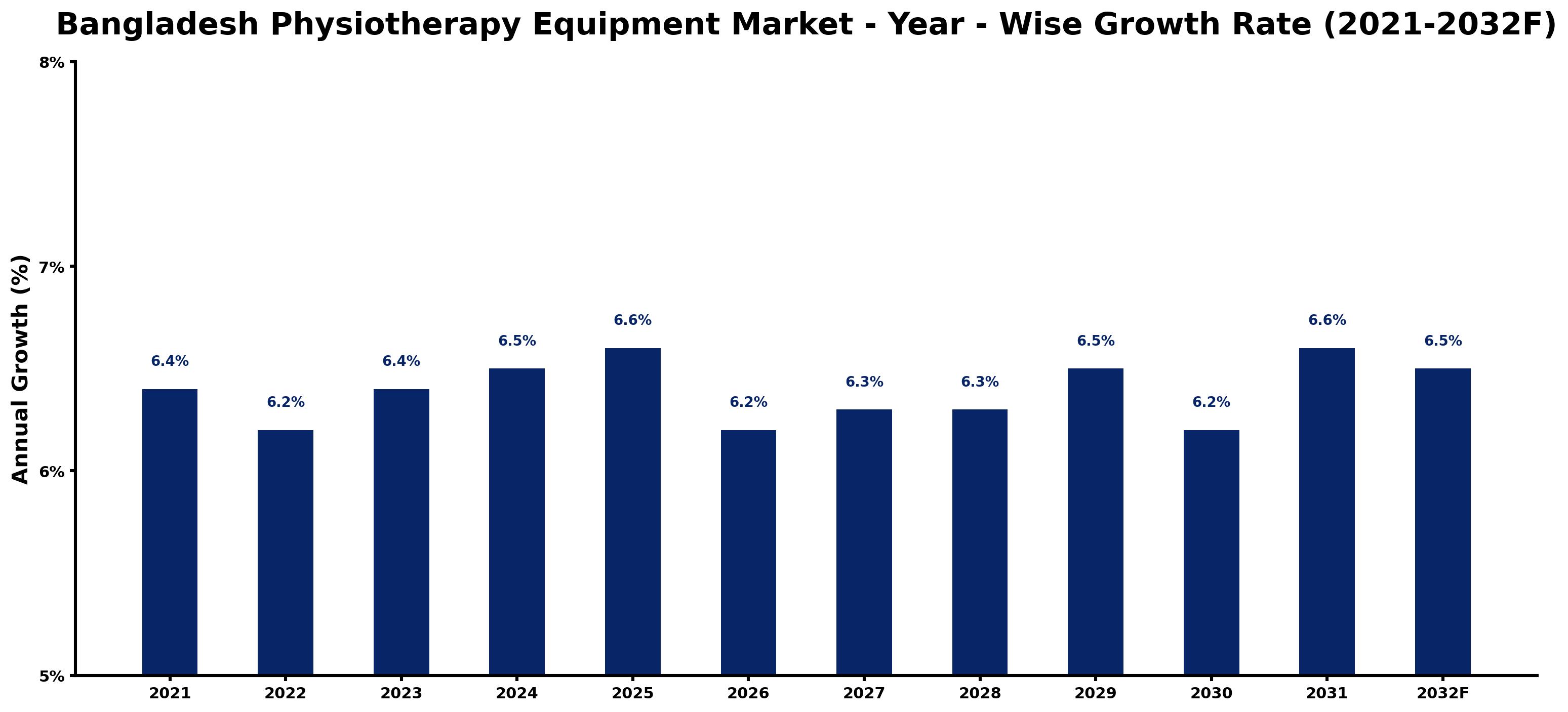
The table below presents the year wise growth rates along with the key drivers influencing the market
| Year | Growth Rate | Major Drivers |
| 2021 | 6.4% | Telehealth integration encouraged remote physiotherapy consultations, expanding patient access significantly. |
| 2022 | 6.2% | Increased awareness of chronic pain management highlighted physiotherapy's essential role in healthcare. |
| 2023 | 6.4% | Investment in healthcare infrastructure boosted physiotherapy service availability across urban and rural areas. |
| 2024 | 6.5% | Collaborations between hospitals and physiotherapy clinics enhanced service efficiency during patient recovery. |
| 2025 | 6.6% | Emerging fitness trends underscored the importance of physiotherapy in preventive healthcare strategies. |
| 2026 | 6.2% | Insurance companies began covering more physiotherapy services, improving accessibility for patients. |
| 2027 | 6.3% | Technological innovation in rehabilitation equipment attracted more private sector investments into physiotherapy. |
| 2028 | 6.3% | Educational programs increased, leading to a surge in qualified physiotherapists throughout the nation. |
| 2029 | 6.5% | Sports injury management campaigns fostered a greater understanding of physiotherapy benefits among athletes. |
| 2030 | 6.2% | Aging population necessitated more specialized physiotherapy services tailored to geriatric care. |
| 2031 | 6.6% | Public health campaigns focused on physical fitness promoted physiotherapy as a key component. |
| 2032 | 6.5% | Cross-border partnerships in healthcare technology introduced state-of-the-art physiotherapy equipment into Bangladesh. |
Note - Market size estimations and growth projections presented in this report are based on 6Wresearch's advanced forecasting approach, validated with industry datasets as of June 2026.
Bangladesh Physiotherapy Equipment Market Synopsis
The Bangladesh Physiotherapy Equipment Market is projected to reach 6.2% and witness significant growth during the forecast period (2026-2032). This market is witnessing an upward trajectory characterized by increased awareness regarding the benefits of physiotherapy, driven by an aging population and the growing prevalence of chronic diseases. Additionally, advancements in medical technology further elevate the demand for various therapeutic equipment that enhances patient care and rehabilitation processes.
Bangladesh Physiotherapy Equipment Market Growth Drivers
Several key factors are propelling the growth of the Bangladesh Physiotherapy Equipment Market. The convergence of a burgeoning elderly population and the heightened incidence of chronic health conditions underscores the need for effective physiotherapy solutions. This sector is further supported by:
- A significant increase in healthcare infrastructure, which includes new physiotherapy clinics and rehabilitation centers across urban and rural areas.
- Growing public awareness of the importance of physiotherapy in rehabilitation and preventive health, leading to increased patient volume.
- The proliferation of advanced therapeutic technologies such as electrotherapy and ultrasound devices that improve patient outcomes.
- Government initiatives aimed at enhancing healthcare services and promoting rehabilitation, thus increasing the adoption of physiotherapy.
- A rise in sports-related injuries among the youth, necessitating more sophisticated physiotherapy interventions.
Bangladesh Physiotherapy Equipment Market Challenges and Restraints
Despite the promising growth trajectory, the Bangladesh Physiotherapy Equipment Market faces several challenges. Limited public knowledge about the advantages of physiotherapy can lead to underutilization of available services. Additional challenges include:
- A lack of standardized regulations and certifications for physiotherapy equipment, which can create market entry barriers for new and innovative products.
- Infrastructure inadequacies and logistical hurdles that impede the distribution and accessibility of physiotherapy equipment, especially in remote regions.
- High costs associated with quality physiotherapy devices, making it difficult for many healthcare facilities to invest in essential equipment.
- Limited financial resources among healthcare providers, which could restrict the purchase of advanced therapeutic technologies.
- The emerging competition from local and international market players, impacting pricing strategies and market positioning.
Bangladesh Physiotherapy Equipment Market Trends and Opportunities
The dynamics of the Bangladesh Physiotherapy Equipment Market reveal several trends and opportunities that stakeholders can capitalize on. Significant trends include:
- An increasing preference for home-based physiotherapy solutions, leading to a demand for portable and user-friendly equipment.
- Technological innovations, such as virtual reality and tele-rehabilitation systems, which are beginning to reshape treatment methodologies.
- A shift towards preventative healthcare, with physiotherapy becoming a critical component in chronic disease management.
- Investment in training and education programs to enhance professional capacity in physiotherapy practices across the country.
- Collaboration opportunities with local healthcare providers to establish comprehensive rehabilitation programs, improving patient access to treatment.
Bangladesh Physiotherapy Equipment Market Government Investment and Initiatives
The Bangladesh government plays a critical role in shaping the physiotherapy equipment market through several initiatives aimed at bolstering the healthcare system. Policies include:
- Stringent regulations and oversight from the Bangladesh Drug Administration (DGDA) to ensure the safety and efficacy of physiotherapy devices.
- Public spending on healthcare infrastructure improvement, which encompasses the development of physiotherapy clinics and rehabilitation centers.
- Financial incentives to encourage local manufacturing of physiotherapy equipment, reducing reliance on imports and enhancing domestic capabilities.
- Government-sponsored training programs that aim to elevate the skill levels of physiotherapists and healthcare professionals in the country.
- Support for public health campaigns that raise awareness about the importance of physiotherapy in preventive health and rehabilitation.
Bangladesh Physiotherapy Equipment Market Latest Developments (May 2025 - June 2026)
Recent developments in the Bangladesh Physiotherapy Equipment Market indicate a robust growth pattern ahead. Stakeholders are increasingly focusing on technological advancements to enhance treatment efficacy and patient comfort. Key trends observed during this period include:
- The introduction of smart physiotherapy devices that integrate digital technologies for better monitoring and evaluation of patient progress.
- Expansion of partnerships between healthcare providers and physiotherapy equipment manufacturers to create bespoke solutions tailored to specific treatment needs.
- Increased collaboration within the medical community to standardize treatment protocols, enhancing the overall quality of physiotherapy services.
- Growing investment in research and development, focusing on innovative therapeutic solutions that address emerging health trends.
- A rising number of conferences and workshops aimed at educating healthcare professionals about the latest advancements in physiotherapy technology.
Bangladesh Physiotherapy Equipment Market - Key Attractiveness of the Report
- 10 Years of Market Numbers
- Historical Data Starting from 2022 to 2025
- Base Year: 2025
- Forecast Data until 2032
- Key Performance Indicators Impacting the Market
- Major Upcoming Developments and Projects
Key Highlights of the Report:
- Bangladesh Physiotherapy Equipment Market Outlook
- Market Size of Bangladesh Physiotherapy Equipment Market, 2025
- Forecast of Bangladesh Physiotherapy Equipment Market, 2032F
- Historical Data and Forecast of Bangladesh Physiotherapy Equipment Revenues & Volume for the Period 2022-2032F
- Bangladesh Physiotherapy Equipment Market Trend Evolution
- Bangladesh Physiotherapy Equipment Market Drivers and Challenges
- Bangladesh Physiotherapy Equipment Price Trends
- Bangladesh Physiotherapy Equipment Porter's Five Forces
- Bangladesh Physiotherapy Equipment Industry Life Cycle
- Historical Data and Forecast of Bangladesh Physiotherapy Equipment Market Revenues & Volume By Product Types for the Period 2022-2032F
- Historical Data and Forecast of Bangladesh Physiotherapy Equipment Market Revenues & Volume By Equipment for the Period 2022-2032F
- Historical Data and Forecast of Bangladesh Physiotherapy Equipment Market Revenues & Volume By Accessories for the Period 2022-2032F
- Historical Data and Forecast of Bangladesh Physiotherapy Equipment Market Revenues & Volume By Application? for the Period 2022-2032F
- Historical Data and Forecast of Bangladesh Physiotherapy Equipment Market Revenues & Volume By Musculoskeletal Applications for the Period 2022-2032F
- Historical Data and Forecast of Bangladesh Physiotherapy Equipment Market Revenues & Volume By Neurological Applications for the Period 2022-2032F
- Historical Data and Forecast of Bangladesh Physiotherapy Equipment Market Revenues & Volume By Cardiovascular & Pulmonary Applications for the Period 2022-2032F
- Historical Data and Forecast of Bangladesh Physiotherapy Equipment Market Revenues & Volume By Pediatric Applications for the Period 2022-2032F
- Historical Data and Forecast of Bangladesh Physiotherapy Equipment Market Revenues & Volume By Gynecological Applications for the Period 2022-2032F
- Historical Data and Forecast of Bangladesh Physiotherapy Equipment Market Revenues & Volume By Other? for the Period 2022-2032F
- Historical Data and Forecast of Bangladesh Physiotherapy Equipment Market Revenues & Volume By End-user for the Period 2022-2032F
- Historical Data and Forecast of Bangladesh Physiotherapy Equipment Market Revenues & Volume By Physiotherapy & Rehabilitation Centers for the Period 2022-2032F
- Historical Data and Forecast of Bangladesh Physiotherapy Equipment Market Revenues & Volume By Hospitals for the Period 2022-2032F
- Historical Data and Forecast of Bangladesh Physiotherapy Equipment Market Revenues & Volume By Home Care Settings for the Period 2022-2032F
- Historical Data and Forecast of Bangladesh Physiotherapy Equipment Market Revenues & Volume By Physician Offices for the Period 2022-2032F
- Historical Data and Forecast of Bangladesh Physiotherapy Equipment Market Revenues & Volume By Others for the Period 2022-2032F
- Bangladesh Physiotherapy Equipment Import Export Trade Statistics
- Market Opportunity Assessment By Product Types
- Market Opportunity Assessment By Application?
- Market Opportunity Assessment By End-user
- Bangladesh Physiotherapy Equipment Top Companies Market Share
- Bangladesh Physiotherapy Equipment Competitive Benchmarking By Technical and Operational Parameters
- Bangladesh Physiotherapy Equipment Company Profiles
- Bangladesh Physiotherapy Equipment Key Strategic Recommendations






































