Bangladesh Plastic Waste Management Market Size, Share & Growth Rate
The Bangladesh Plastic Waste Management Market was estimated at USD 278 Million in 2025 and is projected to reach USD 363 Million by 2032, growing at a CAGR of 3.9% from 2026 to 2032. This growth trajectory is primarily fueled by heightened environmental awareness among the populace and robust government initiatives aimed at tackling plastic pollution. As stakeholders increasingly prioritize sustainable practices, the demand for efficient waste management solutions continues to surge.
Bangladesh Plastic Waste Management Market Year-wise Growth Rate and Key Drivers
This graph highlights how the Bangladesh Plastic Waste Management Market has steadily grown over the years, supported by major growth factors.
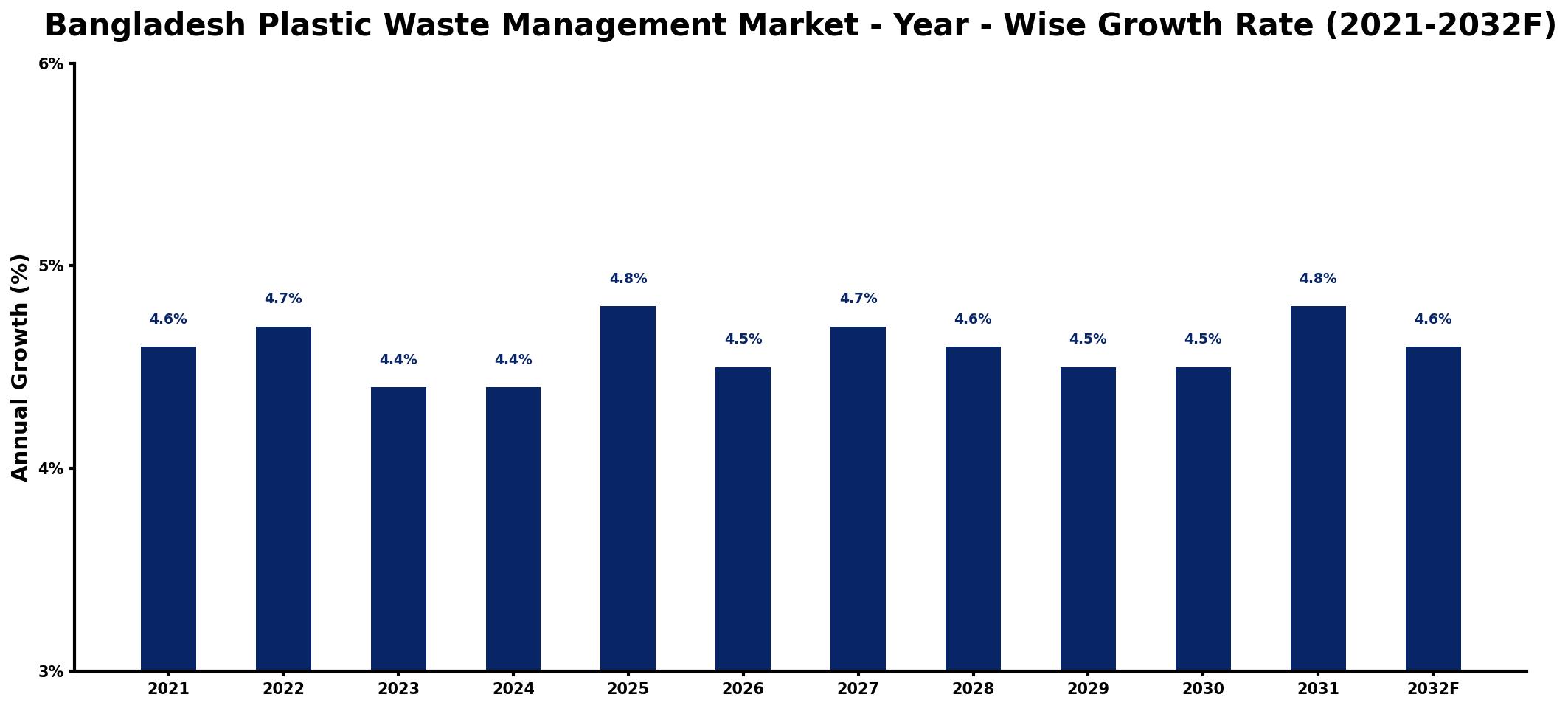
The table below presents the year‑wise growth rates along with the key drivers influencing the market
| Year | Growth Rate | Major Drivers |
| 2021 | 4.6% | Rising awareness of environmental issues |
| 2022 | 4.7% | Increased government policy support |
| 2023 | 4.4% | Growing recycling technology investments |
| 2024 | 4.4% | Expansion of sustainable business practices |
| 2025 | 4.8% | Surge in consumer eco-friendly products |
| 2026 | 4.5% | Enhancements in collection infrastructure |
| 2027 | 4.7% | Development of new recycling technologies |
| 2028 | 4.6% | Higher public-private partnership initiatives |
| 2029 | 4.5% | Increased funding for circular economy |
| 2030 | 4.5% | Rising demand for biodegradable alternatives |
| 2031 | 4.8% | Strengthened community engagement programs |
| 2032 | 4.6% | Growth in educational awareness campaigns |
Note: Market size estimations and growth projections presented in this report are based on 6Wresearch's proprietary forecasting methodology, utilizing the latest available industry data, government publications, and primary research inputs.
Bangladesh Plastic Waste Management Market Synopsis
In recent years, Bangladesh has seen a remarkable surge in attention towards managing plastic waste, spurred by environmental concerns and regulatory pressure. This momentum is set against a backdrop of growing public consciousness about the detrimental effects of plastic pollution, resulting in a shift towards more sustainable waste management approaches.
Looking ahead, the Bangladesh Plastic Waste Management Market is poised for significant evolution. Increasing collaborations among government entities, NGOs, and private sectors to establish effective waste management infrastructures are paving the way for innovative recycling initiatives. This collective effort aims to minimize plastic pollution and embrace a circular economy model, fostering a cleaner environment.
Bangladesh Plastic Waste Management Market Key Takeaways
- Growing environmental awareness is driving demand for sustainable waste management solutions.
- Government regulations are increasingly emphasizing biodegradable alternatives and recycling initiatives.
- Investment opportunities abound in innovative recycling technologies and infrastructure development.
- Collaboration among various sectors is enhancing waste management practices.
- The market is expected to expand with a shift towards circular economy principles and sustainable practices.
Evaluation of Restraints in Bangladesh Plastic Waste Management Market
Despite the optimistic outlook, several challenges continue to hinder the Bangladesh Plastic Waste Management Market. A critical constraint is the underdeveloped infrastructure, which hampers effective waste collection and disposal. This inadequacy leads to significant plastic accumulation in landfills and waterways, exacerbating pollution levels. Additionally, the lack of awareness among the general population regarding the environmental ramifications of plastic waste further complicates efforts to implement sustainable practices. Moreover, the presence of an informal recycling sector leads to unregulated and inefficient processes that undermine the overall efficacy of waste management systems. Addressing these barriers necessitates comprehensive strategies, including enhanced regulatory frameworks and community education programs.
Bangladesh Plastic Waste Management Market Trends
The market is witnessing a notable shift towards sustainability, driven by increased environmental awareness. There is a marked emphasis on recycling and upcycling plastic waste, aiming to reduce ecological footprints. Government regulations are pivotal in this shift, promoting biodegradable materials and imposing restrictions on single-use plastics. Furthermore, advancements in waste-to-energy technologies are gaining traction, aligning with circular economy principles that encourage resource efficiency and waste minimization.
Bangladesh Plastic Waste Management Market Opportunities
Opportunities within the Bangladesh Plastic Waste Management Market are abundant, particularly for enterprises focusing on developing recycling technologies and infrastructure. Investments aimed at enhancing collection, sorting, and processing capabilities are crucial as demand for effective waste management solutions continues to rise. The burgeoning market for recycled plastic products also presents promising avenues for manufacturers, who can capitalize on the increasing consumer preference for sustainable goods. Engaging in public-private partnerships can further enhance these prospects, driving innovation and efficiency in the sector.
Government Initiatives in the Bangladesh Plastic Waste Management Market
The Bangladeshi government has established a framework of policies aimed at mitigating plastic waste. The Plastic Products (Control) Act 2015 places restrictions on non-biodegradable plastics, while the National Environment Policy 2020 underscores the need for eco-friendly alternatives. Recent initiatives include the introduction of Extended Producer Responsibility (EPR) regulations, which hold manufacturers accountable for managing their products end-of-life waste. These regulations, coupled with increased public spending on waste management infrastructure, reflect a strong commitment to addressing plastic pollution.
Future Insights of the Bangladesh Plastic Waste Management Market
Looking forward to the period from 2026 to 2032, the Bangladesh Plastic Waste Management Market is set for considerable growth. As sustainability becomes a central tenet of public policy and private enterprise, the demand for innovative waste management solutions is likely to escalate. Stricter regulations against single-use plastics and an emphasis on circular economy practices will further shape the market landscape. Collaborations among public, private, and non-governmental entities are expected to create a synergistic environment, spurring technological advancements and facilitating more effective waste management initiatives.
Bangladesh Plastic Waste Management Market Latest Developments (2025 - 2026)
In the past year, there has been a marked uptick in initiatives aimed at improving plastic waste management within Bangladesh. New partnerships have emerged, uniting various stakeholders in the pursuit of developing cutting-edge recycling technologies and establishing robust waste management infrastructures. Additionally, awareness campaigns targeting the general population have gained traction, focusing on the importance of reducing plastic waste and promoting recycling practices. The landscape of the market is evolving as stakeholders rally around sustainable solutions and circular economy principles.
Bangladesh Plastic Waste Management Market - Key Attractiveness of the Report
- 10 Years of Market Numbers
- Historical Data Starting from 2022 to 2025
- Base Year: 2025
- Forecast Data until 2032
- Key Performance Indicators Impacting the Market
- Major Upcoming Developments and Projects
Key Highlights of the Report:
- Bangladesh Plastic Waste Management Market Outlook
- Market Size of Bangladesh Plastic Waste Management Market, 2025
- Forecast of Bangladesh Plastic Waste Management Market, 2032
- Historical Data and Forecast of Bangladesh Plastic Waste Management Revenues & Volume for the Period 2022-2032F
- Bangladesh Plastic Waste Management Market Trend Evolution
- Bangladesh Plastic Waste Management Market Drivers and Challenges
- Bangladesh Plastic Waste Management Price Trends
- Bangladesh Plastic Waste Management Porter's Five Forces
- Bangladesh Plastic Waste Management Industry Life Cycle
- Historical Data and Forecast of Bangladesh Plastic Waste Management Market Revenues & Volume By Source for the Period 2022-2032F
- Historical Data and Forecast of Bangladesh Plastic Waste Management Market Revenues & Volume By Industrial Waste for the Period 2022-2032F
- Historical Data and Forecast of Bangladesh Plastic Waste Management Market Revenues & Volume By Municipal Waste for the Period 2022-2032F
- Historical Data and Forecast of Bangladesh Plastic Waste Management Market Revenues & Volume By Material for the Period 2022-2032F
- Historical Data and Forecast of Bangladesh Plastic Waste Management Market Revenues & Volume By Polyethylene for the Period 2022-2032F
- Historical Data and Forecast of Bangladesh Plastic Waste Management Market Revenues & Volume By Polypropylene for the Period 2022-2032F
- Historical Data and Forecast of Bangladesh Plastic Waste Management Market Revenues & Volume By Polyethylene Terephthalate for the Period 2022-2032F
- Historical Data and Forecast of Bangladesh Plastic Waste Management Market Revenues & Volume By Polystyrene for the Period 2022-2032F
- Historical Data and Forecast of Bangladesh Plastic Waste Management Market Revenues & Volume By Others for the Period 2022-2032F
- Historical Data and Forecast of Bangladesh Plastic Waste Management Market Revenues & Volume By Product Type for the Period 2022-2032F
- Historical Data and Forecast of Bangladesh Plastic Waste Management Market Revenues & Volume By Packaging for the Period 2022-2032F
- Historical Data and Forecast of Bangladesh Plastic Waste Management Market Revenues & Volume By Construction for the Period 2022-2032F
- Historical Data and Forecast of Bangladesh Plastic Waste Management Market Revenues & Volume By Automotive for the Period 2022-2032F
- Historical Data and Forecast of Bangladesh Plastic Waste Management Market Revenues & Volume By Electrical & Electronics for the Period 2022-2032F
- Historical Data and Forecast of Bangladesh Plastic Waste Management Market Revenues & Volume By Others for the Period 2022-2032F
- Historical Data and Forecast of Bangladesh Plastic Waste Management Market Revenues & Volume By Treatment Method for the Period 2022-2032F
- Historical Data and Forecast of Bangladesh Plastic Waste Management Market Revenues & Volume By Collection for the Period 2022-2032F
- Historical Data and Forecast of Bangladesh Plastic Waste Management Market Revenues & Volume By Recycling for the Period 2022-2032F
- Historical Data and Forecast of Bangladesh Plastic Waste Management Market Revenues & Volume By Disposal for the Period 2022-2032F
- Bangladesh Plastic Waste Management Import Export Trade Statistics
- Market Opportunity Assessment By Source
- Market Opportunity Assessment By Material
- Market Opportunity Assessment By Product Type
- Market Opportunity Assessment By Treatment Method
- Bangladesh Plastic Waste Management Top Companies Market Share
- Bangladesh Plastic Waste Management Competitive Benchmarking By Technical and Operational Parameters
- Bangladesh Plastic Waste Management Company Profiles
- Bangladesh Plastic Waste Management Key Strategic Recommendations






































