Bangladesh Point Of Sale Terminals Market Size, Share & Growth Rate
The Bangladesh Point Of Sale Terminals Market was estimated at USD 219 Million in 2025 and is projected to reach USD 290 Million by 2032, growing at a CAGR of 4.1% from 2026 to 2032. This promising trajectory is fueled by a surge in digital payment adoption as both consumers and businesses increasingly prefer cashless transactions. Additionally, the government's commitment to enhancing financial inclusion is spurring investments in POS infrastructure across various sectors.
Bangladesh Point Of Sale Terminals Market Year-wise Growth Rate and Key Drivers
This graph highlights how the Bangladesh Point Of Sale Terminals Market has steadily grown over the years, supported by major growth factors.
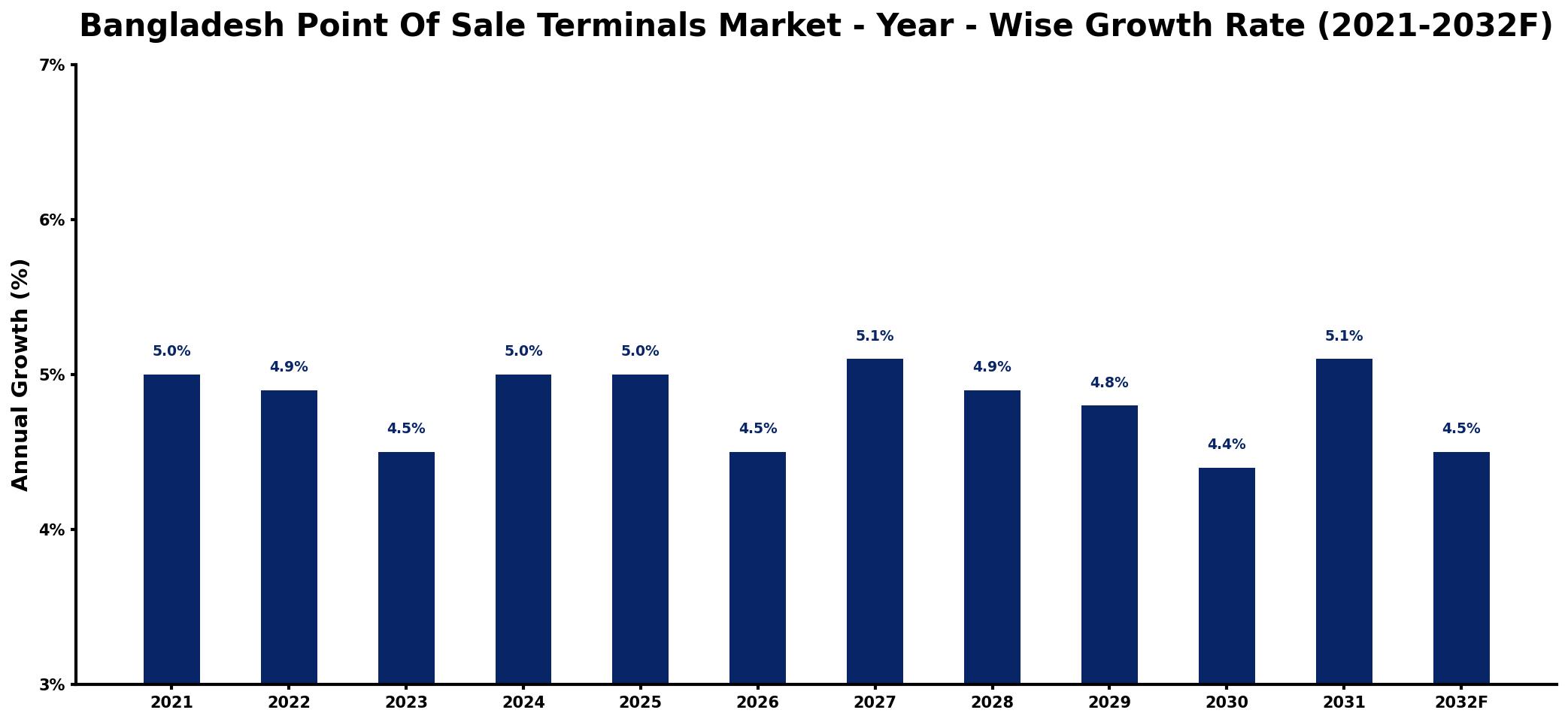
The table below presents the year‑wise growth rates along with the key drivers influencing the market
| Year | Growth Rate | Major Drivers |
| 2021 | 5.0% | Increased mobile payment adoption |
| 2022 | 4.9% | Expansion of retail sector growth |
| 2023 | 4.5% | Rising demand for cashless transactions |
| 2024 | 5.0% | Growth in e-commerce platforms |
| 2025 | 5.0% | Investment in fintech innovations |
| 2026 | 4.5% | Emergence of digital wallets popularity |
| 2027 | 5.1% | stronger distribution network expansion |
| 2028 | 4.9% | Enhanced consumer shopping experiences |
| 2029 | 4.8% | Adoption of contactless payment methods |
| 2030 | 4.4% | expanding manufacturing base activity |
| 2031 | 5.1% | Increase in government digital initiatives |
| 2032 | 4.5% | increased capital investment inflows |
Note: Market size estimations and growth projections presented in this report are based on 6Wresearch's proprietary forecasting methodology, utilizing the latest available industry data, government publications, and primary research inputs.
Bangladesh Point Of Sale Terminals Market Synopsis
In Bangladesh, the acceptance of electronic payments through point of sale terminals is rapidly gaining momentum, especially in urban areas. A notable aspect of this market is the growing preference for mobile wallets, driven by younger consumers seeking convenience and speed in their transactions.
Moreover, retailers are increasingly recognizing the operational efficiencies that POS systems provide. By integrating these terminals, businesses can streamline their checkout processes and gain valuable insights into consumer behavior, further reinforcing their market position.
Bangladesh Point Of Sale Terminals Market Key Takeaways
- The market is projected to grow significantly due to rising digital payment trends.
- POS terminals facilitate diverse payment methods, enhancing consumer convenience.
- Government initiatives are crucial in promoting the adoption of electronic payment solutions.
- Businesses are increasingly investing in POS technology to improve operational efficiency.
- Urban areas are seeing a faster adoption rate compared to rural regions.
Evaluation of Restraints in Bangladesh Point Of Sale Terminals Market
Despite the positive outlook, the Bangladesh Point Of Sale Terminals Market faces real challenges. Technological infrastructure limitations, particularly in rural areas, pose significant barriers to widespread adoption. Businesses often struggle with high initial costs associated with purchasing and installing POS systems, which can deter investment. Moreover, concerns regarding data security and fraud prevention persist, requiring ongoing attention to ensure consumer trust and confidence in digital payment systems.
Bangladesh Point Of Sale Terminals Market Trends
Currently, the trend of integrating POS terminals with e-commerce platforms is gaining traction, allowing retailers to reach a broader customer base. Additionally, the shift towards contactless payments has accelerated, driven by pandemic-related health concerns, as more consumers seek safe and efficient transaction methods. The emergence of artificial intelligence and machine learning technologies within POS systems is also on the rise, facilitating enhanced analytics and personalized customer experiences.
Bangladesh Point Of Sale Terminals Market Opportunities
The market presents numerous opportunities for growth and investment, particularly in enhancing technological infrastructure and developing secure payment solutions. Expanding POS services into underserved rural markets could unlock significant potential, as many consumers in these areas have yet to experience the benefits of digital payments. Additionally, partnerships between fintech companies and traditional retailers can foster innovation, driving the development of more user-friendly and efficient POS solutions.
Government Initiatives in the Bangladesh Point Of Sale Terminals Market
The government of Bangladesh is actively promoting the adoption of electronic payment systems through a range of policies and initiatives. Incentives are being provided for businesses to invest in POS technology, while regulatory frameworks are being established to ensure transaction security and consumer protection. These efforts are aimed at creating a robust digital payments ecosystem that facilitates financial inclusion and supports overall economic growth.
Future Insights of the Bangladesh Point Of Sale Terminals Market
Looking ahead to 2026-2032, the Bangladesh Point Of Sale Terminals Market is set to evolve significantly as technological advancements continue to shape the landscape. Increasing internet penetration and mobile device usage will likely enhance the accessibility of POS solutions, particularly in rural regions. Furthermore, as security measures improve and consumer confidence grows, more businesses will adopt POS systems, leading to broader market expansion and innovation.
Bangladesh Point Of Sale Terminals Market Latest Developments (2025 - 2026)
Recent developments in the Bangladesh Point Of Sale Terminals Market highlight an increased focus on integrating advanced technologies into POS systems. Many companies are exploring innovative features, including AI-driven analytics and improved fraud detection mechanisms. Furthermore, the ongoing collaboration between banks and payment service providers is fostering a more secure and efficient payments ecosystem, ultimately benefiting businesses and consumers alike.
Bangladesh Point Of Sale Terminals Market - Key Attractiveness of the Report
- 10 Years of Market Numbers
- Historical Data Starting from 2022 to 2025
- Base Year: 2025
- Forecast Data until 2032
- Key Performance Indicators Impacting the Market
- Major Upcoming Developments and Projects
Key Highlights of the Report:
- Bangladesh Point Of Sale Terminals Market Outlook
- Market Size of Bangladesh Point Of Sale Terminals Market, 2025
- Forecast of Bangladesh Point Of Sale Terminals Market, 2032
- Historical Data and Forecast of Bangladesh Point Of Sale Terminals Revenues & Volume for the Period 2022-2032F
- Bangladesh Point Of Sale Terminals Market Trend Evolution
- Bangladesh Point Of Sale Terminals Market Drivers and Challenges
- Bangladesh Point Of Sale Terminals Price Trends
- Bangladesh Point Of Sale Terminals Porter's Five Forces
- Bangladesh Point Of Sale Terminals Industry Life Cycle
- Historical Data and Forecast of Bangladesh Point Of Sale Terminals Market Revenues & Volume By Product for the Period 2022-2032F
- Historical Data and Forecast of Bangladesh Point Of Sale Terminals Market Revenues & Volume By Fixed for the Period 2022-2032F
- Historical Data and Forecast of Bangladesh Point Of Sale Terminals Market Revenues & Volume By Mobile for the Period 2022-2032F
- Historical Data and Forecast of Bangladesh Point Of Sale Terminals Market Revenues & Volume By Component for the Period 2022-2032F
- Historical Data and Forecast of Bangladesh Point Of Sale Terminals Market Revenues & Volume By Hardware for the Period 2022-2032F
- Historical Data and Forecast of Bangladesh Point Of Sale Terminals Market Revenues & Volume By Software for the Period 2022-2032F
- Historical Data and Forecast of Bangladesh Point Of Sale Terminals Market Revenues & Volume By Services for the Period 2022-2032F
- Historical Data and Forecast of Bangladesh Point Of Sale Terminals Market Revenues & Volume By Deployment for the Period 2022-2032F
- Historical Data and Forecast of Bangladesh Point Of Sale Terminals Market Revenues & Volume By Cloud for the Period 2022-2032F
- Historical Data and Forecast of Bangladesh Point Of Sale Terminals Market Revenues & Volume By On-premise for the Period 2022-2032F
- Historical Data and Forecast of Bangladesh Point Of Sale Terminals Market Revenues & Volume By End Use for the Period 2022-2032F
- Historical Data and Forecast of Bangladesh Point Of Sale Terminals Market Revenues & Volume By Restaurants for the Period 2022-2032F
- Historical Data and Forecast of Bangladesh Point Of Sale Terminals Market Revenues & Volume By Retail for the Period 2022-2032F
- Historical Data and Forecast of Bangladesh Point Of Sale Terminals Market Revenues & Volume By Hospitality for the Period 2022-2032F
- Historical Data and Forecast of Bangladesh Point Of Sale Terminals Market Revenues & Volume By Healthcare for the Period 2022-2032F
- Historical Data and Forecast of Bangladesh Point Of Sale Terminals Market Revenues & Volume By Warehouse for the Period 2022-2032F
- Historical Data and Forecast of Bangladesh Point Of Sale Terminals Market Revenues & Volume By Entertainment for the Period 2022-2032F
- Historical Data and Forecast of Bangladesh Point Of Sale Terminals Market Revenues & Volume By Others for the Period 2022-2032F
- Bangladesh Point Of Sale Terminals Import Export Trade Statistics
- Market Opportunity Assessment By Product
- Market Opportunity Assessment By Component
- Market Opportunity Assessment By Deployment
- Market Opportunity Assessment By End Use
- Bangladesh Point Of Sale Terminals Top Companies Market Share
- Bangladesh Point Of Sale Terminals Competitive Benchmarking By Technical and Operational Parameters
- Bangladesh Point Of Sale Terminals Company Profiles
- Bangladesh Point Of Sale Terminals Key Strategic Recommendations






































