Bangladesh Policy Management in Telecom Market Size & Growth Rate (2026-2032)
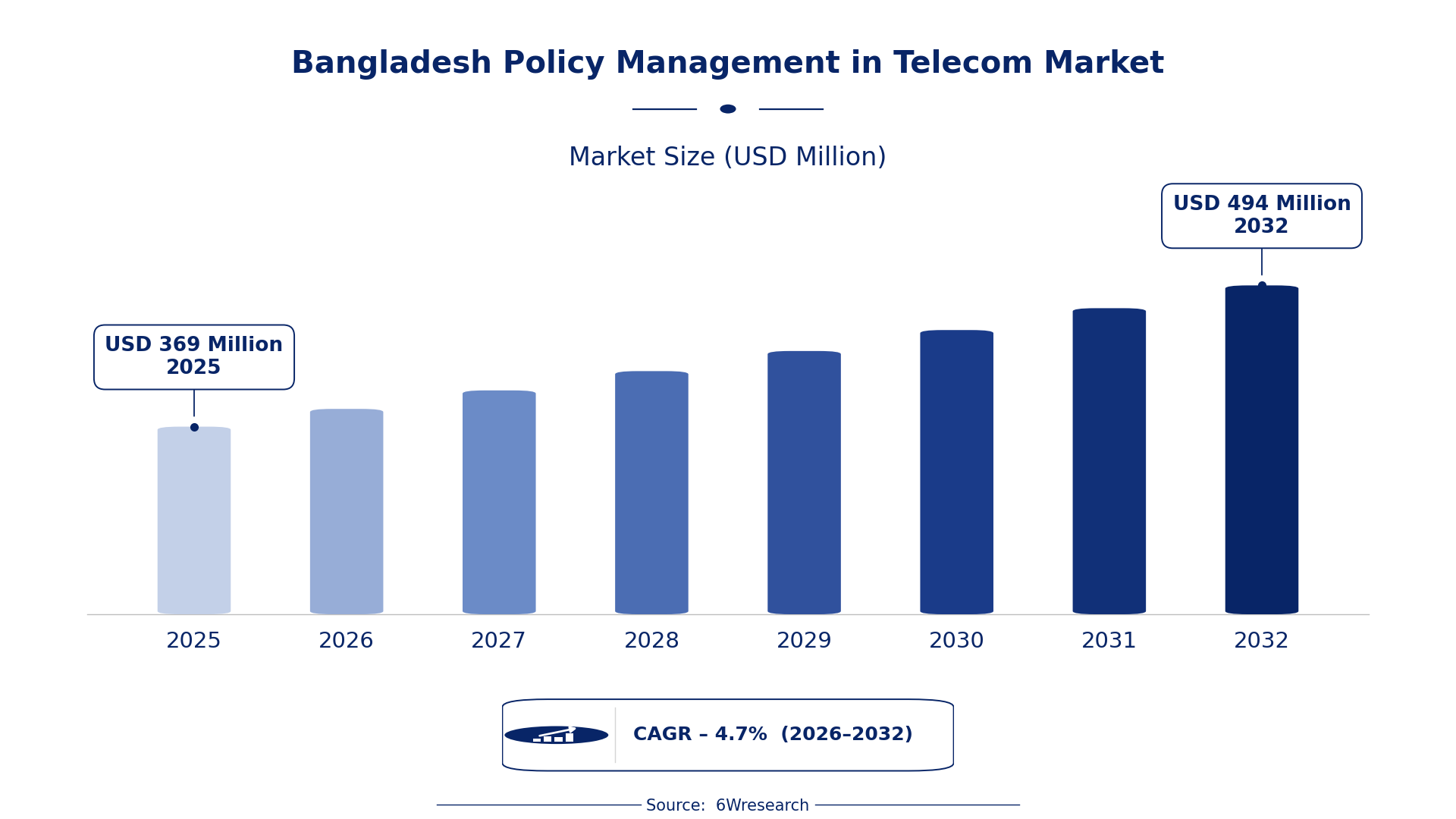
The Bangladesh Policy Management in Telecom Market was estimated at USD 369 Million in 2025 and is projected to reach USD 494 Million by 2032, growing at a CAGR of 4.7% from 2026 to 2032.
Bangladesh Policy Management in Telecom Market Synopsis
The demand for policy management solutions in Bangladesh's telecom market is gaining momentum as service providers increasingly seek to optimize their subscriber experiences. As mobile and broadband services expand, telecom operators are turning to advanced software systems to ensure effective policy enforcement and billing management, which are crucial for enhancing service delivery.
The government’s focus on fostering a competitive telecom sector is encouraging operators to adopt innovative technologies for managing subscriber policies. This trend not only aids compliance with regulatory requirements but also helps in enhancing service quality and optimizing network resources, thereby propelling market growth.
Bangladesh Policy Management in Telecom Market Year-wise Growth Rate and Key Drivers
This graph illustrates the annual growth rates of the Bangladesh Policy Management in Telecom Market from 2021 to 2032, highlighting a steady upward trajectory and projected expansion over the forecast period.
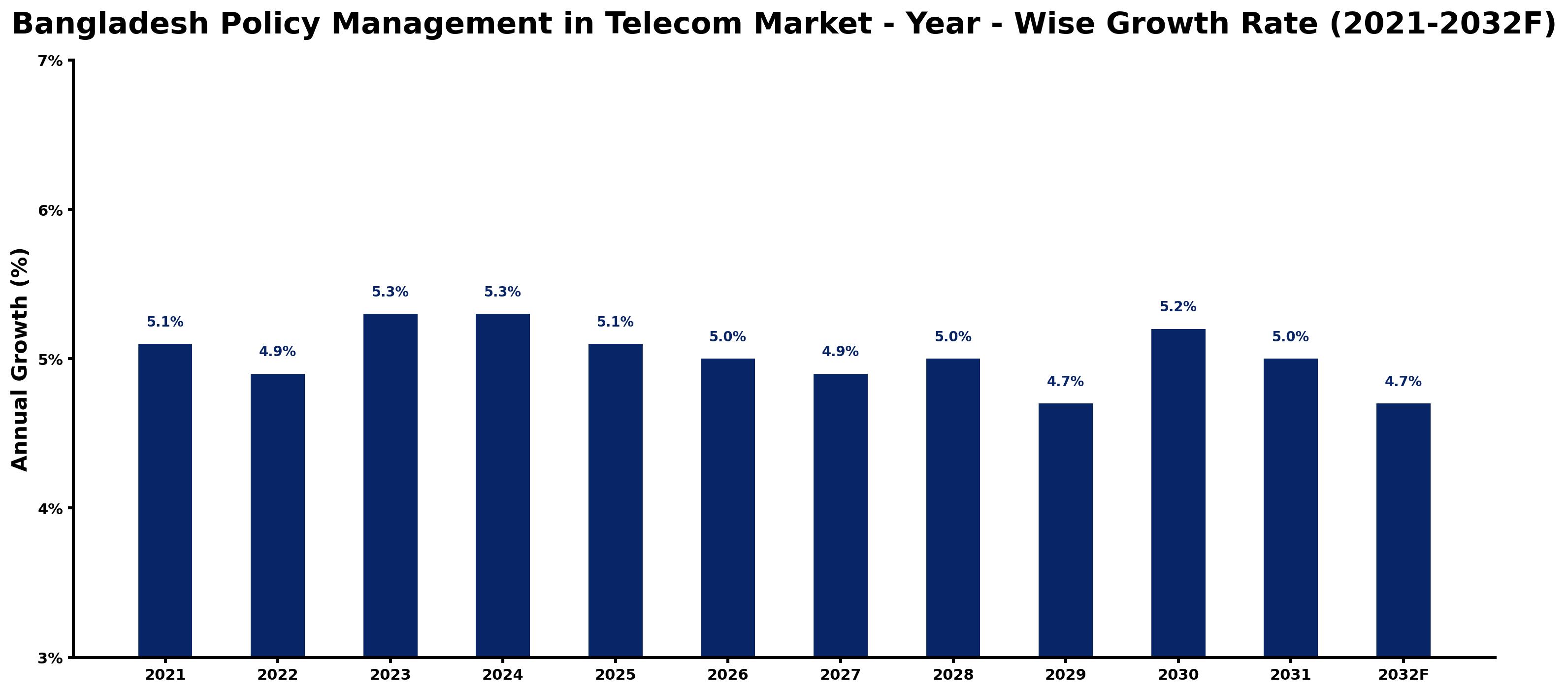
The table below presents the year‑wise growth rates along with the key drivers influencing the market
| Year | Growth Rate | Major Drivers |
| 2021 | 5.1% | Implementation of Digital Bangladesh Vision 2021 initiatives. |
| 2022 | 4.9% | Rise in mobile internet subscriptions driving regulatory focus. |
| 2023 | 5.3% | Government's push for 5G rollout and licensing reforms. |
| 2024 | 5.3% | Increased foreign investment in telecom infrastructure projects. |
| 2025 | 5.1% | National Telecom Policy promoting rural coverage expansion. |
| 2026 | 5.0% | Adoption of e-wallets enhances digital service regulations. |
| 2027 | 4.9% | Growth in local startups fostering regulatory innovation. |
| 2028 | 5.0% | Enhanced cybersecurity laws boosting consumer confidence. |
| 2029 | 4.7% | Regulatory incentives for improving telecom service quality. |
| 2030 | 5.2% | Digital inclusion policies targeting underserved populations. |
| 2031 | 5.0% | Government initiatives promoting telecommunications as essential service. |
| 2032 | 4.7% | Increased focus on telecom reforms for economic recovery. |
Note: Market size estimations and growth projections presented in this report are based on 6Wresearch's proprietary forecasting methodology, utilizing the latest available industry data, government publications, and primary research inputs.
Bangladesh Policy Management in Telecom Market Key Takeaways
Below are some of the specific key takeaways from the market, including:
- Bangladesh's telecom operators are increasingly integrating policy management systems to ensure compliance and operational efficiency.
- The government's regulatory frameworks are crucial for defining the competitive landscape of the telecom sector.
- There is a pressing need for personalized subscription plans to enhance user satisfaction and retention.
- Operators are investing in advanced software solutions to better manage network resources and subscriber services.
- Technological advancements and evolving consumer demands are driving the market's evolution.
Evaluation of Restraints in Bangladesh Policy Management in Telecom Market
The Bangladesh telecom market faces notable restraints that can impede growth. Operators grapple with an intricate regulatory environment that is constantly evolving, making compliance a persistent challenge. Furthermore, integrating new policy management systems with existing network infrastructures poses technical hurdles, often requiring significant investment in resources and time. Data privacy concerns also loom large, demanding stringent measures to protect subscriber information from potential breaches.
Bangladesh Policy Management in Telecom Market Trends
Recent trends indicate a shift towards automation in policy management systems, allowing telecom operators to achieve greater operational efficiencies. The rise of data analytics is enabling companies to better understand subscriber behavior, leading to more targeted marketing and improved service offerings. Furthermore, the growing focus on enhancing network security is prompting operators to adopt more sophisticated policy management solutions to safeguard their infrastructures.
Bangladesh Policy Management in Telecom Market Opportunities
Significant growth opportunities exist in the Bangladesh telecom market, primarily driven by increasing mobile penetration and the expansion of broadband services. As more consumers come online, the demand for customized solutions is rising, paving the way for operators to invest in innovative policy management technologies. Additionally, collaborative initiatives between the government and private sectors can further facilitate infrastructure improvements and service delivery enhancements.
Government Initiatives in the Bangladesh Policy Management in Telecom Market
The Bangladeshi government is actively shaping the policy management framework within the telecom sector. This includes a strong emphasis on promoting fair competition and ensuring efficient spectrum management, which is vital for a thriving telecommunications environment. The public sector's focus on regulatory compliance and investment in digital infrastructure is crucial for the future of the telecom industry.
- A regulatory framework introduced in 2025 mandating billing transparency has been implemented to ensure fairness in subscriber charges.
- A national digital infrastructure upgrade programme currently underway aims to enhance broadband access across rural regions.
- Ongoing initiatives for spectrum allocation and licensing guidelines are expected to encourage more investments in telecom infrastructure.
- A planned public-private partnership initiative is expected to facilitate innovation in telecom services by 2028.
Future Insights of the Bangladesh Policy Management in Telecom Market
Looking towards 2026-2032, the Bangladesh Policy Management in Telecom Market is anticipated to continue its growth trajectory driven by technological advancements and increased regulatory support. With an emphasis on enhancing customer experience and ensuring data security, telecom operators will likely prioritize investments in state-of-the-art policy management systems. As consumer expectations evolve, the ability to provide personalized services will emerge as a key differentiator in this competitive market.
Bangladesh Policy Management in Telecom Market Latest Developments
In the past year, the Bangladesh telecom sector has witnessed a flurry of activities aimed at improving policy management systems. Operators are adopting next-generation technologies to enhance their service offerings and streamline operations. This aligns with the government's efforts to modernize the regulatory framework, paving the way for more efficient telecommunications management.
- A major telecom operator launched an upgraded policy management system in early 2025, enhancing subscriber experience through improved billing accuracy.
- An initiative currently ongoing involves the integration of AI capabilities into policy management solutions to better predict subscriber needs.
- Plans for a comprehensive cybersecurity enhancement project are set to begin in late 2026 to bolster data protection measures across the telecom sector.
- A collaboration with technology vendors is expected to facilitate the rollout of advanced analytics tools by mid-2026.
Bangladesh Policy Management in Telecom Market - Key Attractiveness of the Report
- 10 Years of Market Numbers
- Historical Data Starting from 2022 to 2025
- Base Year: 2025
- Forecast Data until 2032
- Key Performance Indicators Impacting the Market
- Major Upcoming Developments and Projects
Key Highlights of the Report:
- Bangladesh Policy Management in Telecom Market Outlook
- Market Size of Bangladesh Policy Management in Telecom Market, 2025
- Forecast of Bangladesh Policy Management in Telecom Market, 2032
- Historical Data and Forecast of Bangladesh Policy Management in Telecom Revenues & Volume for the Period 2022-2032F
- Bangladesh Policy Management in Telecom Market Trend Evolution
- Bangladesh Policy Management in Telecom Market Drivers and Challenges
- Bangladesh Policy Management in Telecom Price Trends
- Bangladesh Policy Management in Telecom Porter's Five Forces
- Bangladesh Policy Management in Telecom Industry Life Cycle
- Historical Data and Forecast of Bangladesh Policy Management in Telecom Market Revenues & Volume By Network for the Period 2022-2032F
- Historical Data and Forecast of Bangladesh Policy Management in Telecom Market Revenues & Volume By Fixed for the Period 2022-2032F
- Historical Data and Forecast of Bangladesh Policy Management in Telecom Market Revenues & Volume By Wireless for the Period 2022-2032F
- Historical Data and Forecast of Bangladesh Policy Management in Telecom Market Revenues & Volume By Component for the Period 2022-2032F
- Historical Data and Forecast of Bangladesh Policy Management in Telecom Market Revenues & Volume By Solutions for the Period 2022-2032F
- Historical Data and Forecast of Bangladesh Policy Management in Telecom Market Revenues & Volume By Services for the Period 2022-2032F
- Historical Data and Forecast of Bangladesh Policy Management in Telecom Market Revenues & Volume By Deployment for the Period 2022-2032F
- Historical Data and Forecast of Bangladesh Policy Management in Telecom Market Revenues & Volume By Cloud for the Period 2022-2032F
- Historical Data and Forecast of Bangladesh Policy Management in Telecom Market Revenues & Volume By On-Premises for the Period 2022-2032F
- Bangladesh Policy Management in Telecom Import Export Trade Statistics
- Market Opportunity Assessment By Network
- Market Opportunity Assessment By Component
- Market Opportunity Assessment By Deployment
- Bangladesh Policy Management in Telecom Top Companies Market Share
- Bangladesh Policy Management in Telecom Competitive Benchmarking By Technical and Operational Parameters
- Bangladesh Policy Management in Telecom Company Profiles
- Bangladesh Policy Management in Telecom Key Strategic Recommendations






































