Bangladesh Prepaid Cards Market Size, Share & Growth Rate
The Bangladesh Prepaid Cards Market was estimated at USD 340 Million in 2025 and is projected to reach USD 579 Million by 2032, growing at a CAGR of 7.9% from 2026 to 2032. This growth trajectory is primarily driven by the increasing shift towards cashless payment solutions, coupled with the Bangladeshi governments robust initiatives aimed at enhancing financial inclusion. Additionally, the rise of e-commerce and digital payment platforms further contributes to the growing popularity of prepaid cards among various consumer segments.
Bangladesh Prepaid Cards Market Year-wise Growth Rate and Key Drivers
This graph highlights how the Bangladesh Prepaid Cards Market has steadily grown over the years, supported by major growth factors.
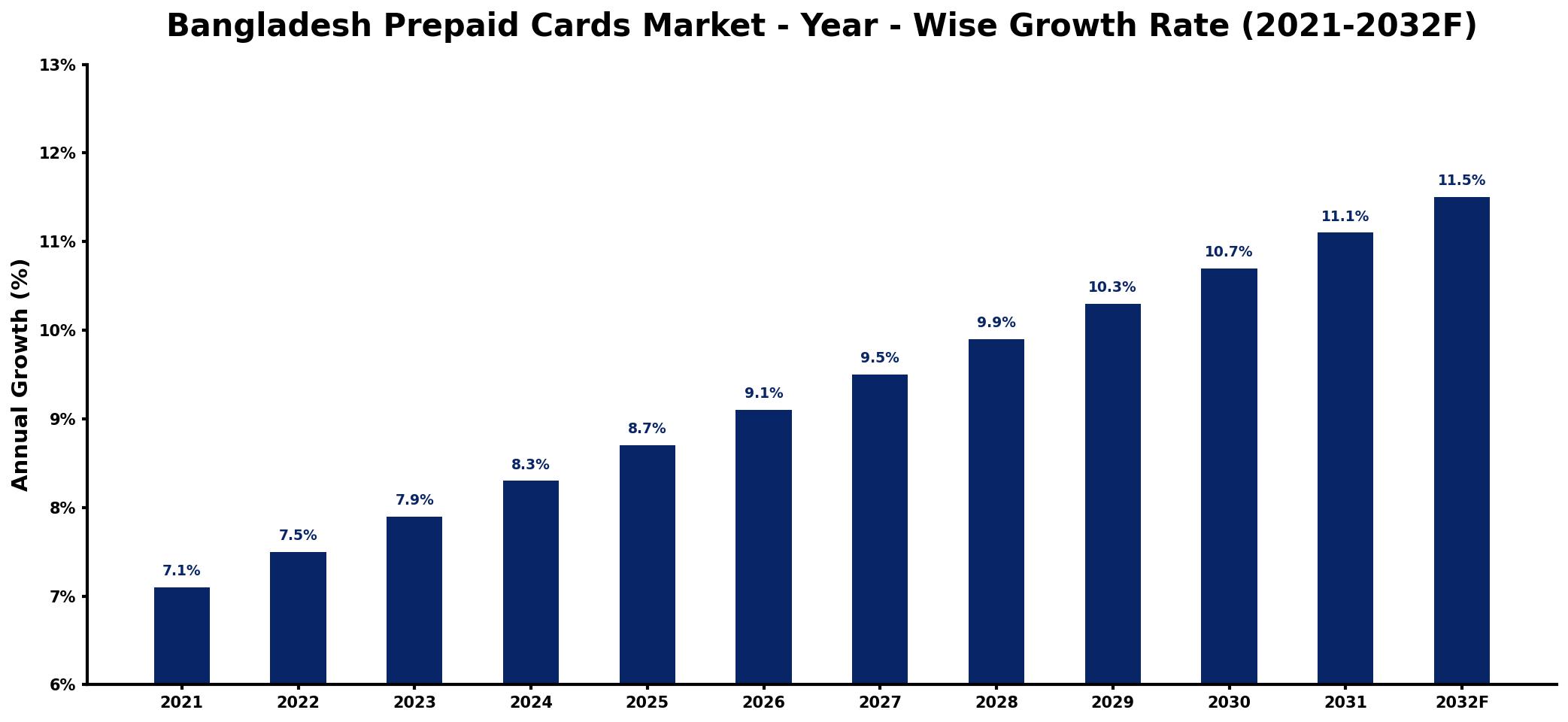
The table below presents the year‑wise growth rates along with the key drivers influencing the market
| Year | Growth Rate | Major Drivers |
| 2021 | 7.1% | Rising digital payment adoption |
| 2022 | 7.5% | Increased mobile wallet usage |
| 2023 | 7.9% | growing commercial sector adoption |
| 2024 | 8.3% | Expansion of retail partnerships |
| 2025 | 8.7% | Enhanced consumer awareness programs |
| 2026 | 9.1% | Investment in fintech innovations |
| 2027 | 9.5% | Improved merchant acceptance rates |
| 2028 | 9.9% | Surge in cross-border transactions |
| 2029 | 10.3% | Development of loyalty programs |
| 2030 | 10.7% | Integration of AI technologies |
| 2031 | 11.1% | enhanced product quality standards |
| 2032 | 11.5% | Expansion into rural markets |
Note: Market size estimations and growth projections presented in this report are based on 6Wresearch's proprietary forecasting methodology, utilizing the latest available industry data, government publications, and primary research inputs.
Bangladesh Prepaid Cards Market Synopsis
The strongest force shaping the Bangladesh Prepaid Cards Market is the rapid adoption of digital payment solutions. As consumers become more accustomed to cashless transactions, prepaid cards are emerging as a preferred option for their convenience and security. This shift is particularly pronounced in urban areas, where online shopping and digital payment platforms are becoming mainstream.
Moreover, government efforts to promote financial literacy and increase access to banking services are further driving the uptake of prepaid cards. These efforts are essential to bridging the gap between traditional cash-based transactions and modern digital payment systems, ensuring that all segments of society can benefit from these advancements.
Bangladesh Prepaid Cards Market Key Takeaways
- Rapid growth driven by cashless payment adoption and government support for financial inclusion.
- Prepaid cards are gaining traction among diverse consumer segments, including individuals and businesses.
- Rising e-commerce and digital payment platforms are significantly influencing market demand.
- Challenges remain in rural areas with cash-centric transactions and limited electronic payment acceptance.
- Trust and regulatory complexities continue to be pivotal in shaping the market's future dynamics.
Evaluation of Restraints in Bangladesh Prepaid Cards Market
Despite the promising growth prospects, the Bangladesh Prepaid Cards Market faces significant restraints. One major challenge is the deep-rooted preference for cash transactions, particularly in rural regions where access to digital payment infrastructure is limited. Additionally, concerns regarding the security and reliability of prepaid cards deter many potential users. The complexity of regulatory frameworks, along with interoperability issues among different card networks, further hampers the market's ability to innovate and expand effectively.
Bangladesh Prepaid Cards Market Trends
Current trends within the Bangladesh Prepaid Cards Market indicate a growing integration of advanced technologies such as mobile wallets and contactless payments. This technological convergence enhances user experience and promotes increased adoption among tech-savvy consumers. Furthermore, the rising demand for personalized financial products and services indicates a shift towards tailored offerings in the prepaid card space, responding to the unique needs of diverse customer bases.
Bangladesh Prepaid Cards Market Opportunities
There are considerable growth opportunities within the Bangladesh Prepaid Cards Market, particularly in leveraging digital innovations to enhance user engagement and trust. Developing prepaid card solutions tailored for various demographics, including the youth and underserved populations, can tap into unaddressed market segments. Additionally, partnerships between fintech companies and traditional financial institutions can lead to novel product offerings, expanding the market reach and fostering broader adoption.
Government Initiatives in the Bangladesh Prepaid Cards Market
The Bangladeshi government is actively promoting the prepaid cards market as part of its overarching strategy to enhance financial inclusion. Initiatives include the establishment of a regulatory framework that supports the issuance of prepaid cards while ensuring consumer protection. Furthermore, public spending on digital infrastructure and campaigns to educate citizens about cashless transactions are pivotal in expanding the reach and acceptance of prepaid card solutions across the country.
Future Insights of the Bangladesh Prepaid Cards Market
Looking ahead to 2026-2032, the Bangladesh Prepaid Cards Market is poised for robust growth, influenced by a combination of technological advancements and evolving consumer preferences. As financial literacy improves and digital payment infrastructure expands, the demand for prepaid cards is expected to surge. Additionally, ongoing government initiatives aimed at supporting cashless transactions will play a crucial role in shaping market dynamics, paving the way for innovation and enhanced service delivery.
Bangladesh Prepaid Cards Market Latest Developments (2025 - 2026)
In recent months, the Bangladesh Prepaid Cards Market has witnessed a significant push toward integrating innovative payment technologies. Efforts are being made to enhance the interoperability of various prepaid card systems, which could lead to greater consumer trust and usage. Additionally, public awareness campaigns are increasingly focusing on the benefits of prepaid cards, emphasizing their safety and convenience, particularly in urban centers.
Bangladesh Prepaid Cards Market - Key Attractiveness of the Report
- 10 Years of Market Numbers
- Historical Data Starting from 2022 to 2025
- Base Year: 2025
- Forecast Data until 2032
- Key Performance Indicators Impacting the Market
- Major Upcoming Developments and Projects
Key Highlights of the Report:
- Bangladesh Prepaid Cards Market Outlook
- Market Size of Bangladesh Prepaid Cards Market, 2025
- Forecast of Bangladesh Prepaid Cards Market, 2032
- Historical Data and Forecast of Bangladesh Prepaid Cards Revenues & Volume for the Period 2022-2032F
- Bangladesh Prepaid Cards Market Trend Evolution
- Bangladesh Prepaid Cards Market Drivers and Challenges
- Bangladesh Prepaid Cards Price Trends
- Bangladesh Prepaid Cards Porter's Five Forces
- Bangladesh Prepaid Cards Industry Life Cycle
- Historical Data and Forecast of Bangladesh Prepaid Cards Market Revenues & Volume By Offering for the Period 2022-2032F
- Historical Data and Forecast of Bangladesh Prepaid Cards Market Revenues & Volume By General Purpose Card for the Period 2022-2032F
- Historical Data and Forecast of Bangladesh Prepaid Cards Market Revenues & Volume By Gift Card for the Period 2022-2032F
- Historical Data and Forecast of Bangladesh Prepaid Cards Market Revenues & Volume By Government Benefit/Disbursement Card for the Period 2022-2032F
- Historical Data and Forecast of Bangladesh Prepaid Cards Market Revenues & Volume By Incentive/Payroll Card for the Period 2022-2032F
- Historical Data and Forecast of Bangladesh Prepaid Cards Market Revenues & Volume By Others for the Period 2022-2032F
- Historical Data and Forecast of Bangladesh Prepaid Cards Market Revenues & Volume By Card Type for the Period 2022-2032F
- Historical Data and Forecast of Bangladesh Prepaid Cards Market Revenues & Volume By Closed Loop Card for the Period 2022-2032F
- Historical Data and Forecast of Bangladesh Prepaid Cards Market Revenues & Volume By Open Loop Card for the Period 2022-2032F
- Historical Data and Forecast of Bangladesh Prepaid Cards Market Revenues & Volume By End User for the Period 2022-2032F
- Historical Data and Forecast of Bangladesh Prepaid Cards Market Revenues & Volume By Retail for the Period 2022-2032F
- Historical Data and Forecast of Bangladesh Prepaid Cards Market Revenues & Volume By Corporate for the Period 2022-2032F
- Historical Data and Forecast of Bangladesh Prepaid Cards Market Revenues & Volume By Government/Public Sector for the Period 2022-2032F
- Bangladesh Prepaid Cards Import Export Trade Statistics
- Market Opportunity Assessment By Offering
- Market Opportunity Assessment By Card Type
- Market Opportunity Assessment By End User
- Bangladesh Prepaid Cards Top Companies Market Share
- Bangladesh Prepaid Cards Competitive Benchmarking By Technical and Operational Parameters
- Bangladesh Prepaid Cards Company Profiles
- Bangladesh Prepaid Cards Key Strategic Recommendations






































