Bangladesh Professional Lighting Market Summary
The bangladesh professional lighting market was estimated at USD 403 Million in 2025 and is projected to reach USD 536 Million by 2032, growing at a CAGR of 4.6% from 2026 to 2032.
Bangladesh Professional Lighting Market Year-wise Growth Rate and Key Drivers
This graph highlights how the Bangladesh Professional Lighting Market has steadily grown over the past five years, supported by major growth factors.
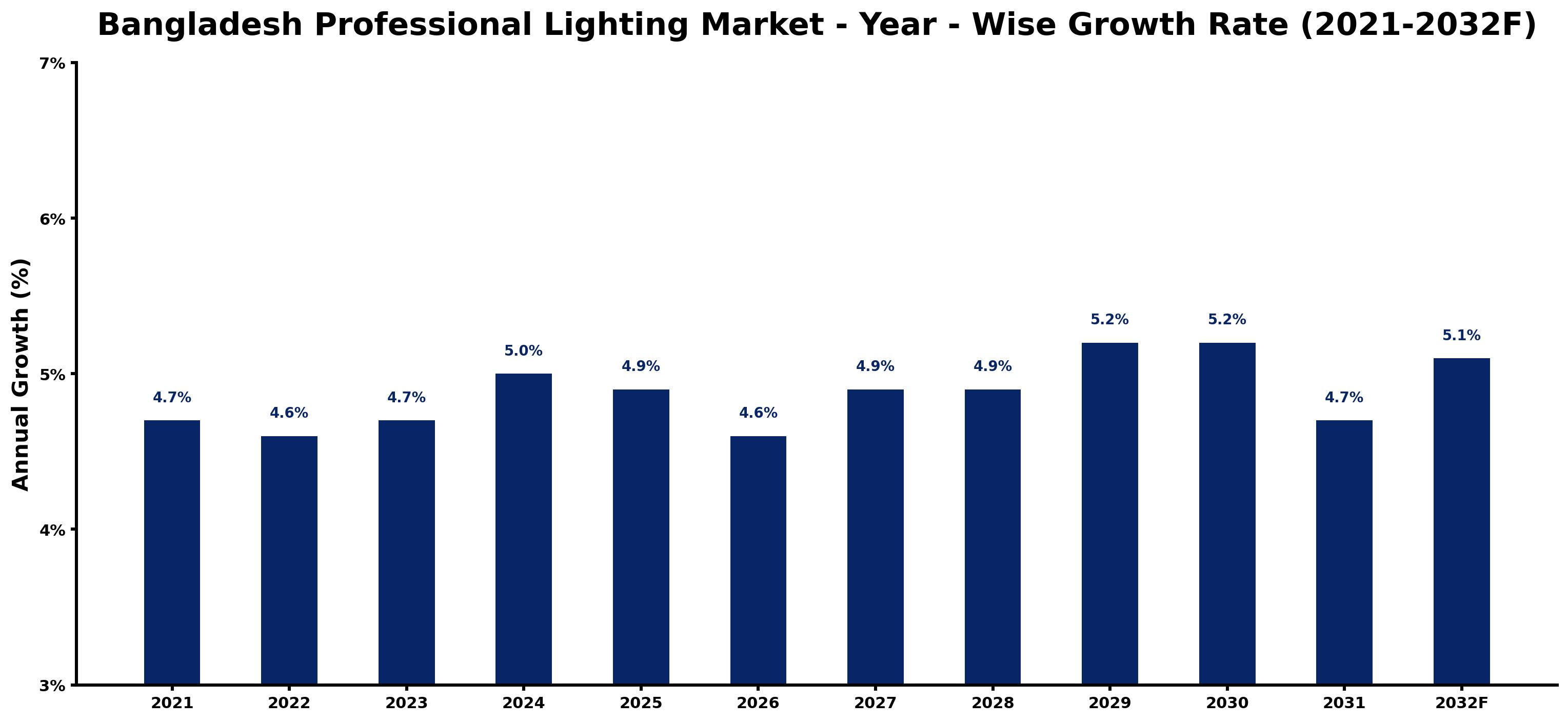
The table below presents the year wise growth rates along with the key drivers influencing the market
| Year | Growth Rate | Major Drivers |
| 2021 | 4.7% | Post-lockdown retail projects stimulated demand for energy-efficient lighting solutions. |
| 2022 | 4.6% | Legacy copper grid failures highlighted the need for advanced lighting technologies. |
| 2023 | 4.7% | Corporate budgets prioritizing sustainable practices bolstered investments in LED lighting. |
| 2024 | 5.0% | Increased urbanization prompts demand for smart city infrastructure, including lighting. |
| 2025 | 4.9% | Commercial real estate expansions drive requirements for innovative lighting applications. |
| 2026 | 4.6% | Educational institutions invest heavily in modern lighting systems for enhanced learning. |
| 2027 | 4.9% | Rural electrification projects accelerate, bringing lighting solutions to underserved areas. |
| 2028 | 4.9% | Technological innovations in IoT create opportunities for smarter lighting control systems. |
| 2029 | 5.2% | Green building standards gain traction, fostering eco-friendly lighting product adoption. |
| 2030 | 5.2% | Public awareness around energy conservation influences residential lighting purchasing decisions. |
| 2031 | 4.7% | Collaboration between manufacturers and local businesses enhances distribution networks significantly. |
| 2032 | 5.1% | Market consolidation leads to more competitive pricing and innovative product offerings. |
Note - Market size estimations and growth projections presented in this report are based on 6Wresearch's advanced forecasting approach, validated with industry datasets as of June 2026.
Bangladesh Professional Lighting Market Synopsis
The Bangladesh Professional Lighting Market is projected to reach 4.6% and witness significant growth during the forecast period (2026-2032). This anticipated growth is underpinned by several factors, including the increasing consumer expenditure on interior design, heightened construction activities, and advancements in energy-efficient lighting technologies. The market dynamics are expected to shift favorably as government initiatives aimed at promoting green building practices and alternative lighting sources gain momentum. As of 2020, the market was primarily driven by general illumination solutions such as LED bulbs and fixtures. However, specialized solutions, notably smart and connected lighting systems, have started to capture market attention, particularly for their energy efficiency benefits.
Bangladesh Professional Lighting Market Growth Drivers
The primary drivers fueling growth in the Bangladesh Professional Lighting Market encompass a range of consumer, technological, and economic factors:
- The shift in consumer preferences towards aesthetic and energy-efficient lighting options is driving demand across various sectors, including residential, commercial, and industrial settings.
- An increase in construction activities, spurred by urbanization and infrastructural development, provides a robust foundation for the expansion of the professional lighting market.
- Technological advancements, particularly in smart technology and automation, are revolutionizing how lighting solutions are integrated into homes and commercial spaces, promoting enhanced energy efficiency and user control.
- Growing emphasis on green building initiatives and sustainable practices aligned with government regulations is further propelling the adoption of energy-efficient lighting products.
- The increasing demand from hospitality and retail industries for decorative lighting solutions is amplifying market revenues, as businesses seek to create more appealing environments.
Bangladesh Professional Lighting Market Trends and Opportunities
The Bangladesh Professional Lighting Market is experiencing transformative trends that are poised to create new opportunities for growth:
- Integration of smart home technology with various types of lighting solutions is anticipated to be a key trend, enhancing user experience through automation and control.
- The rise of eco-conscious consumers is leading to greater demand for sustainable lighting options, driving innovations in product design and functionality.
- The development of automated control systems is becoming increasingly vital for both indoor and outdoor lighting applications, catering to diverse end-use sectors.
- There is a noticeable shift towards interconnected systems that not only provide lighting but also enhance security and convenience for end-users.
- The growing trend of energy management solutions among commercial establishments is expanding the market for advanced lighting systems that contribute to operational efficiency.
Bangladesh Professional Lighting Market Challenges and Restraints
Despite the promising growth trajectory of the Bangladesh Professional Lighting Market, several challenges and restraints could impact its expansion:
- High initial costs associated with advanced lighting technologies may deter some consumers from making the switch from traditional lighting solutions.
- Market saturation in certain product categories, particularly basic LED solutions, may limit growth opportunities for manufacturers.
- The lack of awareness and education regarding energy-efficient products can lead to slower adoption rates in certain demographics.
- Supply chain disruptions and fluctuations in raw material prices can affect production timelines and profit margins for manufacturers.
- Regulatory challenges and compliance issues could hinder the introduction of new technologies and products within the market.
Bangladesh Professional Lighting Market Government Investment and Initiatives
The government of Bangladesh has implemented various policies and initiatives aimed at fostering the development of the professional lighting sector. Key initiatives include:
- Investment in infrastructure and public lighting projects has increased, signifying a commitment to enhancing urban environments through improved lighting solutions.
- Regulatory frameworks to support green initiatives have been established, promoting the adoption of energy-efficient lighting products in both public and private sectors.
- Subsidies and incentives for businesses investing in sustainable technologies are being introduced, encouraging the transition to energy-efficient lighting systems.
- Public awareness campaigns aimed at educating citizens about the benefits of energy-efficient lighting are being promoted to foster greater market adoption.
- Collaboration with international organizations for technology transfer and capacity building in the lighting sector is being actively pursued.
Bangladesh Professional Lighting Market Latest Developments (May 2025 - June 2026)
Recent developments in the Bangladesh Professional Lighting Market from May 2025 to June 2026 reflect the industry's dynamic nature:
- Innovation in smart lighting technologies has accelerated, with increased focus on integrating IoT capabilities into lighting solutions for enhanced user experiences.
- Regulatory updates regarding energy efficiency standards have prompted manufacturers to expedite the development of compliant products.
- The push for sustainable development has led to the introduction of new eco-friendly lighting products that adhere to green building standards.
- There has been a surge in partnerships between local firms and technology providers for developing automated lighting systems aimed at commercial applications.
- Consumer interest in decorative and aesthetic lighting has surged, particularly in the hospitality sector, influencing product innovation and marketing strategies.
Bangladesh Professional Lighting Market - Key Attractiveness of the Report
- 10 Years of Market Numbers
- Historical Data Starting from 2022 to 2025
- Base Year: 2025
- Forecast Data until 2032
- Key Performance Indicators Impacting the Market
- Major Upcoming Developments and Projects
Key Highlights of the Report:
- Bangladesh Professional Lighting Market Outlook
- Market Size of Bangladesh Professional Lighting Market, 2025
- Forecast of Bangladesh Professional Lighting Market, 2032F
- Historical Data and Forecast of Bangladesh Professional Lighting Revenues & Volume for the Period 2022-2032F
- Bangladesh Professional Lighting Market Trend Evolution
- Bangladesh Professional Lighting Market Drivers and Challenges
- Bangladesh Professional Lighting Price Trends
- Bangladesh Professional Lighting Porter's Five Forces
- Bangladesh Professional Lighting Industry Life Cycle
- Historical Data and Forecast of Bangladesh Professional Lighting Market Revenues & Volume By Light Source for the Period 2022-2032F
- Historical Data and Forecast of Bangladesh Professional Lighting Market Revenues & Volume By LEDs for the Period 2022-2032F
- Historical Data and Forecast of Bangladesh Professional Lighting Market Revenues & Volume By Others (halogen lamps, xenon bulbs, incandescent lamps) for the Period 2022-2032F
- Historical Data and Forecast of Bangladesh Professional Lighting Market Revenues & Volume By Applications for the Period 2022-2032F
- Historical Data and Forecast of Bangladesh Professional Lighting Market Revenues & Volume By Entertainment for the Period 2022-2032F
- Historical Data and Forecast of Bangladesh Professional Lighting Market Revenues & Volume By Stage lighting for the Period 2022-2032F
- Historical Data and Forecast of Bangladesh Professional Lighting Market Revenues & Volume By Medical for the Period 2022-2032F
- Historical Data and Forecast of Bangladesh Professional Lighting Market Revenues & Volume By UV Lamps for the Period 2022-2032F
- Historical Data and Forecast of Bangladesh Professional Lighting Market Revenues & Volume By Others for the Period 2022-2032F
- Bangladesh Professional Lighting Import Export Trade Statistics
- Market Opportunity Assessment By Light Source
- Market Opportunity Assessment By Applications
- Bangladesh Professional Lighting Top Companies Market Share
- Bangladesh Professional Lighting Competitive Benchmarking By Technical and Operational Parameters
- Bangladesh Professional Lighting Company Profiles
- Bangladesh Professional Lighting Key Strategic Recommendations






































