Bangladesh Retail and Wholesale Market Growth Rate
According to 6Wresearch internal database and industry insights, the Bangladesh Retail and Wholesale Market is growing at a compound annual growth rate (CAGR) of 6.5% during the forecast period (2026-2032).
Bangladesh Retail and Wholesale Market Year-wise Growth Rate and Key Drivers
This graph highlights how the Bangladesh Retail and Wholesale Market has steadily grown over the past five years, supported by major growth factors.
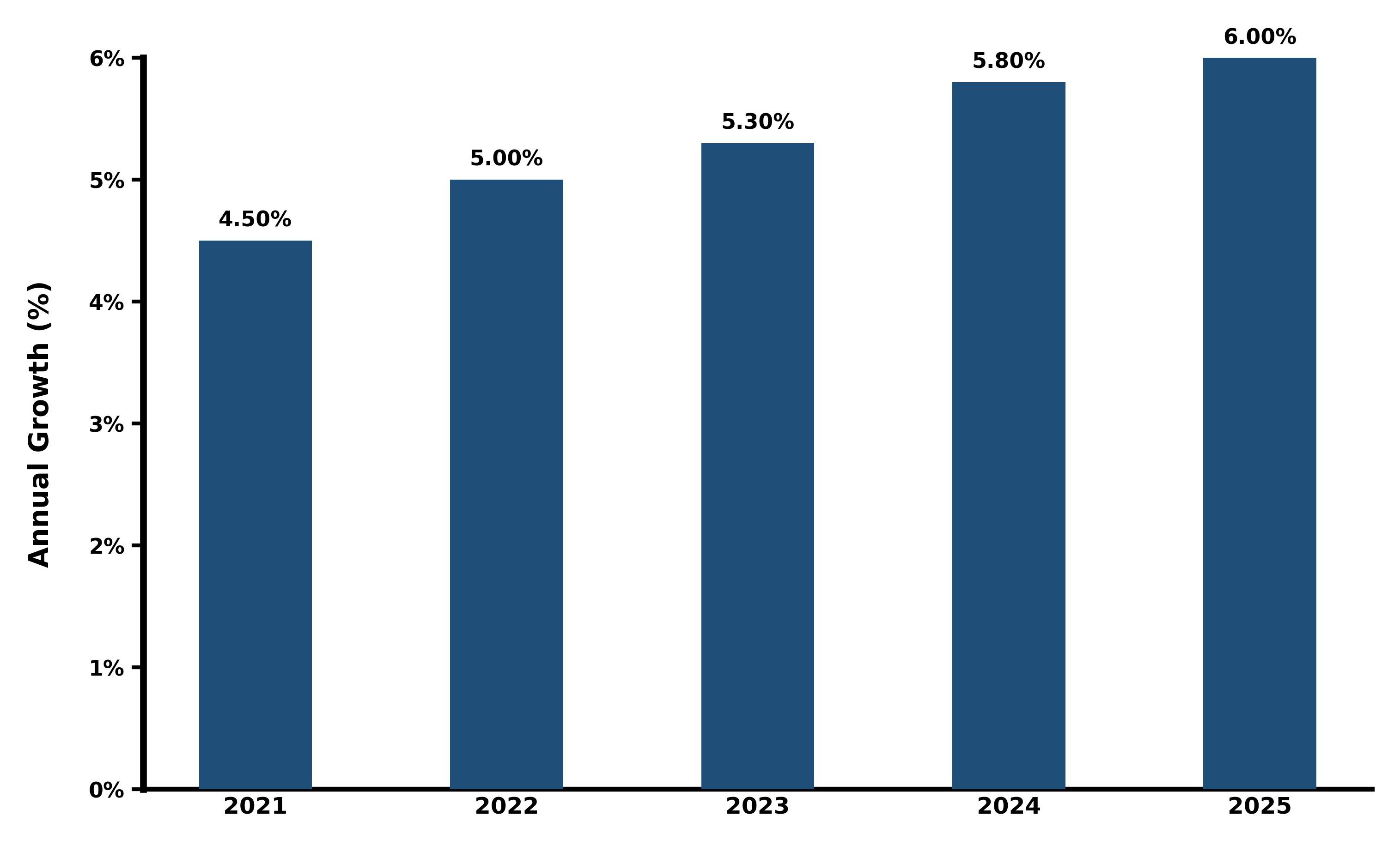
The table below presents the year‑wise growth rates along with the key drivers influencing the market
| Years | Est. Annual Growth in % | Growth Drivers |
| 2021 | 4.5% | Increase in consumer spending and urbanization |
| 2022 | 5% | Growth of e-commerce platforms and digital payment systems |
| 2023 | 5.3% | Rise of organized retail and expanding retail chains |
| 2024 | 5.8% | Rising disposable incomes and consumer preferences |
| 2025 | 6% | Government support and improved retail infrastructure |
Topics Covered in the Bangladesh Retail and Wholesale Market Report
The Bangladesh Retail and Wholesale Market report thoroughly covers the market by type, ownership, price range, and distribution channel. The market report provides an unbiased and detailed analysis of ongoing market trends, opportunities/high growth areas, and market drivers, which would help stakeholders devise and align their market strategies according to the current and future market dynamics.
Bangladesh Retail and Wholesale Market Highlights
| Report Name | Bangladesh Retail and Wholesale Market |
| Forecast period | 2026-2032 |
| CAGR | 6.5% |
| Growing Sector | E-commerce |
Bangladesh Retail and Wholesale Market Synopsis
The Bangladesh Retail and Wholesale Market is growing robustly. The market expansion is driven by increasing spending power of consumers and growth in urbanization. Further, the growth of online retail platforms is encouraging market growth by providing one-click home delivery service to the consumers. The enhanced online digital payment solutions are also encouraging the expansion of the industry. Increasing government policies promoting investment in infrastructure are expected to drive the industry expansion.
Evaluation of Growth Drivers in the Bangladesh Retail and Wholesale Market
Below mentioned are some growth drivers and their impact on market dynamics:
| Drivers | Primary Segments Affected | Why It Matters |
| Rising Disposable Income | Retail, Wholesale | Increased disposable income fuels demand for consumer goods |
| E-commerce Growth | Retail, Wholesale | Expands access to products and enhances convenience |
| Government Initiatives | Retail Chains, Wholesale Chains | Policies support infrastructure development and business growth |
| Shift Toward Organized Retail | Retail Chains, Supermarkets, Convenience Stores | Consumers prefer organized retail due to variety and convenience |
| Urbanization and Changing Lifestyles | Retail Chains, Wholesale Chains, Supermarkets | Cities drive demand for diverse retail options and convenience |
The Bangladesh Retail and Wholesale Market is expected to grow significantly, at a CAGR of 6.5% during the forecast period of 2026-2032. The market growth is driven by several key factors encouraging the market expansion. Key drivers include increasing internet penetration, which is propelling the demand for online shopping. Other than that, increasing spending power of consumers and urbanization are also fueling the market expansion. Also, the expansion of retail stores such as supermarkets and hypermarkets is encouraging the market expansion in the coming years. The growing government support for infrastructure development is also encouraging the expansion of the market. Increasing development of online payment system platforms is also encouraging the growth of Bangladesh's retail and wholesale market.
Evaluation of Restraints in the Bangladesh Retail and Wholesale Market
Below mentioned are some major restraints and their impact on market dynamics:
| Restraints | Primary Segments Affected | What This Means |
| High Operational Costs | Retail Chains, Wholesale Chains | Increased costs can limit profit margins and expansion. |
| Infrastructure Limitations | Wholesale, Retail Chains | Poor infrastructure hinders efficient supply chain management. |
| Regulatory Challenges | Retail Chains, Wholesale Chains | Stringent regulations can increase compliance costs. |
| Intense Competition | Retail, Wholesale | High competition can lead to price wars and reduced profitability. |
| Cultural Barriers | Retail, Wholesale | Regional preferences may restrict product offerings in certain areas. |
Bangladesh Retail and Wholesale Market Challenges
The Bangladesh Retail and Wholesale Market operates under three major challenges which include its unstable infrastructure system and its restricted financial options for small enterprises and its prevailing use of conventional retail practices. The market encounters problems with supply chain operations which result in product deficiencies and increased operational expenses. The organized retail chains and e-commerce platforms are increasing their competitive pressure on small independent retailers. The market expansion process experiences delays as of regulatory obstacles and taxation complications which restrict business growth opportunities.
Bangladesh Retail and Wholesale Market Trends
Some major trends contributing to the Bangladesh Retail and Wholesale Market growth are:
- Government Policies for Infrastructure Development: The growing infrastructure development including retail parks, shopping malls, and improved supply chain management is expected to increase the market expansion.
- Consumer Shift Toward Premium Products: The consumers are increasingly preferring for premium quality products due to rising disposable incomes and willingness to pay for high quality goods.
- Expanding Organized Retail: The supermarkets, and hypermarkets are expanding rapidly, mainly in urban areas, thus contributing to this industry expansion.
Investment Opportunities in the Bangladesh Retail and Wholesale Market
Here are some investment opportunities in the Bangladesh Retail and Wholesale Industry:
- E-commerce Platforms: The online retail channels are having robust growth due to consumer preference for convenience and demand for variety of products choices.
- Retail Chains Expansion: The investors can invest more in expanding organized retail chains in urban and semi-urban areas, which will increase the expansion of the market.
- Infrastructure Development: Investors can invest more in the warehouses, and retail infrastructure development due to government support for infrastructure development.
Top 5 Leading Players in the Bangladesh Retail and Wholesale Market
Here are some top companies contributing to Bangladesh Retail and Wholesale Market Share:
1. Unilever Bangladesh
| Company Name | Unilever Bangladesh |
| Established Year | 1964 |
| Headquarters | Dhaka, Bangladesh |
| Official Website | Click Here |
Unilever Bangladesh is a leading consumer goods company with a strong presence in retail and wholesale. It offers a wide range of products, from food and beverages to home and personal care, in both urban and rural markets.
2. Aarong
| Company Name | Aarong |
| Established Year | 1978 |
| Headquarters | Dhaka, Bangladesh |
| Official Website | Click Here |
Aarong is a prominent retail chain offering a variety of clothing, accessories, and home products. The company focuses on providing high-quality, locally sourced products and operates a network of retail outlets across the country.
3. GSK Bangladesh
| Company Name | GSK Bangladesh |
| Established Year | 1959 |
| Headquarters | Dhaka, Bangladesh |
| Official Website | Click Here |
GSK Bangladesh specializes in pharmaceutical products, healthcare goods, and over-the-counter items. The company has a strong presence in retail and wholesale markets through partnerships with local distributors.
4. Meena Bazar
| Company Name | Meena Bazar |
| Established Year | 2000 |
| Headquarters | Dhaka, Bangladesh |
| Official Website | Click Here |
Meena Bazar is a leading supermarket chain in Bangladesh, offering a wide range of groceries, household products, and fresh produce. Its emphasis on quality and customer service makes it one of the largest retail chains in the country.
5. Bashundhara Group
| Company Name | Bashundhara Group |
| Established Year | 1987 |
| Headquarters | Dhaka, Bangladesh |
| Official Website | Click Here |
Bashundhara Group operates in various sectors, including retail, construction, and manufacturing. It owns and operates several retail chains in Bangladesh, providing a variety of consumer goods, including groceries, clothing, and electronics.
Government Regulations Introduced in the Bangladesh Retail and Wholesale Market
According to Bangladeshi government data, the Bangladesh Retail and Wholesale Market is well regulated by various government policies ensuring the expansion of the market. Also, the Bangladesh government has introduced several initiatives aimed at boosting the retail sector, including tax benefits for retailers, infrastructure development, and easing the process for foreign investment. The National Board of Revenue (NBR) has made regulations that assist businesses in creating efficient supply chains while lowering import tariffs on consumer goods, which enables companies to decrease expenses and increase their product range.
Future Insights of the Bangladesh Retail and Wholesale Market
The Bangladesh Retail and Wholesale Market shows a positive future as it will experience strong growth during the forecast period. The market will grow as consumers will have more spending power and urban development will create additional need for retail products. The market will grow as government programs support retail and wholesale infrastructure development and e-commerce activity increases. The retail chains sector will remain the main industry force while wholesale trade sectors will expand as customers want to buy large quantities of different product types.
Market Segmentation Analysis
The report offers a comprehensive study of the subsequent market segments and their leading categories.
Retail Chains to Dominate the Market – By Type
According to Guneet Kaur, Senior Research Analyst at 6Wresearch, the Retail chains are the fastest-growing segment due to the increasing preference for organized retail stores among consumers. Retail chains provide better quality control, a wide range of products, and convenience, especially in urban areas.
Supermarkets to Dominate the Market – By Distribution Channel
Supermarkets are expected to dominate the distribution channel segment due to their convenience and broad product offerings. Consumers prefer one-stop shops that provide groceries, personal care products, and electronics.
Key attractiveness of the report
- 10 Years Market Numbers.
- Historical Data Starting from 2022 to 2025.
- Base Year: 2025
- Forecast Data until 2032.
- Key Performance Indicators Impacting the Market.
- Major Upcoming Developments and Projects.
Key Highlights of the Report:
- Bangladesh Retail And Wholesale Market Outlook
- Market Size of Bangladesh Retail And Wholesale Market, 2025
- Forecast of Bangladesh Retail And Wholesale Market, 2032
- Historical Data and Forecast of Bangladesh Retail And Wholesale Revenues & Volume for the Period 2022-2032F
- Bangladesh Retail And Wholesale Market Trend Evolution
- Bangladesh Retail And Wholesale Market Drivers and Challenges
- Bangladesh Retail And Wholesale Price Trends
- Bangladesh Retail And Wholesale Porter's Five Forces
- Bangladesh Retail And Wholesale Industry Life Cycle
- Historical Data and Forecast of Bangladesh Retail And Wholesale Market Revenues & Volume By Type for the Period 2022-2032F
- Historical Data and Forecast of Bangladesh Retail And Wholesale Market Revenues & Volume By Retail for the Period 2022-2032F
- Historical Data and Forecast of Bangladesh Retail And Wholesale Market Revenues & Volume By Wholesale for the Period 2022-2032F
- Historical Data and Forecast of Bangladesh Retail And Wholesale Market Revenues & Volume By Ownership for the Period 2022-2032F
- Historical Data and Forecast of Bangladesh Retail And Wholesale Market Revenues & Volume By Retail Chain/Wholesale Chain for the Period 2022-2032F
- Historical Data and Forecast of Bangladesh Retail And Wholesale Market Revenues & Volume By Independent Retailer/Independent Wholesalers for the Period 2022-2032F
- Historical Data and Forecast of Bangladesh Retail And Wholesale Market Revenues & Volume By Price Range for the Period 2022-2032F
- Historical Data and Forecast of Bangladesh Retail And Wholesale Market Revenues & Volume By Premium for the Period 2022-2032F
- Historical Data and Forecast of Bangladesh Retail And Wholesale Market Revenues & Volume By Mid-Range for the Period 2022-2032F
- Historical Data and Forecast of Bangladesh Retail And Wholesale Market Revenues & Volume By Economy for the Period 2022-2032F
- Historical Data and Forecast of Bangladesh Retail And Wholesale Market Revenues & Volume By Distribution Channel for the Period 2022-2032F
- Historical Data and Forecast of Bangladesh Retail And Wholesale Market Revenues & Volume By Supermarkets/Hypermarkets for the Period 2022-2032F
- Historical Data and Forecast of Bangladesh Retail And Wholesale Market Revenues & Volume By Convenience Stores for the Period 2022-2032F
- Historical Data and Forecast of Bangladesh Retail And Wholesale Market Revenues & Volume By Department Stores for the Period 2022-2032F
- Historical Data and Forecast of Bangladesh Retail And Wholesale Market Revenues & Volume By Specialty Stores for the Period 2022-2032F
- Bangladesh Retail And Wholesale Import Export Trade Statistics
- Market Opportunity Assessment By Type
- Market Opportunity Assessment By Ownership
- Market Opportunity Assessment By Price Range
- Market Opportunity Assessment By Distribution Channel
- Bangladesh Retail And Wholesale Top Companies Market Share
- Bangladesh Retail And Wholesale Competitive Benchmarking By Technical and Operational Parameters
- Bangladesh Retail And Wholesale Company Profiles
- Bangladesh Retail And Wholesale Key Strategic Recommendations
Markets Covered
The report provides a detailed analysis of the following market segments:
By Type
- Retail
- Wholesale
By Ownership
- Retail Chain/Wholesale Chain
- Independent Retailer/Independent Wholesalers
By Price Range
- Premium
- Mid-Range
- Economy
By Distribution Channel
- Supermarkets/Hypermarkets
- Convenience Stores
- Department Stores
- Specialty Stores






































