Bangladesh Retail Industry Market Size, Share & Growth Rate
The Bangladesh Retail Industry Market was estimated at USD 372 Million in 2025 and is projected to reach USD 474 Million by 2032, growing at a CAGR of 3.5% from 2026 to 2032. This upward trajectory is fundamentally driven by rising disposable incomes, significant urbanization, and a burgeoning middle class that is increasingly favoring organized retail formats. Additionally, the rapid expansion of e-commerce platforms and digital payment systems is enhancing consumer accessibility and reshaping shopping experiences in the region.
Bangladesh Retail Industry Market Year-wise Growth Rate and Key Drivers
This graph highlights how the Bangladesh Retail Industry Market has steadily grown over the years, supported by major growth factors.
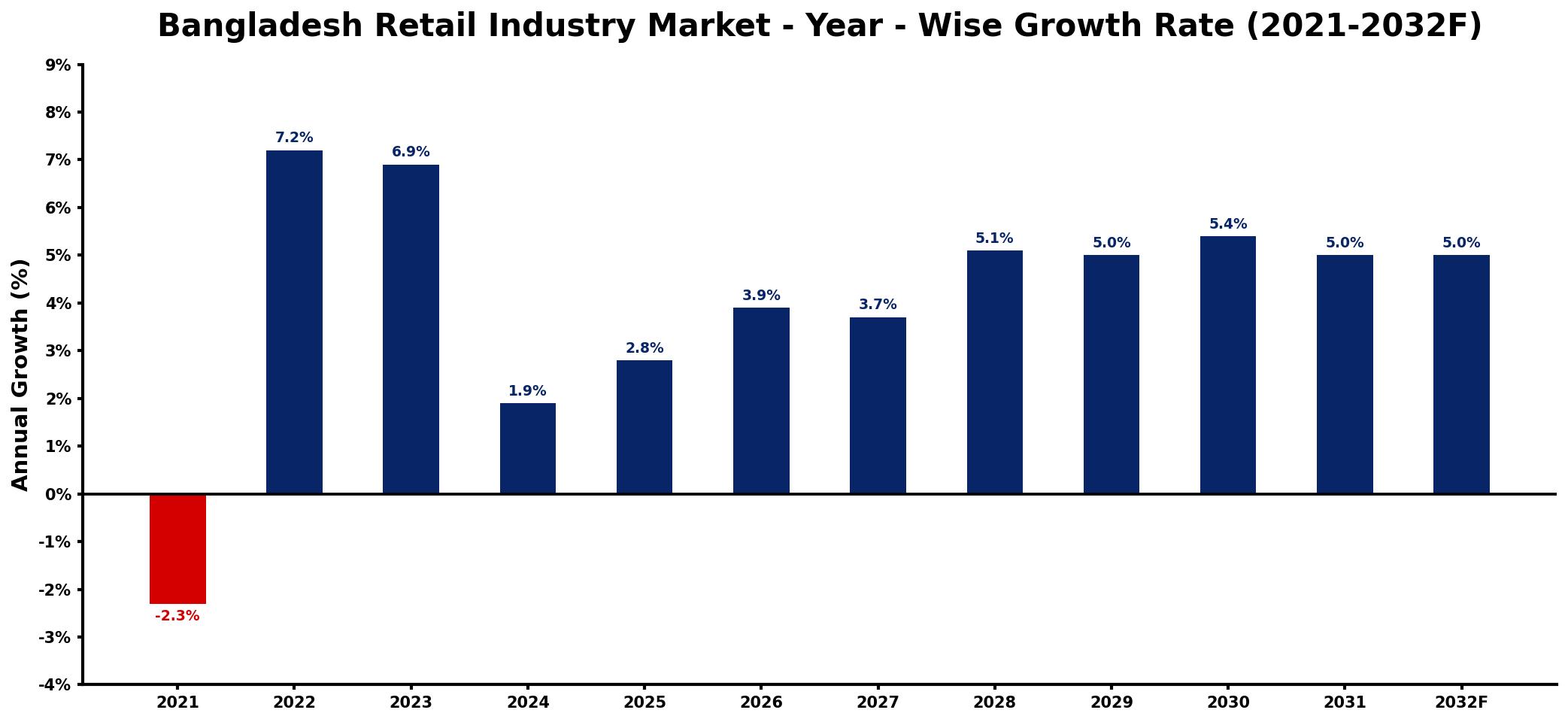
The table below presents the year‑wise growth rates along with the key drivers influencing the market
| Year | Growth Rate | Major Drivers |
| 2021 | -2.3% | decrease in consumer spending |
| 2022 | 7.2% | rise in disposable income |
| 2023 | 6.9% | increased online shopping adoption |
| 2024 | 1.9% | expansion of local brands |
| 2025 | 2.8% | growth in urban population |
| 2026 | 3.9% | enhanced supply chain efficiency |
| 2027 | 3.7% | increased foreign direct investment |
| 2028 | 5.1% | boost in e-commerce platforms |
| 2029 | 5.0% | growing automotive sector requirements |
| 2030 | 5.4% | growing commercial sector adoption |
| 2031 | 5.0% | improved processing technologies adoption |
| 2032 | 5.0% | increased focus on sustainability |
Note: Market size estimations and growth projections presented in this report are based on 6Wresearch's proprietary forecasting methodology, utilizing the latest available industry data, government publications, and primary research inputs.
Bangladesh Retail Industry Market Synopsis
Urbanization stands as the strongest force shaping the Bangladesh Retail Industry Market today. As cities expand, theres a noticeable shift in consumer behavior toward modern retail formats, which offer greater convenience and variety.
Moreover, changing consumer preferences, particularly among the younger demographic, are fostering a growing appetite for branded and quality products. This evolving landscape is prompting retailers to innovate, enhancing their offerings and customer experiences.
Bangladesh Retail Industry Market Key Takeaways
- The retail sector is experiencing significant transformation due to urbanization and a growing middle class.
- Modern retail formats like supermarkets and online platforms are gaining prominence.
- Consumer preferences are shifting towards branded and quality products, influenced by rising incomes.
- Technological advancements in e-commerce and digital payments are revolutionizing shopping behaviors.
- Government policies are supportive of infrastructure development and fair competition within the sector.
Evaluation of Restraints in Bangladesh Retail Industry Market
Despite its growth potential, the Bangladesh Retail Industry Market is held back by several factors. Informal sector competition continues to pose challenges for organized retailers, resulting in price wars and lower profit margins. Additionally, supply chain inefficiencies often lead to product shortages and delayed deliveries, which can frustrate both retailers and consumers. Regulatory hurdles further complicate market access and compliance, highlighting the need for modernization efforts and strategic investments to enhance overall competitiveness.
Bangladesh Retail Industry Market Trends
Several trends are currently shaping the Bangladesh Retail Industry Market, most notably the shift towards sustainability and eco-friendly products. Consumers are becoming increasingly aware of environmental issues, and there is a rising demand for products that reflect ethical sourcing and production practices. Additionally, the integration of technology into retail, such as personalized shopping experiences through AI and data analytics, is gaining traction. Mobile commerce is also on the rise, fueled by improved internet connectivity and smartphone penetration.
Bangladesh Retail Industry Market Opportunities
The growing urban population and the increasing propensity for online shopping present genuine opportunities for investment in the Bangladesh Retail Industry Market. Retailers who can effectively leverage digital platforms and optimize their supply chains stand to gain significantly. Theres also potential for growth in niche markets, such as health and wellness products, organic foods, and local artisanal goods, as consumer preferences continue to evolve.
Government Initiatives in the Bangladesh Retail Industry Market
The Bangladesh government has recognized the pivotal role of the retail sector in economic development and is actively promoting policies to support its growth. These initiatives focus on enhancing retail infrastructure, fostering fair competition, and protecting consumer rights. The government collaborates with various stakeholders, including industry associations, to address challenges related to market access and compliance while encouraging investment in technology and skills development within the retail sector.
Future Insights of the Bangladesh Retail Industry Market
Looking ahead to 2026-2032, the Bangladesh Retail Industry Market is poised for continued growth driven by urbanization and an increasingly affluent consumer base. The rise of e-commerce will likely play a crucial role in shaping the retail landscape, as retailers adopt more innovative approaches to enhance customer engagement and streamline operations. Additionally, as government policies support further modernization, the market is expected to attract more foreign investment, leading to a diverse and competitive retail environment.
Bangladesh Retail Industry Market Latest Developments (2025 - 2026)
Recent developments in the Bangladesh Retail Industry highlight a growing emphasis on digital transformation. Retailers are increasingly adopting omnichannel strategies to enhance customer experiences, integrating physical stores with online platforms. Furthermore, there is a noticeable trend of collaborations between local businesses and international brands aimed at expanding product offerings and enhancing market reach. These developments reflect a dynamic retail environment responsive to consumer needs and technological advancements.
Bangladesh Retail Industry Market - Key Attractiveness of the Report
- 10 Years of Market Numbers
- Historical Data Starting from 2022 to 2025
- Base Year: 2025
- Forecast Data until 2032
- Key Performance Indicators Impacting the Market
- Major Upcoming Developments and Projects
Key Highlights of the Report:
- Bangladesh Retail Industry Market Outlook
- Market Size of Bangladesh Retail Industry Market, 2025
- Forecast of Bangladesh Retail Industry Market, 2032
- Historical Data and Forecast of Bangladesh Retail Industry Revenues & Volume for the Period 2022-2032F
- Bangladesh Retail Industry Market Trend Evolution
- Bangladesh Retail Industry Market Drivers and Challenges
- Bangladesh Retail Industry Price Trends
- Bangladesh Retail Industry Porter's Five Forces
- Bangladesh Retail Industry Industry Life Cycle
- Historical Data and Forecast of Bangladesh Retail Industry Market Revenues & Volume By Product for the Period 2022-2032F
- Historical Data and Forecast of Bangladesh Retail Industry Market Revenues & Volume By Food and Beverages for the Period 2022-2032F
- Historical Data and Forecast of Bangladesh Retail Industry Market Revenues & Volume By Personal and Household Care for the Period 2022-2032F
- Historical Data and Forecast of Bangladesh Retail Industry Market Revenues & Volume By Apparel, Footwear, and Accessories for the Period 2022-2032F
- Historical Data and Forecast of Bangladesh Retail Industry Market Revenues & Volume By Furniture, Toys, and Hobby for the Period 2022-2032F
- Historical Data and Forecast of Bangladesh Retail Industry Market Revenues & Volume By Electronic and Household Appliances for the Period 2022-2032F
- Historical Data and Forecast of Bangladesh Retail Industry Market Revenues & Volume By Other Products for the Period 2022-2032F
- Historical Data and Forecast of Bangladesh Retail Industry Market Revenues & Volume By Distribution Channel for the Period 2022-2032F
- Historical Data and Forecast of Bangladesh Retail Industry Market Revenues & Volume By Supermarkets/Hypermarkets for the Period 2022-2032F
- Historical Data and Forecast of Bangladesh Retail Industry Market Revenues & Volume By Convenience Stores for the Period 2022-2032F
- Historical Data and Forecast of Bangladesh Retail Industry Market Revenues & Volume By Department Stores for the Period 2022-2032F
- Historical Data and Forecast of Bangladesh Retail Industry Market Revenues & Volume By Specialty Stores for the Period 2022-2032F
- Historical Data and Forecast of Bangladesh Retail Industry Market Revenues & Volume By Online for the Period 2022-2032F
- Historical Data and Forecast of Bangladesh Retail Industry Market Revenues & Volume By Other Distribution Channels for the Period 2022-2032F
- Bangladesh Retail Industry Import Export Trade Statistics
- Market Opportunity Assessment By Product
- Market Opportunity Assessment By Distribution Channel
- Bangladesh Retail Industry Top Companies Market Share
- Bangladesh Retail Industry Competitive Benchmarking By Technical and Operational Parameters
- Bangladesh Retail Industry Company Profiles
- Bangladesh Retail Industry Key Strategic Recommendations






































