Bangladesh Secondhand Apparel Market Size, Share & Growth Rate
The Bangladesh Secondhand Apparel Market was estimated at USD 1116 Million in 2025 and is projected to reach USD 1590 Million by 2032, growing at a CAGR of 5.2% from 2026 to 2032. This growth trajectory is fueled by a rising consumer consciousness towards sustainable fashion, alongside the increasing acceptance of thrift shopping among younger demographics. Additionally, the economic pressure of rising living costs is leading more consumers to seek affordable alternatives, further propelling the demand for pre-owned clothing.
Bangladesh Secondhand Apparel Market Year-wise Growth Rate and Key Drivers
This graph highlights how the Bangladesh Secondhand Apparel Market has steadily grown over the years, supported by major growth factors.
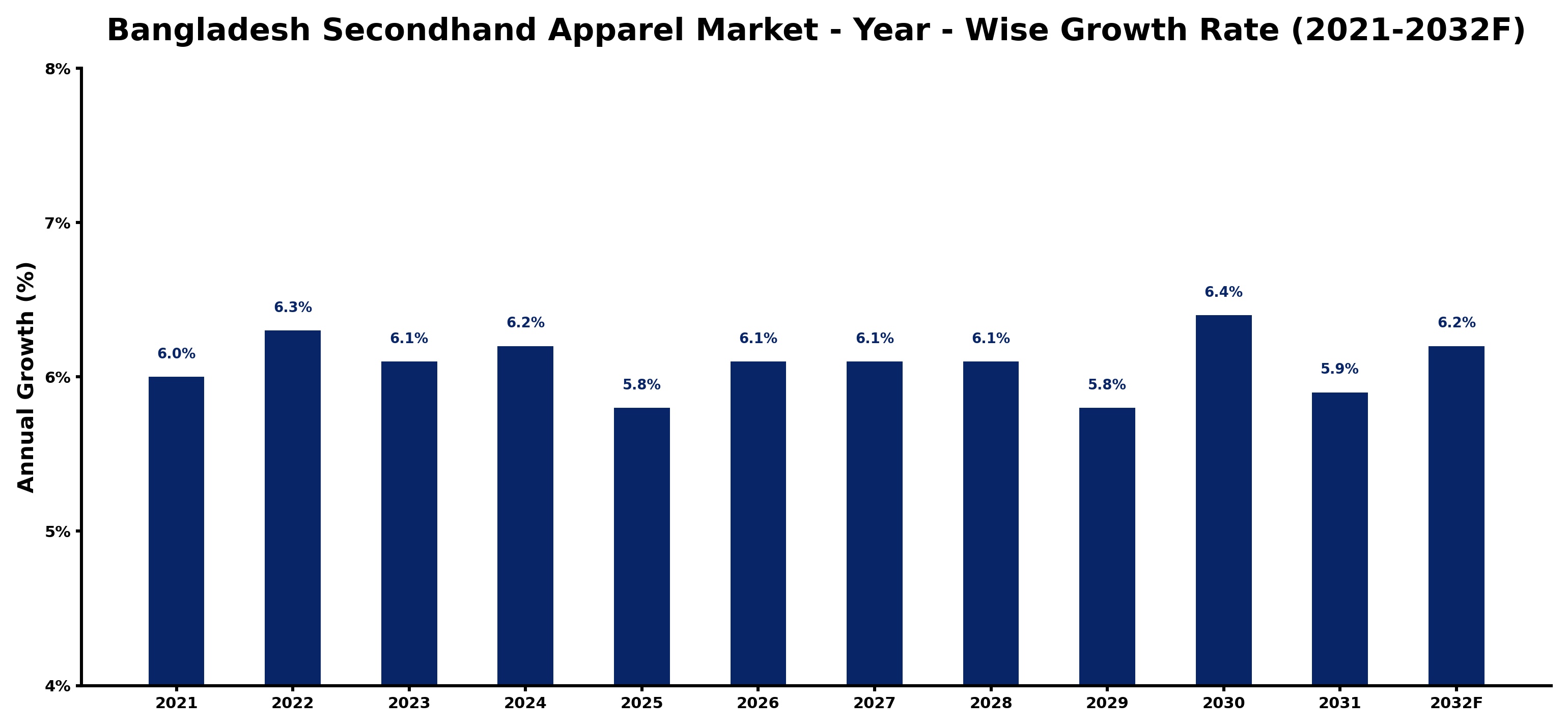
The table below presents the year‑wise growth rates along with the key drivers influencing the market
| Year | Growth Rate | Major Drivers |
| 2021 | 6.0% | Growing renewable energy integration projects |
| 2022 | 6.3% | Increasing industrial infrastructure investments |
| 2023 | 6.1% | Increasing industrial automation investments |
| 2024 | 6.2% | Growing renewable energy integration projects |
| 2025 | 5.8% | Growing urbanization and commercial development |
| 2026 | 6.1% | Increasing smart city development projects |
| 2027 | 6.1% | Growing urbanization and commercial development |
| 2028 | 6.1% | Increasing adoption of advanced technologies |
| 2029 | 5.8% | Expansion of manufacturing activities |
| 2030 | 6.4% | Expansion of manufacturing activities |
| 2031 | 5.9% | Increasing industrial infrastructure investments |
| 2032 | 6.2% | Government infrastructure modernization initiatives |
Note - Market size estimations and growth projections presented in this report are based on 6Wresearch’s advanced forecasting approach, validated with industry datasets as of June 2026.
Bangladesh Secondhand Apparel Market Synopsis
One of the defining characteristics of the Bangladesh secondhand apparel market is its vibrant online ecosystem. E-commerce platforms have become essential channels for consumers looking for a diverse range of pre-owned clothing, enabling easy access to unique and affordable fashion choices. This shift towards digital shopping has significantly enhanced the visibility and availability of secondhand items.
The market is also influenced by a deep-rooted cultural practice of recycling clothing. Many Bangladeshi consumers view secondhand shopping not only as a cost-effective solution but as an eco-friendly option that aligns with their values, promoting a lifestyle of sustainability. As awareness grows, the secondhand apparel market is set to attract a broader consumer base.
Bangladesh Secondhand Apparel Market Key Takeaways
- The secondhand apparel segment in Bangladesh is rapidly expanding, driven by sustainability trends and economic considerations.
- Online platforms are becoming the primary channel for buying and selling secondhand clothing, reflecting a broader shift in consumer behavior.
- The market holds significant appeal for younger generations, who are increasingly engaged in thrift shopping.
- Government policies are evolving to support sustainability within the textile industry, which benefits the secondhand market.
- Investors are encouraged by promising opportunities in both physical thrift stores and digital marketplaces.
Evaluation of Restraints in Bangladesh Secondhand Apparel Market
Despite its growth, the Bangladesh secondhand apparel market encounters notable challenges. The lack of regulatory oversight raises concerns about product quality, leading some consumers to hesitate when purchasing secondhand items. Furthermore, societal perceptions of secondhand clothing often carry stigma, with many consumers still preferring new garments. Issues such as limited distribution networks and storage facilities also impede market scalability, necessitating strategic solutions to enhance operational efficiency.
Bangladesh Secondhand Apparel Market Trends
Current trends in the Bangladesh secondhand apparel market highlight a significant uptick in digital engagement. Social media platforms are increasingly utilized for marketing and community-building around thrift shopping. Furthermore, there is a rising interest in vintage clothing, as consumers seek distinctive styles that stand out from fast fashion. Collaborative initiatives between traditional retailers and online resale platforms are also growing, enhancing the variety and convenience available to shoppers.
Bangladesh Secondhand Apparel Market Opportunities
The Bangladesh secondhand apparel market is ripe with opportunities for investment and expansion. Entrepreneurs can explore the establishment of innovative online platforms catering to the growing demand for secondhand clothing. Additionally, creating physical thrift stores in urban areas could tap into the local consumer base seeking affordable fashion. Investments in sustainable practices, such as partnerships with local textile recycling centers, would not only be profitable but also align with the increasing emphasis on environmental responsibility.
Government Initiatives in the Bangladesh Secondhand Apparel Market
The Bangladesh government has implemented several initiatives to regulate the secondhand apparel market while promoting sustainable practices. Key policies focus on the importation of used clothing, ensuring compliance with environmental standards and quality regulations. There are also measures in place to protect local textile manufacturing through the imposition of duties on imported secondhand garments. Through these efforts, the government aims to balance economic growth in the secondhand sector with environmental sustainability and the protection of domestic industries.
Future Insights of the Bangladesh Secondhand Apparel Market
Looking ahead to the years 2026-2032, the Bangladesh secondhand apparel market is positioned for sustained growth. As consumer awareness of sustainability continues to rise, the trend towards affordable and unique fashion will likely intensify. The proliferation of digital platforms will further ease the process of buying and selling pre-owned apparel, enhancing market access for consumers. In conjunction with supportive government policies and a strong cultural inclination towards recycling, the market's future appears robust and full of potential.
Bangladesh Secondhand Apparel Market Latest Developments (May 2025 - June 2026)
Recent developments in the Bangladesh secondhand apparel market reflect a dynamic industry landscape. Various online platforms have begun to introduce features that enhance user experience, such as augmented reality tools for virtual try-ons. Simultaneously, traditional retailers are increasingly partnering with online marketplaces to reach a wider audience. These collaborations are paving the way for innovative retail experiences that combine the benefits of both physical and digital shopping.
Bangladesh Secondhand Apparel Market - Key Attractiveness of the Report
- 10 Years of Market Numbers
- Historical Data Starting from 2022 to 2025
- Base Year: 2025
- Forecast Data until 2032
- Key Performance Indicators Impacting the Market
- Major Upcoming Developments and Projects
Key Highlights of the Report:
- Bangladesh Secondhand Apparel Market Outlook
- Market Size of Bangladesh Secondhand Apparel Market, 2025
- Forecast of Bangladesh Secondhand Apparel Market, 2032
- Historical Data and Forecast of Bangladesh Secondhand Apparel Revenues & Volume for the Period 2022-2032F
- Bangladesh Secondhand Apparel Market Trend Evolution
- Bangladesh Secondhand Apparel Market Drivers and Challenges
- Bangladesh Secondhand Apparel Price Trends
- Bangladesh Secondhand Apparel Porter's Five Forces
- Bangladesh Secondhand Apparel Industry Life Cycle
- Historical Data and Forecast of Bangladesh Secondhand Apparel Market Revenues & Volume By Sector for the Period 2022-2032F
- Historical Data and Forecast of Bangladesh Secondhand Apparel Market Revenues & Volume By Resale for the Period 2022-2032F
- Historical Data and Forecast of Bangladesh Secondhand Apparel Market Revenues & Volume By Traditional Thrift Stores and Donations for the Period 2022-2032F
- Historical Data and Forecast of Bangladesh Secondhand Apparel Market Revenues & Volume By Product Type for the Period 2022-2032F
- Historical Data and Forecast of Bangladesh Secondhand Apparel Market Revenues & Volume By Dresses & Tops for the Period 2022-2032F
- Historical Data and Forecast of Bangladesh Secondhand Apparel Market Revenues & Volume By Shirts & T-shirts for the Period 2022-2032F
- Historical Data and Forecast of Bangladesh Secondhand Apparel Market Revenues & Volume By Sweaters, Coats & Jackets for the Period 2022-2032F
- Historical Data and Forecast of Bangladesh Secondhand Apparel Market Revenues & Volume By Jeans & Pants for the Period 2022-2032F
- Historical Data and Forecast of Bangladesh Secondhand Apparel Market Revenues & Volume By Others for the Period 2022-2032F
- Historical Data and Forecast of Bangladesh Secondhand Apparel Market Revenues & Volume By Target Population for the Period 2022-2032F
- Historical Data and Forecast of Bangladesh Secondhand Apparel Market Revenues & Volume By Men for the Period 2022-2032F
- Historical Data and Forecast of Bangladesh Secondhand Apparel Market Revenues & Volume By Women for the Period 2022-2032F
- Historical Data and Forecast of Bangladesh Secondhand Apparel Market Revenues & Volume By Kids for the Period 2022-2032F
- Historical Data and Forecast of Bangladesh Secondhand Apparel Market Revenues & Volume By Sales Channel for the Period 2022-2032F
- Historical Data and Forecast of Bangladesh Secondhand Apparel Market Revenues & Volume By Wholesalers/Distributors for the Period 2022-2032F
- Historical Data and Forecast of Bangladesh Secondhand Apparel Market Revenues & Volume By Hypermarkets/Supermarkets for the Period 2022-2032F
- Historical Data and Forecast of Bangladesh Secondhand Apparel Market Revenues & Volume By Multi-brand Stores for the Period 2022-2032F
- Historical Data and Forecast of Bangladesh Secondhand Apparel Market Revenues & Volume By Independent Small Stores for the Period 2022-2032F
- Historical Data and Forecast of Bangladesh Secondhand Apparel Market Revenues & Volume By Departmental Stores for the Period 2022-2032F
- Historical Data and Forecast of Bangladesh Secondhand Apparel Market Revenues & Volume By Online Retailers for the Period 2022-2032F
- Historical Data and Forecast of Bangladesh Secondhand Apparel Market Revenues & Volume By Others for the Period 2022-2032F
- Bangladesh Secondhand Apparel Import Export Trade Statistics
- Market Opportunity Assessment By Sector
- Market Opportunity Assessment By Product Type
- Market Opportunity Assessment By Target Population
- Market Opportunity Assessment By Sales Channel
- Bangladesh Secondhand Apparel Top Companies Market Share
- Bangladesh Secondhand Apparel Competitive Benchmarking By Technical and Operational Parameters
- Bangladesh Secondhand Apparel Company Profiles
- Bangladesh Secondhand Apparel Key Strategic Recommendations






































