Bangladesh Television Broadcasting Market Size, Share & Growth Rate
The Bangladesh Television Broadcasting Market was estimated at USD 621 Million in 2025 and is projected to reach USD 1174 Million by 2032, growing at a CAGR of 9.5% from 2026 to 2032. This significant growth trajectory is driven by an increasing demand for high-quality content and a rapidly expanding viewer base that is gaining access to digital platforms and satellite television. Additionally, the rising disposable income among the population is encouraging greater investment in advertising, which further fuels the expansion of the market.
Bangladesh Television Broadcasting Market Year-wise Growth Rate and Key Drivers
This graph highlights how the Bangladesh Television Broadcasting Market has steadily grown over the years, supported by major growth factors.
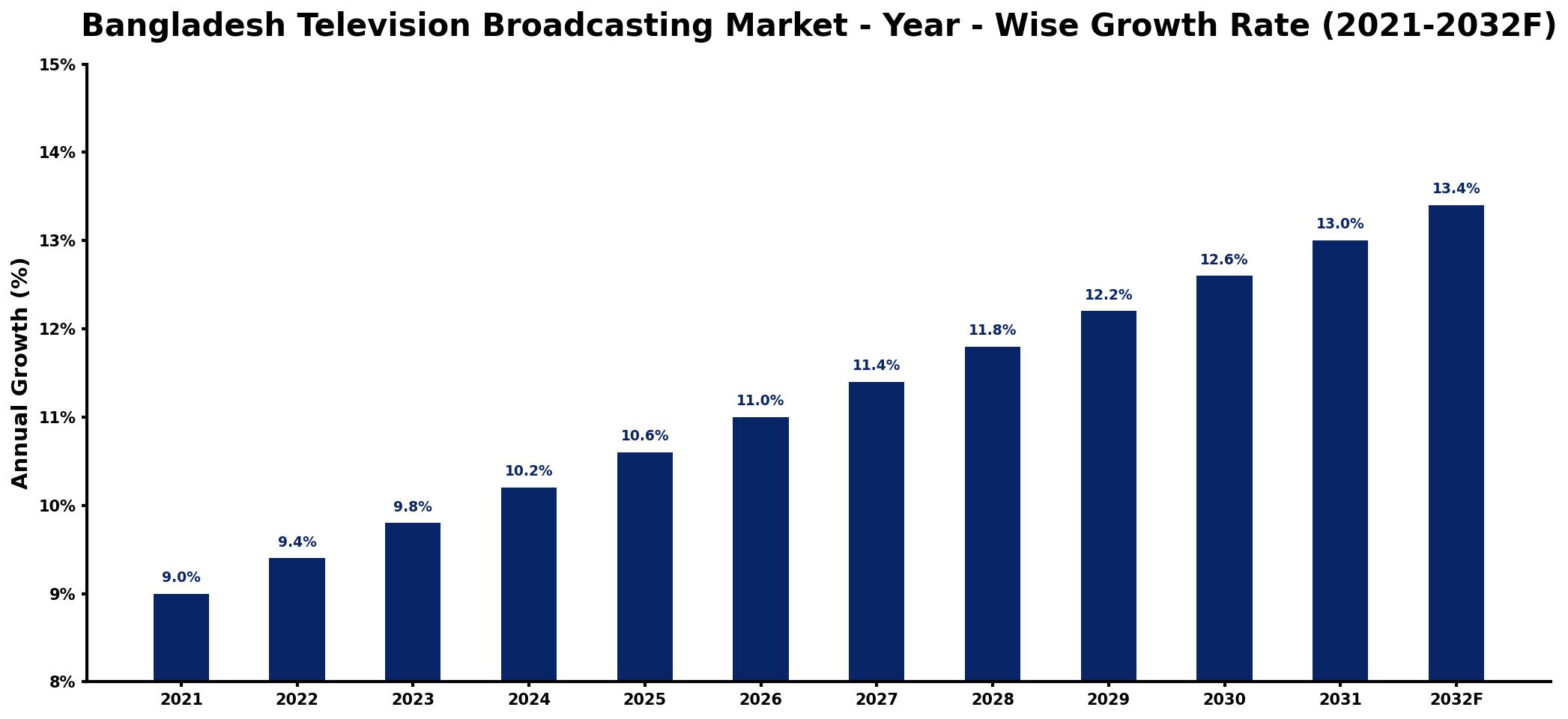
The table below presents the year‑wise growth rates along with the key drivers influencing the market
| Year | Growth Rate | Major Drivers |
| 2021 | 9.0% | Rising disposable income levels |
| 2022 | 9.4% | Increased smartphone penetration rate |
| 2023 | 9.8% | Growing digital content consumption |
| 2024 | 10.2% | Expansion of internet infrastructure |
| 2025 | 10.6% | Higher advertising expenditures anticipated |
| 2026 | 11.0% | Emergence of new content creators |
| 2027 | 11.4% | Growth in subscription services popularity |
| 2028 | 11.8% | Increased investment in local productions |
| 2029 | 12.2% | Diversification of entertainment options available |
| 2030 | 12.6% | Advancements in streaming technologies |
| 2031 | 13.0% | Strengthening of content distribution networks |
| 2032 | 13.4% | Rise in youth audience engagement |
Note: Market size estimations and growth projections presented in this report are based on 6Wresearch's proprietary forecasting methodology, utilizing the latest available industry data, government publications, and primary research inputs.
Bangladesh Television Broadcasting Market Synopsis
Digital platforms and online streaming services are currently the most influential forces shaping the Bangladesh Television Broadcasting Market. As audiences increasingly migrate towards on-demand content, traditional broadcasters are compelled to innovate and adapt their offerings to retain viewership.
The competitive landscape is further heightened by a proliferation of channels, both state-owned and private, leading to a more fragmented market. Consequently, there is a pressing need for content localization and diversity, as viewers increasingly seek programming that resonates with their cultural identity and preferences.
Bangladesh Television Broadcasting Market Key Takeaways
- Rapid growth fueled by rising disposable incomes and digital platform adoption.
- High demand for localized and high-definition content among diverse viewer segments.
- Increased collaboration between broadcasters and telecom companies for bundled offerings.
- Strong advertising revenue potential despite market fragmentation.
- Government initiatives promoting local content production and fair competition.
Evaluation of Restraints in Bangladesh Television Broadcasting Market
Despite the promising growth, the Bangladesh Television Broadcasting Market faces several restraints that could hinder its full potential. Intense competition among numerous channels results in viewer fragmentation, making it challenging for broadcasters to maintain audience loyalty. Additionally, limited advertising revenue stemming from the relatively small market size restricts the capacity for investment in high-quality content production. Technological constraints also pose challenges, as many broadcasters struggle to adopt advanced broadcasting technologies effectively. Furthermore, regulatory and political influences complicate the landscape, making it imperative for broadcasters to navigate these hurdles with strategic innovation.
Bangladesh Television Broadcasting Market Trends
The landscape of the Bangladesh Television Broadcasting Market is currently characterized by several key trends. The shift towards digital platforms and streaming services is transforming viewer habits, thereby increasing competition for traditional television. High-definition content and interactive viewing experiences are now more desirable, prompting investments in production quality and technology. Moreover, partnerships between broadcasters and telecom companies are growing to facilitate bundled service offerings, enhancing audience reach. Lastly, a greater emphasis on local content and cultural representation is becoming critical in engaging viewers effectively.
Bangladesh Television Broadcasting Market Opportunities
Investment opportunities in the Bangladesh Television Broadcasting Market are robust and diverse. The rising demand for high-quality local content offers promising avenues for partnerships with production companies that can deliver engaging programming. The surge in digital consumption opens up possibilities for investment in over-the-top (OTT) platforms and streaming services, enabling broadcasters to diversify their revenue streams. Advertising remains a lucrative domain, making investments in advertising agencies particularly appealing. Furthermore, advancements in technology and infrastructure offer significant investment opportunities in broadcasting equipment and technologies that can elevate viewer experiences.
Government Initiatives in the Bangladesh Television Broadcasting Market
The Bangladesh Television Broadcasting Market is governed by regulations from the Bangladesh Telecommunication Regulatory Commission (BTRC), which oversees licensing and content standards. Government policies also focus on promoting local content production, requiring broadcasters to dedicate a portion of their airtime to locally produced programs. Furthermore, regulations regarding foreign ownership aim to protect local stakeholders and ensure a competitive landscape. These initiatives are designed to uphold quality standards and support the growth of the broadcasting industry.
Future Insights of the Bangladesh Television Broadcasting Market
The outlook for the Bangladesh Television Broadcasting Market appears promising, with expectations for sustained growth through 2032. Key drivers such as increasing disposable incomes, a burgeoning middle class, and ongoing technological advancements will continue to shape demand. The proliferation of digital platforms and government efforts to enhance internet access will create new opportunities for broadcasters to connect with wider audiences. Moving forward, players in the market will need to focus on innovative content strategies and multi-platform distribution methods to capitalize on these emerging trends.
Bangladesh Television Broadcasting Market Latest Developments (2025 - 2026)
Recent developments in the Bangladesh Television Broadcasting Market indicate a shift towards more interactive viewing experiences, as broadcasters increasingly incorporate digital elements into traditional formats. Collaborations between telecom operators and broadcasters are also on the rise, facilitating enhanced service offerings that bundle television with mobile and internet services. Government initiatives aimed at fostering local content production continue to evolve, ensuring a competitive environment that encourages innovation while meeting consumer demand for culturally resonant programming.
Bangladesh Television Broadcasting Market - Key Attractiveness of the Report
- 10 Years of Market Numbers
- Historical Data Starting from 2022 to 2025
- Base Year: 2025
- Forecast Data until 2032
- Key Performance Indicators Impacting the Market
- Major Upcoming Developments and Projects
Key Highlights of the Report:
- Bangladesh Television Broadcasting Market Outlook
- Market Size of Bangladesh Television Broadcasting Market, 2025
- Forecast of Bangladesh Television Broadcasting Market, 2032
- Historical Data and Forecast of Bangladesh Television Broadcasting Revenues & Volume for the Period 2022-2032F
- Bangladesh Television Broadcasting Market Trend Evolution
- Bangladesh Television Broadcasting Market Drivers and Challenges
- Bangladesh Television Broadcasting Price Trends
- Bangladesh Television Broadcasting Porter's Five Forces
- Bangladesh Television Broadcasting Industry Life Cycle
- Historical Data and Forecast of Bangladesh Television Broadcasting Market Revenues & Volume By Type for the Period 2022-2032F
- Historical Data and Forecast of Bangladesh Television Broadcasting Market Revenues & Volume By Television Station for the Period 2022-2032F
- Historical Data and Forecast of Bangladesh Television Broadcasting Market Revenues & Volume By Television Network for the Period 2022-2032F
- Historical Data and Forecast of Bangladesh Television Broadcasting Market Revenues & Volume By Broadcaster Type for the Period 2022-2032F
- Historical Data and Forecast of Bangladesh Television Broadcasting Market Revenues & Volume By Public for the Period 2022-2032F
- Historical Data and Forecast of Bangladesh Television Broadcasting Market Revenues & Volume By Commercial for the Period 2022-2032F
- Historical Data and Forecast of Bangladesh Television Broadcasting Market Revenues & Volume By Revenue Source for the Period 2022-2032F
- Historical Data and Forecast of Bangladesh Television Broadcasting Market Revenues & Volume By Subscription-based for the Period 2022-2032F
- Historical Data and Forecast of Bangladesh Television Broadcasting Market Revenues & Volume By Advertisement-based for the Period 2022-2032F
- Bangladesh Television Broadcasting Import Export Trade Statistics
- Market Opportunity Assessment By Type
- Market Opportunity Assessment By Broadcaster Type
- Market Opportunity Assessment By Revenue Source
- Bangladesh Television Broadcasting Top Companies Market Share
- Bangladesh Television Broadcasting Competitive Benchmarking By Technical and Operational Parameters
- Bangladesh Television Broadcasting Company Profiles
- Bangladesh Television Broadcasting Key Strategic Recommendations






































