Bangladesh Time and Attendance Software Market Size, Share & Growth Rate
The Bangladesh Time and Attendance Software Market was estimated at USD 179 Million in 2025 and is projected to reach USD 236 Million by 2032, growing at a CAGR of 4.0% from 2026 to 2032. This growth trajectory is fueled by the rapid digital transformation initiatives within the country, compelling organizations to adopt automated workforce management solutions. As companies increasingly recognize the efficiency gains offered by cloud-based systems, the demand for advanced time and attendance software is expected to rise significantly.
Bangladesh Time and Attendance Software Market Year-wise Growth Rate and Key Drivers
This graph highlights how the Bangladesh Time and Attendance Software Market has steadily grown over the years, supported by major growth factors.
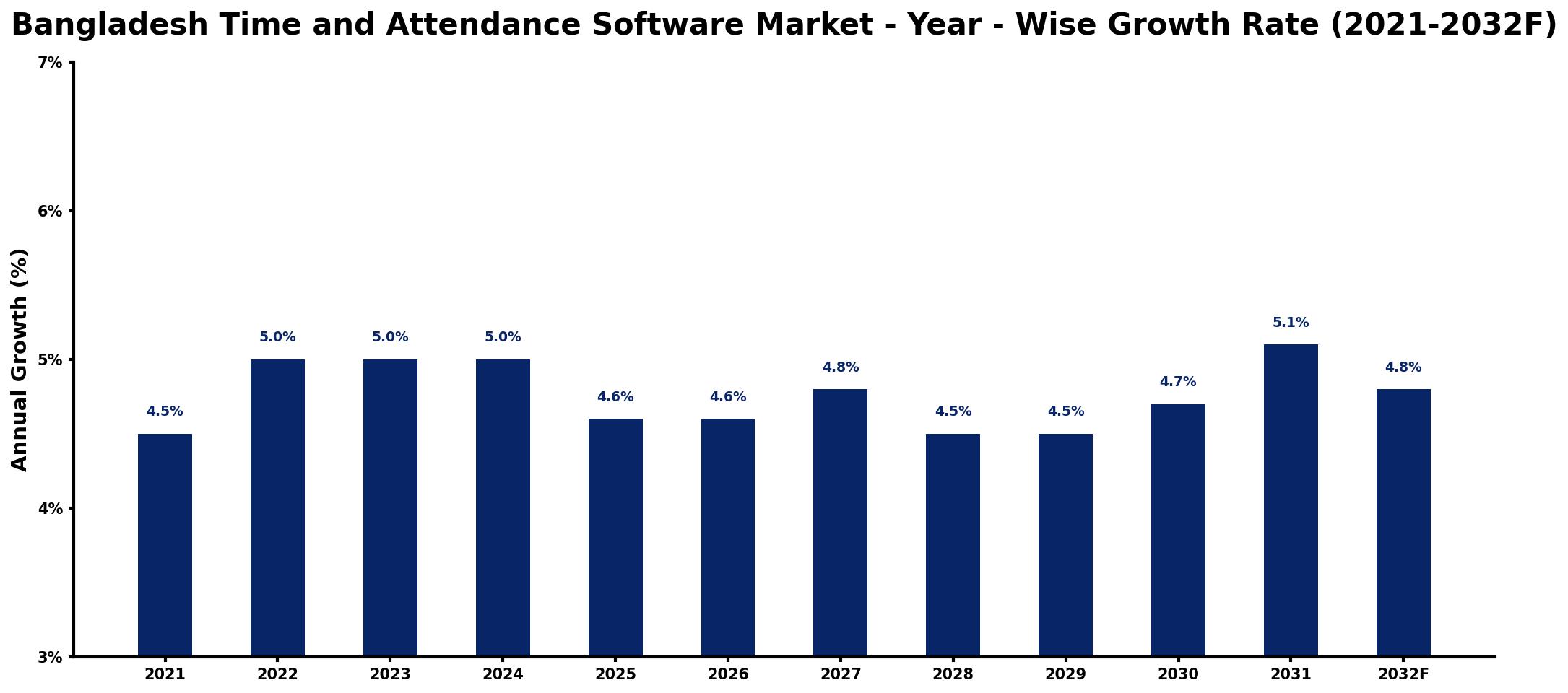
The table below presents the year‑wise growth rates along with the key drivers influencing the market
| Year | Growth Rate | Major Drivers |
| 2021 | 4.5% | Rising demand for workforce management |
| 2022 | 5.0% | Increased adoption of digital solutions |
| 2023 | 5.0% | Expansion of remote work practices |
| 2024 | 5.0% | Growing focus on employee productivity |
| 2025 | 4.6% | Investment in HR technology solutions |
| 2026 | 4.6% | Emergence of mobile workforce applications |
| 2027 | 4.8% | Enhanced regulatory compliance requirements |
| 2028 | 4.5% | Development of integrated management systems |
| 2029 | 4.5% | Shift towards data-driven decision making |
| 2030 | 4.7% | Focus on operational efficiency initiatives |
| 2031 | 5.1% | Growth in cloud-based service offerings |
| 2032 | 4.8% | Surge in analytics-driven insights |
Note: Market size estimations and growth projections presented in this report are based on 6Wresearch's proprietary forecasting methodology, utilizing the latest available industry data, government publications, and primary research inputs.
Bangladesh Time and Attendance Software Market Synopsis
The strongest force shaping the Bangladesh Time and Attendance Software Market is the burgeoning demand for cloud-based solutions that enhance operational efficiency across various sectors. Organizations are eager to leverage advanced features like biometric tracking and real-time reporting to streamline workforce management.
In addition, government initiatives aimed at promoting digitalization are playing a critical role in this market. With increased awareness regarding the importance of tracking employee attendance accurately and the benefits of automation, businesses in Bangladesh are moving away from traditional methods, setting the stage for sustained market growth.
Bangladesh Time and Attendance Software Market Key Takeaways
- The market is projected to experience a robust CAGR of 4.0% from 2026 to 2032.
- Cloud-based solutions are becoming the standard, offering scalability and flexibility for organizations.
- Features like biometric authentication and mobile access are driving user adoption.
- Integration with other HR systems enhances operational efficiency and data accuracy.
- Government initiatives are creating a favorable environment for software adoption.
Evaluation of Restraints in Bangladesh Time and Attendance Software Market
Despite the promising growth outlook, the Bangladesh Time and Attendance Software Market faces several restraints that could hinder its expansion. A notable challenge is the limited understanding of automated systems, particularly among small and medium-sized enterprises, which often rely on traditional attendance methods. Concerns about data privacy and security also loom large, potentially deterring businesses from fully embracing these technologies. Furthermore, the uneven quality of internet connectivity in various regions complicates the implementation and effectiveness of cloud-based solutions, limiting access to advanced software features.
Bangladesh Time and Attendance Software Market Trends
Current trends in the Bangladesh Time and Attendance Software Market reveal a significant shift towards mobile app solutions and biometric authentication methods. Companies are increasingly adopting tools that allow for remote attendance tracking, aligning with the growing trend of flexible work environments. Additionally, integration capabilities with payroll and HR management systems are becoming essential, providing businesses with a comprehensive approach to workforce management and data analysis.
Bangladesh Time and Attendance Software Market Opportunities
The market presents lucrative investment opportunities as businesses strive to enhance their operational efficiency through sophisticated time and attendance solutions. The ongoing digital transformation across various sectors in Bangladesh indicates a fertile ground for technology providers willing to offer tailored and innovative software solutions. Furthermore, as remote work continues to gain traction, the demand for scalable and customizable attendance tracking systems is likely to surge, offering significant growth potential for investors.
Government Initiatives in the Bangladesh Time and Attendance Software Market
While the Bangladesh government has not established specific policies targeting the Time and Attendance Software Market directly, it has implemented broader initiatives that foster economic growth and technology adoption. These initiatives include improving digital infrastructure and enhancing internet connectivity, thereby creating a conducive environment for technology companies. Additionally, various incentives aimed at the technology sector, such as tax benefits and reduced duties on IT imports, indirectly support the market's growth trajectory.
Future Insights of the Bangladesh Time and Attendance Software Market
Looking ahead to the period from 2026 to 2032, the Bangladesh Time and Attendance Software Market is expected to experience substantial growth driven by continuous advancements in technology and evolving workplace dynamics. The need for precise employee attendance tracking and compliance with labor regulations will drive demand for sophisticated software solutions. As businesses emphasize automation and data-driven decision-making, there is likely to be an increased focus on features such as analytics and integration capabilities, further propelling the market forward.
Bangladesh Time and Attendance Software Market Latest Developments (2025 - 2026)
The industry is witnessing an influx of innovations and new product releases, aligning with the growing demand for user-friendly and efficient attendance solutions. Many software providers are enhancing their offerings with advanced biometric technologies and mobile applications that allow for seamless attendance management. As organizations adapt to remote work setups, the integration of time and attendance software with other HR platforms is becoming more prevalent, indicating a shift towards comprehensive workforce management solutions.
Bangladesh Time and Attendance Software Market - Key Attractiveness of the Report
- 10 Years of Market Numbers
- Historical Data Starting from 2022 to 2025
- Base Year: 2025
- Forecast Data until 2032
- Key Performance Indicators Impacting the Market
- Major Upcoming Developments and Projects
Key Highlights of the Report:
- Bangladesh Time and Attendance Software Market Outlook
- Market Size of Bangladesh Time and Attendance Software Market, 2025
- Forecast of Bangladesh Time and Attendance Software Market, 2032
- Historical Data and Forecast of Bangladesh Time and Attendance Software Revenues & Volume for the Period 2022-2032F
- Bangladesh Time and Attendance Software Market Trend Evolution
- Bangladesh Time and Attendance Software Market Drivers and Challenges
- Bangladesh Time and Attendance Software Price Trends
- Bangladesh Time and Attendance Software Porter's Five Forces
- Bangladesh Time and Attendance Software Industry Life Cycle
- Historical Data and Forecast of Bangladesh Time and Attendance Software Market Revenues & Volume By Component for the Period 2022-2032F
- Historical Data and Forecast of Bangladesh Time and Attendance Software Market Revenues & Volume By Software for the Period 2022-2032F
- Historical Data and Forecast of Bangladesh Time and Attendance Software Market Revenues & Volume By Services for the Period 2022-2032F
- Historical Data and Forecast of Bangladesh Time and Attendance Software Market Revenues & Volume By Deployment Mode for the Period 2022-2032F
- Historical Data and Forecast of Bangladesh Time and Attendance Software Market Revenues & Volume By On-premise for the Period 2022-2032F
- Historical Data and Forecast of Bangladesh Time and Attendance Software Market Revenues & Volume By Cloud for the Period 2022-2032F
- Historical Data and Forecast of Bangladesh Time and Attendance Software Market Revenues & Volume By Hybrid for the Period 2022-2032F
- Historical Data and Forecast of Bangladesh Time and Attendance Software Market Revenues & Volume By Organization Size for the Period 2022-2032F
- Historical Data and Forecast of Bangladesh Time and Attendance Software Market Revenues & Volume By Large Enterprises for the Period 2022-2032F
- Historical Data and Forecast of Bangladesh Time and Attendance Software Market Revenues & Volume By SMES for the Period 2022-2032F
- Historical Data and Forecast of Bangladesh Time and Attendance Software Market Revenues & Volume By Industry Vertical for the Period 2022-2032F
- Historical Data and Forecast of Bangladesh Time and Attendance Software Market Revenues & Volume By BFSI for the Period 2022-2032F
- Historical Data and Forecast of Bangladesh Time and Attendance Software Market Revenues & Volume By Manufacturing for the Period 2022-2032F
- Historical Data and Forecast of Bangladesh Time and Attendance Software Market Revenues & Volume By Healthcare for the Period 2022-2032F
- Historical Data and Forecast of Bangladesh Time and Attendance Software Market Revenues & Volume By Government for the Period 2022-2032F
- Historical Data and Forecast of Bangladesh Time and Attendance Software Market Revenues & Volume By Retail & E-commerce for the Period 2022-2032F
- Historical Data and Forecast of Bangladesh Time and Attendance Software Market Revenues & Volume By IT & Telecom for the Period 2022-2032F
- Historical Data and Forecast of Bangladesh Time and Attendance Software Market Revenues & Volume By Education for the Period 2022-2032F
- Historical Data and Forecast of Bangladesh Time and Attendance Software Market Revenues & Volume By Others for the Period 2022-2032F
- Bangladesh Time and Attendance Software Import Export Trade Statistics
- Market Opportunity Assessment By Component
- Market Opportunity Assessment By Deployment Mode
- Market Opportunity Assessment By Organization Size
- Market Opportunity Assessment By Industry Vertical
- Bangladesh Time and Attendance Software Top Companies Market Share
- Bangladesh Time and Attendance Software Competitive Benchmarking By Technical and Operational Parameters
- Bangladesh Time and Attendance Software Company Profiles
- Bangladesh Time and Attendance Software Key Strategic Recommendations






































