Bangladesh Transaction Monitoring Market Size & Growth Rate (2026-2032)
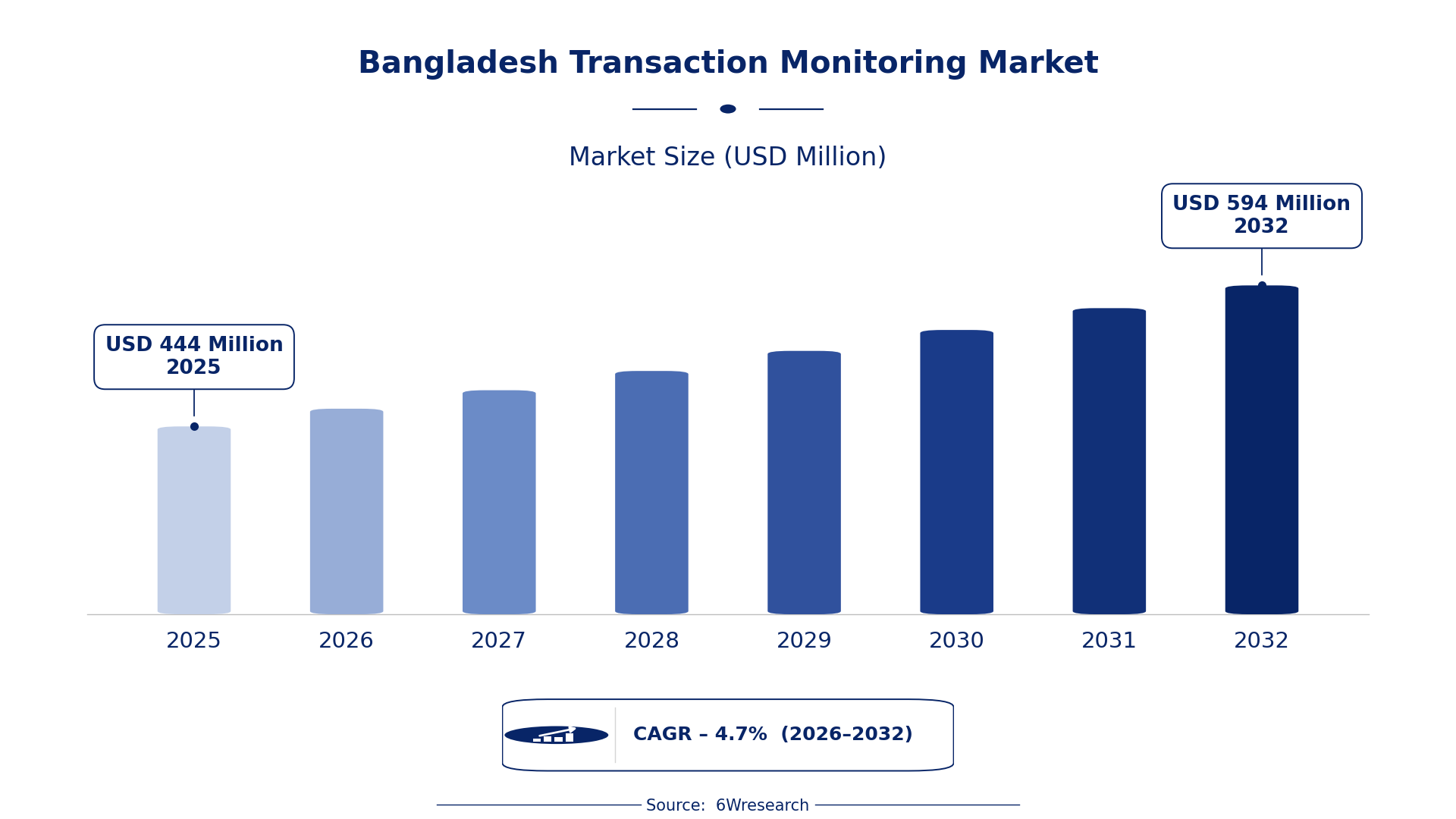
The Bangladesh Transaction Monitoring Market was estimated at USD 444 Million in 2025 and is projected to reach USD 594 Million by 2032, growing at a CAGR of 4.7% from 2026 to 2032.
Bangladesh Transaction Monitoring Market Synopsis
Transaction monitoring has become a cornerstone for financial institutions in Bangladesh. With increasing financial crime threats and stringent regulatory frameworks, organizations are ramping up their investment in advanced monitoring solutions. This market's expansion reflects a broader commitment to risk management and compliance, as companies seek to protect their reputations and operational integrity.
In an era of rapid digitalization, Bangladesh's financial sector is witnessing unprecedented growth in electronic transactions. This surge is driving demand for sophisticated transaction monitoring systems to identify and prevent suspicious activities, including money laundering and fraud. As the landscape of financial services transforms, so does the imperative to enhance transaction oversight.
Bangladesh Transaction Monitoring Market Year-wise Growth Rate and Key Drivers
This graph illustrates the annual growth rates of the Bangladesh Transaction Monitoring Market from 2021 to 2032, highlighting a steady upward trajectory and projected expansion over the forecast period.
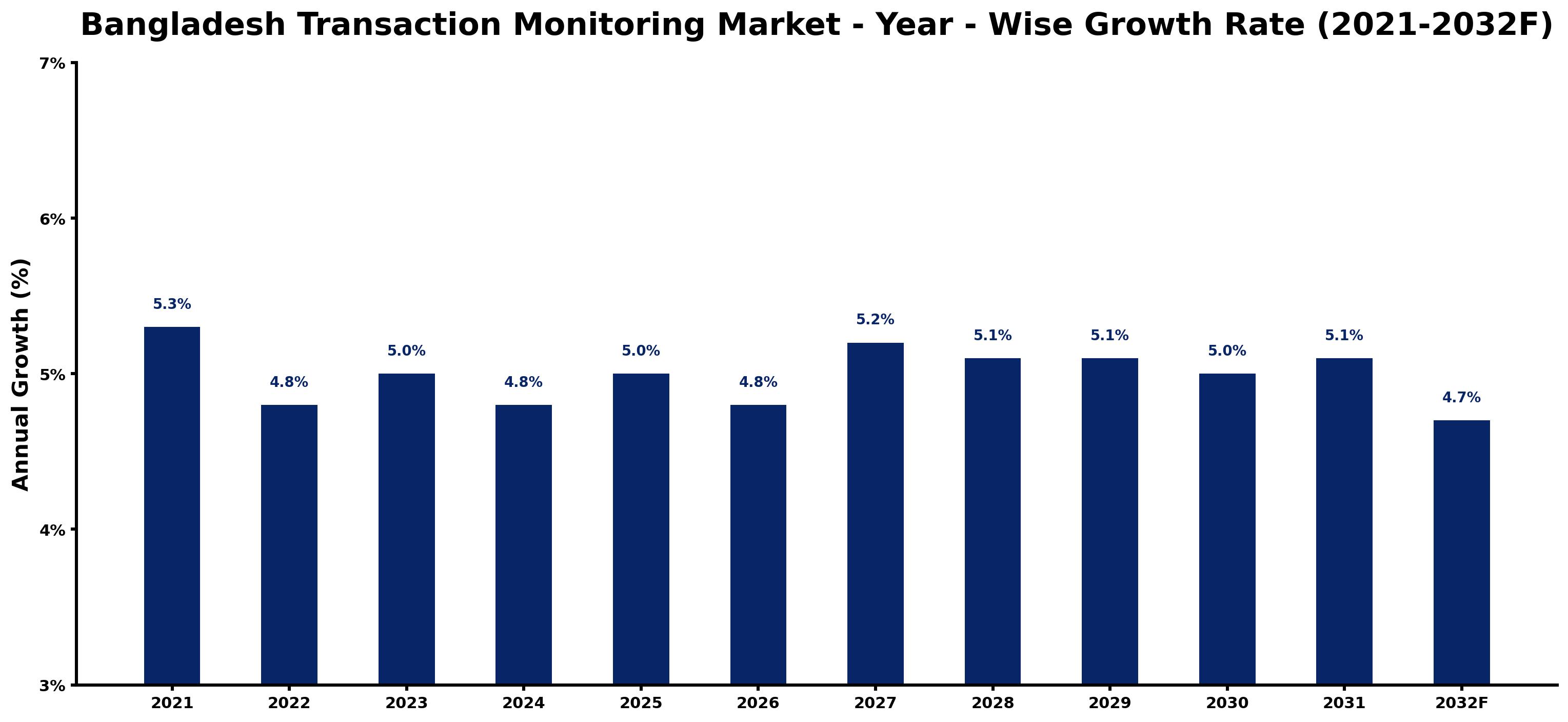
The table below presents the year‑wise growth rates along with the key drivers influencing the market
| Year | Growth Rate | Major Drivers |
| 2021 | 5.3% | Bangladesh Bank's stronger anti-money laundering regulations. |
| 2022 | 4.8% | Increased mobile banking usage post-pandemic drives demand. |
| 2023 | 5.0% | Rising fintech investments enhance transaction monitoring capabilities. |
| 2024 | 4.8% | Government's digital financial inclusion strategy promotes regulation adherence. |
| 2025 | 5.0% | Growth in e-commerce transactions heightens monitoring necessity. |
| 2026 | 4.8% | Enhanced cybersecurity threats underline need for monitoring solutions. |
| 2027 | 5.2% | Regulatory emphasis on KYC compliance fuels market growth. |
| 2028 | 5.1% | Digital currency initiatives spur adoption of transaction monitoring. |
| 2029 | 5.1% | Consumer awareness of fraud drives transaction security demands. |
| 2030 | 5.0% | Collaboration with international agencies strengthens monitoring frameworks. |
| 2031 | 5.1% | Tech advancements in AI improve transaction analysis efficiency. |
| 2032 | 4.7% | Focus on consumer protection regulations demands robust monitoring. |
Note: Market size estimations and growth projections presented in this report are based on 6Wresearch's proprietary forecasting methodology, utilizing the latest available industry data, government publications, and primary research inputs.
Bangladesh Transaction Monitoring Market Key Takeaways
Below are some of the specific key takeaways from the market, including:
- The demand for transaction monitoring solutions is increasingly driven by the need for compliance with anti-money laundering (AML) and counter-terrorism financing (CTF) regulations.
- Rapid technological advancements in artificial intelligence and machine learning are spurring innovation within the transaction monitoring domain.
- Real-time fraud detection and prevention capabilities are becoming essential as the volume of digital transactions escalates.
- The market is challenged by technological constraints, including outdated systems that can hinder timely monitoring and analytics.
- Data privacy and security concerns remain critical as institutions manage sensitive transactional information.
Evaluation of Restraints in Bangladesh Transaction Monitoring Market
While the transaction monitoring market in Bangladesh is on an upward trajectory, it is not without its challenges. A lack of sophisticated technology hampers the ability of financial institutions to conduct effective real-time monitoring. Many organizations are still reliant on outdated systems that struggle to integrate with newer technologies. Compliance with evolving regulatory requirements adds to the complexity, especially given the international standards that must be met. on top of that, there are ongoing concerns regarding data security, which necessitate substantial investments in protective measures. Addressing these restraints is crucial for the continued growth and effectiveness of transaction monitoring solutions in the country.
Bangladesh Transaction Monitoring Market Trends
The Bangladesh transaction monitoring market is witnessing several noteworthy trends. One of the most significant is the shift towards real-time monitoring, necessitated by the rapid increase in digital transactions. Financial institutions are now prioritizing the integration of artificial intelligence to automate and enhance the detection of anomalies. on top of that, there’s a growing emphasis on behavioral analytics, which enables organizations to understand transaction patterns better and identify potential risks. As global financial crime tactics evolve, Bangladesh is expected to adapt its monitoring practices accordingly, ensuring more stringent oversight of transactions.
Bangladesh Transaction Monitoring Market Opportunities
Significant opportunities exist for stakeholders in the Bangladesh transaction monitoring market. The ongoing expansion of the financial sector creates a fertile ground for innovative solutions that address compliance and fraud detection. As more businesses adopt digital payment systems, the demand for effective monitoring technologies is set to grow. on top of that, collaboration between financial institutions and technology providers can result in tailored solutions that address specific regional challenges. Investment in capacity building and training can also enhance the operational efficacy of monitoring systems, opening new avenues for growth.
Government Initiatives in the Bangladesh Transaction Monitoring Market
The Bangladeshi government has recognized the necessity of robust transaction monitoring systems to combat financial crime effectively. Public policies are increasingly focused on strengthening regulatory frameworks and enhancing collaboration with international agencies. By fostering an environment conducive to innovation, the government aims to bolster the financial sector’s integrity. Given the rising challenges of money laundering and terrorist financing, these initiatives are timely and essential.
- A national regulatory framework was introduced in 2025, mandating enhanced compliance measures across financial institutions.
- Currently, an ongoing initiative aims to upgrade the digital infrastructure within the banking sector to support better transaction monitoring practices.
- A recently launched anti-money laundering technology grant program is providing financial assistance for institutions to acquire advanced monitoring solutions.
- There are plans for a public-private collaboration expected to commence in 2026 to improve data sharing mechanisms among financial institutions.
- The government is working on a comprehensive training program scheduled to roll out by early 2027, focusing on the latest transaction monitoring technologies.
Future Insights of the Bangladesh Transaction Monitoring Market
Looking ahead to 2026-2032, the Bangladesh transaction monitoring market is set to experience continued growth. As financial institutions increasingly prioritize compliance and risk management, the adoption of advanced monitoring technologies will likely accelerate. The integration of artificial intelligence and machine learning will redefine the capabilities of transaction monitoring solutions, enabling organizations to detect suspicious activity with greater accuracy and speed. The commitment to regulatory compliance will further underpin investments, ensuring that Bangladesh’s financial system remains resilient against emerging threats.
Bangladesh Transaction Monitoring Market Latest Developments
Recent developments in the Bangladesh transaction monitoring market indicate a strong push towards enhancing technological capabilities and compliance standards. Over the last year, several key initiatives have been set in motion to address pressing concerns in financial monitoring.
- A major technology vendor initiated a comprehensive upgrade of transaction monitoring systems across various banks, beginning in early 2025 and expected to complete by late 2025.
- Several financial institutions are currently undergoing the integration of AI-driven analytics tools to improve the detection of fraudulent transactions, a project that remains underway.
- A new collaborative initiative among leading banks is planned for the second half of 2026, focusing on the development of standardized monitoring protocols.
- In mid-2025, a pilot program launched by a regional operator aimed at enhancing data security measures within transaction monitoring solutions has shown promising results.
- An upcoming workshop series designed to educate financial professionals about best practices in transaction monitoring is expected to begin in early 2027.
Bangladesh Transaction Monitoring Market - Key Attractiveness of the Report
- 10 Years of Market Numbers
- Historical Data Starting from 2022 to 2025
- Base Year: 2025
- Forecast Data until 2032
- Key Performance Indicators Impacting the Market
- Major Upcoming Developments and Projects
Key Highlights of the Report:
- Bangladesh Transaction Monitoring Market Outlook
- Market Size of Bangladesh Transaction Monitoring Market, 2025
- Forecast of Bangladesh Transaction Monitoring Market, 2032
- Historical Data and Forecast of Bangladesh Transaction Monitoring Revenues & Volume for the Period 2022-2032F
- Bangladesh Transaction Monitoring Market Trend Evolution
- Bangladesh Transaction Monitoring Market Drivers and Challenges
- Bangladesh Transaction Monitoring Price Trends
- Bangladesh Transaction Monitoring Porter's Five Forces
- Bangladesh Transaction Monitoring Industry Life Cycle
- Historical Data and Forecast of Bangladesh Transaction Monitoring Market Revenues & Volume By Application Area for the Period 2022-2032F
- Historical Data and Forecast of Bangladesh Transaction Monitoring Market Revenues & Volume By AML for the Period 2022-2032F
- Historical Data and Forecast of Bangladesh Transaction Monitoring Market Revenues & Volume By FDP for the Period 2022-2032F
- Historical Data and Forecast of Bangladesh Transaction Monitoring Market Revenues & Volume By Compliance Management for the Period 2022-2032F
- Historical Data and Forecast of Bangladesh Transaction Monitoring Market Revenues & Volume By Customer Identity Management for the Period 2022-2032F
- Historical Data and Forecast of Bangladesh Transaction Monitoring Market Revenues & Volume By Component for the Period 2022-2032F
- Historical Data and Forecast of Bangladesh Transaction Monitoring Market Revenues & Volume By Solution for the Period 2022-2032F
- Historical Data and Forecast of Bangladesh Transaction Monitoring Market Revenues & Volume By Services for the Period 2022-2032F
- Historical Data and Forecast of Bangladesh Transaction Monitoring Market Revenues & Volume By Function for the Period 2022-2032F
- Historical Data and Forecast of Bangladesh Transaction Monitoring Market Revenues & Volume By Case Management for the Period 2022-2032F
- Historical Data and Forecast of Bangladesh Transaction Monitoring Market Revenues & Volume By KYC/Customer Onboarding for the Period 2022-2032F
- Historical Data and Forecast of Bangladesh Transaction Monitoring Market Revenues & Volume By Dashboard and Reporting for the Period 2022-2032F
- Historical Data and Forecast of Bangladesh Transaction Monitoring Market Revenues & Volume By Watch List Screening for the Period 2022-2032F
- Historical Data and Forecast of Bangladesh Transaction Monitoring Market Revenues & Volume By Deployment Mode for the Period 2022-2032F
- Historical Data and Forecast of Bangladesh Transaction Monitoring Market Revenues & Volume By On-Premises for the Period 2022-2032F
- Historical Data and Forecast of Bangladesh Transaction Monitoring Market Revenues & Volume By Cloud for the Period 2022-2032F
- Historical Data and Forecast of Bangladesh Transaction Monitoring Market Revenues & Volume By Organization Size for the Period 2022-2032F
- Historical Data and Forecast of Bangladesh Transaction Monitoring Market Revenues & Volume By SMEs for the Period 2022-2032F
- Historical Data and Forecast of Bangladesh Transaction Monitoring Market Revenues & Volume By Large Enterprises for the Period 2022-2032F
- Historical Data and Forecast of Bangladesh Transaction Monitoring Market Revenues & Volume By Vertical for the Period 2022-2032F
- Historical Data and Forecast of Bangladesh Transaction Monitoring Market Revenues & Volume By Banking, Financial Services, and Insurance for the Period 2022-2032F
- Historical Data and Forecast of Bangladesh Transaction Monitoring Market Revenues & Volume By Government and Defense for the Period 2022-2032F
- Historical Data and Forecast of Bangladesh Transaction Monitoring Market Revenues & Volume By IT and Telecom for the Period 2022-2032F
- Historical Data and Forecast of Bangladesh Transaction Monitoring Market Revenues & Volume By Retail for the Period 2022-2032F
- Historical Data and Forecast of Bangladesh Transaction Monitoring Market Revenues & Volume By Healthcare for the Period 2022-2032F
- Historical Data and Forecast of Bangladesh Transaction Monitoring Market Revenues & Volume By Energy and Utilities for the Period 2022-2032F
- Historical Data and Forecast of Bangladesh Transaction Monitoring Market Revenues & Volume By Manufacturing for the Period 2022-2032F
- Historical Data and Forecast of Bangladesh Transaction Monitoring Market Revenues & Volume By Others for the Period 2022-2032F
- Bangladesh Transaction Monitoring Import Export Trade Statistics
- Market Opportunity Assessment By Application Area
- Market Opportunity Assessment By Component
- Market Opportunity Assessment By Function
- Market Opportunity Assessment By Deployment Mode
- Market Opportunity Assessment By Organization Size
- Market Opportunity Assessment By Vertical
- Bangladesh Transaction Monitoring Top Companies Market Share
- Bangladesh Transaction Monitoring Competitive Benchmarking By Technical and Operational Parameters
- Bangladesh Transaction Monitoring Company Profiles
- Bangladesh Transaction Monitoring Key Strategic Recommendations






































