Bangladesh Winding Wire Market Size, Share & Growth Rate
The Bangladesh Winding Wire Market was estimated at USD 320 Million in 2025 and is projected to reach USD 434 Million by 2032, growing at a CAGR of 4.4% from 2026 to 2032. This growth trajectory is significantly influenced by the expansion of the country's power infrastructure, along with the escalating demand from the automotive and construction sectors. In particular, government initiatives to improve rural electrification and enhance energy efficiency are expected to further propel the market in the coming years.
Bangladesh Winding Wire Market Year-wise Growth Rate and Key Drivers
This graph highlights how the Bangladesh Winding Wire Market has steadily grown over the years, supported by major growth factors.
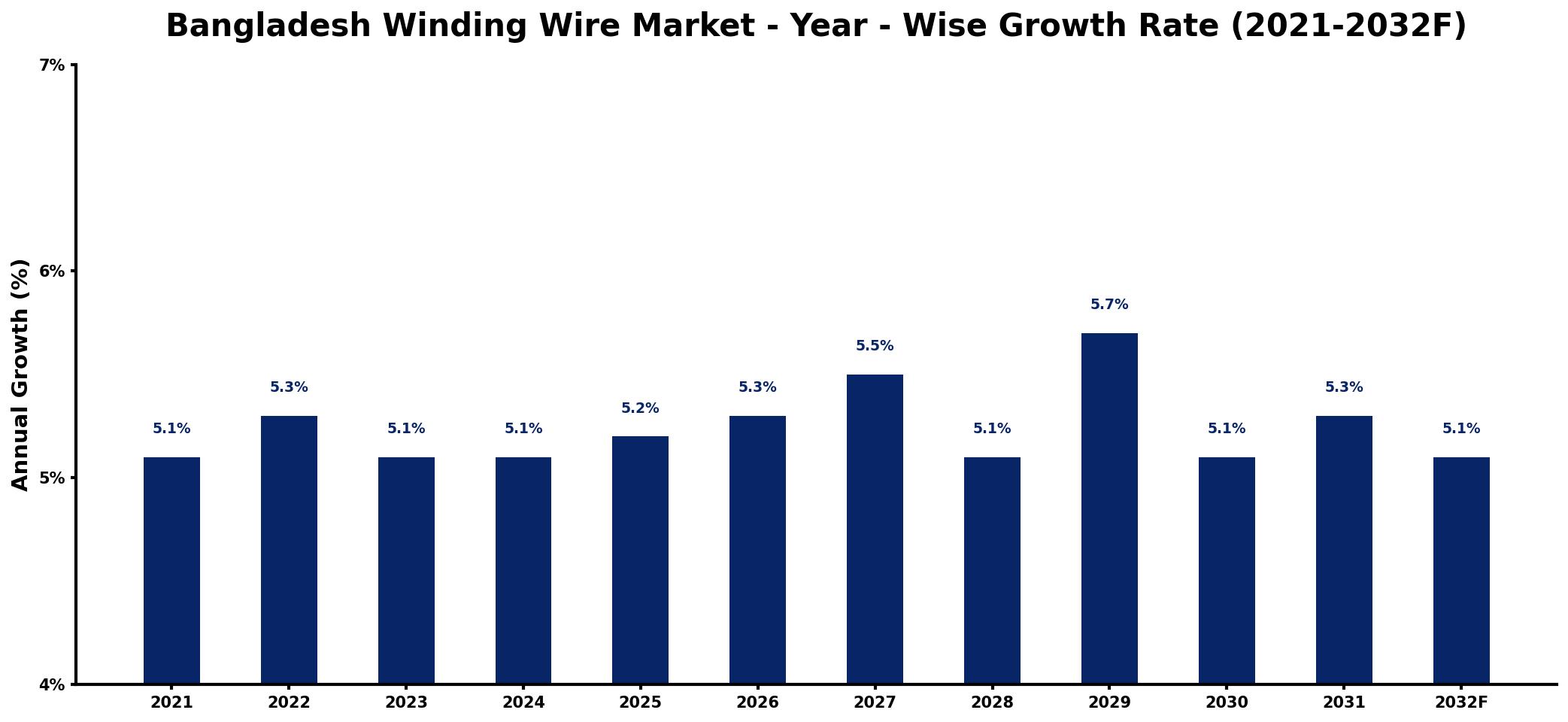
The table below presents the year‑wise growth rates along with the key drivers influencing the market
| Year | Growth Rate | Major Drivers |
| 2021 | 5.1% | Increased manufacturing capacity investments |
| 2022 | 5.3% | Growing demand from renewable energy |
| 2023 | 5.1% | Expansion in automotive sector applications |
| 2024 | 5.1% | Rising infrastructure development projects |
| 2025 | 5.2% | Technological advancements in production |
| 2026 | 5.3% | Increased exports to neighboring markets |
| 2027 | 5.5% | Growth in consumer electronics sector |
| 2028 | 5.1% | Surge in electric vehicle production |
| 2029 | 5.7% | Investment in smart grid technologies |
| 2030 | 5.1% | Rising urbanization driving demand |
| 2031 | 5.3% | Expansion of telecommunications infrastructure |
| 2032 | 5.1% | rising end-use demand growth |
Note: Market size estimations and growth projections presented in this report are based on 6Wresearch's proprietary forecasting methodology, utilizing the latest available industry data, government publications, and primary research inputs.
Bangladesh Winding Wire Market Synopsis
The Bangladesh winding wire market is currently in a phase of steady growth, driven by various industrial applications including electrical, automotive, and construction. As urbanization increases and infrastructure projects proliferate, the demand for high-quality winding wires has become more pronounced, presenting unique opportunities for manufacturers.
With a focus on innovation and quality improvement, local manufacturers are actively seeking to enhance their product offerings. This includes exploring alternative materials, such as aluminum, which is gaining traction as a cost-effective substitute for copper. As such, the market landscape is evolving to meet the diverse needs of various industries.
Bangladesh Winding Wire Market Key Takeaways
- The market is projected to grow from USD 320 Million in 2025 to USD 434 Million by 2032, at a CAGR of 4.4% from 2026 to 2032.
- Increasing demand for energy-efficient solutions and a push for renewable energy sources are driving market growth.
- Technological advancements in production processes are enhancing the quality and durability of winding wires.
- Government policies are supporting local manufacturing and promoting quality standards.
- Investment opportunities exist in specialized winding wire products tailored to meet industry-specific requirements.
Evaluation of Restraints in Bangladesh Winding Wire Market
Despite its growth potential, the Bangladesh winding wire market faces several restraints that could hinder its progress. Fierce competition from both domestic and international manufacturers creates price pressures that can erode profit margins. Additionally, fluctuating raw material costs contribute to market volatility, making it challenging for businesses to maintain consistent pricing and quality. The presence of counterfeit products and inconsistent quality standards further complicate the landscape, necessitating stringent quality control measures. Infrastructure limitations and a lack of skilled labor also impede operational efficiencies, posing significant challenges for companies in the industry.
Bangladesh Winding Wire Market Trends
Current trends in the Bangladesh winding wire market reveal a significant shift towards materials that support energy efficiency. The demand for copper winding wires continues to grow due to their superior conductivity, yet aluminum is emerging as a popular alternative, particularly in cost-sensitive applications. Additionally, manufacturers are increasingly focusing on sustainable practices, aligning their products with global environmental standards. Technological innovations, such as advanced insulation materials and high-performance coatings, are also gaining traction, enhancing the functionality and lifespan of winding wires.
Bangladesh Winding Wire Market Opportunities
Opportunities for investment in the Bangladesh winding wire market are substantial, particularly as the country amplifies its industrial sector. With an increasing need for electrical equipment across various applications—ranging from motors and transformers to household appliances—there's a strong case for increased production and distribution efforts. Furthermore, the government's commitment to infrastructure development provides a fertile ground for sustained demand growth. Firms that emphasize innovation and quality in their offerings are well-positioned to capitalize on these opportunities, especially by developing customized winding wire products that address specific industrial needs.
Government Initiatives in the Bangladesh Winding Wire Market
Government initiatives play a crucial role in shaping the landscape of the Bangladesh winding wire market. Policies aimed at promoting domestic production are bolstered by measures such as import tariffs on raw materials, which serve to protect local manufacturers. The government is also committed to enforcing quality standards and certifications, ensuring that products meet international benchmarks. Additionally, export incentives are being provided to enhance market access for local manufacturers, supporting efforts to increase competitiveness in global trade.
Future Insights of the Bangladesh Winding Wire Market
The Bangladesh winding wire market is expected to maintain a positive trajectory from 2026 to 2032, largely driven by rising demand across sectors like construction and automotive. The government's focus on infrastructure projects, coupled with a growing emphasis on renewable energy, is set to further augment market needs. As investments in manufacturing capabilities increase, and technological advancements continue to emerge, the market will likely witness enhanced product offerings, catering to evolving consumer preferences and industry standards.
Bangladesh Winding Wire Market Latest Developments (2025 - 2026)
Recent developments in the Bangladesh winding wire market have shown a renewed focus on quality improvements and sustainability. Many manufacturers are investing in advanced production technologies that not only improve efficiency but also reduce environmental impact. This trend is in response to increasing consumer awareness and regulatory pressures. Furthermore, local firms are starting to collaborate more closely with international partners to adopt best practices and enhance product standards, paving the way for a more competitive market landscape.
Bangladesh Winding Wire Market - Key Attractiveness of the Report
- 10 Years of Market Numbers
- Historical Data Starting from 2022 to 2025
- Base Year: 2025
- Forecast Data until 2032
- Key Performance Indicators Impacting the Market
- Major Upcoming Developments and Projects
Key Highlights of the Report:
- Bangladesh Winding Wire Market Outlook
- Market Size of Bangladesh Winding Wire Market, 2025
- Forecast of Bangladesh Winding Wire Market, 2032
- Historical Data and Forecast of Bangladesh Winding Wire Revenues & Volume for the Period 2022-2032F
- Bangladesh Winding Wire Market Trend Evolution
- Bangladesh Winding Wire Market Drivers and Challenges
- Bangladesh Winding Wire Price Trends
- Bangladesh Winding Wire Porter's Five Forces
- Bangladesh Winding Wire Industry Life Cycle
- Historical Data and Forecast of Bangladesh Winding Wire Market Revenues & Volume By Product for the Period 2022-2032F
- Historical Data and Forecast of Bangladesh Winding Wire Market Revenues & Volume By Copper Winding Wire for the Period 2022-2032F
- Historical Data and Forecast of Bangladesh Winding Wire Market Revenues & Volume By Aluminum Winding Wire for the Period 2022-2032F
- Bangladesh Winding Wire Import Export Trade Statistics
- Market Opportunity Assessment By Product
- Bangladesh Winding Wire Top Companies Market Share
- Bangladesh Winding Wire Competitive Benchmarking By Technical and Operational Parameters
- Bangladesh Winding Wire Company Profiles
- Bangladesh Winding Wire Key Strategic Recommendations






































