Belgium Ceiling Tiles Market Top 5 Importing Countries and Market Competition (HHI) Analysis
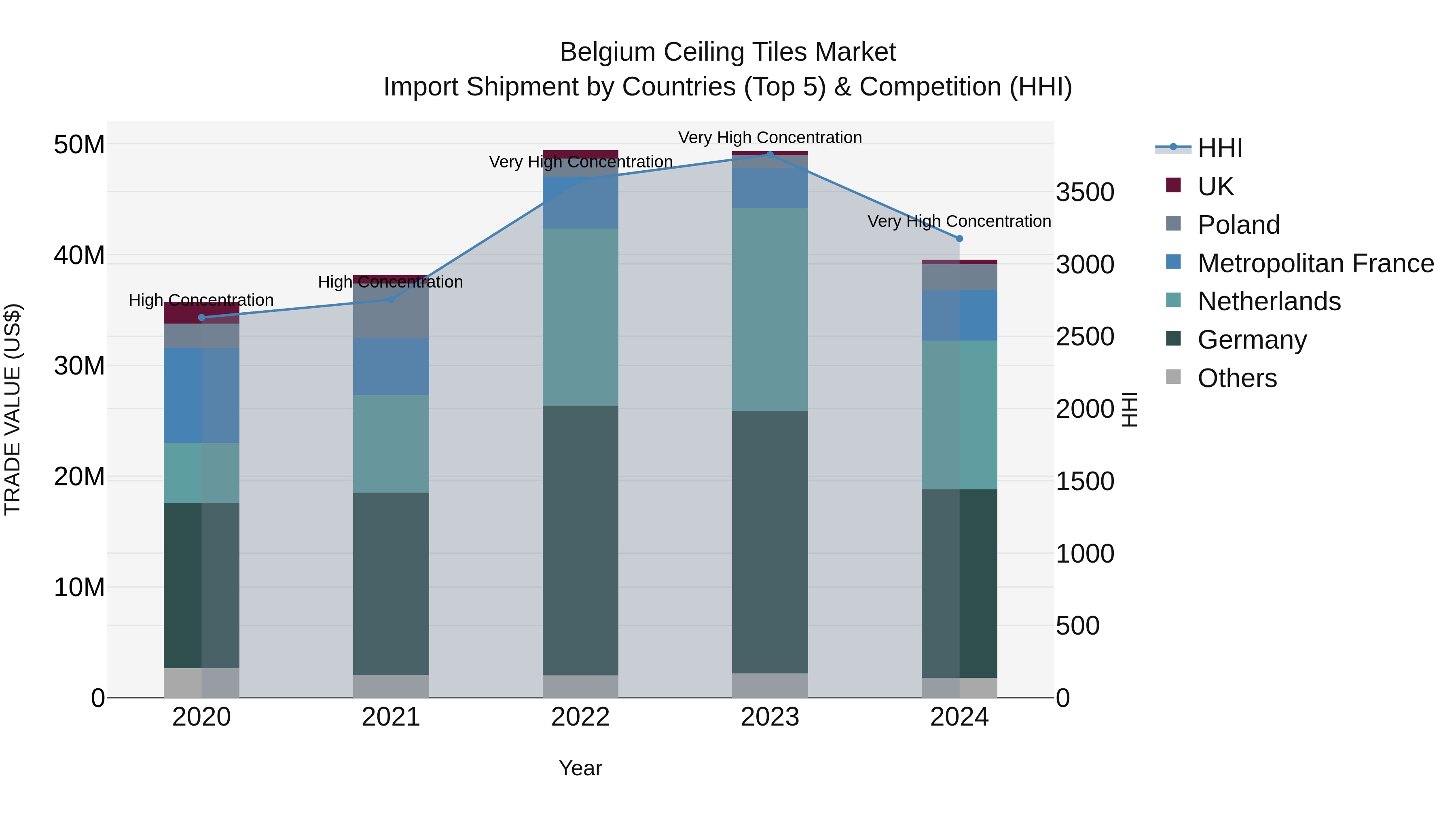
In 2024, Belgium continued to see significant imports of ceiling tiles, with top exporters being Germany, Netherlands, Metropolitan France, Poland, and Spain. The market remained highly concentrated with a high Herfindahl-Hirschman Index (HHI). Despite a modest compound annual growth rate (CAGR) of 2.57% from 2020 to 2024, the growth rate saw a decline of -19.78% from 2023 to 2024. This indicates a recent slowdown in the import market, suggesting potential shifts in demand or supply dynamics that importers and industry players should monitor closely.
Belgium Ceiling Tiles Market Overview
The Belgium ceiling tiles market is expanding owing to the increasing construction activities in residential and commercial sectors. The market benefits from the demand for aesthetic interior solutions and improved acoustic properties. Innovations in materials, such as eco-friendly and lightweight ceiling tiles, are gaining traction. The renovation of existing buildings and the construction of new infrastructure projects are key drivers of market growth.
Drivers of the market
The ceiling tiles market in Belgium is experiencing growth due to the booming construction sector, particularly in commercial buildings and infrastructure projects. The increasing focus on aesthetic appeal and interior design in both residential and commercial spaces drives the demand for ceiling tiles. Moreover, advancements in materials and manufacturing technologies have led to the production of innovative and sustainable ceiling tiles, appealing to environmentally conscious consumers and businesses. The renovation and retrofitting of old buildings to improve energy efficiency and acoustic performance also contribute to market growth.
Challenges of the market
The ceiling tiles market in Belgium encounters challenges related to sustainability and environmental impact. There is an increasing demand for eco-friendly and recyclable materials, pushing manufacturers to innovate and adopt sustainable practices. Additionally, the market faces competition from alternative ceiling solutions such as gypsum boards and metal ceilings, which can offer better durability and aesthetic appeal. The fluctuating costs of raw materials, especially mineral fibers and metals, also pose a challenge. Moreover, stringent building codes and regulations require continuous compliance, adding to the operational costs for manufacturers and installers.
Government Policy of the market
In Belgium, the ceiling tiles market is impacted by building regulations and standards that emphasize fire safety, acoustic performance, and environmental sustainability. The government has introduced policies that encourage the use of eco-friendly and recyclable materials in construction, influencing the types of ceiling tiles available in the market. Compliance with the European Construction Products Regulation (CPR) also plays a significant role in shaping this market.
Key Highlights of the Report:
- Belgium Ceiling Tiles Market Outlook
- Market Size of Belgium Ceiling Tiles Market, 2024
- Forecast of Belgium Ceiling Tiles Market, 2031
- Historical Data and Forecast of Belgium Ceiling Tiles Revenues & Volume for the Period 2021-2031
- Belgium Ceiling Tiles Market Trend Evolution
- Belgium Ceiling Tiles Market Drivers and Challenges
- Belgium Ceiling Tiles Price Trends
- Belgium Ceiling Tiles Porter`s Five Forces
- Belgium Ceiling Tiles Industry Life Cycle
- Historical Data and Forecast of Belgium Ceiling Tiles Market Revenues & Volume By Material Type for the Period 2021-2031
- Historical Data and Forecast of Belgium Ceiling Tiles Market Revenues & Volume By Mineral Wool for the Period 2021-2031
- Historical Data and Forecast of Belgium Ceiling Tiles Market Revenues & Volume By Metal for the Period 2021-2031
- Historical Data and Forecast of Belgium Ceiling Tiles Market Revenues & Volume By Gypsum for the Period 2021-2031
- Historical Data and Forecast of Belgium Ceiling Tiles Market Revenues & Volume By Others for the Period 2021-2031
- Historical Data and Forecast of Belgium Ceiling Tiles Market Revenues & Volume By Application for the Period 2021-2031
- Historical Data and Forecast of Belgium Ceiling Tiles Market Revenues & Volume By Residential for the Period 2021-2031
- Historical Data and Forecast of Belgium Ceiling Tiles Market Revenues & Volume By Non-residential for the Period 2021-2031
- Belgium Ceiling Tiles Import Export Trade Statistics
- Market Opportunity Assessment By Material Type
- Market Opportunity Assessment By Application
- Belgium Ceiling Tiles Top Companies Market Share
- Belgium Ceiling Tiles Competitive Benchmarking By Technical and Operational Parameters
- Belgium Ceiling Tiles Company Profiles
- Belgium Ceiling Tiles Key Strategic Recommendations






































