Belgium Centrifugal Pumps Market Size (2020-2030)
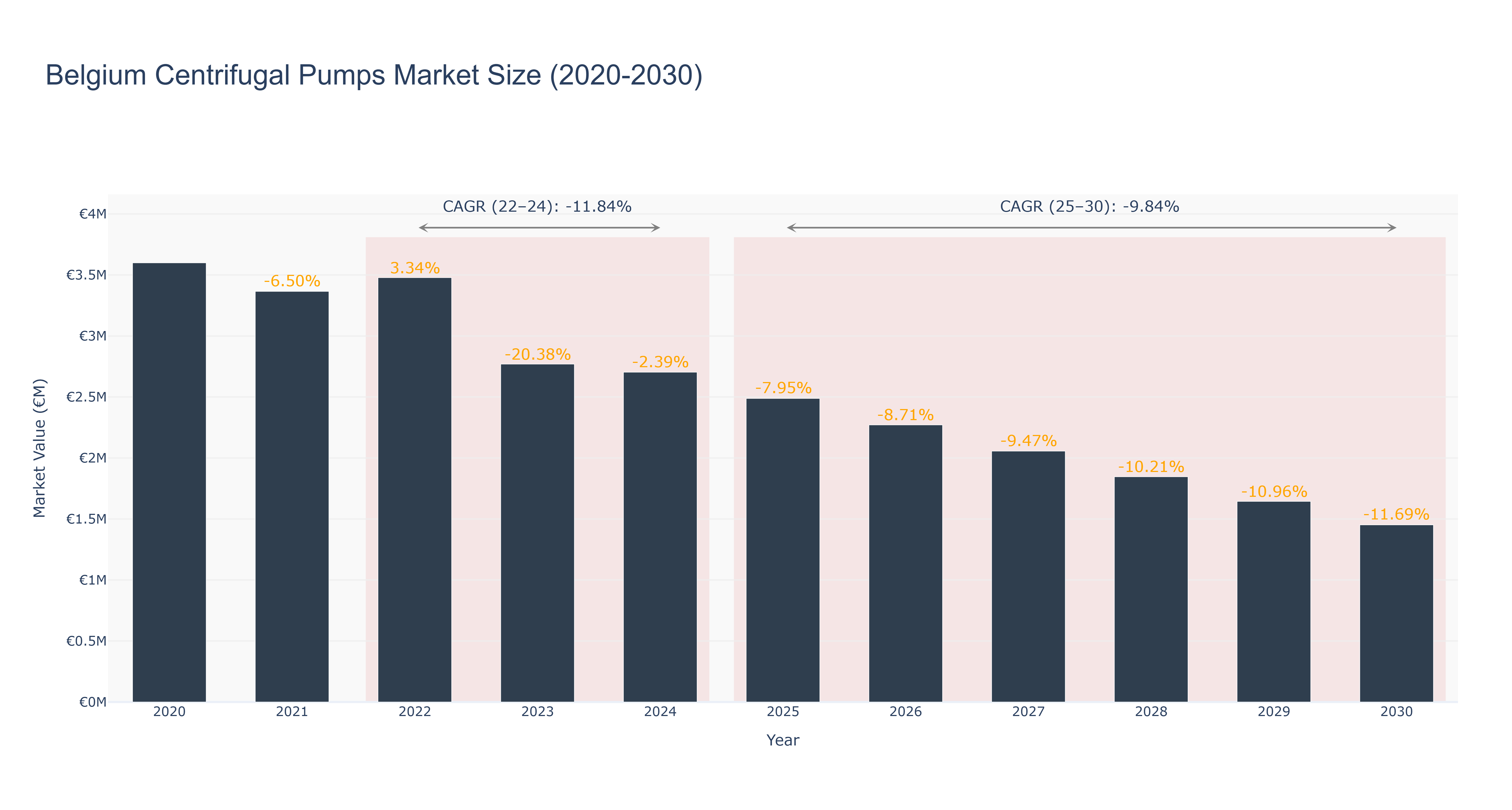
Belgium Centrifugal Pumps Market has experienced a downward trend in market size, reaching its peak at €3.60 million in 2020. The market size declined steadily from 2020 to 2024, with the actual market size decreasing to €2.70 million. Forecasted market size from 2025 to 2030 shows a further decrease, with a CAGR of -9.84% expected for the period. The decline can be attributed to factors such as economic slowdown, technological advancements leading to more efficient pumps, and shifting consumer preferences towards alternative solutions. Despite the challenging market conditions, recent developments in Belgium's renewable energy sector are set to drive demand for centrifugal pumps, particularly in sustainable energy projects. Looking ahead, continued investments in green energy initiatives are expected to create opportunities for growth in the centrifugal pumps market. Industry drivers include the increasing focus on sustainability, government initiatives promoting renewable energy sources, and the need for efficient water management solutions.
Belgium Centrifugal Pumps Market: Production & Trade Performance (2019-2025)
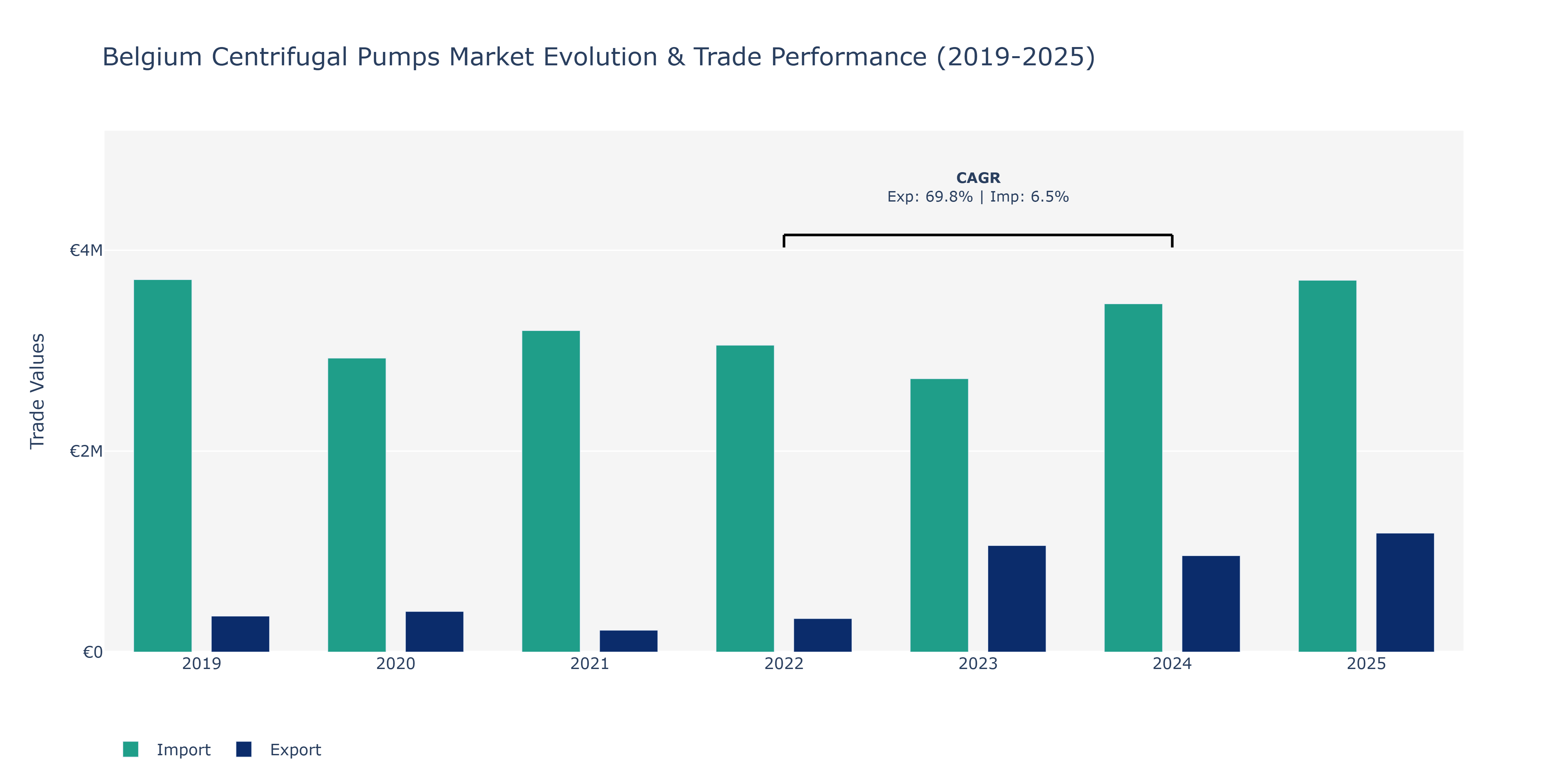
The Belgium Centrifugal Pumps Market exhibited notable fluctuations in both Exports and Imports from 2019 to 2025. In 2019, Imports dominated at €3.71 million significantly surpassing Exports at €357.49 thousand. By 2021, Exports dropped to €216.67 thousand while Imports slightly increased to €3.2 million. The year 2023 saw a substantial upsurge in Exports to €1.06 million, marking a peak point during this period, while Imports decreased to €2.72 million. However, by 2025, Exports peaked at €1.18 million, whereas Imports remained relatively stable at €3.7 million. This fluctuation can be attributed to various factors such as changes in demand for centrifugal pumps, global economic conditions, and technological advancements influencing trade dynamics. The surge in Exports in 2023 may have been fueled by increased demand for Belgian centrifugal pumps due to their quality and reliability, showcasing potential market competitiveness and strategic positioning in the industry.
Belgium Centrifugal pumps Market Overview
The centrifugal pump market in Belgium is witnessing steady growth owing to the rising demand from water and wastewater treatment, oil and gas, and chemical industries. Technological advancements and the need for efficient and reliable pumping solutions are key factors driving this market. Government regulations on energy efficiency and sustainable water management practices are also playing a crucial role in market development.
Drivers of the market
The centrifugal pump market in Belgium is driven by the growing need for efficient water and wastewater management solutions. Increasing urbanization and industrialization have led to a rise in demand for reliable and efficient pumping systems. The expanding agriculture sector, which relies on irrigation systems, also contributes to the market growth. Additionally, the chemical and petrochemical industries, which require robust pumping solutions for various processes, are significant drivers. Government initiatives and investments in infrastructure development further bolster the market, along with advancements in pump technology that offer improved efficiency and energy savings.
Challenges of the market
The centrifugal pump market in Belgium is challenged by the high cost of manufacturing and the need for constant technological advancements to meet the evolving demands of various industries, including water treatment, oil and gas, and chemical processing. Competition from international manufacturers who can offer similar products at lower prices puts pressure on local companies. Additionally, maintenance and energy efficiency concerns are critical as end-users seek reliable and cost-effective solutions. Regulatory compliance and the need for customization to suit specific applications further complicate the market landscape.
Government Policy of the market
In Belgium, policies affecting the centrifugal pump market emphasize energy efficiency and environmental compliance. The government implements strict energy consumption standards for industrial equipment, including pumps. Financial incentives and subsidies are available for companies that upgrade to energy-efficient centrifugal pumps, aligning with Belgium`s goals to reduce industrial energy usage and greenhouse gas emissions.
Key Highlights of the Report:
- Belgium Centrifugal pumps Market Outlook
- Market Size of Belgium Centrifugal pumps Market, 2024
- Forecast of Belgium Centrifugal pumps Market, 2031
- Historical Data and Forecast of Belgium Centrifugal pumps Revenues & Volume for the Period 2021-2031
- Belgium Centrifugal pumps Market Trend Evolution
- Belgium Centrifugal pumps Market Drivers and Challenges
- Belgium Centrifugal pumps Price Trends
- Belgium Centrifugal pumps Porter`s Five Forces
- Belgium Centrifugal pumps Industry Life Cycle
- Historical Data and Forecast of Belgium Centrifugal pumps Market Revenues & Volume By Pump Type for the Period 2021-2031
- Historical Data and Forecast of Belgium Centrifugal pumps Market Revenues & Volume By Overhung Impeller for the Period 2021-2031
- Historical Data and Forecast of Belgium Centrifugal pumps Market Revenues & Volume By Vertically Suspended for the Period 2021-2031
- Historical Data and Forecast of Belgium Centrifugal pumps Market Revenues & Volume By Between Bearing for the Period 2021-2031
- Historical Data and Forecast of Belgium Centrifugal pumps Market Revenues & Volume By Stage for the Period 2021-2031
- Historical Data and Forecast of Belgium Centrifugal pumps Market Revenues & Volume By Single Stage for the Period 2021-2031
- Historical Data and Forecast of Belgium Centrifugal pumps Market Revenues & Volume By Multistage for the Period 2021-2031
- Historical Data and Forecast of Belgium Centrifugal pumps Market Revenues & Volume By End User for the Period 2021-2031
- Historical Data and Forecast of Belgium Centrifugal pumps Market Revenues & Volume By Industrial for the Period 2021-2031
- Historical Data and Forecast of Belgium Centrifugal pumps Market Revenues & Volume By Commercial and Residential for the Period 2021-2031
- Belgium Centrifugal pumps Import Export Trade Statistics
- Market Opportunity Assessment By Pump Type
- Market Opportunity Assessment By Stage
- Market Opportunity Assessment By End User
- Belgium Centrifugal pumps Top Companies Market Share
- Belgium Centrifugal pumps Competitive Benchmarking By Technical and Operational Parameters
- Belgium Centrifugal pumps Company Profiles
- Belgium Centrifugal pumps Key Strategic Recommendations






































