Belgium Cyclohexane Market Top 5 Importing Countries and Market Competition (HHI) Analysis
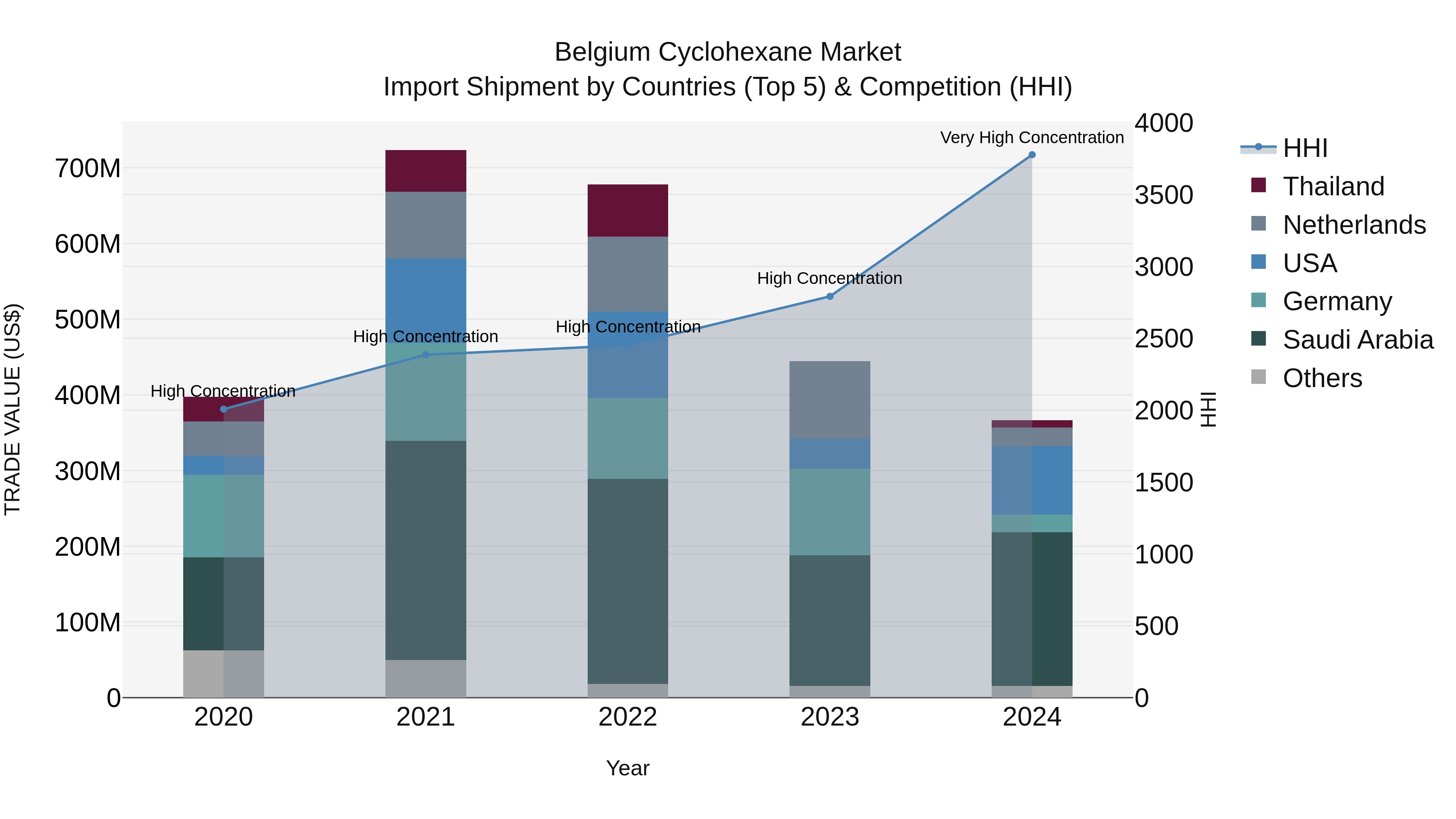
In 2024, Belgium`s cyclohexane import market saw a significant shift with top exporters being Saudi Arabia, USA, Netherlands, Germany, and India. The Herfindahl-Hirschman Index (HHI) indicated a notable increase in market concentration from 2023 to 2024, reaching a very high level. The compound annual growth rate (CAGR) for the period 2020-2024 was -2.0%, reflecting a decline in demand. Moreover, the growth rate from 2023 to 2024 experienced a steep decrease of -17.56%, highlighting a challenging year for cyclohexane imports in Belgium.
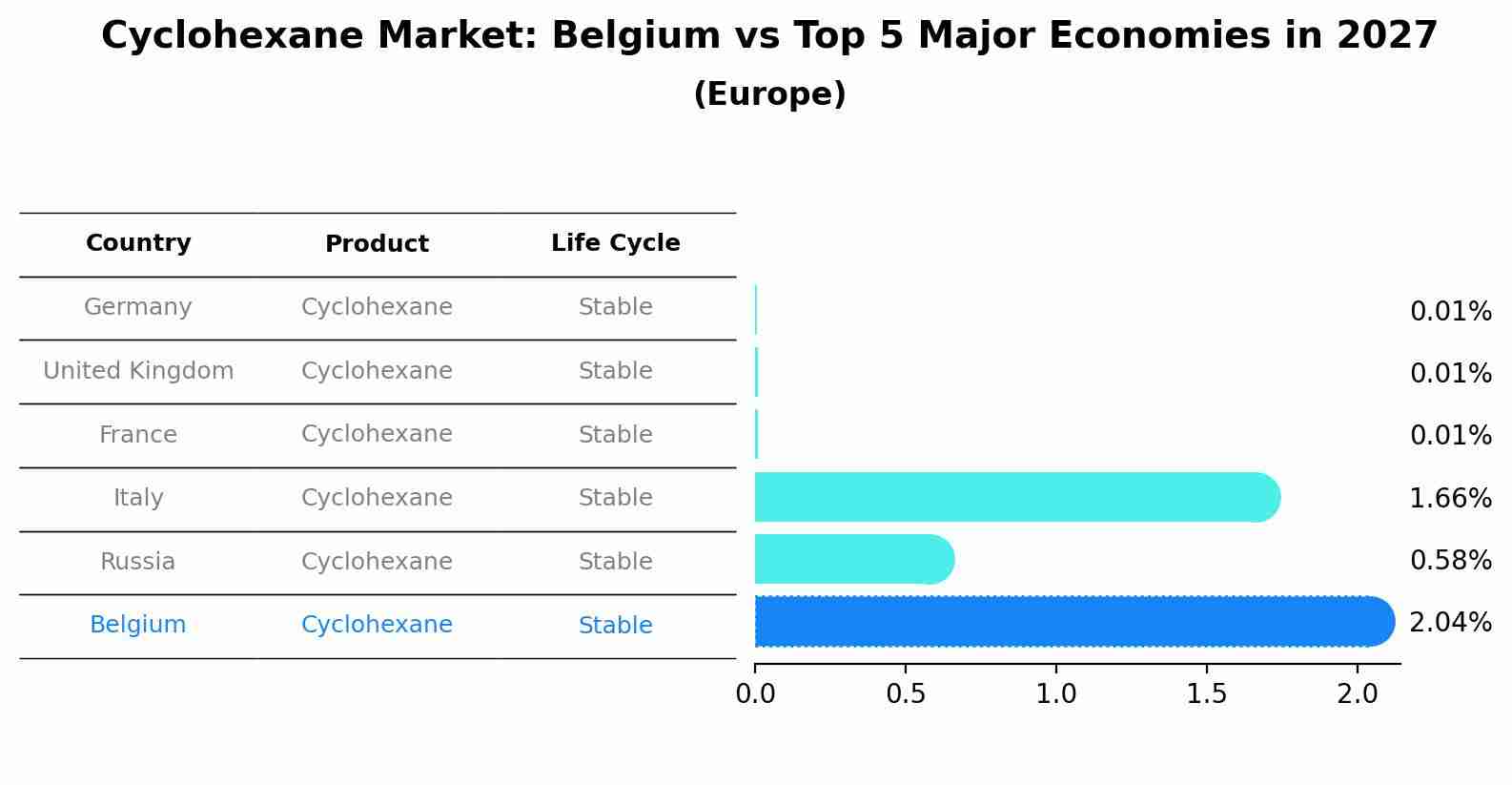
Cyclohexane Market: Belgium vs Top 5 Major Economies in 2027 (Europe)
By 2027, Belgium's Cyclohexane market is forecasted to achieve a stable growth rate of 2.04%, with Germany leading the Europe region, followed by United Kingdom, France, Italy and Russia.
Belgium Cyclohexane Market Overview
The Cyclohexane market in Belgium is influenced by its use in various industrial applications, including the production of chemicals and polymers. Cyclohexane is a key intermediate in the manufacture of nylon and other synthetic fibers. The market is driven by demand from industries such as textiles, automotive, and electronics. Factors such as production capacities, regulatory standards, and fluctuations in raw material prices impact the cyclohexane market.
Drivers of the market
The Belgium Cyclohexane market is driven by its applications in various industries, including chemicals, textiles, and pharmaceuticals. Cyclohexane is a key raw material in the production of nylon, which is widely used in textiles and automotive applications. The growth of these sectors in Belgium is contributing to the demand for cyclohexane. Additionally, the rising focus on sustainable and eco-friendly production processes is influencing the market, as manufacturers seek to optimize their use of cyclohexane and explore alternative sources.
Challenges of the market
The Belgium Cyclohexane market is confronted with challenges related to environmental and regulatory pressures. Cyclohexane, a solvent used in various industrial applications, is subject to strict environmental regulations due to its potential impact on air quality and human health. Compliance with these regulations often requires significant investment in emission control technologies and process adjustments. Additionally, fluctuations in raw material prices and the need for efficient production processes can impact the cost and availability of cyclohexane, posing challenges for manufacturers and consumers alike.
Government Policy of the market
The cyclohexane market in Belgium is influenced by the countrys industrial sector and regulatory environment. Belgian policies support the chemical industry through research and development incentives and adherence to environmental regulations. The government enforces strict safety and environmental standards for chemical production and handling, impacting the cyclohexane market by ensuring compliance with health and safety norms. Belgiums position as a central hub in Europe also facilitates the distribution and trade of cyclohexane across the region.
Key Highlights of the Report:
- Belgium Cyclohexane Market Outlook
- Market Size of Belgium Cyclohexane Market, 2024
- Forecast of Belgium Cyclohexane Market, 2031
- Historical Data and Forecast of Belgium Cyclohexane Revenues & Volume for the Period 2021-2031
- Belgium Cyclohexane Market Trend Evolution
- Belgium Cyclohexane Market Drivers and Challenges
- Belgium Cyclohexane Price Trends
- Belgium Cyclohexane Porter`s Five Forces
- Belgium Cyclohexane Industry Life Cycle
- Historical Data and Forecast of Belgium Cyclohexane Market Revenues & Volume By Application for the Period 2021-2031
- Historical Data and Forecast of Belgium Cyclohexane Market Revenues & Volume By Adipic acid for the Period 2021-2031
- Historical Data and Forecast of Belgium Cyclohexane Market Revenues & Volume By Caprolactam for the Period 2021-2031
- Historical Data and Forecast of Belgium Cyclohexane Market Revenues & Volume By Others for the Period 2021-2031
- Historical Data and Forecast of Belgium Cyclohexane Market Revenues & Volume By End-use for the Period 2021-2031
- Historical Data and Forecast of Belgium Cyclohexane Market Revenues & Volume By Nylon 6 for the Period 2021-2031
- Historical Data and Forecast of Belgium Cyclohexane Market Revenues & Volume By Nylon 66 for the Period 2021-2031
- Historical Data and Forecast of Belgium Cyclohexane Market Revenues & Volume By Others for the Period 2021-2031
- Belgium Cyclohexane Import Export Trade Statistics
- Market Opportunity Assessment By Application
- Market Opportunity Assessment By End-use
- Belgium Cyclohexane Top Companies Market Share
- Belgium Cyclohexane Competitive Benchmarking By Technical and Operational Parameters
- Belgium Cyclohexane Company Profiles
- Belgium Cyclohexane Key Strategic Recommendations






































