Ecuador Cyclohexane Market Top 5 Importing Countries and Market Competition (HHI) Analysis
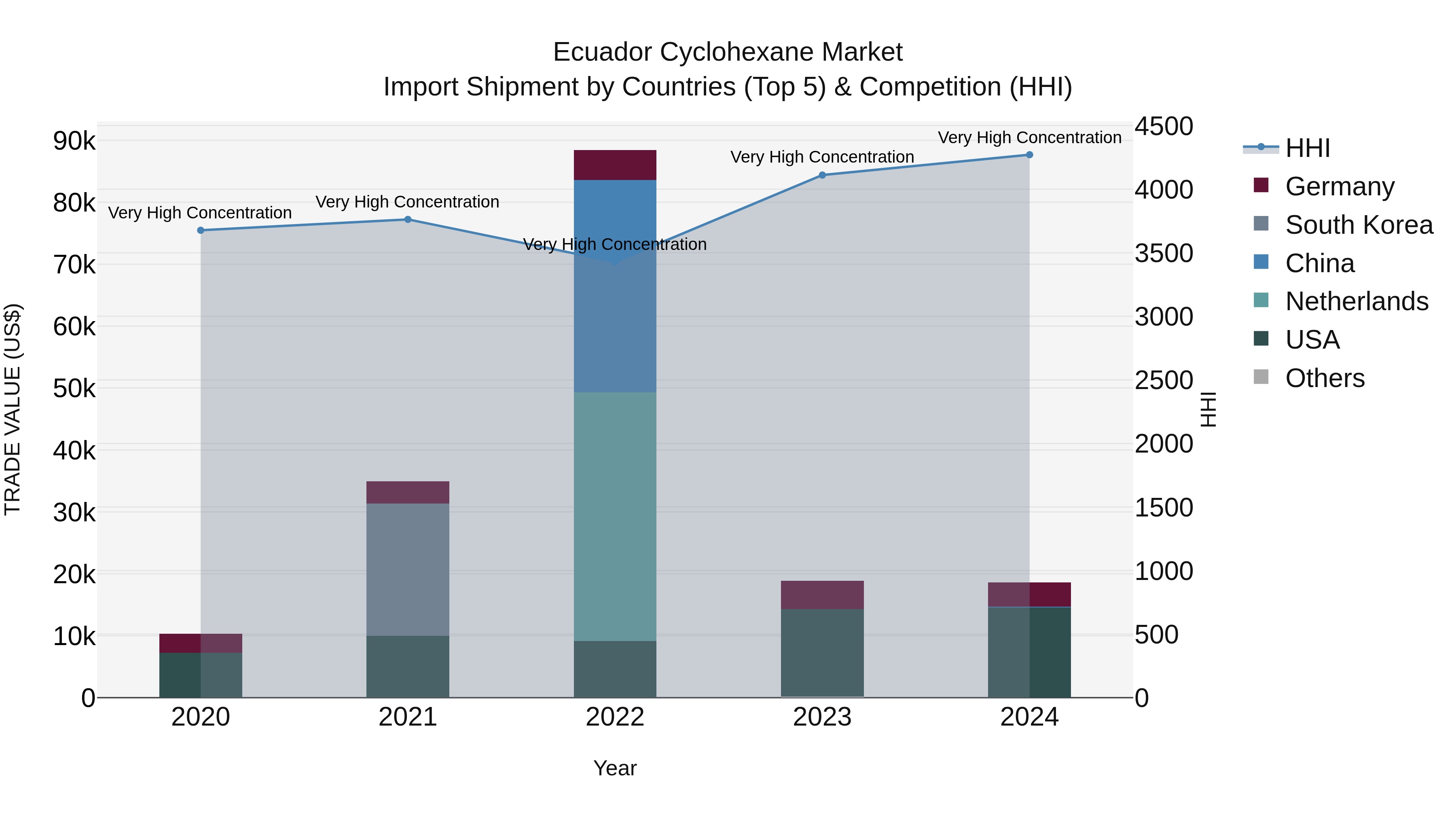
In 2024, Ecuador continued to see significant imports of cyclohexane, with top exporting countries being the USA, Germany, China, India, and Metropolitan France. The Market Top 5 Importing Countries and Market Competition (HHI) Analysis remained highly concentrated, as indicated by the high Herfindahl-Hirschman Index (HHI). Despite a slight decline in growth rate from 2023 to 2024, the compound annual growth rate (CAGR) over the 4-year period from 2020 to 2024 was impressive at 15.97%. This data suggests a stable demand for cyclohexane in Ecuador, with key players maintaining their positions in the Market Top 5 Importing Countries and Market Competition (HHI) Analysis.
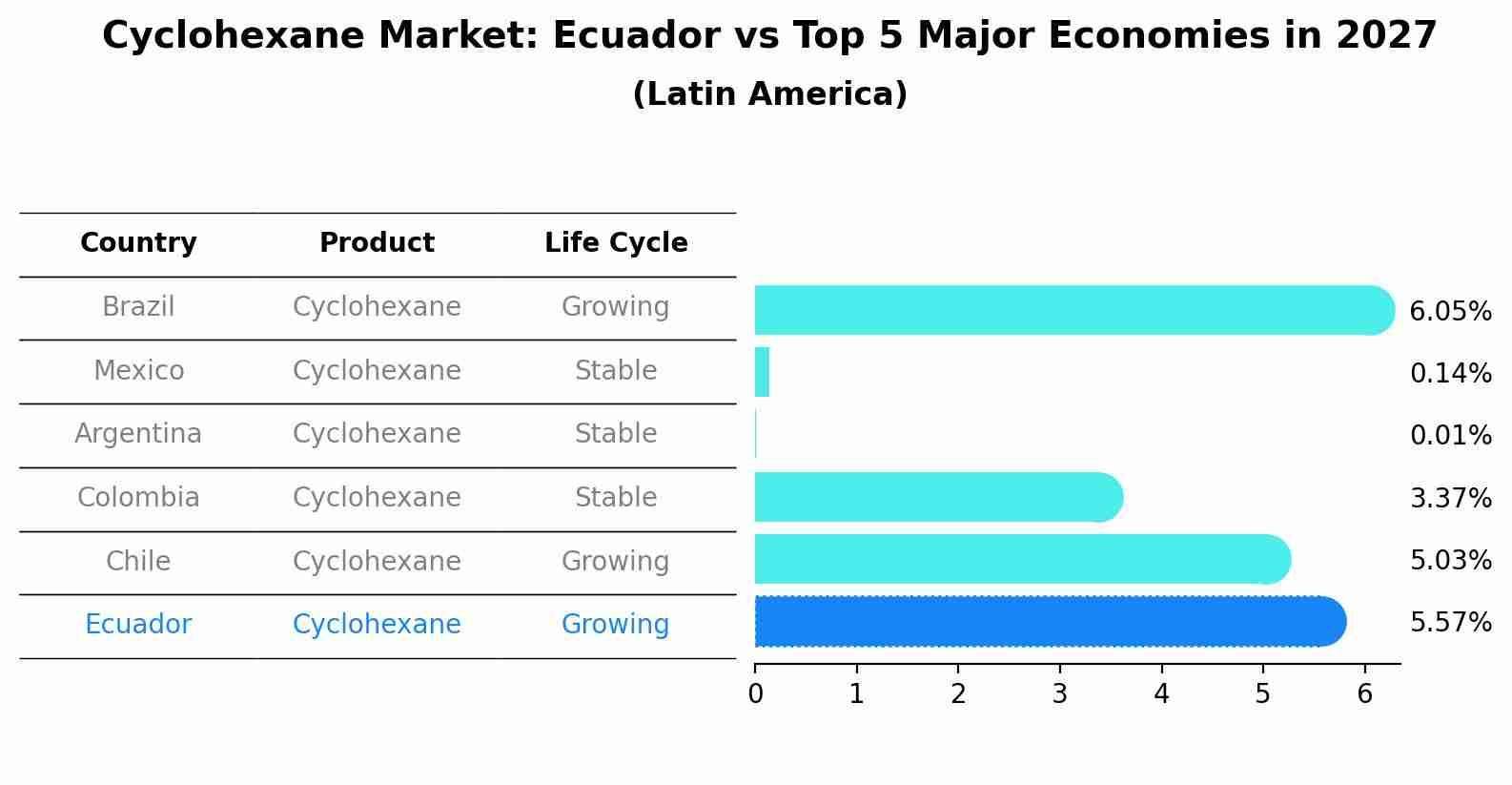
Cyclohexane Market: Ecuador vs Top 5 Major Economies in 2027 (Latin America)
The Cyclohexane market in Ecuador is projected to grow at a growing growth rate of 5.57% by 2027, highlighting the country's increasing focus on advanced technologies within the Latin America region, where Brazil holds the dominant position, followed closely by Mexico, Argentina, Colombia and Chile, shaping overall regional demand.
Ecuador Cyclohexane Market Overview
Cyclohexane is a chemical used primarily in the production of nylon and other industrial applications. The Ecuador Cyclohexane Market is driven by demand from the chemical and manufacturing sectors, where cyclohexane serves as a key raw material.
Drivers of the market
The Ecuador Cyclohexane Market is influenced by the growing demand for cyclohexane in the production of chemicals, solvents, and synthetic fibers. As industries such as textiles and plastics expand, the need for cyclohexane as a key raw material is increasing. Additionally, the trend towards sustainable production processes is driving innovation in cyclohexane applications.
Challenges of the market
In the cyclohexane market, challenges arise from fluctuating demand driven by key industries such as chemicals and textiles. Manufacturers must navigate competition from alternative solvents, which can pressure pricing and market share. Regulatory compliance concerning environmental impacts and safety standards complicates operations, requiring ongoing investments in quality control and waste management practices. Additionally, the availability and cost of raw materials can affect production costs, impacting profitability. The market is also influenced by economic fluctuations, creating uncertainty in demand for cyclohexane and its derivatives.
Government Policy of the market
In the cyclohexane market, the Ecuadorian government implements regulations to ensure the safe handling and usage of this chemical, primarily used in the production of nylon and other industrial applications. Policies focus on environmental protection and worker safety, promoting the use of best practices in manufacturing processes. Additionally, the government encourages research and development initiatives that aim to reduce the environmental impact of cyclohexane production and explore sustainable alternatives.
Key Highlights of the Report:
- Ecuador Cyclohexane Market Outlook
- Market Size of Ecuador Cyclohexane Market, 2024
- Forecast of Ecuador Cyclohexane Market, 2031
- Historical Data and Forecast of Ecuador Cyclohexane Revenues & Volume for the Period 2021-2031
- Ecuador Cyclohexane Market Trend Evolution
- Ecuador Cyclohexane Market Drivers and Challenges
- Ecuador Cyclohexane Price Trends
- Ecuador Cyclohexane Porter`s Five Forces
- Ecuador Cyclohexane Industry Life Cycle
- Historical Data and Forecast of Ecuador Cyclohexane Market Revenues & Volume By Application for the Period 2021-2031
- Historical Data and Forecast of Ecuador Cyclohexane Market Revenues & Volume By Adipic acid for the Period 2021-2031
- Historical Data and Forecast of Ecuador Cyclohexane Market Revenues & Volume By Caprolactam for the Period 2021-2031
- Historical Data and Forecast of Ecuador Cyclohexane Market Revenues & Volume By Others for the Period 2021-2031
- Historical Data and Forecast of Ecuador Cyclohexane Market Revenues & Volume By End-use for the Period 2021-2031
- Historical Data and Forecast of Ecuador Cyclohexane Market Revenues & Volume By Nylon 6 for the Period 2021-2031
- Historical Data and Forecast of Ecuador Cyclohexane Market Revenues & Volume By Nylon 66 for the Period 2021-2031
- Historical Data and Forecast of Ecuador Cyclohexane Market Revenues & Volume By Others for the Period 2021-2031
- Ecuador Cyclohexane Import Export Trade Statistics
- Market Opportunity Assessment By Application
- Market Opportunity Assessment By End-use
- Ecuador Cyclohexane Top Companies Market Share
- Ecuador Cyclohexane Competitive Benchmarking By Technical and Operational Parameters
- Ecuador Cyclohexane Company Profiles
- Ecuador Cyclohexane Key Strategic Recommendations






































