Burkina Faso Cyclohexane Market Top 5 Importing Countries and Market Competition (HHI) Analysis
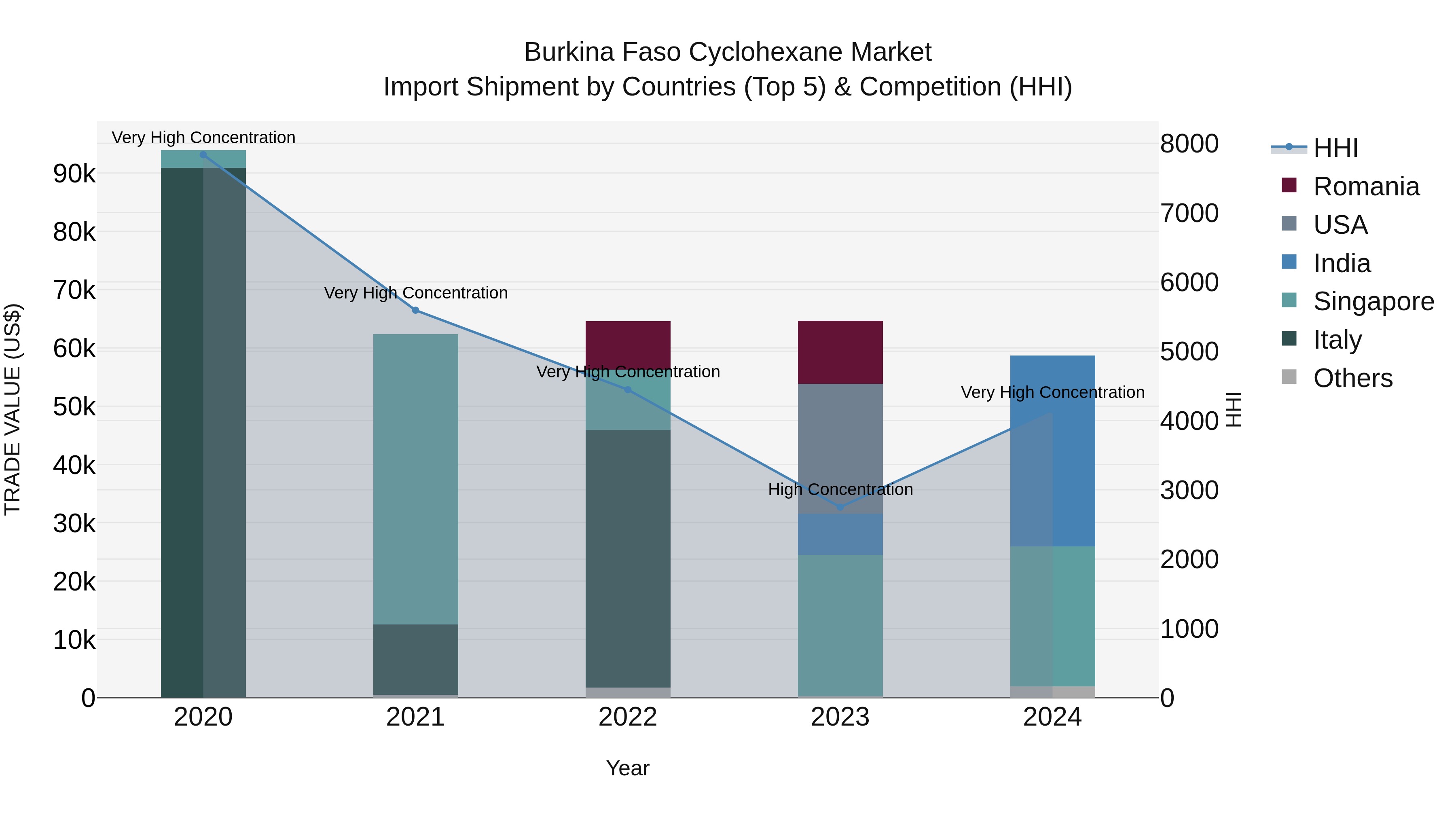
Burkina Faso`s cyclohexane import market in 2024 saw a notable increase in concentration, with a very high Herfindahl-Hirschman Index (HHI) indicating dominance by top exporters. Top countries in 2024 include India, Singapore, France, Poland, and Italy. The compound annual growth rate (CAGR) from 2020 to 2024 was -11.09%, reflecting a declining trend. Furthermore, the growth rate from 2023 to 2024 was -9.24%, highlighting a continued decrease in demand for cyclohexane in Burkina Faso. It will be important to monitor these trends for potential shifts in the market dynamics.
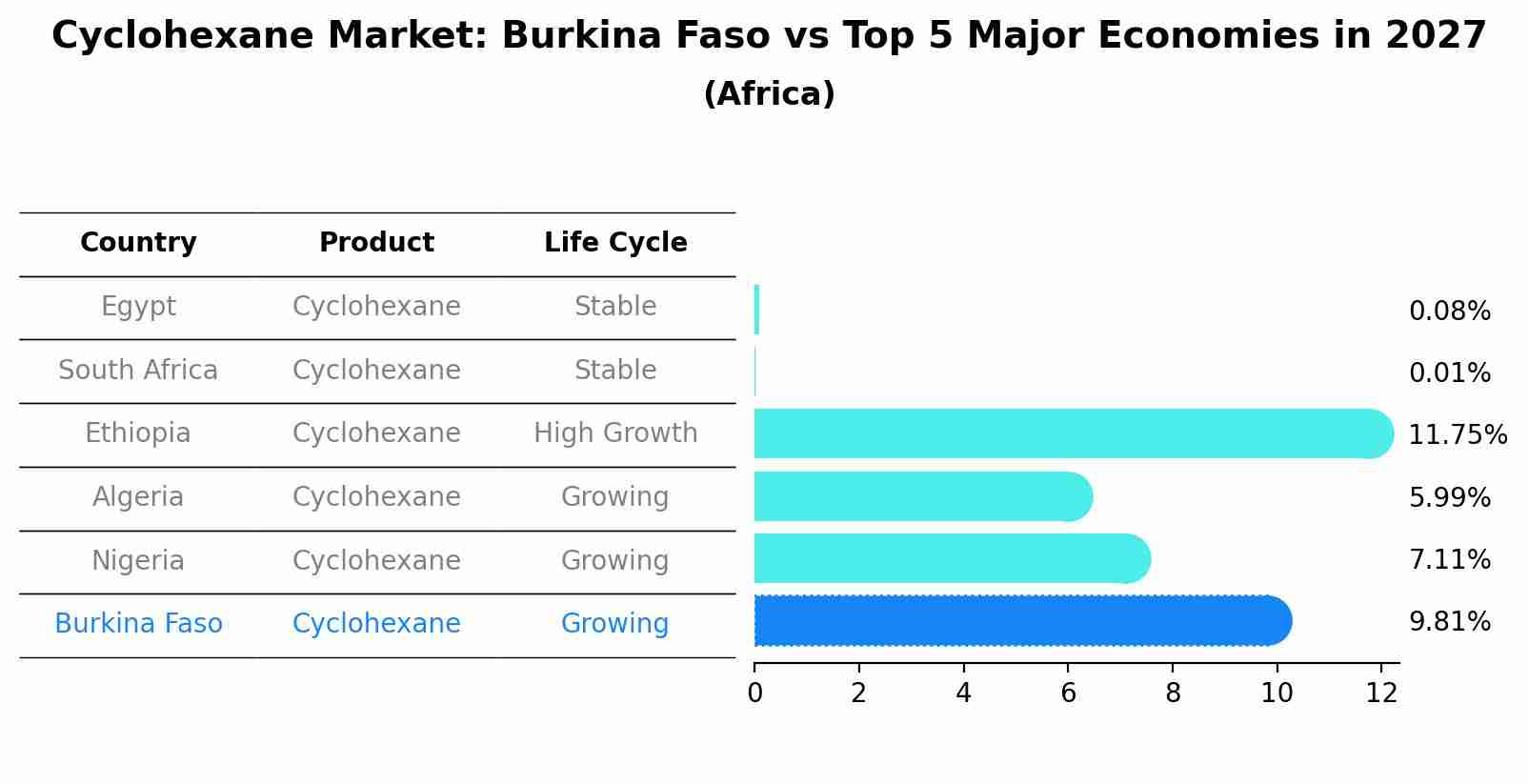
Cyclohexane Market: Burkina Faso vs Top 5 Major Economies in 2027 (Africa)
By 2027, the Cyclohexane market in Burkina Faso is anticipated to reach a growth rate of 9.81%, as part of an increasingly competitive Africa region, where Egypt remains at the forefront, supported by South Africa, Ethiopia, Algeria and Nigeria, driving innovations and market adoption across sectors.
Burkina Faso Cyclohexane Market Overview
Cyclohexane is used in various industrial applications, including the production of synthetic fibers and chemicals. In Burkina Faso, the cyclohexane market is influenced by industrial growth and demand for chemical products. However, challenges include the reliance on imports, which can lead to price volatility, and environmental concerns associated with cyclohexane production and use. The market also faces competition from alternative chemicals and processes.
Drivers of the market
The cyclohexane market in Burkina Faso is driven by its applications in the production of chemicals and pharmaceuticals. Cyclohexane is used as a solvent and a raw material in the manufacture of nylon, synthetic fibers, and other industrial chemicals. The growth in the textile and automotive industries, along with the expanding chemical manufacturing sector, fuels the demand for cyclohexane. Additionally, increasing investments in industrial infrastructure and the rise in domestic manufacturing activities contribute to the market`s growth.
Challenges of the market
The cyclohexane market in Burkina Faso faces challenges related to both supply and demand. A major issue is the reliance on imports for cyclohexane, which can be affected by international trade policies and transportation costs. Additionally, the market is constrained by limited local production facilities and infrastructure for handling and distributing cyclohexane. There are also concerns about the environmental and safety regulations related to the use and storage of cyclohexane, which can impact its market dynamics. The lack of awareness about the applications and benefits of cyclohexane in various industries can further limit market growth.
Government Policy of the market
The cyclohexane market in Burkina Faso is influenced by policies related to chemical safety and environmental protection. The government imposes regulations to control the production, import, and use of cyclohexane, ensuring that it adheres to safety standards and does not pose risks to public health or the environment. Additionally, there may be incentives for industries adopting cleaner and more sustainable practices in the handling and usage of cyclohexane.
Key Highlights of the Report:
- Burkina Faso Cyclohexane Market Outlook
- Market Size of Burkina Faso Cyclohexane Market, 2024
- Forecast of Burkina Faso Cyclohexane Market, 2031
- Historical Data and Forecast of Burkina Faso Cyclohexane Revenues & Volume for the Period 2021-2031
- Burkina Faso Cyclohexane Market Trend Evolution
- Burkina Faso Cyclohexane Market Drivers and Challenges
- Burkina Faso Cyclohexane Price Trends
- Burkina Faso Cyclohexane Porter`s Five Forces
- Burkina Faso Cyclohexane Industry Life Cycle
- Historical Data and Forecast of Burkina Faso Cyclohexane Market Revenues & Volume By Application for the Period 2021-2031
- Historical Data and Forecast of Burkina Faso Cyclohexane Market Revenues & Volume By Adipic acid for the Period 2021-2031
- Historical Data and Forecast of Burkina Faso Cyclohexane Market Revenues & Volume By Caprolactam for the Period 2021-2031
- Historical Data and Forecast of Burkina Faso Cyclohexane Market Revenues & Volume By Others for the Period 2021-2031
- Historical Data and Forecast of Burkina Faso Cyclohexane Market Revenues & Volume By End-use for the Period 2021-2031
- Historical Data and Forecast of Burkina Faso Cyclohexane Market Revenues & Volume By Nylon 6 for the Period 2021-2031
- Historical Data and Forecast of Burkina Faso Cyclohexane Market Revenues & Volume By Nylon 66 for the Period 2021-2031
- Historical Data and Forecast of Burkina Faso Cyclohexane Market Revenues & Volume By Others for the Period 2021-2031
- Burkina Faso Cyclohexane Import Export Trade Statistics
- Market Opportunity Assessment By Application
- Market Opportunity Assessment By End-use
- Burkina Faso Cyclohexane Top Companies Market Share
- Burkina Faso Cyclohexane Competitive Benchmarking By Technical and Operational Parameters
- Burkina Faso Cyclohexane Company Profiles
- Burkina Faso Cyclohexane Key Strategic Recommendations






































