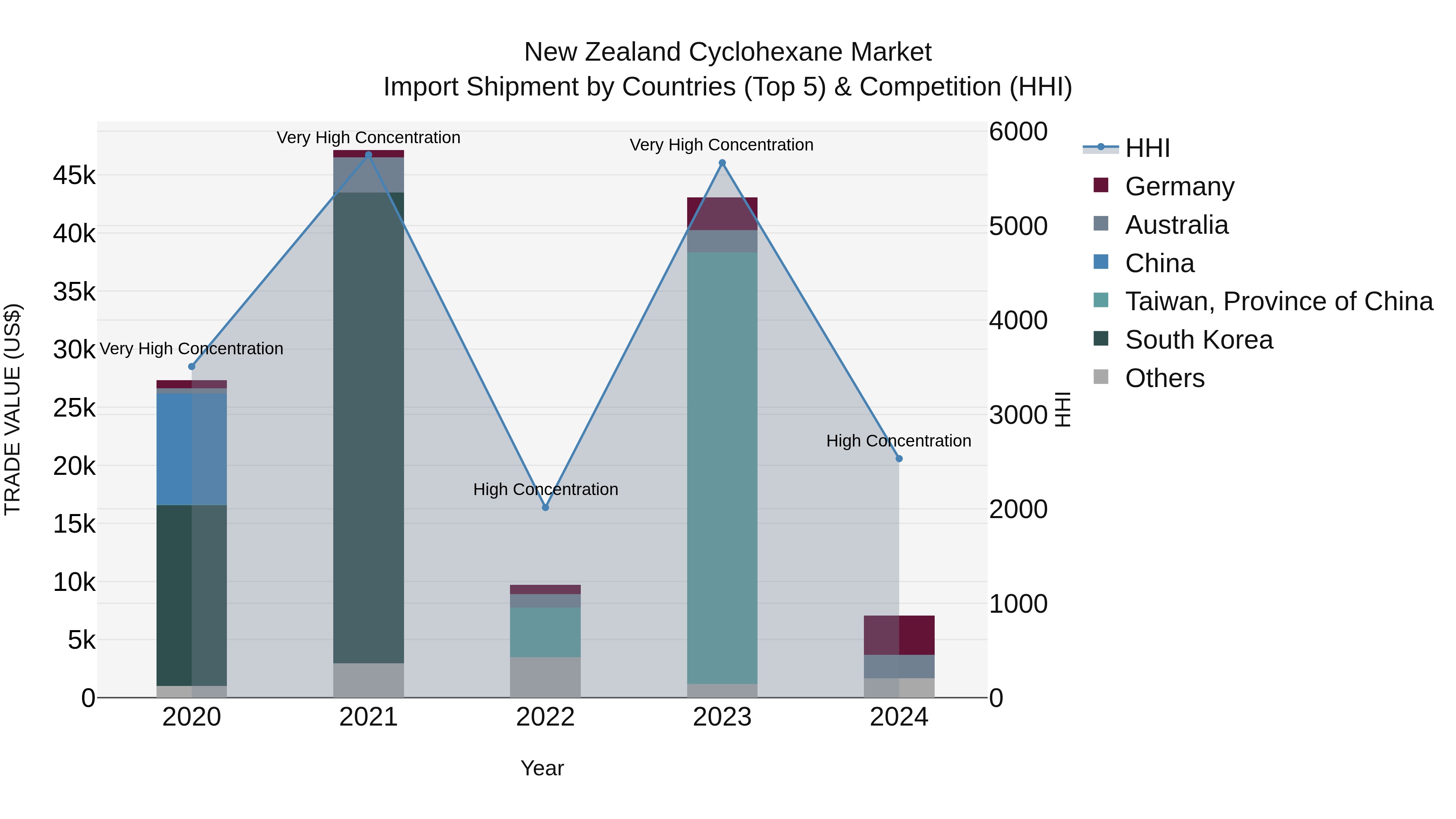
New Zealand Cyclohexane Market Top 5 Importing Countries and Market Competition (HHI) Analysis
In 2024, New Zealand saw significant cyclohexane import shipments from top exporting countries like Germany, Australia, Spain, USA, and India. The market exhibited high concentration levels as measured by the Herfindahl-Hirschman Index (HHI). However, the industry experienced a notable decline with a CAGR of -28.69% from 2020 to 2024. The growth rate plummeted even further in 2024 with a staggering -83.59%. These trends suggest a challenging environment for cyclohexane imports in New Zealand, possibly influenced by global economic conditions and market dynamics.
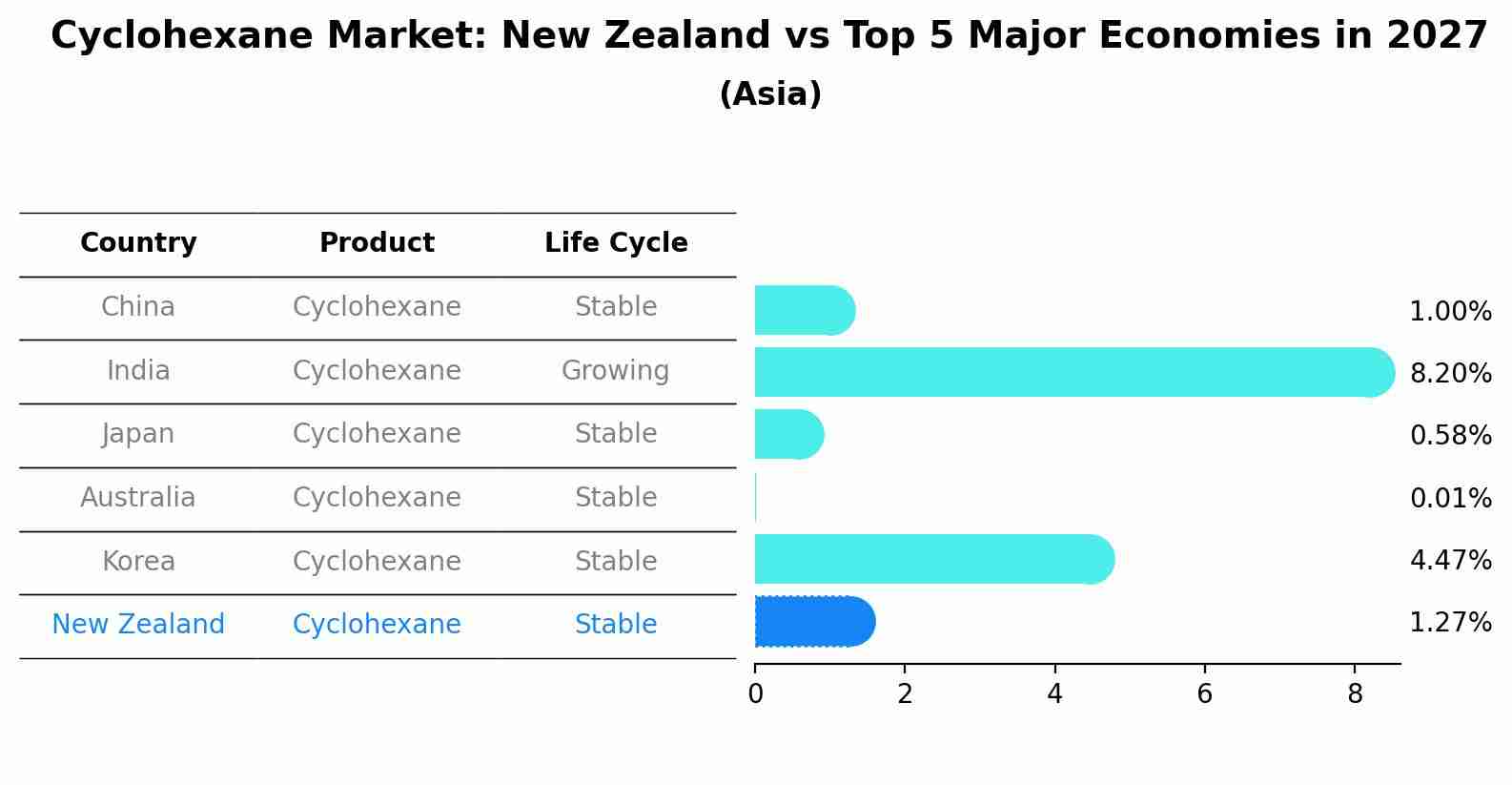
Cyclohexane Market: New Zealand vs Top 5 Major Economies in 2027 (Asia)
By 2027, New Zealand's Cyclohexane market is forecasted to achieve a stable growth rate of 1.27%, with China leading the Asia region, followed by India, Japan, Australia and South Korea.
New Zealand Cyclohexane Market Overview
The cyclohexane market in New Zealand is influenced by factors such as industrial manufacturing, petrochemical refining, and solvent applications. Cyclohexane, a key chemical intermediate, is primarily used in the production of adipic acid, which is further processed into nylon 6,6 and other polymers. With a focus on sustainability and environmental regulations, there is a growing interest in bio-based alternatives to conventional cyclohexane derived from fossil fuels. Market players are exploring opportunities for renewable feedstocks and green manufacturing processes to reduce carbon footprint and enhance competitiveness in the cyclohexane market.
Drivers of the market
The Cyclohexane market in New Zealand is influenced by factors such as industrial growth, chemical manufacturing activities, and demand from end-use sectors including automotive, construction, and pharmaceuticals. Cyclohexane is a key intermediate in the production of adipic acid and caprolactam, which are used in the manufacturing of nylon fibers and resins. The expansion of these downstream industries is driving the demand for cyclohexane in the country.
Challenges of the market
The New Zealand Cyclohexane market is impacted by raw material price volatility and environmental regulations. The market also faces competition from alternative products and processes.
Government Policy of the market
Cyclohexane, a key chemical intermediate, finds applications in various industries including pharmaceuticals and chemicals. The New Zealand Cyclohexane market is influenced by industrial growth and manufacturing activities.
Key Highlights of the Report:
- New Zealand Cyclohexane Market Outlook
- Market Size of New Zealand Cyclohexane Market, 2024
- Forecast of New Zealand Cyclohexane Market, 2031
- Historical Data and Forecast of New Zealand Cyclohexane Revenues & Volume for the Period 2021-2031
- New Zealand Cyclohexane Market Trend Evolution
- New Zealand Cyclohexane Market Drivers and Challenges
- New Zealand Cyclohexane Price Trends
- New Zealand Cyclohexane Porter`s Five Forces
- New Zealand Cyclohexane Industry Life Cycle
- Historical Data and Forecast of New Zealand Cyclohexane Market Revenues & Volume By Application for the Period 2021-2031
- Historical Data and Forecast of New Zealand Cyclohexane Market Revenues & Volume By Adipic acid for the Period 2021-2031
- Historical Data and Forecast of New Zealand Cyclohexane Market Revenues & Volume By Caprolactam for the Period 2021-2031
- Historical Data and Forecast of New Zealand Cyclohexane Market Revenues & Volume By Others for the Period 2021-2031
- Historical Data and Forecast of New Zealand Cyclohexane Market Revenues & Volume By End-use for the Period 2021-2031
- Historical Data and Forecast of New Zealand Cyclohexane Market Revenues & Volume By Nylon 6 for the Period 2021-2031
- Historical Data and Forecast of New Zealand Cyclohexane Market Revenues & Volume By Nylon 66 for the Period 2021-2031
- Historical Data and Forecast of New Zealand Cyclohexane Market Revenues & Volume By Others for the Period 2021-2031
- New Zealand Cyclohexane Import Export Trade Statistics
- Market Opportunity Assessment By Application
- Market Opportunity Assessment By End-use
- New Zealand Cyclohexane Top Companies Market Share
- New Zealand Cyclohexane Competitive Benchmarking By Technical and Operational Parameters
- New Zealand Cyclohexane Company Profiles
- New Zealand Cyclohexane Key Strategic Recommendations






































