Belgium Insulating Glass Window Market Growth Rate
According to 6Wresearch internal database and industry insights, the Belgium Insulating Glass Window Market is projected to grow at a compound annual growth rate (CAGR) of 5.8% during the forecast period (2026-2032).
Belgium Insulating Glass Window Market Year-wise Growth Rate and Key Drivers
This graph highlights how the Belgium Insulating Glass Window Market has steadily grown over the past five years, supported by major growth factors.
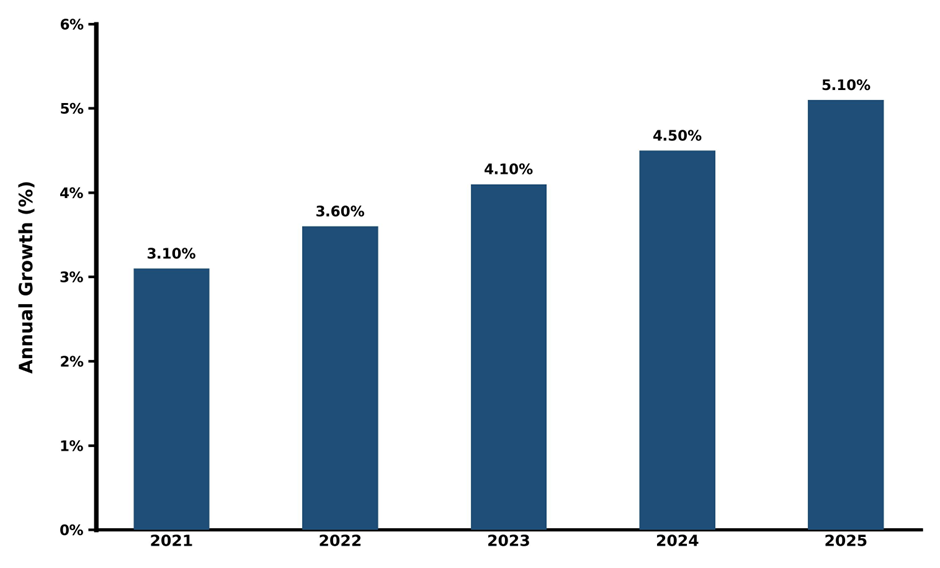
The table below presents the year‑wise growth rates along with the key drivers influencing the market
| Year | Est. Annual Growth (%) | Growth Drivers |
| 2021 | 3.1% | Energy efficiency building demands and environmental sustainability |
| 2022 | 3.6% | Tech innovations in insulating glass production processes |
| 2023 | 4.1% | Government policies to ensure energy efficiency in construction |
| 2024 | 4.5% | Popularity of energy-saving window technologies |
| 2025 | 5.1% | Significant expansion in the commercial construction sector |
Topics Covered in the Belgium Insulating Glass Window Market Report
The Belgium Insulating Glass Window Market report thoroughly covers the market by Product Type, Glazing Type, Spacer Type, Sealant Type and End-Use Industry. The market report provides an unbiased and detailed analysis of ongoing market trends, opportunities/high growth areas, and market drivers, which help stakeholders devise and align their market strategies according to the current and future market dynamics.
Belgium Insulating Glass Window Market Highlights
| Report Name | Belgium Insulating Glass Window Market |
| Forecast period | 2026-2032 |
| CAGR | 5.8% |
| Growing Sector | Residential and Commercial Construction |
Belgium Insulating Glass Window Market Synopsis
Belgium Insulating Glass Window Market is expected to experience continuous growth due to the increasing demand for efficient building materials and favorable government policies that promote sustainability. With the increased need for insulation in new and old buildings, there is an increase in the use of insulating glass windows. In addition, technological developments such as vacuum insulating glass and improved glass coating technologies, coupled with favorable government policies promoting sustainable buildings, are contributing to market growth.
Evaluation of Growth Drivers in the Belgium Insulating Glass Window Market (2026-2032)
Below mentioned are some prominent drivers and their influence on the market dynamics:
| Drivers | Primary Segments Affected | Why it Matters (Evidence) |
| Growing Demand for Energy-Efficient Products | By Product Type, End-Use Industry | Energy-efficient windows reduce energy expenses; therefore, their demand is increasing in both industries. |
| Development of Technology in Production Process | By Product Type | The changing technology of producing energy-efficient windows boosts their efficiency and generates demand in the market. |
| Sustainability Policies of Government Institutions | By End-Use Industry, Product Type | Motivation from government organizations results in the adoption of energy-efficient windows in the market. |
| Construction Industry Growth | By End-Use Industry | The growth in the construction industry, particularly in commercial buildings, drives demand for energy-efficient windows. |
| Popularization of Smart Glass | By Product Type, End-Use Industry | Necessity for smart windows that save on energy costs is increasing due to advancements in glazing technology. |
Belgium Insulating Glass Window Market is expected to grow at a CAGR of 5.8% during the forecast period of 2026-2032. The growth is mainly due to an increase in technological advancements, government encouragement towards energy-efficient buildings, and an increase in constructions. This is leading to a huge increase in the need for insulated glass windows that lead to reduced energy use.
Evaluation of Restraints in the Belgium Insulating Glass Window Market
Below mentioned are some major restraints and their influence on the market dynamics:
| Restraints | Primary Segments Affected | What This Means (Evidence) |
| High Production Costs | By Product Type | Complex manufacturing processes and expensive raw materials result in higher costs for insulating glass products. |
| Limited Awareness of Benefits | By End-Use Industry | Low awareness about energy savings and long-term benefits of insulating glass among end consumers affects adoption rates. |
| High Initial Cost | Per End-Use Application Segment | The insulating glass window, while energy efficient, involves high initial costs which can restrict market penetration. |
| Regulatory Obstacles | Per Product Category | Building regulations may create obstacles for manufacturing firms in meeting certain regulations. |
| Distribution Issues | Per Product Category | Problems in the global supply chain may affect the production process and delivery of products to the market. |
Belgium Insulating Glass Window Market Challenges
However, despite its impressive growth rate, the Belgium Insulating Glass Window Market is hindered by high manufacturing costs, limited consumer awareness of future energy savings, and the upfront cost of implementation. In addition, regulatory issues and disruptions within the supply chain limit the availability of these glass windows. All of these issues might impede the growth of the market in the coming years.
Belgium Insulating Glass Window Market Trends
Key trends shaping the landscape of the Belgium Insulating Glass Window Market are:
- Integration of Smart Glass Technology: The rise of smart windows with adjustable transparency is becoming a significant trend, providing energy efficiency, enhanced privacy, and light control in buildings.
- Increased Requirement for Vacuum Insulated Glass (VIG): Due to improved thermal insulation characteristics of VIG, there is a growing interest in VIG because of its suitability to increase energy efficiency.
- Trend towards Sustainability & Green Building Materials: There has been an increasing trend towards the use of green building materials, as the requirements for green building certifications like LEED and BREEAM continue to increase.
- Retrofit Projects on the Rise: Due to the increased pressure to improve energy efficiency, it is expected that the retro-fit sector of the insulating glass window market will witness strong growth in the coming years.
Investment Opportunities in the Belgium Insulating Glass Window Market
Investment opportunities that are prominent in the Belgium Insulating Glass Window Market include:
- Developing Smart Glass: Allocating funds towards developing smart glass technology that will ensure efficient energy use in buildings.
- Establishing Glass Manufacturing Plants: Establishing manufacturing plants for glass to meet rising demands for energy-efficient insulating glass windows.
- Constructing Energy-Efficient Buildings: Allocating funds to construct energy-efficient buildings, which have insulating glass windows.
- Collaboration with Governmental Organizations on Building Green Structures: Collaborating with governmental organizations to attain energy efficiency goals in building design and obtain financial incentives.
Top 5 Leading Players in the Belgium Insulating Glass Window Market
Some leading players operating in the Belgium Insulating Glass Window Market include:
1. Saint-Gobain
| Company Name | Saint-Gobain |
| Established Year | 1665 |
| Headquarters | Courbevoie, France |
| Official Website | Click Here |
Saint-Gobain is a global leader in insulation materials, offering advanced insulating glass solutions for energy-efficient windows.
2. Guardian Glass
| Company Name | Guardian Glass |
| Established Year | 1932 |
| Headquarters | Auburn Hills, Michigan, USA |
| Official Website | Click Here |
Guardian Glass specializes in high-performance glass, providing a variety of insulating glass products used in both residential and commercial construction.
3. AGC Inc.
| Company Name | AGC Inc. |
| Established Year | 1907 |
| Headquarters | Tokyo, Japan |
| Official Website | - |
AGC offers advanced glazing solutions, including insulating glass that enhances energy efficiency and comfort in buildings.
4. Schott AG
| Company Name | Schott AG |
| Established Year | 1884 |
| Headquarters | Mainz, Germany |
| Official Website | Click Here |
Schott is known for providing high-quality glass products, including those used in insulating glass windows for improved thermal performance.
5. Pilkington (NSG Group)
| Company Name | Pilkington (NSG Group) |
| Established Year | 1826 |
| Headquarters | Tokyo, Japan |
| Official Website | Click Here |
Pilkington is a leading supplier of glass solutions, offering insulating glass products that meet energy efficiency and environmental sustainability standards.
Government Regulations Introduced in the Belgium Insulating Glass Window Market
According to Belgian Government Data, various regulations have been implemented to encourage energy efficiency in the construction industry. One of the policies that has been put into practice is the implementation of the "Energy Performance of Buildings" regulations which require the use of insulating glass windows in buildings. Other supportive government policies include the provision of tax breaks to homeowners who install energy-saving upgrades in their homes.
Future Insights of the Belgium Insulating Glass Window Market
The future for the Belgium Insulating Glass Windows Industry seems promising as the focus shifts towards more sustainable building practices, smart glass technology, and energy efficiency requirements. The consistent backing of the government on the use of energy-efficient building material and advancements in glazing technology will help boost the industry in the coming years.
Market Segmentation Analysis
The report offers a comprehensive study of the subsequent market segments and their leading categories:
Vacuum Insulating Glass – VIG to dominate the Market- By Product Type
According to Ashi, Senior Research Analyst, 6Wresearch, Vacuum Insulating Glass (VIG) is gaining dominance in the Belgium Insulating Glass Window Market Share due to its superior thermal insulation properties. It provides excellent energy efficiency and space-saving advantages, making it ideal for both residential and commercial applications in regions focusing on energy conservation.
Warm Edge Spacer to dominate the Market- By Spacer Type
Warm edge spacers are gaining popularity because they enhance thermal performance, minimizing heat transfer between glass panes. This results in improved energy efficiency and condensation resistance, making them highly sought after in both residential and commercial construction projects.
Silicone to dominate the Market- By Sealant Type
The silicone is the most common because of its strength, elasticity, and thermal resistance. Silicone sealants find extensive use in the manufacture of insulating glass windows owing to their long-term performance and contribution to energy efficiency.
Residential to dominate the Market- By End-Use Industry
The residential segment is becoming dominant as more people are looking for energy-efficient options to cut down on energy use. Insulated glass windows provide great savings in terms of energy efficiency, increased comfort levels, and reduced noise pollution, making them more popular.
Key Attractiveness of the Report
- 10 Years of Market Numbers.
- Historical Data Starting from 2022 to 2025.
- Base Year: 2025.
- Forecast Data until 2032.
- Key Performance Indicators Impacting the Market.
- Major Upcoming Developments and Projects.
Key Highlights of the Report:
- Belgium Insulating Glass Window Market Outlook
- Market Size of Belgium Insulating Glass Window Market, 2025
- Forecast of Belgium Insulating Glass Window Market, 2032
- Historical Data and Forecast of Belgium Insulating Glass Window Revenues & Volume for the Period 2022- 2032
- Belgium Insulating Glass Window Market Trend Evolution
- Belgium Insulating Glass Window Market Drivers and Challenges
- Belgium Insulating Glass Window Price Trends
- Belgium Insulating Glass Window Porter`s Five Forces
- Belgium Insulating Glass Window Industry Life Cycle
- Historical Data and Forecast of Belgium Insulating Glass Window Market Revenues & Volume By Product Type for the Period 2022- 2032
- Historical Data and Forecast of Belgium Insulating Glass Window Market Revenues & Volume By Vacuum insulating glass (VIG) for the Period 2022- 2032
- Historical Data and Forecast of Belgium Insulating Glass Window Market Revenues & Volume By Gas filled insulating glass for the Period 2022- 2032
- Historical Data and Forecast of Belgium Insulating Glass Window Market Revenues & Volume By Air filled insulating glass for the Period 2022- 2032
- Historical Data and Forecast of Belgium Insulating Glass Window Market Revenues & Volume By Glazing Type for the Period 2022- 2032
- Historical Data and Forecast of Belgium Insulating Glass Window Market Revenues & Volume By Double glazed for the Period 2022- 2032
- Historical Data and Forecast of Belgium Insulating Glass Window Market Revenues & Volume By Triple glazed for the Period 2022- 2032
- Historical Data and Forecast of Belgium Insulating Glass Window Market Revenues & Volume By Others for the Period 2022- 2032
- Historical Data and Forecast of Belgium Insulating Glass Window Market Revenues & Volume By Spacer Type for the Period 2022- 2032
- Historical Data and Forecast of Belgium Insulating Glass Window Market Revenues & Volume By Cold edge spacer for the Period 2022- 2032
- Historical Data and Forecast of Belgium Insulating Glass Window Market Revenues & Volume By Warm edge spacer for the Period 2022- 2032
- Historical Data and Forecast of Belgium Insulating Glass Window Market Revenues & Volume By Sealant Type for the Period 2022- 2032
- Historical Data and Forecast of Belgium Insulating Glass Window Market Revenues & Volume By Silicone for the Period 2022- 2032
- Historical Data and Forecast of Belgium Insulating Glass Window Market Revenues & Volume By Polysulfide for the Period 2022- 2032
- Historical Data and Forecast of Belgium Insulating Glass Window Market Revenues & Volume By Hot melt butyl for the Period 2022- 2032
- Historical Data and Forecast of Belgium Insulating Glass Window Market Revenues & Volume By Polyurethane for the Period 2022- 2032
- Historical Data and Forecast of Belgium Insulating Glass Window Market Revenues & Volume By Others for the Period 2022- 2032
- Historical Data and Forecast of Belgium Insulating Glass Window Market Revenues & Volume By End-Use Industry for the Period 2022- 2032
- Historical Data and Forecast of Belgium Insulating Glass Window Market Revenues & Volume By Residential for the Period 2022- 2032
- Historical Data and Forecast of Belgium Insulating Glass Window Market Revenues & Volume By Commercial for the Period 2022- 2032
- Belgium Insulating Glass Window Import Export Trade Statistics
- Market Opportunity Assessment By Product Type
- Market Opportunity Assessment By Glazing Type
- Market Opportunity Assessment By Spacer Type
- Market Opportunity Assessment By Sealant Type
- Market Opportunity Assessment By End-Use Industry
- Belgium Insulating Glass Window Top Companies Market Share
- Belgium Insulating Glass Window Competitive Benchmarking By Technical and Operational Parameters
- Belgium Insulating Glass Window Company Profiles
- Belgium Insulating Glass Window Key Strategic Recommendations
Market Covered
The report offers a comprehensive study of the subsequent market segments:
By Product Type
- Vacuum Insulating Glass (VIG)
- Gas Filled Insulating Glass
- Air Filled Insulating Glass
By Glazing Type
- Double Glazed
- Triple Glazed
- Others
By Spacer Type
- Cold Edge Spacer
- Warm Edge Spacer
By Sealant Type
- Silicone
- Polysulfide
- Hot Melt Butyl
- Polyurethane
- Others
By End-Use Industry
- Residential
- Commercial






































