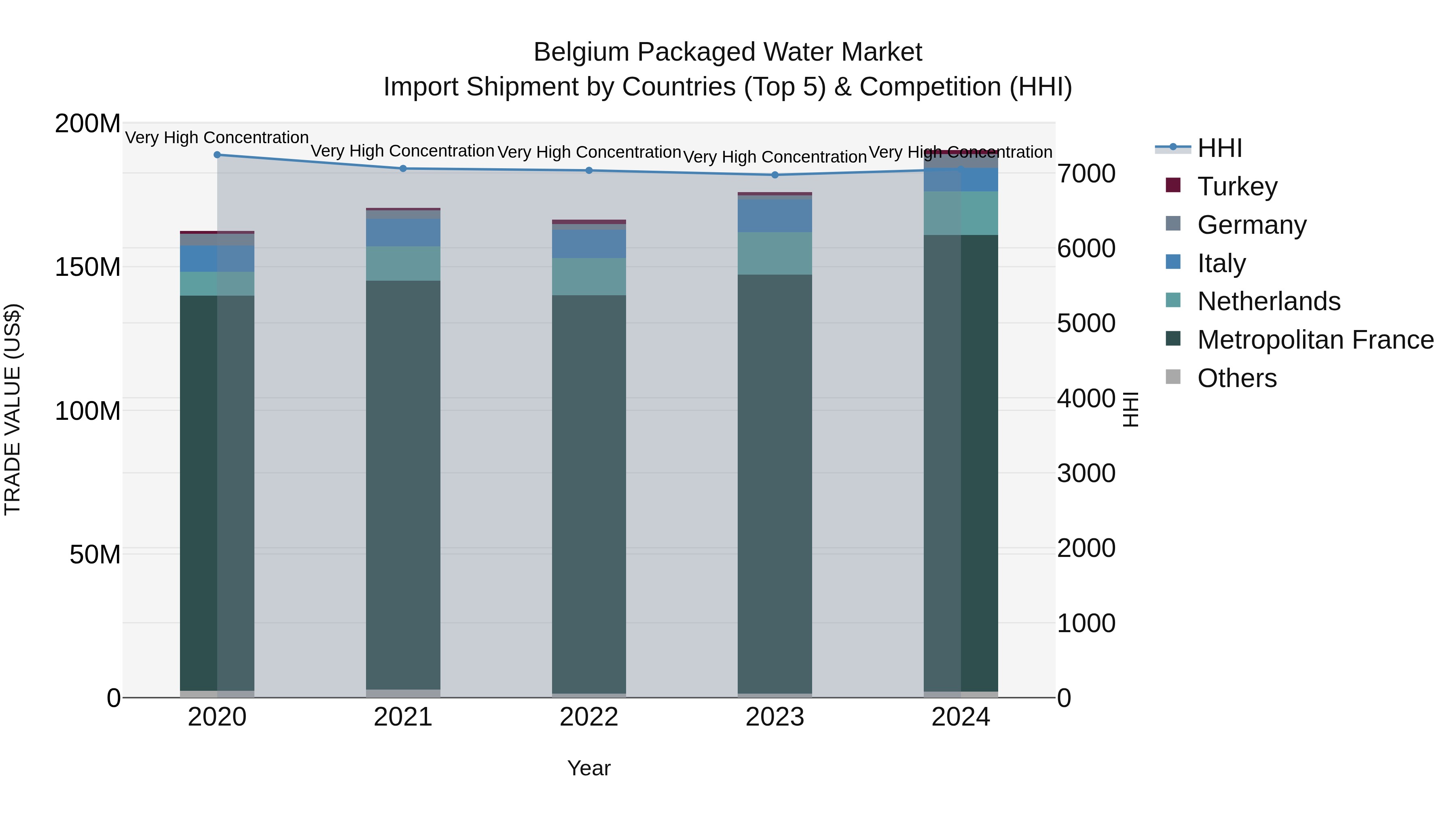
Belgium Packaged Water Market Top 5 Importing Countries and Market Competition (HHI) Analysis
Belgium continues to see a strong influx of packaged water imports, with top exporters like Metropolitan France, Netherlands, Italy, Germany, and Turkey dominating the market in 2024. The high Herfindahl-Hirschman Index (HHI) indicates a concentrated market, suggesting potential challenges for new entrants. However, the Compound Annual Growth Rate (CAGR) from 2020 to 2024 at 4.08% and a notable growth rate of 8.31% from 2023 to 2024 reflect a promising trend for the industry, indicating opportunities for sustained expansion and competition in the coming years.
Belgium Packaged water Market Overview
The Belgium packaged water market is experiencing steady growth due to increasing health consciousness among consumers and a shift towards healthier beverage options. The market is dominated by various local and international brands offering a wide range of packaged water products, including still water, sparkling water, flavored water, and functional water with added vitamins or minerals. The trend towards on-the-go consumption and convenience is driving the demand for single-serve and grab-and-go packaging formats. Sustainability and eco-friendly packaging options are also gaining traction in the market, with consumers showing a preference for recyclable and reusable packaging. The competitive landscape is characterized by constant product innovation, marketing strategies focused on health benefits and sustainability, and collaborations with retailers to expand distribution channels.
Belgium Packaged water Market Trends and Opportunities
The Belgium Packaged water market is experiencing growth driven by increasing health consciousness among consumers and a shift towards healthier beverage options. Environmental concerns and the push to reduce single-use plastic waste have also fueled the demand for sustainable and eco-friendly packaging solutions in the market. Opportunities exist for companies to innovate with new packaging materials and formats, such as biodegradable bottles or refillable containers, to cater to the growing demand for environmentally friendly options. Additionally, there is potential for market players to differentiate themselves through product positioning, such as emphasizing natural mineral content or offering functional benefits like added vitamins or electrolytes, to target specific consumer segments seeking premium or specialized packaged water products.
Belgium Packaged water Market Challenges
In the Belgium packaged water market, one of the main challenges faced is increasing competition from various brands and types of bottled water. This competition leads to a saturated market, making it difficult for new or smaller brands to gain significant market share. Additionally, there is a growing concern among consumers about the environmental impact of single-use plastic bottles, leading to a shift towards more sustainable packaging options such as glass or aluminum. This trend poses a challenge for companies still reliant on plastic packaging. Furthermore, fluctuating raw material prices and changing consumer preferences towards flavored or functional waters also contribute to the challenges faced by companies operating in the Belgium packaged water market. To succeed in this competitive landscape, companies need to innovate in terms of packaging, sustainability, and product offerings to meet consumer demands effectively.
Belgium Packaged water Market Drivers
The Belgium Packaged water market is primarily driven by increasing consumer awareness of the importance of hydration for health and well-being, leading to a growing preference for convenient and safe drinking water options. The rising trend of on-the-go consumption and busy lifestyles further fuel the demand for packaged water. Additionally, concerns about the quality of tap water, environmental consciousness, and the convenience of single-serve packaging are key factors driving market growth. Innovative product offerings, such as flavored and functional waters, sustainable packaging solutions, and enhanced mineral content, are also contributing to the market expansion. Moreover, the influence of health and wellness trends, urbanization, and the expanding tourism industry are expected to sustain the growth momentum in the Belgium Packaged water market.
Belgium Packaged water Market Government Policy
The Belgian government has implemented various policies related to the packaged water market to ensure safety and sustainability. These policies include regulations on water quality standards, packaging materials, labeling requirements, and environmental impact assessments. Additionally, the government encourages recycling and waste management practices to reduce the environmental footprint of packaged water consumption. There are also initiatives to promote public awareness on the importance of choosing sustainable packaging options and reducing single-use plastics. Overall, the government aims to balance consumer demand for packaged water with environmental concerns, promoting a responsible and environmentally friendly approach to the market.
Belgium Packaged water Market Future Outlook
The Belgium packaged water market is expected to witness steady growth in the coming years due to increasing consumer preference for healthy and convenient beverage options. With rising concerns about health and wellness, more consumers are turning to packaged water as a low-calorie and sugar-free alternative to sugary drinks. Additionally, the growing trend of on-the-go consumption and the emphasis on hydration are driving the demand for packaged water in Belgium. The market is also likely to benefit from innovations in packaging, such as eco-friendly materials and convenient formats. Overall, the future outlook for the Belgium packaged water market appears positive, with opportunities for market players to capitalize on evolving consumer preferences and lifestyle trends.
Key Highlights of the Report:
- Belgium Packaged water Market Outlook
- Market Size of Belgium Packaged water Market, 2024
- Forecast of Belgium Packaged water Market, 2031
- Historical Data and Forecast of Belgium Packaged water Revenues & Volume for the Period 2021- 2031
- Belgium Packaged water Market Trend Evolution
- Belgium Packaged water Market Drivers and Challenges
- Belgium Packaged water Price Trends
- Belgium Packaged water Porter's Five Forces
- Belgium Packaged water Industry Life Cycle
- Historical Data and Forecast of Belgium Packaged water Market Revenues & Volume By Product for the Period 2021- 2031
- Historical Data and Forecast of Belgium Packaged water Market Revenues & Volume By Still for the Period 2021- 2031
- Historical Data and Forecast of Belgium Packaged water Market Revenues & Volume By Carbonated for the Period 2021- 2031
- Historical Data and Forecast of Belgium Packaged water Market Revenues & Volume By Flavored for the Period 2021- 2031
- Historical Data and Forecast of Belgium Packaged water Market Revenues & Volume By Functional for the Period 2021- 2031
- Belgium Packaged water Import Export Trade Statistics
- Market Opportunity Assessment By Product
- Belgium Packaged water Top Companies Market Share
- Belgium Packaged water Competitive Benchmarking By Technical and Operational Parameters
- Belgium Packaged water Company Profiles
- Belgium Packaged water Key Strategic Recommendations






































