Belgium Personal Luxury Goods Market Top 5 Importing Countries and Market Competition (HHI) Analysis
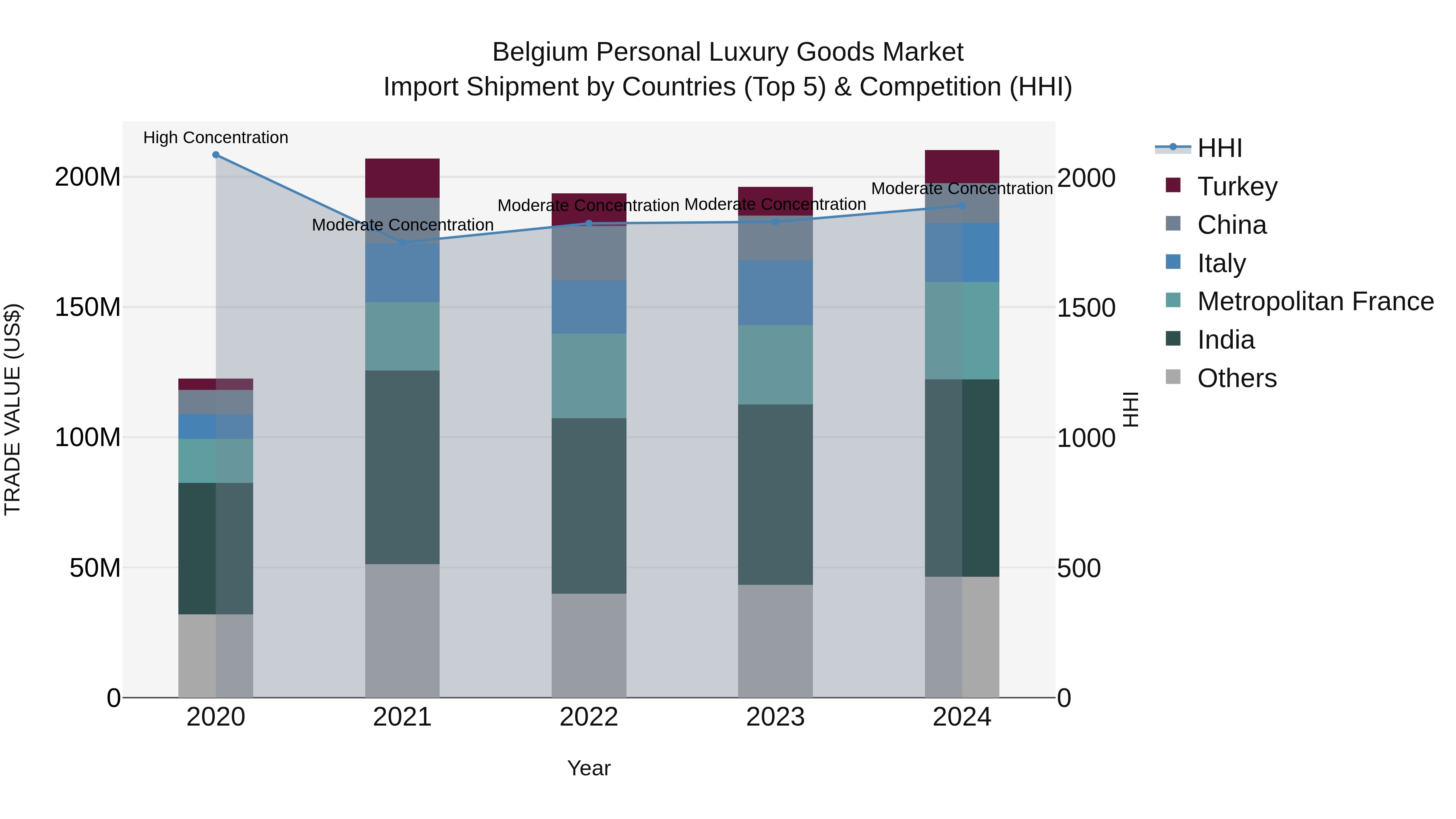
Belgium`s personal luxury goods import market in 2024 saw significant contributions from top exporting countries including India, Metropolitan France, Italy, China, and Turkey. With a moderate concentration level indicated by the Herfindahl-Hirschman Index (HHI), the market demonstrated stability and diversity. The impressive Compound Annual Growth Rate (CAGR) of 14.43% from 2020 to 2024 reflects a strong upward trend, further supported by a notable growth rate of 7.22% in 2024 alone. These figures indicate a thriving and dynamic luxury goods import market in Belgium, driven by a variety of key exporting nations.
Belgium Personal Luxury Goods Market Synopsis
The Belgium Personal Luxury Goods Market is characterized by a strong demand for high-end fashion, accessories, and beauty products. With a discerning consumer base that values quality and exclusivity, major luxury brands have established a significant presence in the country. Belgium`s affluent population, particularly in cities like Brussels and Antwerp, drives the demand for luxury goods. The market is also influenced by a growing trend towards sustainable and ethical luxury, with consumers seeking products that align with their values. E-commerce is playing an increasingly important role in the market, providing luxury brands with opportunities to reach a wider audience. Overall, the Belgium Personal Luxury Goods Market presents a mix of traditional luxury consumption patterns and evolving consumer preferences.
Belgium Personal Luxury Goods Market Trends
The Belgium Personal Luxury Goods Market is experiencing several key trends currently. One prominent trend is the growing demand for sustainable and ethically sourced luxury items, with consumers showing a preference for brands that prioritize environmental and social responsibility. Another trend is the increasing popularity of online shopping for luxury goods, driven by the convenience and wider selection available through e-commerce platforms. Additionally, there is a rising interest in personalized and unique luxury products, as consumers seek to differentiate themselves and express their individuality. Despite economic uncertainties, the Belgium Personal Luxury Goods Market continues to show resilience and adaptability to changing consumer preferences, with a focus on sustainability, digitalization, and personalization shaping the market landscape.
Belgium Personal Luxury Goods Market Challenges
In the Belgium Personal Luxury Goods Market, one of the key challenges faced is the impact of economic fluctuations and consumer spending patterns. The market is highly sensitive to changes in economic conditions, such as fluctuations in income levels and consumer confidence, which can directly affect the demand for luxury goods. Additionally, increasing competition from online retailers and global luxury brands poses a challenge for local luxury retailers in Belgium. Balancing the need to maintain exclusivity and heritage while also adapting to changing consumer preferences and digital trends remains a constant challenge for players in the Belgium Personal Luxury Goods Market. Developing effective marketing strategies to engage with a diverse consumer base and creating unique experiences to differentiate from competitors are crucial in overcoming these challenges.
Belgium Personal Luxury Goods Market Investment Opportunities
The Belgium Personal Luxury Goods Market offers promising investment opportunities in various sectors such as fashion, accessories, beauty, and watches & jewelry. With a growing affluent population and increasing demand for luxury products, particularly among younger consumers, there is a strong potential for growth in this market. Investing in well-known luxury brands, high-end boutiques, or luxury e-commerce platforms could be lucrative opportunities. Additionally, focusing on sustainable and ethical luxury products could appeal to the socially-conscious Belgian consumer. Collaborating with local designers or artisans to create unique luxury goods that cater to the Belgian taste and culture could also be a successful investment strategy in this market.
Jordan Agar Market Government Policies
In Belgium, the Personal Luxury Goods Market is subject to various government policies and regulations aimed at protecting consumers and promoting fair competition within the industry. The government enforces strict regulations on product labeling and advertising to ensure accurate representation of luxury goods. Additionally, there are policies in place to prevent counterfeiting and protect intellectual property rights of luxury brands. Import and export regulations also play a crucial role in governing the Personal Luxury Goods Market in Belgium, with tariffs and duties affecting the pricing and availability of luxury items. Overall, the government`s policies in Belgium seek to maintain a transparent and ethical market environment for consumers and businesses operating in the Personal Luxury Goods sector.
Belgium Personal Luxury Goods Market Future Outlook
The future outlook for the Belgium Personal Luxury Goods Market appears promising, with sustained growth expected in the coming years. Factors driving this growth include increasing disposable income levels, a growing affluent population, and a strong interest in luxury fashion and accessories among Belgian consumers. The rise of e-commerce and digital channels is also likely to contribute to the market`s expansion, providing greater accessibility to luxury goods for a wider audience. Additionally, the demand for sustainable and ethically produced luxury items is on the rise, leading to a shift towards more environmentally friendly and socially responsible practices among luxury brands. Overall, the Belgium Personal Luxury Goods Market is poised for continued growth and innovation, presenting opportunities for both established luxury brands and emerging players in the market.
Key Highlights of the Report:
- Belgium Personal Luxury Goods Market Outlook
- Market Size of Belgium Personal Luxury Goods Market, 2024
- Forecast of Belgium Personal Luxury Goods Market, 2031
- Historical Data and Forecast of Belgium Personal Luxury Goods Revenues & Volume for the Period 2021- 2031
- Belgium Personal Luxury Goods Market Trend Evolution
- Belgium Personal Luxury Goods Market Drivers and Challenges
- Belgium Personal Luxury Goods Price Trends
- Belgium Personal Luxury Goods Porter's Five Forces
- Belgium Personal Luxury Goods Industry Life Cycle
- Historical Data and Forecast of Belgium Personal Luxury Goods Market Revenues & Volume By Distribution Channel for the Period 2021- 2031
- Historical Data and Forecast of Belgium Personal Luxury Goods Market Revenues & Volume By Offline for the Period 2021- 2031
- Historical Data and Forecast of Belgium Personal Luxury Goods Market Revenues & Volume By Online for the Period 2021- 2031
- Historical Data and Forecast of Belgium Personal Luxury Goods Market Revenues & Volume By Product for the Period 2021- 2031
- Historical Data and Forecast of Belgium Personal Luxury Goods Market Revenues & Volume By Hard luxury for the Period 2021- 2031
- Historical Data and Forecast of Belgium Personal Luxury Goods Market Revenues & Volume By Apparel for the Period 2021- 2031
- Historical Data and Forecast of Belgium Personal Luxury Goods Market Revenues & Volume By Cosmetics and perfumes for the Period 2021- 2031
- Historical Data and Forecast of Belgium Personal Luxury Goods Market Revenues & Volume By Accessories for the Period 2021- 2031
- Historical Data and Forecast of Belgium Personal Luxury Goods Market Revenues & Volume By Others for the Period 2021- 2031
- Belgium Personal Luxury Goods Import Export Trade Statistics
- Market Opportunity Assessment By Distribution Channel
- Market Opportunity Assessment By Product
- Belgium Personal Luxury Goods Top Companies Market Share
- Belgium Personal Luxury Goods Competitive Benchmarking By Technical and Operational Parameters
- Belgium Personal Luxury Goods Company Profiles
- Belgium Personal Luxury Goods Key Strategic Recommendations






































