Belgium Polymer Clay Market - Import Trends (2019-2025)
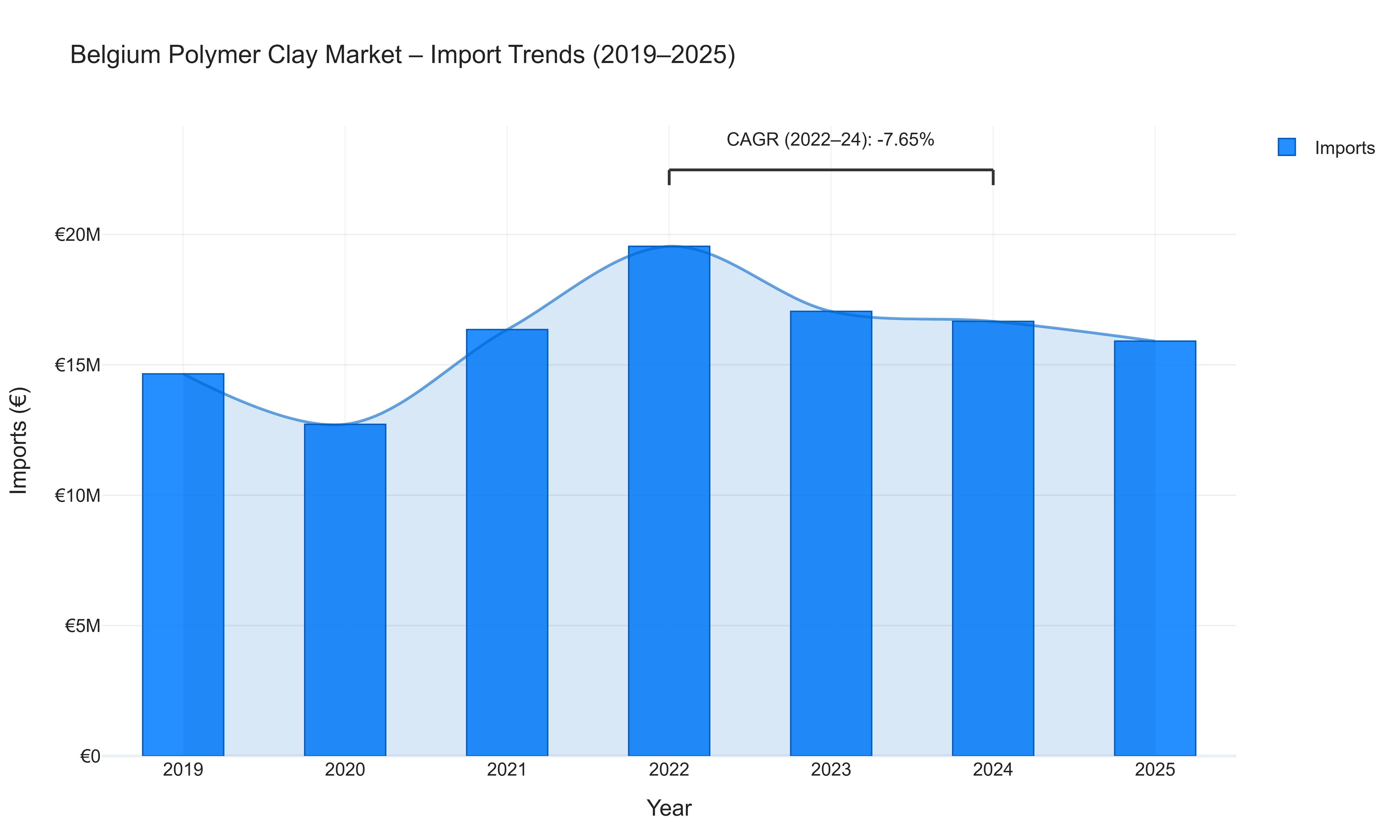
In the Belgium Polymer Clay Market, Import Values exhibited fluctuating trends over the years. Import Values were at €16.35 million in 2021, marking a significant growth of 28.56%, which continued into 2022 with a 19.52% increase, reaching €19.54 million. However, a downturn began in 2023 and persisted through 2025, with Import Values decreasing to €17.05 million, €16.67 million, and €15.91 million, respectively. These fluctuations could be attributed to various factors such as shifts in the global supply chain, changing consumer demands, or even economic uncertainties. The Compound Annual Growth Rate (CAGR) of -7.65% from 2022 to 2024 indicates a declining trend in import values during this period, reflecting a challenging market environment that may have impacted overall import activities in the Belgium Polymer Clay Market.
Belgium Polymer Clay Market Overview
The polymer clay market in Belgium is expanding with the demand for versatile and durable clays used in arts, crafts, and industrial applications. Polymer clay offers properties such as ease of use and variety of colors. Belgiums focus on creativity and material innovation supports the growth of this market.
Drivers of the market
The polymer clay market in Belgium is characterized by the demand for a versatile material used in arts, crafts, and industrial applications. Polymer clay offers properties such as ease of molding and durability. Belgium`s focus on creative industries and hobbyist activities supports market growth. The increasing popularity of DIY projects and craftwork drives market development.
Challenges of the market
The polymer clay market in Belgium is hindered by the high costs of raw materials and the technical complexities of ensuring product quality and performance. Managing the high costs of production and maintaining regulatory compliance are significant challenges. Additionally, the market faces competition from alternative materials and the need for continuous innovation to meet diverse industry demands.
Government Policy of the market
Government policies in Belgium related to arts and crafts, as well as sustainable materials, influence the Polymer Clay market. Regulations promoting the use of safe and eco-friendly materials in creative applications drive demand. The governments support for innovation in polymer technologies and sustainable practices impacts the development and use of polymer clay. Additionally, policies on product safety and quality standards affect market dynamics.
Key Highlights of the Report:
- Belgium Polymer Clay Market Outlook
- Market Size of Belgium Polymer Clay Market, 2024
- Forecast of Belgium Polymer Clay Market, 2031
- Historical Data and Forecast of Belgium Polymer Clay Revenues & Volume for the Period 2021-2031
- Belgium Polymer Clay Market Trend Evolution
- Belgium Polymer Clay Market Drivers and Challenges
- Belgium Polymer Clay Price Trends
- Belgium Polymer Clay Porter`s Five Forces
- Belgium Polymer Clay Industry Life Cycle
- Historical Data and Forecast of Belgium Polymer Clay Market Revenues & Volume By Product Form for the Period 2021-2031
- Historical Data and Forecast of Belgium Polymer Clay Market Revenues & Volume By Solid for the Period 2021-2031
- Historical Data and Forecast of Belgium Polymer Clay Market Revenues & Volume By Liquid for the Period 2021-2031
- Historical Data and Forecast of Belgium Polymer Clay Market Revenues & Volume By Application for the Period 2021-2031
- Historical Data and Forecast of Belgium Polymer Clay Market Revenues & Volume By Jewelry Making for the Period 2021-2031
- Historical Data and Forecast of Belgium Polymer Clay Market Revenues & Volume By Manufacturing of Toys and Novelty Items for the Period 2021-2031
- Historical Data and Forecast of Belgium Polymer Clay Market Revenues & Volume By Arts and Sculpture Making for the Period 2021-2031
- Historical Data and Forecast of Belgium Polymer Clay Market Revenues & Volume By Crockery and Ceramic Products for the Period 2021-2031
- Historical Data and Forecast of Belgium Polymer Clay Market Revenues & Volume By Others for the Period 2021-2031
- Historical Data and Forecast of Belgium Polymer Clay Market Revenues & Volume By End Use for the Period 2021-2031
- Historical Data and Forecast of Belgium Polymer Clay Market Revenues & Volume By Residential for the Period 2021-2031
- Historical Data and Forecast of Belgium Polymer Clay Market Revenues & Volume By Commercial for the Period 2021-2031
- Historical Data and Forecast of Belgium Polymer Clay Market Revenues & Volume By Industrial for the Period 2021-2031
- Belgium Polymer Clay Import Export Trade Statistics
- Market Opportunity Assessment By Product Form
- Market Opportunity Assessment By Application
- Market Opportunity Assessment By End Use
- Belgium Polymer Clay Top Companies Market Share
- Belgium Polymer Clay Competitive Benchmarking By Technical and Operational Parameters
- Belgium Polymer Clay Company Profiles
- Belgium Polymer Clay Key Strategic Recommendations






































