Belgium Tobacco Market Size (2020-2030)
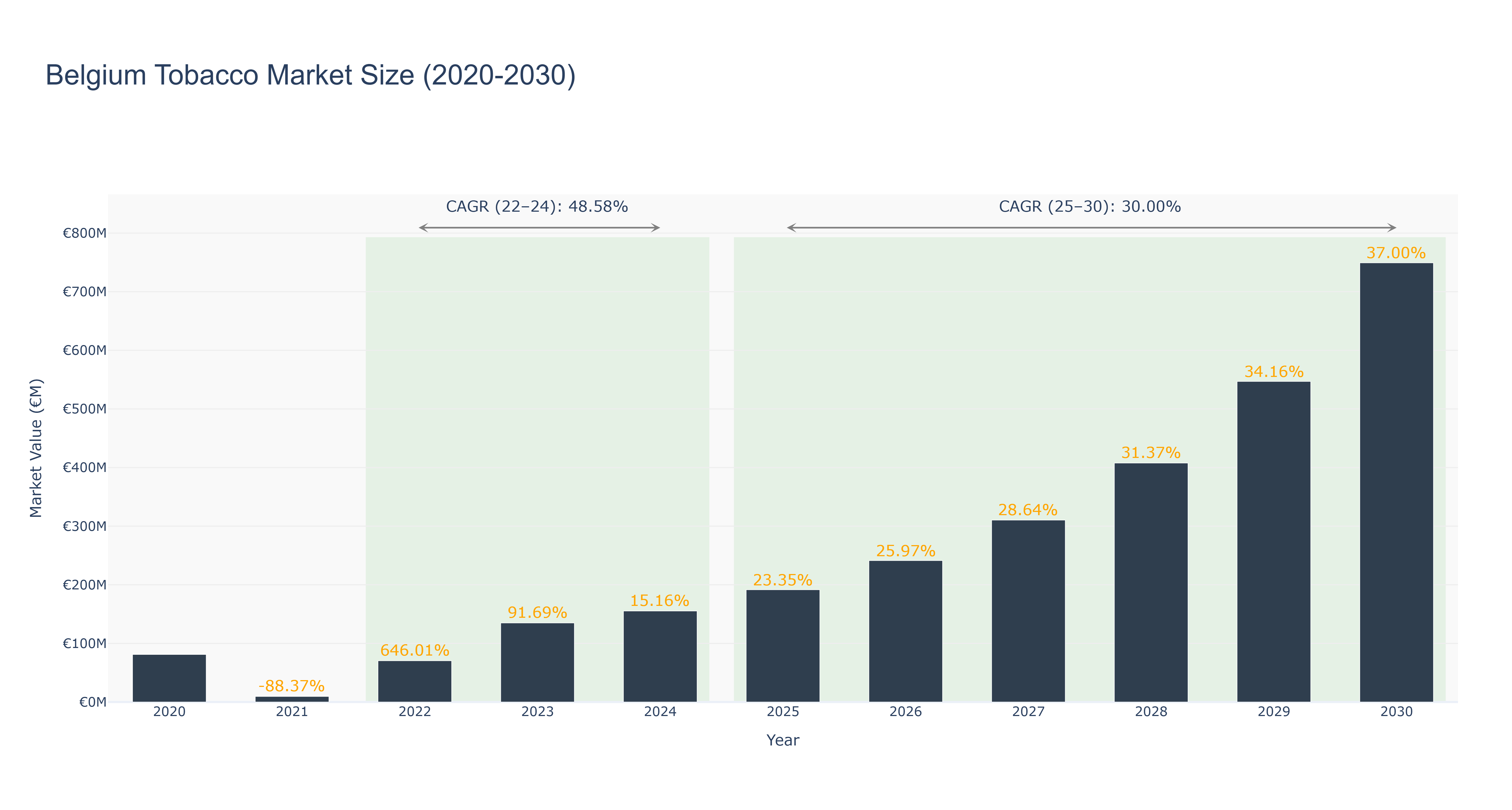
Belgium Tobacco Market has shown a fluctuating trend over the years. The market peaked at €749.25 million in 2030, with a steady growth rate. From 2020 to 2024, the market size ranged from €81.05 million to €155.23 million, experiencing significant growth in 2022 and 2023 due to increased demand and favorable economic conditions. The forecasted market size from 2025 to 2030 is expected to continue growing, with a CAGR of 30.0% from 2025 to 2030. The industry drivers behind this growth include changing consumer preferences and increasing disposable incomes. Looking ahead, Belgium is set to implement stricter regulations on tobacco marketing and sales, aiming to reduce smoking rates and promote public health. This initiative is expected to impact the market dynamics significantly in the coming years.
Belgium Tobacco Market: Production & Trade Performance (2019-2025)
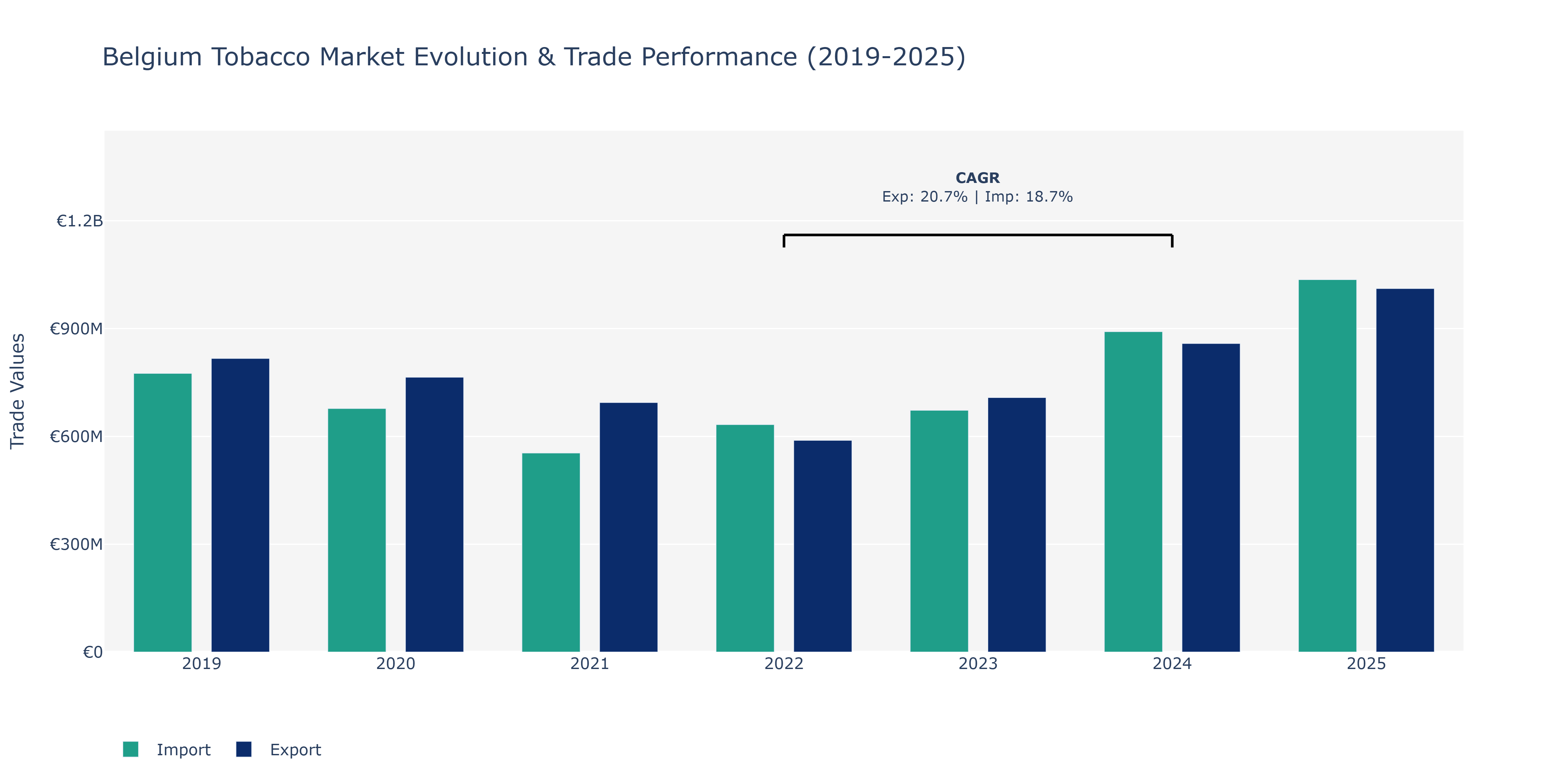
Between 2019 and 2025, the Belgium Tobacco Market experienced fluctuations in both Exports and Imports. In 2019, Exports stood at approximately €816.79 million, which later decreased to around €694.15 million in 2021 before rebounding and reaching its peak at €1.01 billion in 2025. Similarly, Imports started at about €775.28 million in 2019, dipped to around €553.69 million in 2021, and then gradually increased to €1.04 billion in 2025. The market saw a notable decline in Exports from 2019 to 2021, possibly due to changes in global demand or regulatory factors. The subsequent growth post-2021 may be attributed to enhanced product quality or increased market penetration strategies. Imports followed a similar pattern, possibly influenced by shifts in international trade policies or fluctuations in currency exchange rates. These trends highlight a dynamic market influenced by various external factors, necessitating agile strategies to navigate the industry landscape effectively.
Key Highlights of the Report:
- Belgium Tobacco Market Outlook
- Market Size of Belgium Tobacco Market, 2025
- Forecast of Belgium Tobacco Market, 2032
- Historical Data and Forecast of Belgium Tobacco Revenues & Volume for the Period 2022 - 2032F
- Belgium Tobacco Market Trend Evolution
- Belgium Tobacco Market Drivers and Challenges
- Belgium Tobacco Price Trends
- Belgium Tobacco Porter`s Five Forces
- Belgium Tobacco Industry Life Cycle
- Historical Data and Forecast of Belgium Tobacco Market Revenues & Volume By Product for the Period 2022 - 2032F
- Historical Data and Forecast of Belgium Tobacco Market Revenues & Volume By Smokeless for the Period 2022 - 2032F
- Historical Data and Forecast of Belgium Tobacco Market Revenues & Volume By Cigarettes for the Period 2022 - 2032F
- Historical Data and Forecast of Belgium Tobacco Market Revenues & Volume By Cigar & Cigarillos for the Period 2022 - 2032F
- Historical Data and Forecast of Belgium Tobacco Market Revenues & Volume By Next Generation Products for the Period 2022 - 2032F
- Historical Data and Forecast of Belgium Tobacco Market Revenues & Volume By Waterpipes for the Period 2022 - 2032F
- Historical Data and Forecast of Belgium Tobacco Market Revenues & Volume By Distribution Channel for the Period 2022 - 2032F
- Historical Data and Forecast of Belgium Tobacco Market Revenues & Volume By Offline for the Period 2022 - 2032F
- Historical Data and Forecast of Belgium Tobacco Market Revenues & Volume By Online for the Period 2022 - 2032F
- Belgium Tobacco Import Export Trade Statistics
- Market Opportunity Assessment By Product
- Market Opportunity Assessment By Distribution Channel
- Belgium Tobacco Top Companies Market Share
- Belgium Tobacco Competitive Benchmarking By Technical and Operational Parameters
- Belgium Tobacco Company Profiles
- Belgium Tobacco Key Strategic Recommendations






































