Benin Pipe Market Growth Rate Analysis (2025 - 2031)
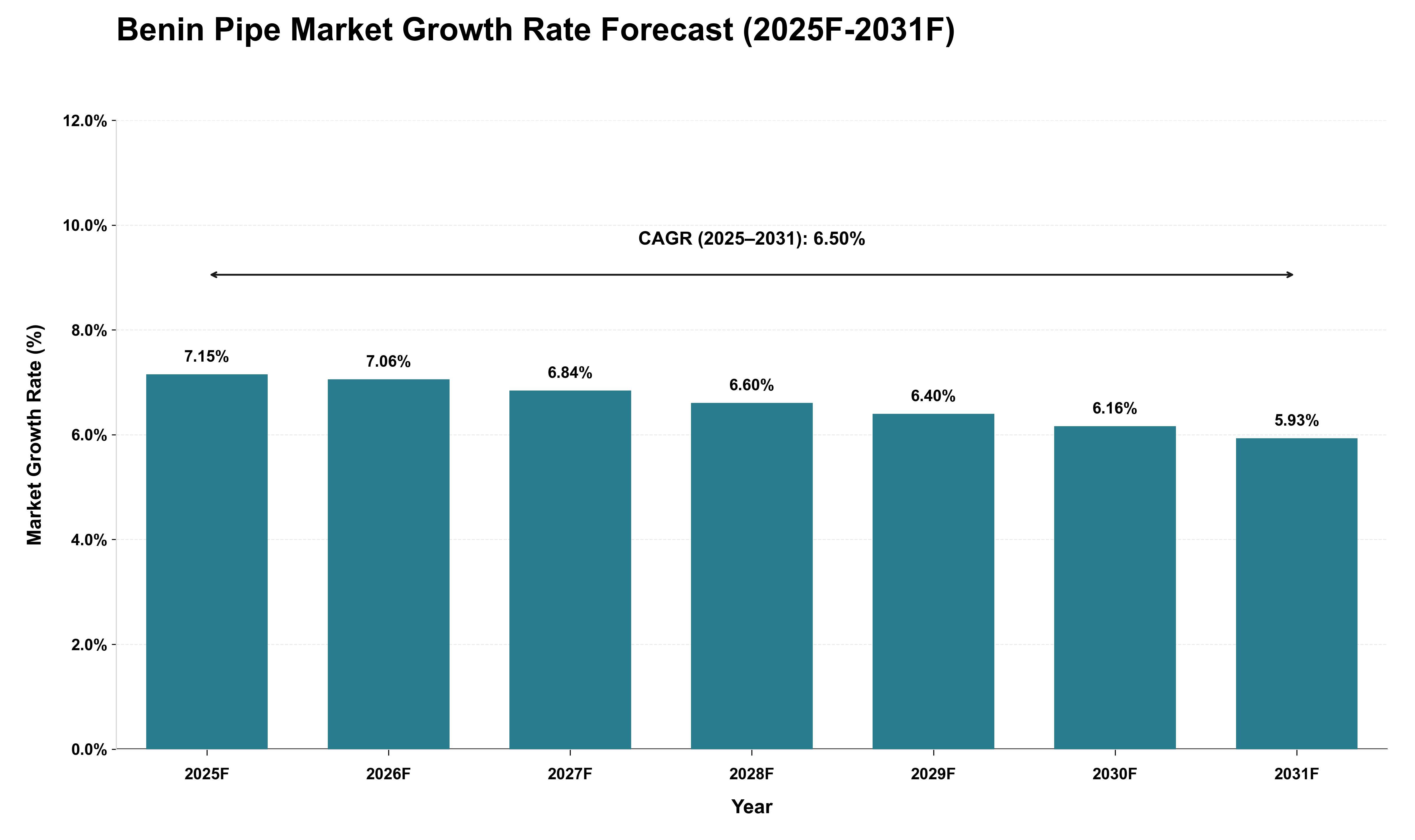
The Benin pipe market is projected to experience a compound annual growth rate of 6.50% from 2025 to 2031, reflecting a robust demand trajectory driven by anticipated infrastructure developments and urbanization trends. The annual growth rates indicate a gradual decline, starting at 7.15% in 2025 and tapering to 5.93% by 2031, suggesting that while growth remains strong, it will be influenced by fluctuations in raw material availability and pricing dynamics. As global supply chains adapt to shifting demand patterns, import dependencies for essential materials such as steel and plastic will play a critical role in shaping production costs and market pricing strategies. Additionally, cyclical trends in construction activity are expected to impact the volume of pipe installations, with potential volatility linked to economic cycles affecting public and private investment levels in infrastructure projects throughout the forecast period.
Key Highlights of the Report:
- Benin Pipe Market Outlook
- Market Size of Benin Pipe Market, 2025
- Forecast of Benin Pipe Market, 2032
- Historical Data and Forecast of Benin Pipe Revenues & Volume for the Period 2022-2032F
- Benin Pipe Market Trend Evolution
- Benin Pipe Market Drivers and Challenges
- Benin Pipe Price Trends
- Benin Pipe Porter's Five Forces
- Benin Pipe Industry Life Cycle
- Historical Data and Forecast of Benin Pipe Market Revenues & Volume By Material for the Period 2022-2032F
- Historical Data and Forecast of Benin Pipe Market Revenues & Volume By Concrete for the Period 2022-2032F
- Historical Data and Forecast of Benin Pipe Market Revenues & Volume By Thermoset and composite for the Period 2022-2032F
- Historical Data and Forecast of Benin Pipe Market Revenues & Volume By Metal for the Period 2022-2032F
- Historical Data and Forecast of Benin Pipe Market Revenues & Volume By Thermoplastic for the Period 2022-2032F
- Historical Data and Forecast of Benin Pipe Market Revenues & Volume By Diameter for the Period 2022-2032F
- Historical Data and Forecast of Benin Pipe Market Revenues & Volume By DN upto 50 mm for the Period 2022-2032F
- Historical Data and Forecast of Benin Pipe Market Revenues & Volume By DN 51 to 150 mm for the Period 2022-2032F
- Historical Data and Forecast of Benin Pipe Market Revenues & Volume By DN 151 to 300 mm for the Period 2022-2032F
- Historical Data and Forecast of Benin Pipe Market Revenues & Volume By DN 301 to 500 mm for the Period 2022-2032F
- Historical Data and Forecast of Benin Pipe Market Revenues & Volume By DN above 501 mm for the Period 2022-2032F
- Historical Data and Forecast of Benin Pipe Market Revenues & Volume By Application for the Period 2022-2032F
- Historical Data and Forecast of Benin Pipe Market Revenues & Volume By Water and wastewater for the Period 2022-2032F
- Historical Data and Forecast of Benin Pipe Market Revenues & Volume By Industrial for the Period 2022-2032F
- Historical Data and Forecast of Benin Pipe Market Revenues & Volume By Oil and gas for the Period 2022-2032F
- Historical Data and Forecast of Benin Pipe Market Revenues & Volume By Other for the Period 2022-2032F
- Benin Pipe Import Export Trade Statistics
- Market Opportunity Assessment By Material
- Market Opportunity Assessment By Diameter
- Market Opportunity Assessment By Application
- Benin Pipe Top Companies Market Share
- Benin Pipe Competitive Benchmarking By Technical and Operational Parameters
- Benin Pipe Company Profiles
- Benin Pipe Key Strategic Recommendations






































